In The Blogs

Taxes and Christina Romer

TAXES AND CHRISTINA ROMER....Brad DeLong says of fellow Berkeley economics professor Christina Romer — who has just been appointed by Barack Obama as head of the CEA — that she is "very good at explaining economics." That's good, because I have a question.

Last year Christina and David Romer wrote a paper that attempted to quantify the effect of tax changes on economic growth. I read it at the time and didn't understand it. I read it again a few minutes ago and I still don't understand it. So my question is: Can you please explain your paper titled "The Macroeconomic Effects of Tax Changes: Estimates Based on a New Measure of Fiscal Shocks"?

Here's my understanding of what the paper says. Basically, the Romers looked at every tax measure enacted since 1945 and classified them into two groups. The first group they call endogenous. These are tax changes made in response to current or future economic conditions, including responses to spending changes or recessions. Since the effect of these tax changes is difficult to separate from the effects of the events being responded to, they are discarded.

The second group they call exogenous. These are tax changes designed either to reduce a deficit or to raise long-term growth. Since they aren't motivated by current or future economic conditions, their effect on the economy is untainted by external factors.

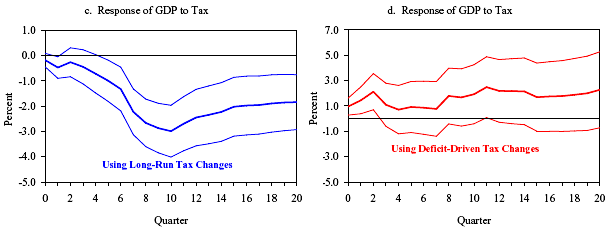
The Romers use this second group to calculate the effect of tax changes on economic growth without confounding factors, and their conclusion is that a tax increase of 1% of GDP reduces output three years later by nearly 3%.

Aside from the difficulties inherent with this kind of classification, I've got a few problems with this. First, their methodology eliminates a whole bunch of tax changes simply because their effect is hard to calculate. This might make practical sense, but doesn't it also introduce a whole new kind of bias?

Second, it assumes that if politicians say a tax increase is designed to spur economic growth or reduce the deficit, then that's what it's for. But ever since 1980, conservative politicians have said this about practically every tax cut whether it's true or not. For this reason, the Romers tag nearly every tax change since 1980 as exogenous. Doesn't this make their post-1980 analysis a little slippery since it essentially includes all tax changes while the pre-1980 analysis doesn't?

Third, it doesn't take into account different kinds of tax changes. If, say, exogenous changes tend to be capital gains cuts while endogenous changes tend to be payroll tax increases, wouldn't you need to take that into account?

Fourth, there have been tax changes practically every year for the past 50 years. How do you separate the effects of one tax change from another?

Fifth, can it really be true that a 1% tax increase produces a 3% GDP reduction over the long term? European countries tend to have total tax rates that are upwards of 15% higher than ours, which should mean their GDPs are 45% lower. For the most part, however, GDP per hour worked in Europe is only modestly lower than ours.

Anyway, those are my questions. I've found very little discussion of the paper on web (see here and here for a couple of exceptions) and I'm curious to know what the economics profession in general thinks of it. Can anyone point me in the right direction?

POSTSCRIPT: One of the Romers' conclusions, by the way, is that tax increases designed to reduce an inherited deficit have a positive impact on economic growth. So if Obama ever does raise taxes, expect this to be the reason he gives for it. Luckily for him, it will probably be true.

image
image
Get Mother Jones by Email - Free. Like what you're reading? Get the best of MoJo three times a week.
Comments
no profile pic for comment author

Here's the big deal on the differences between a stimulus and a tax cut:

1. The tax cut will (for almost everyone) change how much is withheld every week or so, so it dribbles out over time, whereas:
a stimulus can be paid out in more or less a few weeks (well, it's still faster.)

2. The stimulis can be paid out to everyone whether they already pay taxes or not. Conservatives hate that, but it gets money in the pockets of people who not only spend it right away on consumer needs, but it saves many from being on the edge of some problem like missed house payments etc. BTW I think a stimulus payment should go to literally everyone, including (especially!) the homeless etc.

no profile pic for comment author

Wow. Good to point out, Kevin. I don't think our daughter's high school teacher would accept this distinction in tax policies...

no profile pic for comment author

OT -- DeLong still has "Kevin Drum" links that point to WM -- in two places.

no profile pic for comment author

I suppose an important distinction would be whether a tax increase actually resulted in a lower deficit, whatever the stated purpose.

no profile pic for comment author

Since deficits, recessions, and spending changes are pretty easy to quantify can't you just ignore what the politicians say?

I imagine some sort of multivariate statistical analysis which could pay attention to the current state of the country/economy, tax policy, and future growth rate. It must have been done by someone.

I'm guessing the presidential cycle and acts of war have more control than anything else.

no profile pic for comment author

My training is in physics but I thought I'd give the paper a go thinking there would be more than 8 equations and I could attempt to understand the content from those equations. That paper hasn't been published...it may have been submitted and they're waiting for the referees to finish peer reviewing it. I wouldn't start discussing it until it has been published...someone may challenge their results.

And they may tell them to explain what those damn variables are. That was just sloppy.

no profile pic for comment author

Arbitrarily discarding a mountain of data is just their way of "assuming a can opener." If your take on this paper is accurate, it just reinforces the low esteem many of us hold for economists and their work.

no profile pic for comment author

I am an economist and immediately perceive the paper to be a vindication of Keynes not of Laffer. I think your key question is the Europe question. The effect appears to be at a Laffable level. However, what they are really discussing is the medium term effect of budget deficits.

Europe has high taxes, but doesn't have high budget deficits.

Now the Romer's would not propose huge tax cuts. That is because, they assume that the long run effect of budget deficits on GNP is zero (increased demand just ends up as increased inflation) or negative (if deficits crowd out investment).

Roughly 3 years is not at all the long run.

In fact, the long run effects of deficits on growth appear to be negative (and large). This is based on comparing growth in different countries.

Now as to the methodology, the Romers are highly respected, but no one really trusts anyone to make subjective decisions in a way that doesn't lead to bias. I think that this paper, like a similar paper on monetary policy, is likely to convince no one.

no profile pic for comment author

The basic approach they are using makes a reasonable amount of sense, though the details of how they went about executing their model can easily be quibbled with. That is what keeps us academic economists in jobs!!

The use of only the exogenous tax changes isn't going to cause bias in the results, though it does limit its external validity: it may be that endogenous tax changes work fundamentally differently on the economy than do exogenous tax changes (and they might for reasons having to do with the permanent income hypothesis--endogenous changes are more likely to be temporary, I think). If the effects are different then the results only apply to exogenous tax changes.

The big questions are, are the exogenous changes really exogenous (nothing in policy is really exogenous!) and do they have a rigorous, unbiased way of coding the narrative record (hard to do). Those are the areas that the most vigorous fights would occur...

no profile pic for comment author

"European countries tend to have total tax rates that are upwards of 15% higher than ours, which should mean their GDPs are 45% lower. For the most part, however, GDP per hour worked in Europe is only modestly lower than ours."

Wow, that's a pretty dishonest analysis. Why the sudden switch to GDP per hour worked (not exactly the most commonly cited economic statistic)? It's because European countries do indeed have per capita GDPs significantly lower than that of the U.S., which is always a source of consternation to liberals who would prefer a high tax, high regulation, high unionization economy.

And, by the way, it's perfectly plausible that higher taxes produce their GDP-reducing effect by reducing employment, so GDP per hour worked is not just an obscure, cherry-picked statistic, but one which intentionally obscures one of the major issues.

no profile pic for comment author

All of Kevin's points are good ones, except for the first where he questions the whole project of looking for exogenous tax changes. If we really could identify exogenous tax changes, we'd learn a lot. For example, if Congress sometimes flipped a coin to decide whether or not to increase taxes, researchers would obviously want to focus on these randomly chosen tax increases. What the Romers are doing isn't a very close approximation to a random-assignment experiment, but it's hard to see how anyone could do much better.

no profile pic for comment author

And they may tell them to explain what those damn variables are. That was just sloppy.

It seems crystal clear to me, but then I'm an economist. You have to realize that alpha, beta, and b(t) are just unknown constants that will be estimated by a regression. At least I'm guessing that this is your complaint.

no profile pic for comment author

y81: "...Wow, that's a pretty dishonest analysis. Why the sudden switch to GDP per hour worked..."

A nation's per capita GDP is affected by at least two social decisions: average taxation AND average hours worked. Kevin chooses GDP per hour because Europeans can (and often do) choose to work fewer hours than Americans as well as have a lot of social services, which results in higher taxes. Those are both reasonable social choices...

Choosing GDP per capita would obscure the analysis by not considering the hours-worked social choices.

You should probably refrain from accusations of dishonesty until you've taken a little time to think it through.

no profile pic for comment author

I have a problem with one aspect of any tax plan-Doesn't it require a certain number of people working and producing durable commodities like automobiles for example, and electronics, etc. I have yet to have anyone explain how a Service Based Society is supposed to exist without a Manufacturing Base to Service. To me, you need producers and consumers to have an economic system at all-but I never calaimed to be an economist-I am still trying to figure out how a broke treasury is printing money without anything to back it up-Now I am getting a Headache and I am going back to Monopoly-I play it with real money now!

no profile pic for comment author

Jim G, European countries have much higher unemployment rates than does the U.S. If GDP per hour worked were the standard measure, then Bush's "jobless recovery" about which Mr. Drum railed constantly was actually a time of economic miracles. You can't have it both ways without being called intellectually dishonest.

no profile pic for comment author

Fourth, there have been tax changes practically every year for the past 50 years. How do you separate the effects of one tax change from another?

The Romers assume that the time path of the effects of tax cuts is always the same (except for being scaled by the size of the tax cut). That is, they make only weak assumptions about the shape of the time path, but they do make the strong assumption that the shape is the same for all tax cuts. When they relax this assumption they find that different types of tax cuts do have different effects. Kevin is right that there are a lot of other ways in which tax cuts differ from one another, and there might be lots of different effects that the Romers can't identify.

no profile pic for comment author

Jim G, European countries have much higher unemployment rates than does the U.S.

U.S. 6.5% (Bureau of Labor Statistics of the U.S. Department of Labor, October 2008)

European Union-27 7.0%, Union-15 7.1%, Euro area 7.5%, incl. Denmark 2.9%, Austria 3.2% (Statistical Office of the European Communities - EUROSTAT, September 2008)

Much obviously in the eye of the beholder... and we'll ignore for the moment the apples and oranges differences in how the numbers are calculated which for the most part work to make American numbers look more favorable in a horizontal comparison.

no profile pic for comment author

Here's what you need to understand about the paper - it's BS.

When the highest marginal rates were always over 70% and often over 90%, from before WW II until 1981, economic growth was high; cutting rates after that did not improve the economy and probably increased inequality. The Clinton tax increases, which were characterized by Republicans as the biggest tax increase in history, were followed by one of the biggest booms in history.

Economists can play with the assumptions in their analyses and models until they get the result with accords with conventional wisdom or with their ideological biases, but they often don't feel the necessity to test their results against the real world.

no profile pic for comment author

Frankly, footnote 1 of the paper pretty well tells us that the paper is worthless. They identify the separate effects of government spending and government taxes, declare it too hard to comprehend or analyze and throw in the towel.

I don't accept the assumptions of the paper, so there's really not much reason to bother to review the results of the paper. GIGO with formulae is still GIGO.

no profile pic for comment author

Since the effect of these tax changes is difficult to separate from the effects of the events being responded to, they are discarded.

Welcome to the Remedial Selection Bias short course. There are always exogenous factors and effects. There are always endogenous factors and effects. There is no way to selectively find policy decisions that are exclusively endogenous or exogenous in cause or effect. Not only is it silly to try, but it guarantees selection bias. You need to model results, not only of tax policy, but of other known or suspected changes in the economy that affected growth. You need to test it against history and then make certain that there hasn't been a change in the economy that makes some of the older history of minimal use.

Only when you have taken into account all of the known effects over time does it make sense to argue that Cause A provides Effect B under Circumstances C. Ignoring all factors in which a tax increase happens is not useful.

no profile pic for comment author

"Jim G, European countries have much higher unemployment rates than does the U.S. "

Apart from the actual numbers presented by snicker-snack, it is worth remembering that the US numbers are biased by the vast numbers of US citizens in either prison or the military, both of which affect the unemployment number by around a percent, and both of which do not correspond to doing anything useful.

no profile pic for comment author

Official unemployment rate pr. September '08 in Denmark: 1,6 pct.

Number from the Danish Statistical Bureau. For what it's worth.

no profile pic for comment author

It's amazing, the willingness to deny elementary statistical reality, which is that Europe has higher unemployment, and much lower per capital GDP, than the U.S. You guys should get jobs with the tobacco companies.

Alas, Ole, my ancestors left the gaard in Uggelose some time ago. Maybe they made a mistake.

no profile pic for comment author

"Europe has high taxes, but doesn't have high budget deficits."

European countries typically have as high or higher debt than the US.

And to many of the people in the comments, taking the high point in the last 30 years of US unemployment and comparing it to what is essentially the permanent unemployment level for much of Europe isn't precisely what you want out of a fact-based analysis.

And if you think European unemployment isn't about to spike up right now, you haven't thought about the effects of global recession very much.

All that said, I'm skeptical of the Romer paper because whenever you throw out half the data, it is very likely that you aren't sorting it as well as you think.

no profile pic for comment author

You need to model results, not only of tax policy, but of other known or suspected changes in the economy that affected growth.

That hasn't turned out to work so well, since no one knows how to model ALL the factors that affect economic growth. What does that even mean? That's why quasi-experimental approaches like the Romers' have become popular. Randomized experiments can answer important questions without requiring a model of the whole world. At least in principle, quasi-experiments can do the same thing.

To be more specific, if you think arguments like "Clinton raised taxes and that led to faster growth" make sense, you should like the Romers' paper, which just amounts to repeating the exercise with every postwar tax increase.

no profile pic for comment author

t's amazing, the willingness to deny elementary statistical reality, which is that Europe has higher unemployment, and much lower per capital GDP, than the U.S.

Yeah y81, don't believe your lying eyes because 1.6% (Denmark) >> 6.5%. Yeesh, what a idiot!

And gee, I guess you're right, 7.0% is larger that 6.5%, by .5 points. If that's what you're resting your argument on it's a pretty weak foundation.

Face it, if higher taxes had such a devastating effect on unemployment then we wouldn't be seeing a mere half percent point difference between the EU and the US, now would we?

no profile pic for comment author

European countries tend to have total tax rates that are upwards of 15% higher than ours...

Kevin: You mean 15 points, not 15%, correct? I know this is incredibly pedantic of me, but it's one of my pet peeves.

It's amazing, the willingness to deny elementary statistical reality, which is that Europe has higher unemployment, and much lower per capital GDP...

It's amazing, the willingness to post such blather in a comments section. Firstly, "Europe" contains such places as Ukraine and Moldova, so of course it's not as wealthy as the US. If what you mean rather is the European Union, you're still dealing with a per capita GDP that is (obviously) going to be temporarily lowered by the recent additions of places like Romania and Bulgaria. I would imagine the same effect would be observable were the US to absorb, say, Venezuela and Honduras.

I'm pretty confident excluding former communist members of the EU will give you a per capita GDP figure a lot closer to the US number. My guess is the US still likely possesses an edge over this EU "core," but a big reason for that edge is the longer hours worked by Americans. IIRC Western European workers are now as productive or more so than their transatlantic cousins; they simply enjoy more of their productivity in the form of leisure.

Bottom line, much of Europe is as rich and as developed as the US, despite the presence of a public sector that eats a good ten points or so of GDP more than its American equivalent.

no profile pic for comment author

To be more specific, if you think arguments like "Clinton raised taxes and that led to faster growth" make sense, you should like the Romers' paper, which just amounts to repeating the exercise with every postwar tax increase.

I don't think anybody really makes the case that higher taxes led to higher growth, in the same way that drinking nine shots of espresso would lead to an increase in energy. The closest people come to making that leap seems to be when they say that higher taxes led to lower deficits, which lead to lower interest rates and higher growth. But mostly, people seem to question the claims that any sort of tax increase is going to bring about an economic disaster, because the last time taxes were raised directly, the economy was more than fine a few years later. This leads people to believe that the relationship isn't as clear cut as most on the right like to think it is, myself included.

no profile pic for comment author

This is really sad. I had a group of friends take the test. None of us are U.S. residents or citizens. Our average score was 93.4% and Americans only score half that?

no profile pic for comment author

Abby's is about the only sensible comment on here. Academics are frequently called upon to trade off internal validity (are they really measuring what they think they are measuring?) and external validity (does it generalise?)

Like lots of academic work, this paper chooses the former over the latter. From a scholarly point of view, I tend to think that's the right decision. But it means we as readers have the right (indeed, the responsibility) to be skeptical about what we infer from their findings and how we apply them to policy debates.

no profile pic for comment author

"This is really sad. I had a group of friends take the test. None of us are U.S. residents or citizens. Our average score was 93.4% and Americans only score half that?"

(1) How did you or your friends do on the question that involved commenting on the appropriate post, not an earlier post?

(2) Look, we all enjoy beating up on the US, but USE YOUR FREAKING BRAIN!!! Did it not ever occur to you that perhaps you and your friends are not exactly representative of whatever countries you come from?

I expect that if we gathered together a group of my US friends (all college-educated overachievers) we'd also achieve a great score. The main thing this proves that my friends don't happen to be the poor, the ignorant and the stupid. Note that I don't run around claiming that my friends correspond to a representative sample of US society.

no profile pic for comment author

This is really sad. I had a group of friends take the test. None of us are U.S. residents or citizens. Our average score was 93.4% and Americans only score half that?

Posted by: Anonymous on 11/25/08

Test? What test? Do I still have time to cram for it?

no profile pic for comment author

y81, Denmark doesn't hold any foreign debt worthy of notice. Some domestic debt in the form of bonds, but anything else would be unnatural.

As far as the 1,6 pct number goes, the exact figure is debatable. But it's low - too low some would say. Causes structural problems in the workforce.

Bottom line: I don't know. One of my cousins emigrated to the US some years ago and has become a succesful CEO of the merger between his own upstart and a couple of other smallish SAP consultant firms. Betcha he's making a lot of money, good for him. But the strain due to the basic lack of social/health care security did take it's toll while he and the firm was on the rise. Still does.

Not saying our system is inherently better, priorities I guess.

For what it's worth - and anyone who got out of Ugerløse in time is the lucky guy ;-)

Sebastian: Danish unemployment is bound to go up, sure. But predictions are in the 5-7 pct range for 2010 - I'll be happy to go with that in the midst of a global recession.

no profile pic for comment author

Are you seriously trying to use Danish unemployment as representative of Europe? It has barely the population of two large cities in the US. It would be like taking Minneapolis as if it were the whole nation.

At least pick something with a serious population--Germany and France or something. Both of those countries have had many more unemployed people than the US for decades. It is considered a sign of an enormous economic downturn that we are even approaching their levels of unemployment.

no profile pic for comment author

Sebastian, nope. Just saying that maybe the Danish model of so called "flexonomics" has something going for it.

We don't have the rigorous making-it-almost-impossible-to-lay-off-a-worker-regime in place that specially Germany (and to some/same extent also France) has.

Yet we do have what quite a lot of Americans would see as a decidedly "socialist" political system, tax structure, unemployment benefits, universal health care etc.

The Danish workforce is one of the most flexible in the world, despite our high taxes.

Not saying our model is universally exportable ... just saying it's feasible for us. And thus proving that y81 isn't universally right. And maybe, perhaps maybe, there's something there to be learned for the US?

no profile pic for comment author

(Sebastian: Some parts of our "Danish Model" is being put under pressure. The universal health care thingy is ... slowly deteriorating into a basic (one could argue more or less crappy) level of (albeit universal) health care coupled with some sort of private insurance for speedy advanced treatment. Kind'a like Germany, I suppose. Which might not be all that bad, but still - doesn't fulfil our socialistic/marxistic dreams ...

Unemployment benefits is another part of the package losing it's value quickly.)

no profile pic for comment author

Are you seriously trying to use Danish unemployment as representative of Europe? It has barely the population of two large cities in the US.

Very little to do with Nordic economic statistics is "representative of Europe" because the Nordic countries have sensibly implemented market-friendly policies that -- especially over last fifteen years or so -- deliver better results (robust growth + robust social protections) than the continental Big Three. I don't hear many people arguing that the United States ought to ape the policies of Germany, France and Italy -- but they're not the only models on offer. A number of European states (I would add Ireland and the Low Countries to the list) enjoy robust safety nets and very free markets. You could probably add Canada and Australia to the list as well. I'd be tempted to include the UK, too, if the latter's regulatory apparatus weren't so obviously, er, American in its level of ineffectiveness.

no profile pic for comment author

I think people should keep in mind a couple of things.

1. German reunification was costly, which lowered growth in Germany and by extension dampened growth throughout the EU.

2. Measured by the trade deficit it's arguable that the US dollar is stronger than it should be. The first half of 2008 saw the dollar weaken and the result was that many EU countries shot past or draw level with US GDP/Capita.

no profile pic for comment author

"And, by the way, it's perfectly plausible that higher taxes produce their GDP-reducing effect by reducing employment."

It is perfectly implausible. As a businessman, I first and foremost focus on growth opportunities, predictability of socio-political conditions, and inflation. Whether the tax rate is 25% instead of 19% may be a personal irritant, but I'd be in the poor house if I'd based my business decisions on low tax rates. ONLY IF all things are otherwise equal, (almost never) would I consider tax rate to be a deciding factor. Hell! If tax rate were THAT important, I'd be living and working in Russia right now.

no profile pic for comment author

mr drum
needs some econ con training

his reading econ con greek
for comprehension
is much like an ape
reading the bible
even in the original hebrew
it ain't likely to mean much

much of his subsequent probing here
feels to me
about like
i suspect
it would feel to him
if el me

--a finely tooled
political economist --

cut open his gizzard
and started pawing around
in there
like a hungry black bear

no profile pic for comment author

One definitely has to separate different kinds of taxes since they have different effects. Under a Single Tax system, land and other finite natural resources which are not produced by people would be taxed, but results of production like wages and capital would not. The result, as 19th century economist Henry George and his present day followers recognized, is that productivity would soar, while inequality and poverty would plummet. Right now, we tax in a way to discourage production, while encouraging rank speculation. It's no accident we've had two of the greatest bear markets in history during the redistributionist Bush administration. If you reward the speculating class, they will gamble away our money. The answer is not to tax the rich, but to tax the speculators who gamble with unearned money based on things like land and commodities. Also, to tax land owners so they don't gobble up all the property while waiting for it to simply appreciate from no effort of theirs.

Post a comment
Alternately, you may login to or register an account
The content of this field is kept private and will not be shown publicly.
  • Web page addresses and e-mail addresses turn into links automatically.
  • Allowed HTML tags: <a> <ul> <ol> <li> <blockquote> <img>
  • Lines and paragraphs break automatically.

More information about formatting options


Jail.org - Inmate Search
Criminal records, instant public records & people search & current court records. www.jail.org

U.S. Public Records Search
Search County & State Court Records, Criminal records, Vital and Adoption Records www.PublicRecordsInfo.com

Records.com - People Search
Public Records and Background Checks. Instantly Search Criminal Records, Addresses and Court Records www.Records.com

Court Records & County Records
Find Instant Public Records, Criminal Records as Well as County Property Records Search. www.PublicRecordsIndex.com

The HIV Mythology
A former AIDS patient reveals the HIV/AIDS deception

TalkBackTees.com
A treasure trove of liberal wit, wisdom and quotations, from ancient to modern, on colorful, cotton tees.

Support Independent Artists
Amazing art, crafts, apparel, paper-goods and more. A carefully curated selection of sundries since 1999.

FREE CONNECTIONS FOR GREEN SINGLES
Meet progressive singles in the environmental, vegetarian & animal rights community who share your values