In The Blogs

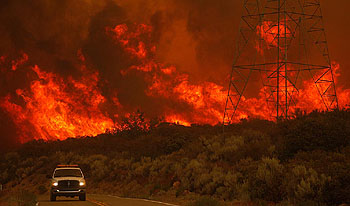
Wildfires and Climate Change

At last year's Netroots Nation I ran into CAP's Brad Johnson one day, and he told me that one of the consequences of global warming was increased wildfire activity in California.  I wasn't sure I really believed that, so he promised to send me some stuff to read.

Well, he did, and I read it, and he was right.  I blogged on that shortly afterward, and with fire season on us once more it's worth writing about again.  Roughly speaking, it turns out that land use issues are probably responsible for about half of the increase in western wildfire activity over the past few decades and climate change is responsible for the other half.  The mechanism is pretty straightforward: higher temperatures lead to both reduced snowpack in the Sierra Nevadas and an earlier melt, which in turn produces a longer and drier fire season.  Result: more and bigger fires.  Plus there's this, from CAP's Tom Kenworthy:

In recent years, a widespread and so far unchecked epidemic of mountain pine beetles that has killed millions of acres of trees from Colorado north into Canada has laid the foundation for a potentially large increase in catastrophic fires. Climate change has played a role in that outbreak, too, as warmer winters spare the beetles from low temperatures that would normally kill them off, and drought stresses trees.

In the western United States, mountain pine beetles have killed some 6.5 million acres of forest, according to the Associated Press. As large as that path of destruction is, it’s dwarfed by the 35 million acres killed in British Columbia, which has experienced a rash of forest fires this summer that as of early this month had burned more than 155,000 acres. In the United States to date about 5.2 million acres — an area larger than Massachusetts  —have burned this year.

Destruction of trees by the mountain pine beetle, combined with climate change and fire, makes for a dangerous feedback loop. Dead forests sequester less carbon dioxide. Burning forests release lots of carbon dioxide into the atmosphere. More carbon dioxide adds to climate change, which raises temperatures, stresses forests, and makes more and bigger fires more likely.

It’s a frightening prospect, as British Columbia’s Forests Minister Pat Bell told an International Energy Agency conference last week. “I am not a doomsayer,” said Bell. “I am not one who wants to say we are beyond the tipping point. But I am afraid that we are getting close to that.”

Today, 100,000-acre conflagrations that take two weeks to contain and kill three or four firefighters along the way are perfectly normal here in Southern California.  They weren't when I was a kid. This is partly due to global warming, and it's something that's happening now — not in 2050 or 2075 or 2100.  And it's only going to get worse if we don't do something about it.

image
image

Get Mother Jones by Email - Free. Like what you're reading? Get the best of MoJo three times a week.
Comments
no profile pic for comment author

What I don't understand is

What I don't understand is what is left to burn. You have been having tremendous wildfire sin CA since I can remember (born 1981, started pay attention in about 1995). How can there possibly be stuff left to burn?

Wow. Huge forests.

no profile pic for comment author

Well, yes, huge forests, but

Well, yes, huge forests, but also huge state. It's not like the same area burns down every year.

Every single year we get the same story: PERFECT STORM OF INGREDIENTS! HOT TEMPERATURES AND FIRE IN AN AREA THAT HASN'T BURNED IN 40 YEARS!

We have utterly retarded forest management out here, due in large part to the environmentalists. We've only recently realized that controlled burns *might* be a good thing.

no profile pic for comment author

Sorry, but don't just say

Sorry, but don't just say "the environmentalists." I've done a lot of work for environmental organizations, many of which are absolutely in favor of controlled burns. So far as I know, it's a commonly understood and accepted practice. So who opposes them? The only one I see named anywhere in a quick Google search is Forest Guardians, whose stature is miniscule relative to burn-supporters like the Sierra Club, The Wilderness Society, Environmental Defense, and The Audubon Society. I'm prepared to believe there are several groups out there who oppose them, but general references to "environmentalists" don't mean much.

no profile pic for comment author

Housebuilding practices

Quite possibly. Yet there is also the tendency of Californians over the last 20 years to build houses farther and farther into land that WILL eventually burn - and all the worse for not having burned in 20 years. Ya'll have a semi-arid climate there with indigenous resinous trees and brush; that's a recipe for periodic large-scale fire regardless.

Cranky

junebug

let the crazy resume

I'm beginning to wonder if your contract with Mother Jones has some kind of quota for comments. You hit the mother lode with your post about cap & trade the other day, so apparently this is your way of doubling down. That, or you just can't resist baiting the whack jobs.

no profile pic for comment author

To really understand the

To really understand the subject, go read the profound comments of Jonah Lucianne in the LA Times today.

no profile pic for comment author

what do we do when we are

what do we do when we are beyond the tipping point? oh the children!

idlemind

putting out fires

I wonder what the annual acreage burned was a hundred or two years ago? It could be that there were mostly smaller conflagrations with massive fires every few decades once enough fuel had built up. Now that we're around to put out the fires, perhaps many areas are better-primed for major fires since no mega-conflagrations have happened and reduced fuel over a large area.

I'm far from being a global warming denier, but in this case I don't think any stronger claim can be made other than saying it might be a significant contributer to present fire danger.

no profile pic for comment author

does anyone care except for

does anyone care except for those that live there? .......no

no profile pic for comment author

Just like a NIMBY

if it's not in my backyard, it doesn't matter.

Let them eat cake.

Certainly seems that the east coast media forgets about California until some city council passes some wacky law, then the come to laugh.

Feh. We're going to cut you all off from our wine, fruits, and vegetables, see what you say.

no profile pic for comment author

Careful...

Be careful....although Colorado and Utah aren't in the East to receive your proclamation. Threatening to deny others your exports could lead them to turn off your water.

no profile pic for comment author

i guess that means you JUST

i guess that means you JUST realized that you a moron for living there, huh?;)

no profile pic for comment author

More CO2 doesn't stress

More CO2 doesn't stress plants out. It actually makes them more efficient and allows them to grow more with less water --> more fuel --> bigger more frequent fires. This is true semi-arid regions around the world and doesn't require global warming to be operative. Are there CO2 deniers? [This seems to be most true for desert trees with strong adaptations for pulling water out of nowhere -- Juniper and Ponderosa. Other systems may be nitrogen or phosphorous limited. . . speaking of which, anthropogenic influence on dry and wet nitrogen deposition in the LA basin has to be huge].

That said, If I remember right, the natural fire recurrence time is about 10 to 20 years in much of southern California. A lot of the territory covered by the Station fire hadn't burned in 50. Fire suppression has a lot to do with the size of this fire too. The LA basin was filled with smoke from native american fires a few hundred years ago, and lightening caused fires 1000's of years before that.

no profile pic for comment author

This is a map of the forest

This is a map of the forest area that has died due to the pine beetle infestation in BC

For reference, BC is larger in area than Texas. The pine beatle has expanded due to a lack of winters that went down to -30 C. After the most of the trees in a forested area die, it then dries out and burns.

A relevant paper in Nature, the world's most prominent science journal:

Mountain pine beetle and forest carbon feedback to climate change:

"The impacts of insects on forest carbon dynamics, however, are generally ignored in large-scale modelling analyses. The current outbreak in British Columbia, Canada, is an order of magnitude larger in area and severity than all previous recorded outbreaks...climate change has contributed to the unprecedented extent and severity of this outbreak..."

ajw_93

you found him!

@Bruce! All this time I was looking for the Fifth Beatle, when it was the Pine Beatle I should have been seeking.

I kid ya. All that aside, that is a pretty amazing map.

I have had Forest Fires on my list of reasons I think CA is nice, but don't want to live there.

no profile pic for comment author

Fires and climate change

Probably you have about the right balance between land use and climate change as causes for an increased fire regime in the American West.

It is also true that the pine beetle outbreak is partly climate-change related, though massive outbreaks of pine beetles have occurred historically. Warmer winter temperatures may play a role, but the stress of lower moisture is probably more important, particularly in Colorado.

However, though it seems intuitively obvious that fire danger in the Rocky Mountain west is greatly increased by the huge stands of beetle-kill trees, it probably isn't true. The alarm is a favorite of the press and politicians, and it is much repeated by foresters.

Tom Veblen of the University of Colorado and his students have studied the correlation between past beetle outbreaks and large fires (as far back as tree rings allow). What they found is that fires are not more severe after massive beetle-kill events. Once the trees have died off, they are actually less volatile than the normal forest.

On this topic, a good place to start is: http://rogerpielkejr.blogspot.com/2009/08/guest-post-by-thomas-velblen.h...

no profile pic for comment author

Domino

Maybe if Kevin were to fill Domino's food dish with pine beetles the problem would be solved?

no profile pic for comment author

Kevin, When you and I were

Kevin,

When you and I were kids, you living behind the Orange Curtain and me living in the Valley, I recall year after year of fires that completely surrounded the valley, turning day to night, with fires burning in the Santa Monica Mountains, in the Santa Susannas and yep, on the road to Canada to just where it's burning now.

There may be something in what you write, but as Cranky says, land use patterns now encroach way into the fire zones, we also have far better helicopter coverage of the ongoing fires as fires 24x7 and not just a dozen images on the front page of the LA Times.

There may be something in what you say, but I think you're completely full of shit in just the same way as anyone who pins one particular storm on global warming is. There is global warming, there is also normal variation.

There is also bug infestation, differing growth patterns, increased technology, accidents, and very different fire management policies.

I don't think you help any cause of global warming by stating this is a global warming fire. I think it makes you look like some jackass with a billboard saying it's the end of the earth and we're all doomed.

My own suspicion is that Barack Obama set the fire in and above Hollywood as payback for Hollywood progressive liberals rejecting him. Krugman and others say they have rejected him, that's about as good as your proof that this was global warming.

Why does Barack Obama hate Mount Wilson?

no profile pic for comment author

>There is global warming,

>There is global warming, there is also normal variation.

If a news blog covered the diabetes epidemic by noting an an actual individual case of diabetes, would you then object with "I don't think you help any cause of [diabetes] by stating this is a [diabetes epidemic case]."

After all, despite the explosion in type 2 diabetes in north america, it still existed before, didn't it? That particular case could be natural variation right?

But that's not how people think. Mostwork by allegory, not statistics. Once in a while, even Kevin's fetish for graphs has to give way to an example, or you're simply failing to speak their language. He couched it enough.

no profile pic for comment author

I believe there's a huge

I believe there's a huge difference between an epidemic and fires or storms due to global warming.

I can't put my finger on it, though I like to put my finger on the definition of obscenity, but for the past decade, when scientists have been asked, "is this hurricane due to global warming", the answer has been much more like mine, than Kevin's.

I think you know that too.

Maybe it's because you're a Canuck and not an Angeleno.

But if you want to increase global warming skepticism, just tell all the Angelenos who have lived hear for 20-30-40-50 years or more that this year's fire season, or the Station Fire is due to global warming as Kevin just did.

We know what we grew up with. We know about the Santa Anas. We know about LA Woman. We know what Raymond Chandler wrote about, and even James M. Cain before him when they wrote about the Santa Anas and the brush fires. We've seen the Malibu fires that burn from Oat Mountain to the ocean, and the Big Tujunga Fires and the El Cajon Fires and the Santa Monica Mountain Fires and the Griffith Park Fires and the fires in San Diego and even the fires on Mt. Tamalpais and the Oakland Fire that killed 25 people and destroyed 3400 homes.

Yes, there is an epidemic of brush fires in Southern California.

Stating as you do, that it's okay for Kevin to make a flat statement but inaccurate statement because the rubes need a good solid example is not a good way to advance any political policy or scientific theory. It won't work, and if it does work, it's unethical and wrong.

no profile pic for comment author

Al Gore: did Global Warming cause Katrina?

"A hundred years ago, Upton Sinclair wrote, "It is difficult to get a man to understand something when his salary depends upon him not understanding." Here's what I think we here understand about Hurricane Katrina and global warming. Yes, it is true that no single hurricane can be blamed on global warming. Hurricanes have come for a long time, and will continue to come in the future. Yes, it is true that the science does not definitively tell us that global warming increases the frequency of hurricanes - because yes, it is true there is a multi-decadal cycle, twenty to forty years that profoundly affects the number of hurricanes that come in any single hurricane season. But it is also true that the science is extremely clear now, that warmer oceans make the average hurricane stronger, not only makes the winds stronger, but dramatically increases the moisture from the oceans evaporating into the storm - thus magnifying its destructive power - makes the duration, as well as the intensity of the hurricane, stronger."

no profile pic for comment author

"Worst Fire Season in

"Worst Fire Season in Decades Seen

By ERIC MALNIC, TIMES STAFF WRITER

Prolonged drought, bark beetles and a rare fungus are drying out and killing brush and trees that surround many Southern California neighborhoods, creating the potential for one of the worst wildfire seasons in decades, fire officials warned Monday.

A map released Monday by the Los Angeles County Fire Department showed that some of the most vulnerable fire zones can be found this summer in chaparral-covered foothill and mountain-canyon slopes beside densely developed residential districts of Los Angeles and its suburbs.

The map was released as the state Department of Forestry officially opened the region's XXXX fire season, which means its firefighting crews have been placed on higher alert and various fire prevention regulations are now in effect."

When was the above written? Was it 2009?

Try 1990.

http://latimes.perfectmarket.com/1990-05-15/news/mn-169_1_fire-departmen...

no profile pic for comment author

More CO2 doesn't stress

More CO2 doesn't stress plants out. It actually makes them more efficient and allows them to grow more with less water --> more fuel --> bigger more frequent fires. This is true semi-arid regions around the world and doesn't require global warming to be operative. Are there CO2 deniers?

CO2 doesn't stress plants out, but it will only make them "more efficient" if they are carbon limited, which most terrestrial plants are not (van Groenigen et al. 2006, PNAS). Some (I stress some) oceanic phytoplankton may get more efficient at higher pCO2. Most plants are limited by nitrogen and phosphorus, not carbon.

As for CO2 causing plants to grow more with less water, I'm not sure what you mean by that. The basic equation for photosynthesis is:
2n CO2 + 2n H2O + photons → 2(CH2O)n + 2n O2

You'll notice that the left side of the equation contains both carbon dioxide and water. So the more carbon dioxide, the MORE water used.

no profile pic for comment author

water use efficiency

That's an interesting article, but I'm still not sure you understand water relations. Plants need a lot more water than that incorporated into their carbohydrates. Most water is transpired.

In semiarid regions plants tend to have water limitations most years (at least they were pre-industrial). They respond by closing their stomates which has the indirect effect of limiting CO2. If you raise the partial pressure of CO2 it diffuses in through closed or mostly closed stomates at a higher rate. Thus they photosynthesize more than they otherwise would. Yes they'll run up against a nutrient wall, but that's because nutrient storage in water limited systems is very poor. This will almost certainly shift if plants year after year maximize their use of nutrients (and are no longer water limited in our high CO2 world).

Adaptive responses of ecosystems to increasing CO2 are not obvious, but I think it's important to understand that nitrogen and phosphorous availability in systems are not fixed. The long term equilibrium may involve a net increase in nutrient storage as biomass, detritus, and soil organic matter change. This years limitations may be in part a historical artifact and slow increases in nutrient storage capacity may be difficult to prove in a grassland over the tenure of a grad student or even a professor.

and WUE increases don't work for swamps or rain forests, just places with long waterless summers like LA.

WULLSCHLEGER, S. D., T. J. TSCHAPLINSKI, AND R. J. NORBY. 2002. Plant water relations at elevated CO2—implications for water-limited environments. Plant, Cell and Environment 25:319–331.

no profile pic for comment author

Fire history

In the past decade or so, the acreage burned in California wildfires has broken record after record. The figures are clear.

However, going way back in history, the acreage burned is by no means abnormal. In, I believe, 1836, everywhere scientists have looked between Tahoe and the Oregon border, they find evidence of a fire. That is, the whole northern third of the state burned. Pioneer records all report a thick haze obscuring the California mountains, thanks to chronic forest fire.

So as a third factor, to growth and warming, I'd add the hangover from fire suppression. It's pretty well-established that the lack of fire in a fire-dependent environment eventually catches up with you, creating a bigger fire. We've arrived there.

no profile pic for comment author

>...or the Station Fire is

>...or the Station Fire is due to global warming as Kevin just did. We know what we grew up with...

And about LA brushfires, I don't. But about the BC fires and forestry issues he raised- what is happening here is new, and widely attributed to global warming, as it results from a lack of really cold winters over a long period of time.

Of note, the BC Minister of forests quoted is NOT a lefty - the governing party is right wing (confusingly named the Liberal party, due to a really weird run of events 20 years ago).

Kevin Drum

Hurricanes are hard to pin

Hurricanes are hard to pin down. Global warming will probably increase their intensity in the future, but it's unlikely there's been enough warming to have much of an effect so far. That's why you really can't say that any particular hurricane is due to global warming.

Wildfires in the Rocky Mountain west are entirely different. A difference of 1 degree makes a substantial difference in snowmelt volume and timing, which in turn has made the fire season drier and longer over the past few decades. This is not a guess, it's an observable fact, and it has a measurable impact on wildfire size and frequency. Land use issues are also important (building patterns, fire suppression, fuel buildup, etc.), but they only account for about half of the increase we've seen. Climate change is responsible for the other half.

There have always been wildfires in Southern California, but fires of the size and frequency that we've seen in the past decade were rare 40 years ago. Angelenos with good memories know this. So the bottom line is that, yes, the Station Fire is partly a result of global warming. This isn't a scare tactic or an exaggeration. It just is.

no profile pic for comment author

I'm afraid I have to agree with anonymous

There's plenty of variables, this is far from a slam-dunk for global warming. Same for Katrina -- what was more interesting was not that Katrina was such a storm, but that Katrina, Rita, and Wilma were all top-6 Atlantic storms -- and even that is not proof, but it surely does focus the attention.

British Columbia, yes -- that's a much clearer cause and effect, ditto retreating arctic ice, ditto retreating Greenland icecap, ditto melting permafrost. Changes in the CO2-dip onset, historical river-melt records, and historical plant-zone/flowering records, those are all better data. Problem is, all that stuff is distant and non-dramatic.

But otherwise, we're trying to pick a small but steady piece of data out of a great big pile of noise and variation.

no profile pic for comment author

disasters loom

Walls of fire and thousands, maybe more, fleeing their homes demonstrates the need for good governance. Popular ideologies belittling the public services and concomitant reduction of tax rates, all of them, has caused poor public financing of needed services. Probably a lot of people have been telling both the public and political and administrative leadership many parts of CA have high fire potential. The leading political trend of less taxation and less government is why disasters loom.

Tom Stewart

Stolen Money

Too bad that the millions (billions?) stolen by Enron and their ilk aren't available to help fight these devastating fires.

no profile pic for comment author

we passed the tiipping point 20 years ago.

The really strong indicators for global warming and climate change are the rising sea level and the melting of the polar ice and diminishing land glaciers. All the other events are local and can be dismissed as seasonal variability.

It takes many thousands perhaps, hundreds of thousands of years to build icecaps and extensive land glaciers. We are watching them shrink year by year before our eyes.

Sea level rises from the melting land ice but even more from the expansion caused by rising temperatures down in the depths. The oceans contain far more climate changing heat than the atmosphere.

Local climates will continue to change worldwide, perhaps so quickly as to be misinterpreted to be annual variability. But the long term tendencies in our latitudes will be warmer and drier with frequent record breaking extremes.

Local climates are shifting to new stable points that may not be suitable for human habitation. Climate change is a non linear process. Forest fires and other explosive combustions are non-linear. So this permanent shift in climate could happen in the space of few years with us watching. Are we watching normal variability or are we watching permanent climate shift?

The pine beetles don't kill the trees. They spread a fungus which causes the trees to weep sap. If there are dry conditions the tree dies of thirst from loosing its moisture. In wet times the tree survives and heals itself.

no profile pic for comment author

Could probably find a much

Could probably find a much better correlation between the growth of the Moslem population in California and wildfires. Flick your Bic, terrorism on the cheap.

J. Frank Parnell

i

More CO2 may or may not stress plants (the latest research suggest it does), but heat and drought definitely do.

As to all you Southern Calaphobes, increased risk of fire is a serious concern throughout the intermountain and far west.

no profile pic for comment author

"the latest research"

That's just silly. The basic tenets of plant physiology indicate that increasing CO2 (of the scale which has been observed) improves the drought adaptations of C3 plants considerably.

I suppose folks are fighting this because it sounds like a positive anthropogenic change. It's not. It results in higher fuel loads and less ground water. It may be a small carbon sink if you presume the average state is closer to "forest" and further from "burned forest", but that's pushing it.

no profile pic for comment author

"There's plenty of

"There's plenty of variables, this is far from a slam-dunk for global warming."

You are entitled to your own opinions, not your own facts.

Yeah there's plenty of variables and they all point to global warming, not as the sole cause, but as a very important cause:

The peak time of melting snow is already about 10 to 15 days earlier in different parts of the West. Scientists have projected a speed-up of 25 to 35 days earlier by the end of this century. A study just released by Purdue University found that at the end of the century, the snowmelt could come 70 days earlier. The effect of the lost snow, and increased heat from solar radiation absorbed in the exposed ground and vegetation, would raise temperatures more than have previously been expected.
Temperatures rising

In the western United States, temperatures for the past five years have risen an average 1.7 degrees when compared with the 20th century. California's average temperatures between 2003 and 2007 rose 1.1 degrees above the past century's. That is slightly more than the 1 degree rise for the planet as a whole. The Colorado River Basin, Arizona, Montana, Utah and Wyoming have had temperatures rise more than 2 degrees in the past five years compared with the past century.
Turning up the heat

The West has had more frequent and severe heat waves, with the number of extremely hot days increasing by up to four days per decade since 1950, according to research supported by the Rocky Mountain Climate Organization, a coalition of 17 local governments, businesses, nonprofits and Colorado's largest water provider.

Since 1980, U.S. wildfires have burned an average of 8,500 square miles per year, a jump from the 1920-1980 average of 5,000 square miles per year.

In the past three decades, the wildfire season in the western United States has increased by 78 days, according to work led by Anthony Westerling, formerly at Scripps, now at UC Merced. Roughly half that increase was due to earlier ignitions, and half to later control. Burn duration of fires greater than 1,000 acres has increased from 7.5 to 37.1 days in response to a spring-summer warming.

Read more: http://www.sfgate.com/cgi-bin/article.cgi?f=/c/a/2008/07/20/MNSC11Q7RD.D...

no profile pic for comment author

I'm not entitled to my own

I'm not entitled to my own facts, and neither are you.

And the fact is, this quote is from the article you just linked to:

"Scientists are quick to caution against blaming one fire or heat wave on global warming. But, Barnett said, "At the minimum, you're getting a glimpse of your future. Do you like it? I think not.""

Kevin's flat statement is perfect for his bogus marketing background, but as a statement of fact, it's nonsense.

no profile pic for comment author

There's nothing in the

There's nothing in the article that contradicts Kevin's post. He assesrted a trend, but dd not blame any particular fire on AGW, Same as the researchers quoted in the article. You're the one feeling entitled to your own facts.

no profile pic for comment author

Look - its really

Look - its really simple.

Climate deniers say there's nothing to worry about !

Many climate deniers are conservatives - they strongly believe that people should be responsible for their own actions - a commendable principle!

Therefore lets just let this science experiment continue.

Then, in years to come, all the cliimate deniers can reap the rich, full rewards they rightly deserve. I mean, they say nothing is wrong, so the feedback they will likely get will be grateful - people will say 'hey that climate thing was a real beatup - you were right!!!'

So, lets just sit back, relax, and look forward to the climate deniers getting the full rich feedback they so richly and rightly deserve!! Can't wait to give it to them!!!!

no profile pic for comment author

"So, lets just sit back,

"So, lets just sit back, relax, and look forward to the climate deniers getting the full rich feedback they so richly and rightly deserve!!"

Problem: they'll be dead.

They are being unfair to my son and other young people, and their kids.

no profile pic for comment author

SoCal fires

Kevin writes:

"Today, 100,000-acre conflagrations that take two weeks to contain and kill three or four firefighters along the way are perfectly normal here in Southern California. They weren't when I was a kid."

I recall plenty of huge fires when I was a kid in the San Fernando Valley, and I'm about two years older than you. We didn't has amazing television coverage of them back then, though.

Also, the population of SoCal has doubled, which increases the number of homes in the hills threatened by fires, and also doubles the number of arsonists and other fire-starters.

no profile pic for comment author

fdsgdfg

Post a comment
Alternately, you may login to or register an account
The content of this field is kept private and will not be shown publicly.
  • Web page addresses and e-mail addresses turn into links automatically.
  • Allowed HTML tags: <a> <ul> <ol> <li> <blockquote> <img>
  • Lines and paragraphs break automatically.

More information about formatting options


Jail.org - Inmate Search
Criminal records, instant public records & people search & current court records. www.jail.org

U.S. Public Records Search
Search County & State Court Records, Criminal records, Vital and Adoption Records www.PublicRecordsInfo.com

Records.com - People Search
Public Records and Background Checks. Instantly Search Criminal Records, Addresses and Court Records www.Records.com

Court Records & County Records
Find Instant Public Records, Criminal Records as Well as County Property Records Search. www.PublicRecordsIndex.com

Mother Jones Podcast
Get in on the conversation! We talk about culture, politics, the environment, the economy and more. Listen now!

TalkBackTees.com
A treasure trove of liberal wit, wisdom and quotations, from ancient to modern, on colorful, cotton tees.

Support Independent Artists
Amazing art, crafts, apparel, paper-goods and more. A carefully curated selection of sundries since 1999.

FREE CONNECTIONS FOR GREEN SINGLES
Meet progressive singles in the environmental, vegetarian & animal rights community who share your values