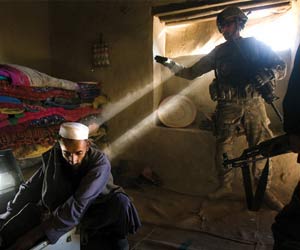
Battling the Low-Tech Boom

America's anti-IED strategy pits million-dollar technology against garage door openers.

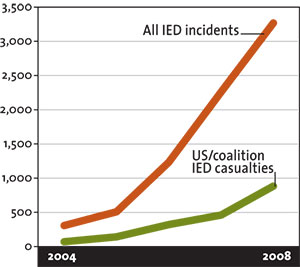
OVER THE PAST FEW YEARS, improvised explosive devices, the tactic of choice for Iraqi insurgents, have spread to the Afghan roadside in a big way: At last count, IEDs accounted for more than 70 percent of US combat casualties in Iraq and half of those in Afghanistan. Since 2003, according to Pentagon documents, the Army's Joint IED Defeat Organization (JIEDDO) and its predecessors have spent $14 billion trying to do what JIEDDO's name implies, including $2.3 billion for high-tech countermeasures "to thwart simple, cheap triggering devices such as two-way radios or garage door openers."

In Afghanistan, the pricey gear has helped coalition troops find and clear nearly three times as many bombs in 2008 as in 2006. But the insurgents have kept pace: Casualties from IEDs have increased by nearly the same margin. As for whether the money might not be better spent on, say, humanitarian and development efforts, the IED chasers note that US forces will now likely face this guerrilla tactic wherever they go. "IEDs are a weapon," notes JIEDDO's 2008 report to Congress. "They are not the enemy."


story continues below story continued from above

Typical IED CellTypical IED Cell

  • A financier pays for explosives and cheap electronics
  • A bomb builder makes the devices
  • An emplacer hides the bombs
  • A spotter watches for the approach of military targets
  • A triggerman detonates IEDs using devices like cell phones or garage-door openers
  • A cameraman tapes the mayhem for online recruitment

How the Military Fights BackHow the Military Fights Back

  • Warrior Alpha aerial surveillance spies on suspected bomb makers at a cost of $242 million
  • Talon robots and thermal cams suss out IEDs and shady characters
  • Rhino predetonation units ($59 million all told) blow up IEDs from afar
  • Wolf Collar gear (a $67 million initiative) rakes up IED trigger wires
  • Hunter and Chameleon jammers blindly thwart IED electronics
  • Dog teams sniff around for hidden bombs
  • Husky device (developed for $33.1 million) detects buried explosives
  • Truck-mounted "interrogator" arms ($216,500 a pop) probe IEDs
  • Frag 5 Humvee-armor kits help protect personnel

IEDS IN AFGHANISTAN
IEDs in Afghanistan

Collateral Damage

Drone air strikes reported since 2007: 40

Civilians they've killed: about 200

Wedding parties obliterated by US air raids: at least 2

Total civilians killed in 2008 during Afghan combat: 2,118

Increase over 2007: 39%

Get Mother Jones by Email - Free. Like what you're reading? Get the best of MoJo three times a week.
Comments
no profile pic for comment author

Pentagon investment in local security

I see this opinion piece tries to convey that billions of dollars spent by the Pentagon on countering IEDs, the network of people who build and emplace them, and putting bad guys in jail could have been better spent. I can't disagree on the level of reactionary funding for jammers and detectors. However, the 2008 annual report states explicitly that the focus is now on the prevention of emplacement, not as much on technology to defeat already active IEDs.

Not too many people realize that CIED efforts are for security. The goal is to provide aid and developmental support and once the roads are clear of booby traps and explosives, the State Department and NGOs will have the way 'paved' to do what they do and the military forces and even JIEDDO may stand down.

no profile pic for comment author

Counter-IED in the proper context

As someone who has studied the good and bad points of counter-IED operations for the past few years, and who has deployed to Iraq twice, it disheartens me to see this sloganeering masquerading as a serious investigative report.

The last quote in this article, "IEDs are a weapon. They are not the enemy," reflects the realization the counter-IED community had around 2006-2007 that defeating the device was actually a much less useful thing than defeating the insurgency. Every one of the C-IED innovations described above except Warrior Alpha, while useful for force protection, is designed to mitigate the threat after we have already suffered a tactical defeat -- an IED has been emplaced. The victories in this fight are coming from exactly what you advocate: getting down and dirty with key leader engagements and using reconstruction projects to shape the battlefield for the kinetic operations that we do conduct. We did this terribly in 2003-2006 and there was a strong tendency to view IEDs as the enemy rather than the weapon. This article engages in the same fallacy, not even considering the broader impact that C-IED technology and innovations can have on the overall insurgency. As a start, what about the possibility that C-IED technology may force the insurgents to expend more effort on their attacks against Coalition forces, taking away resources that they could otherwise be expending on, say, sectarian violence or criminal activity? A growing body of unclassified academic literature supports the conclusion that this may actually be the primary benefit of C-IED operations.

I think now if you were to talk to any company commander (the people who are actually fighting and winning the war) in Iraq, they would agree that the key thing they do is knowing the terrain and conducting population-based counterinsurgency. The situation in Afghanistan has some different nuances to it, but the key points are still the same. At this very moment, the future of Iraq and Afghanistan is being decided over cups of chai between young U.S. Army and U.S. Marine Corps captains, lieutenants, and sergeants and tribal sheikhs. JIEDDO and the entire counter-IED effort enable those company-and-below leaders to engage in population-centric counterinsurgency by providing them with advanced tools that the local population does not have access to. Their confidence in our capabilities gives them the security to come to us with tips and enables them to seek capable and respectful security forces that represent the endgame in these wars.

Given that Mother Jones herself was a community organizer and was focused on grassroots efforts, I find it remarkable that her namesake magazine is treating Afghanistan and counter-IED operations in general as a monolithic strategic-level effort run by decisions about the expenditures of billions of dollars in Washington -- and assumes that the insurgents treat it the same way, without any consideration of how IED and C-IED techniques, tactics, and procedures fit into the battle for the "human terrain" of the population. Your readers would be much better served by reporting on whether and how all this gee-whiz technology is actually utilized by leaders at the company level and below in support of the kind of population-based counterinsurgency that has proven highly effective in Iraq.

Post a comment
Alternately, you may login to or register an account
The content of this field is kept private and will not be shown publicly.
  • Web page addresses and e-mail addresses turn into links automatically.
  • Allowed HTML tags: <a> <ul> <ol> <li> <blockquote> <img>
  • Lines and paragraphs break automatically.

More information about formatting options


Jail.org - Inmate Search
Criminal records, instant public records & people search & current court records. www.jail.org

U.S. Public Records Search
Search County & State Court Records, Criminal records, Vital and Adoption Records www.PublicRecordsInfo.com

Records.com - People Search
Public Records and Background Checks. Instantly Search Criminal Records, Addresses and Court Records www.Records.com

Court Records & County Records
Find Instant Public Records, Criminal Records as Well as County Property Records Search. www.PublicRecordsIndex.com

Mother Jones Podcast
Get in on the conversation! We talk about culture, politics, the environment, the economy and more. Listen now!

TalkBackTees.com
A treasure trove of liberal wit, wisdom and quotations, from ancient to modern, on colorful, cotton tees.

Support Independent Artists
Amazing art, crafts, apparel, paper-goods and more. A carefully curated selection of sundries since 1999.

FREE CONNECTIONS FOR GREEN SINGLES
Meet progressive singles in the environmental, vegetarian & animal rights community who share your values