The World Bank’s Worst Case

Get your news from a source that’s not owned and controlled by oligarchs. Sign up for the free Mother Jones Daily.

The World Bank is pessimistic. They’ve reduced their 2012 growth forecast for Europe by 2.1 percentage points and for other rich countries by about a point. But this is only their mildly pessimistic scenario, and it assumes that the crisis in the eurozone is reasonably well contained. But what happens if it isn’t? Here you go:
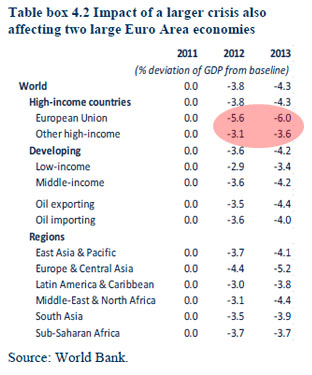
In a second scenario (box table 4.2) the freezing up of credit is assumed to spread to two larger Euro Area economies (equal to around 30 percent of Euro Area GDP), generating similar declines in the GDP and imports of those economies. Repercussions to the Euro Area, global financial systems and precautionary savings are much larger because the shock is 6 times larger. Euro Area GDP falls by 6.0 percent relative to the baseline in 2013. GDP impacts for other high-income countries (-3.6 percent of GDP) and developing countries (-4.2 percent ) are less severe but still enough to push them into a deep recession. Overall, global trade falls by 2.6 percent (7.5 percent relative to baseline) and oil prices by 24 percent (5 percent for food).

So there you have it. If the eurozone crisis turns out to be worse than we think, growth in the EU will be nearly 6 points below their last forecast and growth in other rich countries — including us — would be more than 3 points below their last forecast. That’s enough to send us skittering back into a recession regardless of whether our economic fundamentals are in good shape or not.

How likely is this? That’s more a political question than an economic one, which makes it more than usually difficult to forecast. Against all odds, I still think that European leaders understand the stakes and will avoid the worst once they run out of all other choices. But I’m not sure what odds I’d put on that.
ONLY HOURS LEFT—AND EVERYTHING RIDING ON IT

A full one-third of our annual fundraising comes in this month alone. That’s risky, because a strong December means our newsroom is on the beat and reporting at full strength—but a weak one means budget cuts and hard choices ahead.

With just hours left, we need a huge surge in reader support to get to our $400,000 year-end goal. Whether you've given before or this is your first time, your contribution right now matters. All gifts are 3X matched and tax-deductible.

Managing an independent, nonprofit newsroom is staggeringly hard. There’s no cushion in our budget—no backup revenue, no corporate safety net. We can’t afford to fall short, and we can’t rely on corporations or deep-pocketed interests to fund the fierce, investigative journalism Mother Jones exists to do. That’s why we need you right now. Please chip in to help close the gap.

ONLY HOURS LEFT—AND EVERYTHING RIDING ON IT

A full one-third of our annual fundraising comes in this month alone. That’s risky, because a strong December means our newsroom is on the beat and reporting at full strength—but a weak one means budget cuts and hard choices ahead.

With just hours left, we need a huge surge in reader support to get to our $400,000 year-end goal. Whether you've given before or this is your first time, your contribution right now matters. All gifts are 3X matched and tax-deductible.

Managing an independent, nonprofit newsroom is staggeringly hard. There’s no cushion in our budget—no backup revenue, no corporate safety net. We can’t afford to fall short, and we can’t rely on corporations or deep-pocketed interests to fund the fierce, investigative journalism Mother Jones exists to do. That’s why we need you right now. Please chip in to help close the gap.

We Recommend

Latest

Sign up for our free newsletter

Subscribe to the Mother Jones Daily to have our top stories delivered directly to your inbox.

Get our award-winning magazine

Save big on a full year of investigations, ideas, and insights.

Subscribe

Support our journalism

Help Mother Jones' reporters dig deep with a tax-deductible donation.

Donate