Fierce, investigative journalism doesn’t happen by accident—it happens because readers like you make it possible. Every dollar you give before midnight Friday to support our nonprofit newsroom will be matched dollar-for-dollar. We can’t do our work without you. Don’t miss this chance!
The deadline’s almost here! Fierce, investigative journalism doesn’t happen by accident—it happens because readers like you make it possible. Every dollar you give before midnight Friday to support our nonprofit newsroom will be matched dollar-for-dollar. We can’t do our work without you. Don’t miss this chance!
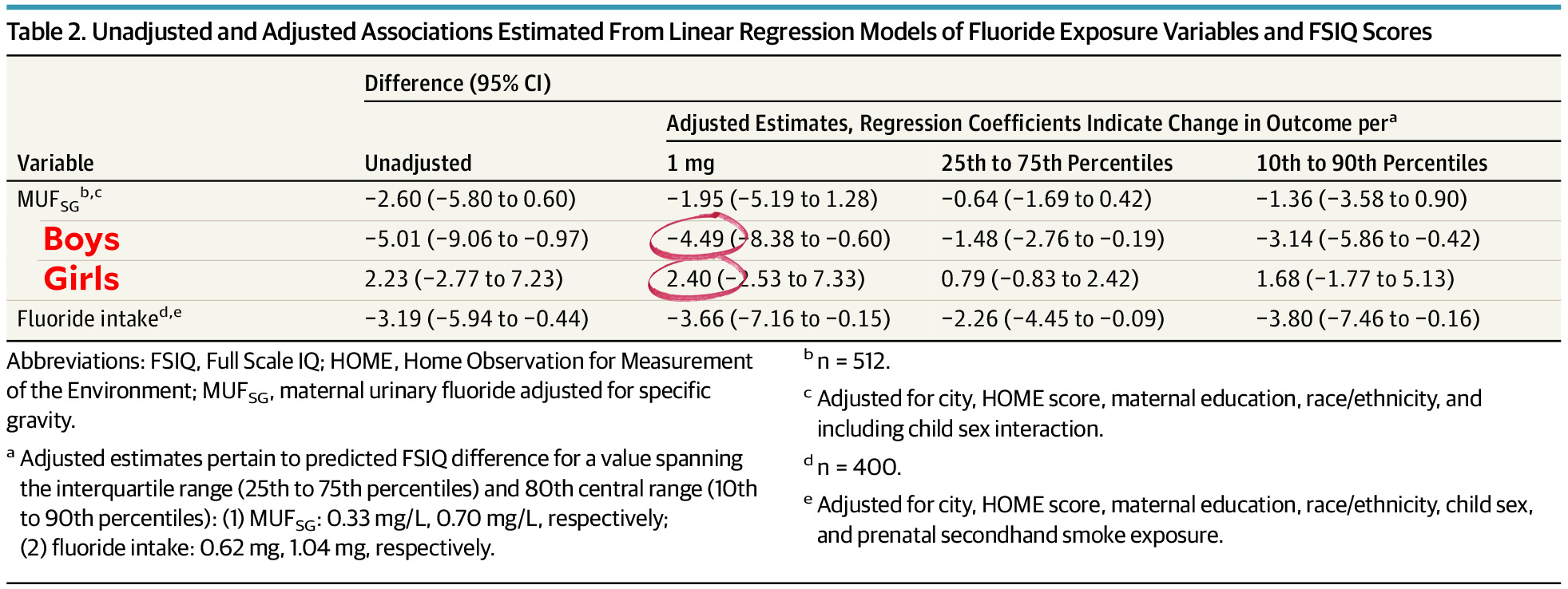
A new study has been published with some startling news: pregnant mothers who drink fluoridated water have babies with lower IQs. More accurately, they have baby boys with lower IQs. But if they have a girl, their baby will have a higher IQ. Here’s the basic table:
A 1 milligram increase in maternal urinary fluoride levels was associated with a decrease of 4.49 IQ points in boys and an increase of 2.40 IQ points in girls. This seems implausibly large, doesn’t it? But I can think of at least one crude way to check it. In 1950 virtually no water in the US was fluoridated. Today, fluoridated water reaches more than 70 percent of the population. At a minimum, this suggests that over the last 70 years the IQ levels of boys and girls (a) should have gone down, and (b) should have diverged by about 7 points. Has this happened?
In a word, no. Overall IQ scores in the United States have increased since 1950 and that steady upward trend has continued at least through 2014. And I’m unable to find any evidence that the mean scores of boys and girls has differed by more than one point or so during this entire period. Obviously lots of other things have been going on at the same time, so this doesn’t prove anything. But it sure puts a high burden on anyone claiming an IQ effect that affects boys and girls differentially by 7 points.
Democrats back off once-fervent embrace of Medicare-for-all
Leaning back on a black leather sofa as her campaign bus rumbled toward Fort Dodge, Kamala D. Harris tried to explain why she spent months defending a plan to replace private health insurance with Medicare-for-all, only to switch to a more modest proposal that would allow private insurance to continue after all.
“I don’t think it was any secret that I was not entirely comfortable — that’s an understatement,” Harris said, holding a to-go cup from a Mexican restaurant at a recent stop. “I finally was like, ‘I can’t make this circle fit into a square.’ I said: ‘We’re going to take hits. People are going to say she’s waffling. It’s going to be awful.’ ” But, she said, she decided it was worth it.
Anyone can immediately buy into Medicare, which will be improved in various ways.
A 10-year phase-in of an expanded Medicare for newborns and the uninsured.
Allow private insurers to offer coverage similar to today’s Medicare Advantage program.
“At the end of the ten-year transition, every American will be a part of this new Medicare system. They will get insurance either through the new public Medicare plan or a Medicare plan offered by a private insurer within that system.”
That’s fine. I have no argument with any of it. However, it leaves out a big issue: how much will people have to pay for it? Is it literally free, paid for entirely by taxes? Or do consumers have to pay an annual premium? Does the premium increase with income, like Obamacare? If so, what’s the top premium level? And what are the caps on copays, deductibles, and out-of-pocket expenses?
The truth is that Obamacare could basically be fixed with a couple of simple changes:
Higher premium subsidies all the way through the middle class, including an absolute cap of 8 percent of income no matter how rich you are.
Stricter rules on deductibles and OOP, which would also apply to private plans.
Add a public option to buy in to Medicare.
That’s it. There are other things it would be nice to fiddle with, but those three would turn Obamacare into something very, very close to a national health care plan. Whether you prefer this to Harris’s plan or Sanders’ plan is, frankly, more a matter of personality and mood than it is of actual dedication to the best possible health care. All three of them would work fine.
A decade after big banks needed government support to dig out of the financial crisis, the Federal Reserve is slowly, but steadily, making a series of regulatory changes that could chip away at new requirements put in place to prevent a repeat of the 2008 meltdown.
….Some current and former Fed officials worry that the central bank and its fellow regulators are giving large banks, which are making big profits, an unnecessary gift that could leave the economy exposed in the next downturn. They say the overseers should be forcing banks to maintain or even build up their defenses given the strong economy, which is in its longest expansion on record, rather than eroding those buffers.
….The changes, some put into place and others still under consideration, range from making it easier for big banks to pass the Fed’s annual “stress test” of their financial health to allowing some to borrow more. One idea being floated could quietly reduce capital levels at the biggest American banks over the course of the business cycle.
What could go wrong?
If regulators had a laundry list of smallish changes they wanted to make in the name of efficiency or ease of regulation or something like that, and they were willing to trade the whole package for, say, a small increase in crude leverage requirements, I’d go along. But unilaterally making capital requirements looser simply because banks look to be in pretty good shape these days is as dumb as it comes. Of course banks look pretty solid after ten years of economic expansion. The question is how will they look after they’ve faced their first recession? At the very least, shouldn’t we leave current policies in place until Wall Street successfully navigates an entire economic cycle from trough to trough before deciding that we’re being too tough on the poor babies?
According to Donald Trump, the economy is booming: all the talk of a possible recession is just fake news and Democratic propaganda. America has the best economy in the world and, possibly, the best economy in all of human history.
Also according to Donald Trump, we need an immediate gigantic cut in interest rates and a big reduction in the payroll tax in order to . . . um, stimulate a weak economy? But that can’t be. Trump says our economy, as always on his watch, is “very strong.”
President Trump came into office promising some fabulous yet unspecified health-care plan to replace the Affordable Care Act. No plan existed…. Trump said he’d bring back manufacturing. In fact, it slowed and now has slumped…. Trump said he’d get tough on drug companies. He hasn’t. He said his tax cut would be aimed at the middle class, deliver $4,000 a year to the average American family and permanently boost business investment, pushing growth above 3 percent. Nope, nope and nope…. The biggest economic lie was Trump’s declaration that trade wars are quickly and easily won, American consumers and farmers wouldn’t be hurt and we somehow would get richer by making Americans pay more at stores. Actually, they are paying a lot.
Rubin is in her element these days. She’s always been very compelling in an attack-dog-attorney kind of way, but it never worked that well back when she was hating on President Obama. There just wasn’t enough there, and it forced her to stretch and exaggerate too much. Now there’s no such problem. Hating on Trump is easy, and there’s really never any need for anything but the bare truth. It’s all clover for someone with a lawyerly mind.
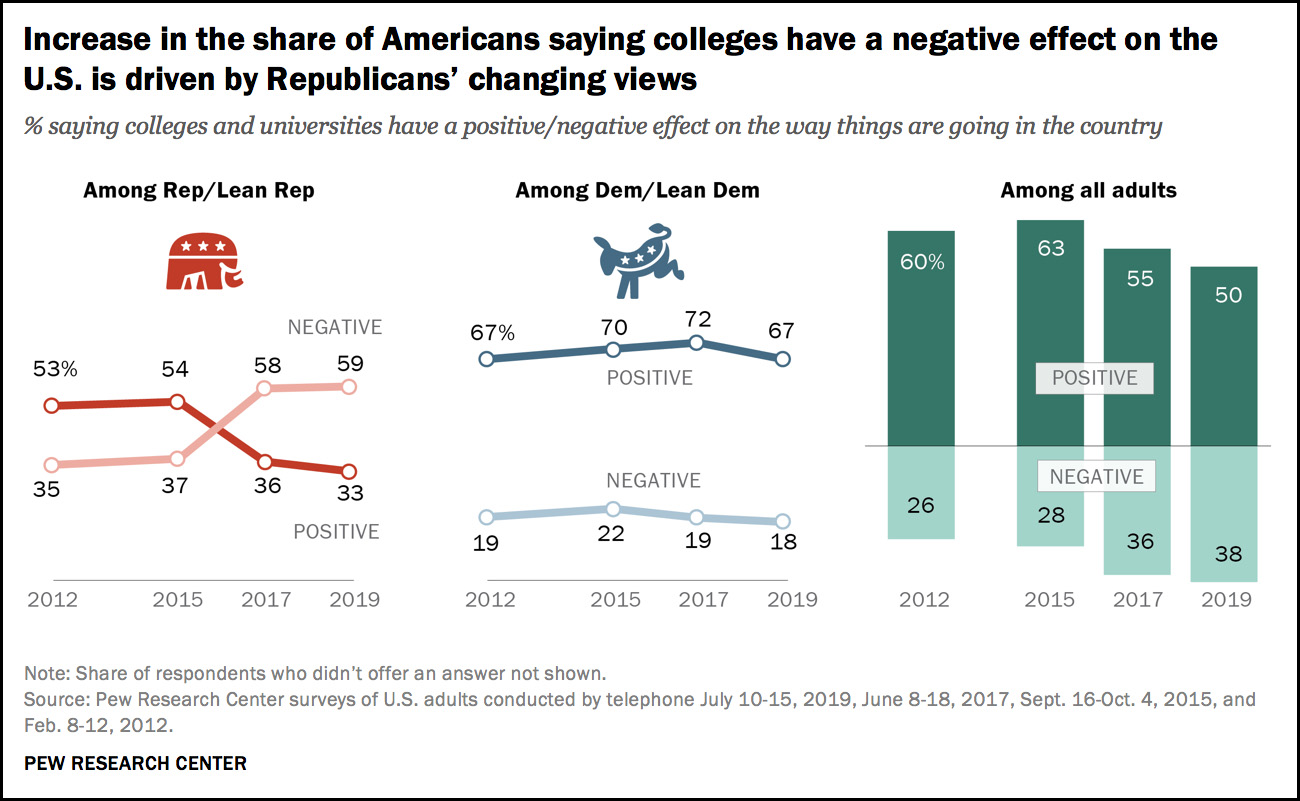
According to a new study from Pew, the 2016 presidential campaign produced a huge increase in the number of Republicans who think universities are bad for America:
I’m a little puzzled by this. Conservatives have been railing about universities forever, from Bill Buckley’s quip about the Boston phone book to Spiro Agnew’s nattering nabobs to the post-Gingrich assault on research of all kinds and continuing to this day with the more recent indignity over safe spaces and trigger warnings. So if this sentiment has been around so long, how did Trump produce such a sudden and large jump in the space of a single year? He mostly goes after the news media, not universities.
Or is it due to something else? I know that National Review has substantially upped its coverage of the latest outrages in higher education, but how about Fox? Have they been campaigning to scare old people about America-hating professors? Or is something else afoot? Does anyone have any ideas?
Seven years ago, when it was still in the construction stage, I mocked Levitated Mass, a planned installation on the grounds of the LA County Museum of Art. It was basically a long trench with a 340-ton rock placed over it, and my contention was that it was ridiculous.
But it got installed over my objections, if you can believe it, and a couple of months ago I finally saw it. I have two pictures for you. The first is taken from down in the trench and attempts to make photographic lemonade out of quarried lemons. The second just shows you what it looks like.
So: Is it art?
June 30, 2019 — Los Angeles, CaliforniaJune 30, 2019 — Los Angeles, California
I actively try not to spend any time reacting to Donald Trump’s idiot tweets these days, but it’s a little slow this morning and this tweet has people genuinely puzzled:
Wow, Report Just Out! Google manipulated from 2.6 million to 16 million votes for Hillary Clinton in 2016 Election! This was put out by a Clinton supporter, not a Trump Supporter! Google should be sued. My victory was even bigger than thought! @JudicialWatch
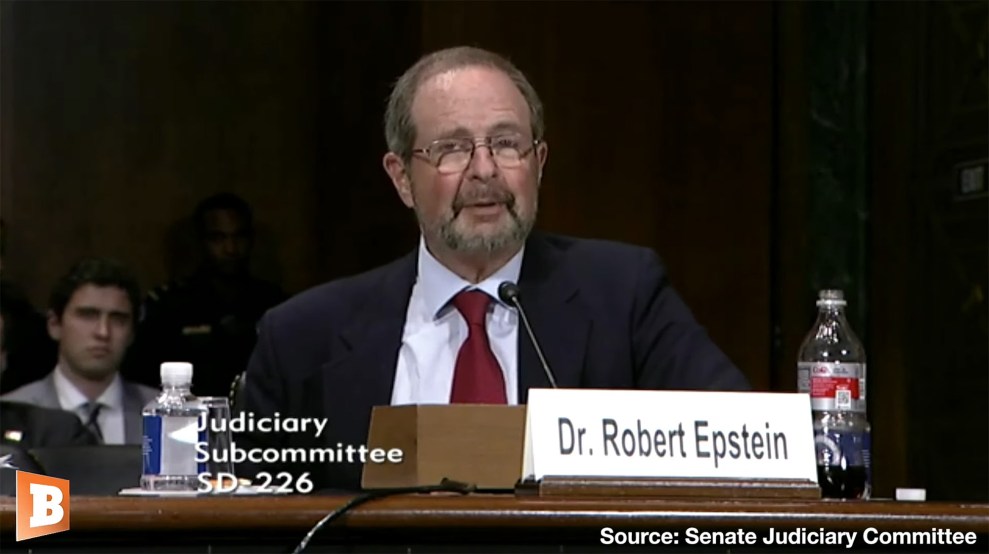
This is old stuff that Trump is just catching up to, for some reason. The nickel version is that several years ago celebrity psychologist Robert Epstein got into a tiff with Google in which he turned out to be embarrassingly in the wrong. Ever since then Epstein has been gunning for Google, and prior to the 2016 election he claimed that they were deliberately manipulating search results in a way that favored Hillary Clinton.¹
So that’s the proximate source. But where do Trump’s numbers come from? That’s a little harder to figure out. Last month, in a conspiracy-laden conversation² with Sen. Ted Cruz, Epstein testified before the Senate Judiciary Committee that Google was responsible for shifting something between 2.6 and 10.4 million votes to Clinton in 2016 and that in 2020 all of big tech together could—and probably would—shift as many as 15 million votes without anyone ever knowing. I assume that Trump misheard this and thought he said 16 million.
Fine. But where does Epstein get those numbers? This is a bit murky, but a couple of years ago he published a paper showing that search results can bias decisionmaking. The limits of the paper are so breathtaking that I’m not sure how you can draw any real-world conclusions from it, but basically he came to the unsurprising conclusion that if you (a) give people a choice of two politicians they’ve never heard of and (b) provide search results that are unanimously positive toward one and negative toward the other, then (c) they’ll tend to support the person who got the positive results. No kidding.
This year he presented another paper, but I can’t find it and there’s a limit to how deeply I’m willing to dive down this particular rabbit hole. However, here’s the LA Times report:
In his latest study, which he and a co-author plan to present in April at the 99th annual meeting of the Western Psychological Assn., in Pasadena, Epstein tracked 47,300 searches by dozens of undecided voters in the districts of newly elected Democratic Reps. Katie Porter, Harley Rouda and Mike Levin.
Mainstream outlets, including the Los Angeles Times and the New York Times, dominated the Google search results. By contrast, searches conducted on Yahoo and Bing more often showcased links from deeply conservative outfits such as Breitbart.
Using a model he has developed to gauge the subliminal effect of what he sees as tilted search results, Epstein projected 35,455 voters who were on the fence were persuaded to vote for a Democrat entirely because of the sources Google fed them.
You read that right: Epstein thinks Google’s algorithms are biased because they give too much weight to mainstream news outlets and too little to folks like Breitbart. Then he fed this alleged bias into a model of his own devising, which claims it was responsible for 35,455 Democratic votes in three congressional districts in 2018. Presumably this is then projected yet again to produce the 2.6 million number for Hillary Clinton in 2016.
This is a house of cards and appears to have virtually nothing behind it aside from the initial grudge against Google that Epstein brought into it. However, because Epstein is a liberal Democrat, conservatives are in love with him. They can’t get enough of the Hillary supporter who nonetheless claims that Trump was cheated out of votes by the evil geniuses at Google.
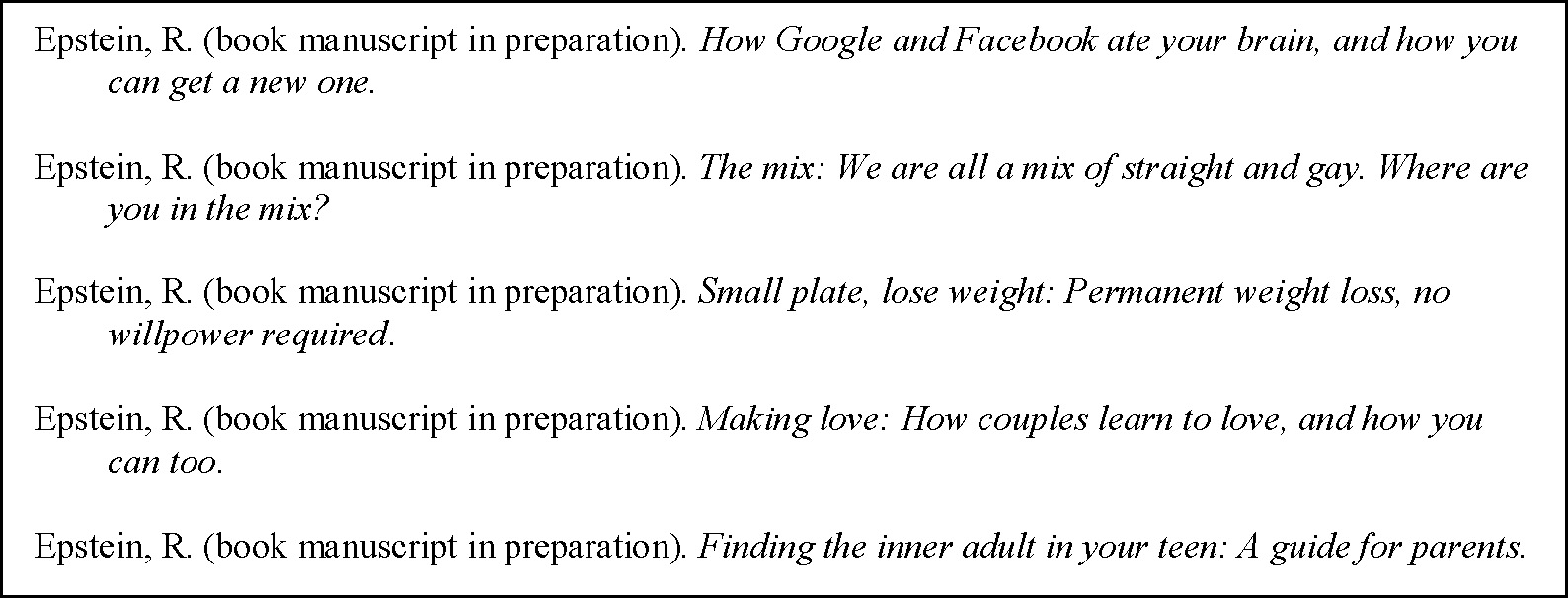
Maybe someone else will dive into this a little more deeply, but that’s about as much as I’m willing to do. In any case, I’m not sure how much more we’re going to see from Epstein. He’s busy on a whole bunch of books right now and probably won’t have much time for this.
¹FWIW, Google looked at Epstein’s claims last year and dismissed them as methodologically flawed.
²Perhaps you think I’m exaggerating? Fine. At great expense I have hired a team of expert transcribers to take down Epstein’s exact words. Here he is after Ted Cruz asks him to explain how a get-out-the-vote message could be transformed from a PSA to a manipulation of the vote:
On Election Day in 2016, if Mark Zuckerberg, for example, had chosen to send out a Go Vote reminder, say, just to Democrats—and no one would have known if he had done this—that would have given that day an additional at least 450,000 votes to Democrats.
….I don’t think that Mr. Zuckerberg sent out that reminder in 2016. I think he was overconfident; I think Google was overconfident, all these companies were…. But the point is in 2018 I’m sure they were more aggressive. We have lots of data to support that. And in 2020? You can bet that all of these companies are going to go all out, and the methods that they’re using are invisible, they’re subliminal, they’re more powerful than most any effects I’ve ever seen in the behavioral sciences.
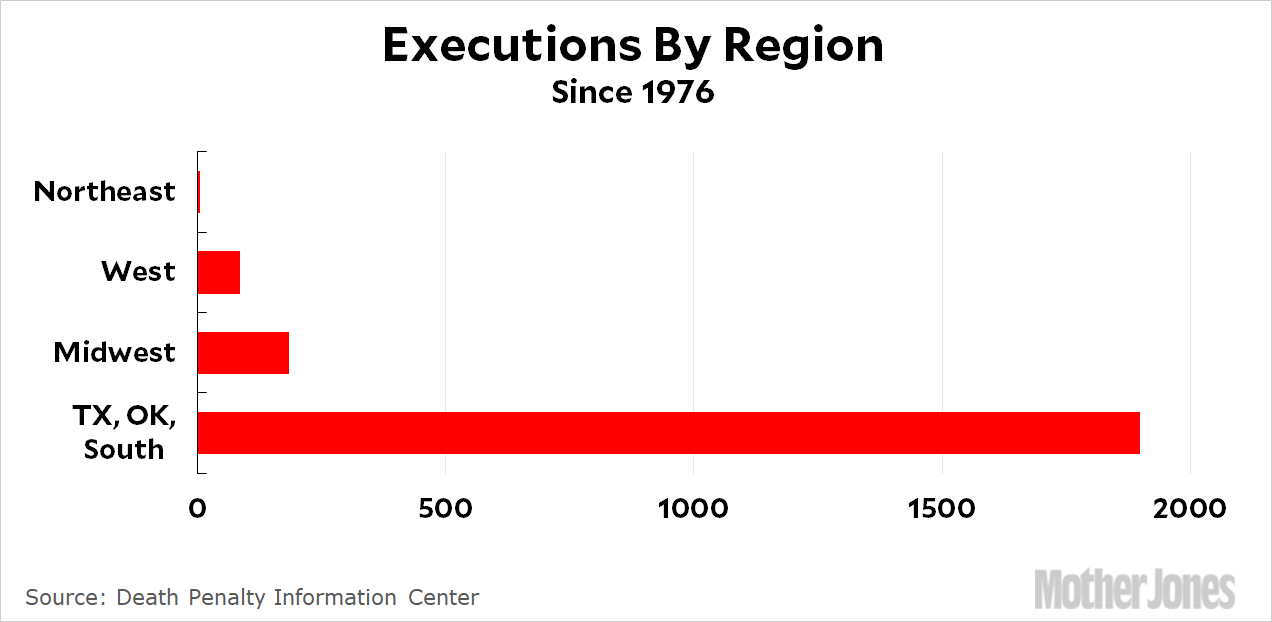
In an op-ed about the death penalty in the New York Times today, I came across a link to a fact sheet about executions in America. I guess this is no surprise, but if you want to know which region keeps the whole industry alive, here it is:
Breaking it down by state is also instructive. If you live someplace that was never a slave state (or territory), the death penalty is all but gone these days. But if you live someplace that was formerly a slave state, executions continue to be a big part of your cultural heritage. Just a coincidence, I’m sure.
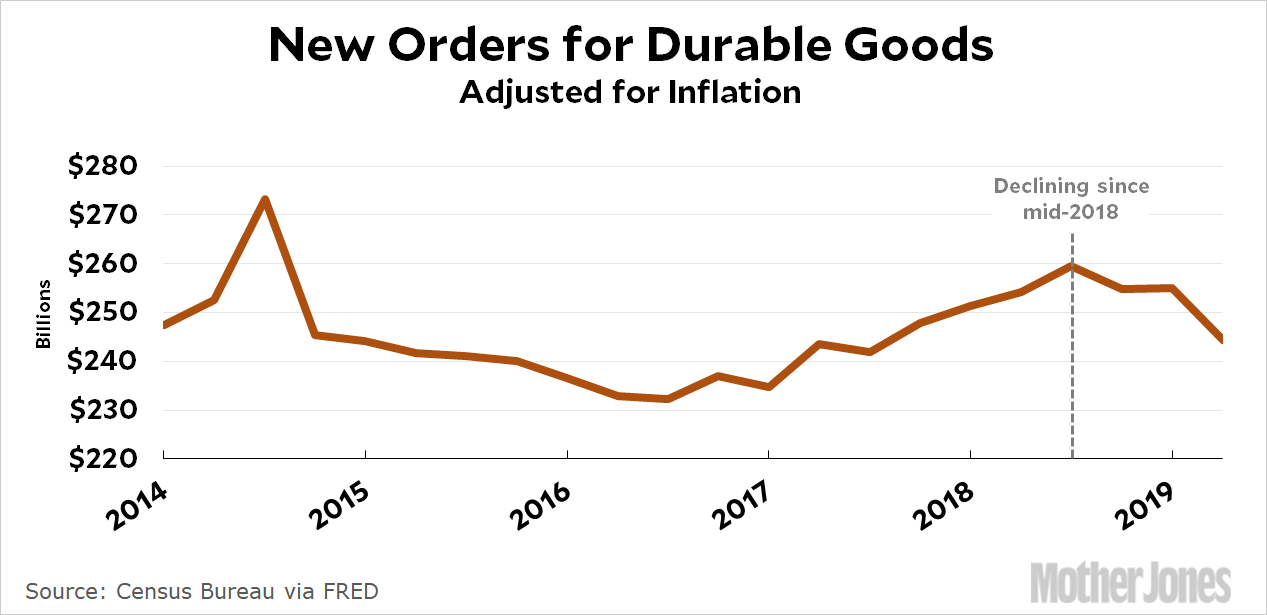
I guess we should all be prepared for a spate of articles using various home-brew metrics to predict whether a recession is near. You know the drill: sunspots, hemlines, banana consumption, whatever. Today the Wall Street Journal takes a look at RVs:
Shipments of recreational vehicles to dealers have fallen about 20% so far this year, after a 4.1% drop last year, according to data from the RV Industry Association. Multiyear drops in shipments have preceded the last three recessions. “The RV industry is better at calling recessions than economists are,” said Michael Hicks, an economist at Ball State University, in Muncie, Ind. Mr. Hicks says softening consumer demand for RVs coupled with rising vehicle prices due to tariffs suggests the economy is either in a recession or soon headed for one.
Wait. What’s this about rising prices due to tariffs?
RVs can range in price from about $12,000 for a folding camping trailer to $212,000 for a high-end motor home, according to average retail prices collected by the RV Industry Association. The prices have been sensitive to the U.S. tariffs imposed on some Chinese goods. The industry estimates that as many as 523 items could be hit by the tariffs, everything from the toilet-seat covers that go into RV bathrooms and cow hides for leather furniture to the aluminum or steel used throughout the vehicles.
Divya Brown, the president of Houston.-based TAXA Outdoors, a small RV manufacturer, said her company bought most of its parts from Elkhart. Her suppliers are raising their prices to account for the hit they are taking from imported goods such as aluminum and steel. Ms. Brown said the company saw a 22% jump in the cost of steel and a 9% jump in the cost of aluminum.
So there you have it. The yield curve has inverted and business is bad in Elkhart, Indiana. We are all doomed.
Over at the Washington Post, Hugh Hewitt gives Donald Trump some advice about how to win reelection: tell the Navy to build more stuff in Michigan, Wisconsin, and Pennsylvania. I’m not joking or exaggerating. Hewitt is very explicit about the whole thing:
A focus on Michigan, Pennsylvania and Wisconsin need not be limited to the Defense Department. Recently, Sen. Cory Gardner (R-Colo.) pushed successfully for the planned relocation of the Interior Department’s Bureau of Land Management to Grand Junction, Colo., in a brilliant move to bring bureaucrats closer to the citizens they regulate and whom they are supposed to serve. Sending large parts of the Environmental Protection Agency to Flint, Mich., or nearby locations would drive home the same message.
Trump has the chance to drain the swamp while making government agencies much more attuned to the people in flyover country. But he must act soon.
Behold modern conservatism: the way to drain the swamp is to order the military to spend more money in swing states, with the express purpose of helping a Republican win the election. And don’t even bother trying to hide what you’re doing. Go ahead and write about it openly in one of the most influential newspapers in America. That’s making America great again, my friends.
Can you pitch in a few bucks to help fund Mother Jones' investigative journalism? We're a nonprofit (so it's tax-deductible), and reader support makes up about two-thirds of our budget.
We noticed you have an ad blocker on. Can you pitch in a few bucks to help fund Mother Jones' investigative journalism?