• Donald Trump Has Done Almost Nothing for the Working and Middle Classes

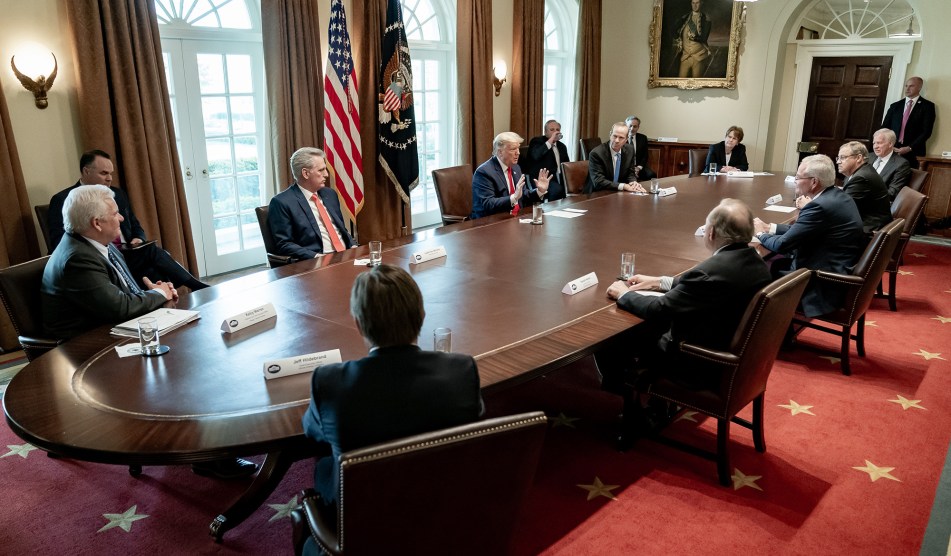
    Who do you think Trump is talking to here? Yet another corporate roundtable? A group of his millionaire buddies? One thing you can be sure of is that he's not talking to either union leaders or people who make less than $50,000 per year. (Answer: it's a meeting with a bunch of corporate suits from the energy sector.)Shealah Craighead/White House/ZUMA

    Donald Trump has bamboozled the working classes into thinking that he has their best interests at heart. He did this during the 2016 campaign mainly by appealing to immigration fears; bashing China; and disparaging liberal elites. The question in 2020 is whether the working classes still believe this.

    Some do. Trump did, after all, work hard to keep out Central American immigrants. He did go toe-to-toe with China. And he’s certainly kept up the drumbeat against liberal elites. If this is enough for you, then you’ll remain a Trump fan.

    But if you’re wondering whose interests he really considers important, all you have to do is look at his actions:

    • Given a chance to intervene in oil prices, he chose to raise them. This was good for the oil industry but not so good for American gasoline purchasers.
    • He tried to take away Obamacare without any kind of effective replacement. This would have reduced taxes on the affluent while denying the working classes one of their key sources of affordable health care.
    • His tax cut in 2017 was almost entirely aimed at corporations and the rich. The rest of us got close to nothing.
    • He promised he was the best thing ever for farmers, but his tariff war destroyed our agricultural markets in China.
    • He is currently supporting a Republican war against the Post Office. This will probably help private package delivery services but hurt rural areas far more than urban areas.
    • Manufacturing workers? When Trump took office they made up 8.5 percent of the workforce. Today they make up 8.4 percent and their hourly earnings have lagged the rest of the labor force. Meanwhile, corporate profits have jumped by 14 percent. That’s good for the rich but not so good for workers.
    • In the coronavirus bill, he was concerned almost exclusively with bailing out businesses. His only sop to the working and middle classes was a one-time $1,200 check that his Treasury Secretary seemed to think would tide a family over for ten weeks. Meanwhile, it was up to Democrats to provide real assistance in the form of increased unemployment benefits, help for hospitals, and help for schools.
    • Trump’s tariff war with China has cost middle-class families $500-1000 each. It’s not paid by China and it’s not a tax on corporations, who pass it along to consumers. It’s basically a tax on everyone who buys inexpensive things from overseas—which is mostly the middle class. The affluent escape most of the tax.

    I understand entirely that rational arguments like this have only a limited effect in presidential elections. But surely they have some effect? There must be at least an appreciable chunk of the working and middle classes who are open to the argument that Trump has talked big but hasn’t really done much for them. When it comes to concrete campaign promises with a dollar sign in front of them, Trump has been great about keeping his promises to big business and the wealthy. It’s only his promises to the middle class that he’s broken.
  • How to Beat COVID-19

    Will this be enough? No one knows, because even now there are still a surprisingly large number of fairly basic questions we can’t answer about the coronavirus. We don’t know for sure how transmissible it is. We don’t know how effective social distancing is. We don’t know how many people get infected and never know it. We don’t know how infectious these asymptomatic carriers are. We don’t know if recovering from COVID-19 confers immunity in the future. We don’t know for sure how deadly it is in the absence of any underlying conditions. Even basic statistics on the spread of the virus are pretty questionable—and torturing the data won’t change that. Because of this we should all be fairly humble about how much we think we know and how confident we can be in our prescriptions. We should also strive on both sides not to dismiss hypotheses just because someone on the other side has proposed them.

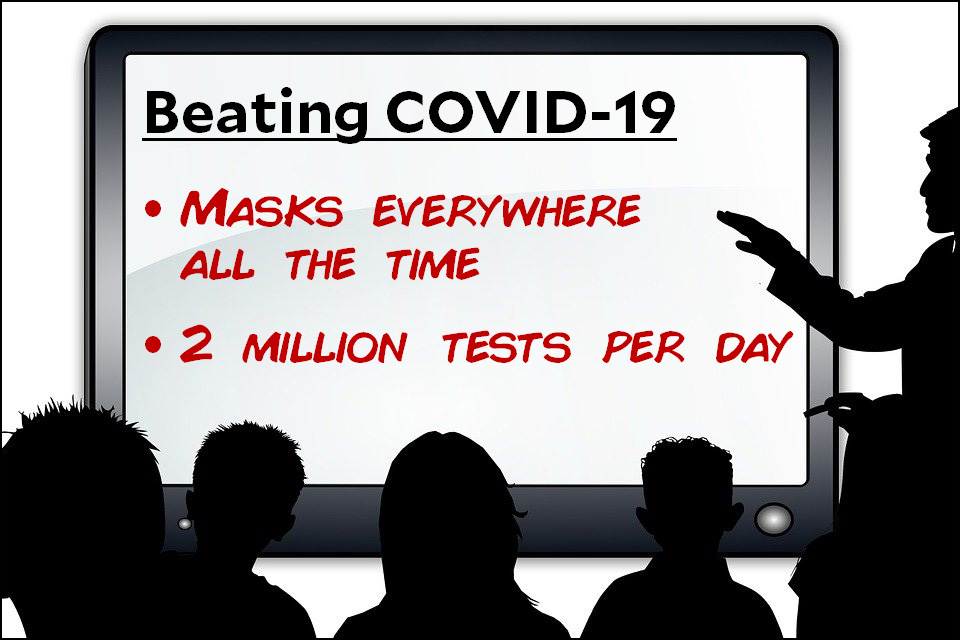
    However, masks and testing—for now, at least—seem to be almost unanimously agreed upon by epidemiologists as ways to rein in the coronavirus after lockdowns have reduced the spread of the virus to small numbers. And they’re both doable: mask wearing requires a PR campaign, and God knows that’s one thing that Donald Trump is good at. Testing is harder, but if Trump appointed a genuinely competent test czar with essentially unlimited power and funding, we could probably do it. It would certainly be a good national goal, even if we didn’t make it.

    I’m sort of intrigued by the idea of increasing test throughput by testing groups of people. It’s a simple idea: you take swabs from, say, 10 people, mix them all together, and then run them through the PCR machine. If it comes back negative, the entire group is cleared. Only if you get a positive result do you go back and do individual tests to see who’s infected. On average, about three out of four tests would come back negative, which means you’d run 14 tests for 40 people rather than 40 tests. That triples your throughput even with no increase in testing capacity.

    I haven’t heard anyone explain why this wouldn’t work, but there might be a catch. If I hear of one, I’ll let you know.

    In the meantime, wash your hands, stay home as much as possible, and try to keep your distance from other people. And pray that Trump is somehow shaken into sanity and finally decides to take concrete action instead of fomenting red-state rebellion because he’s mad that the virus isn’t doing what he tells it.

  • Coronavirus Growth in Western Countries: April 17 Update

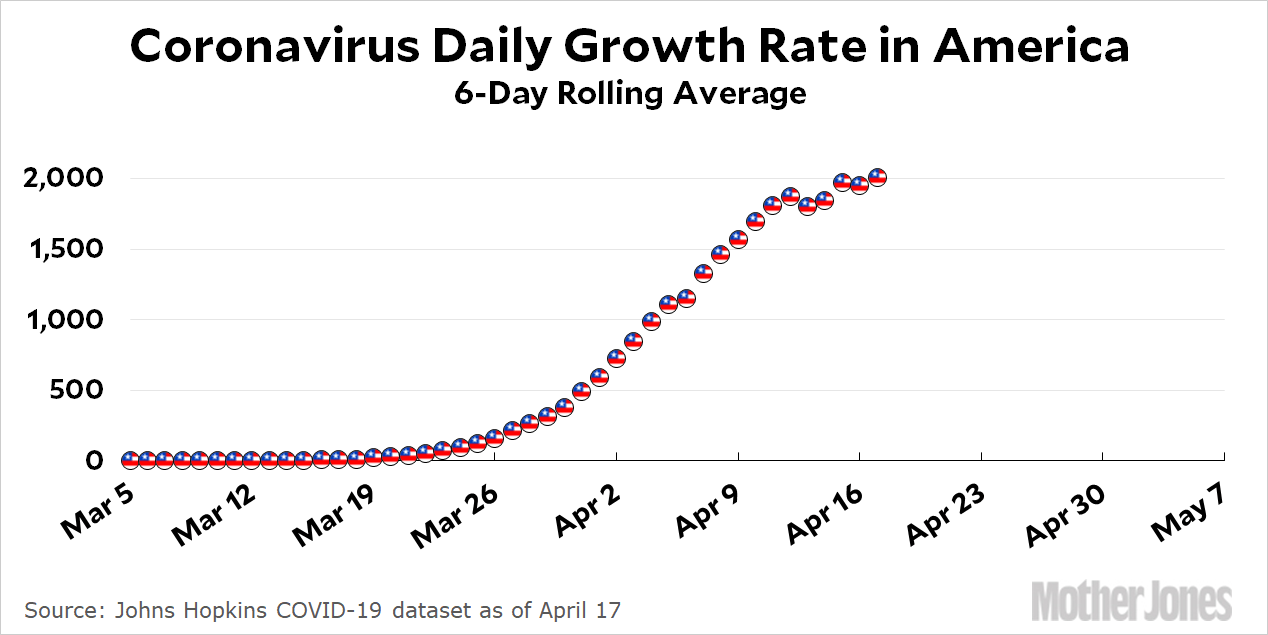
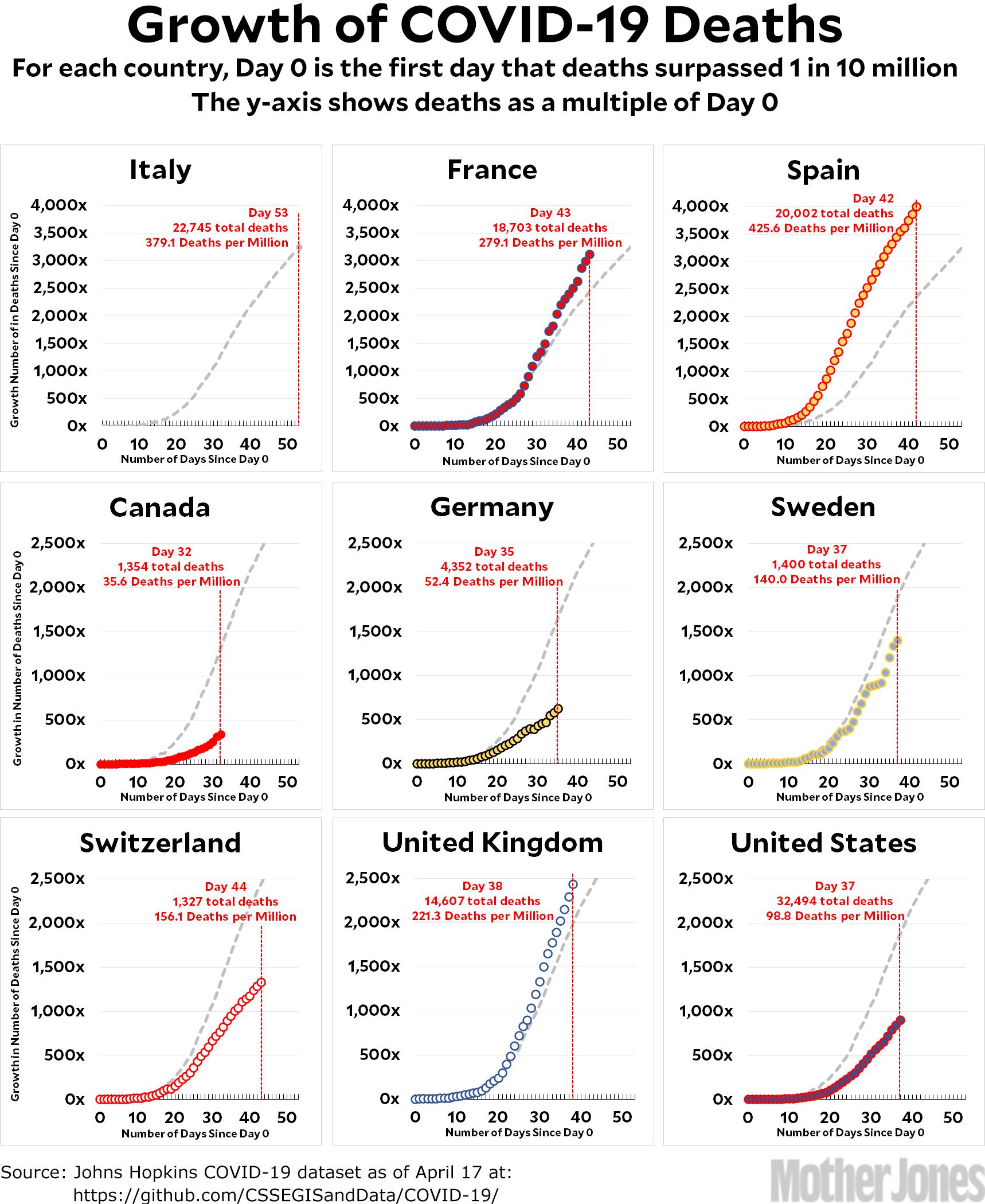
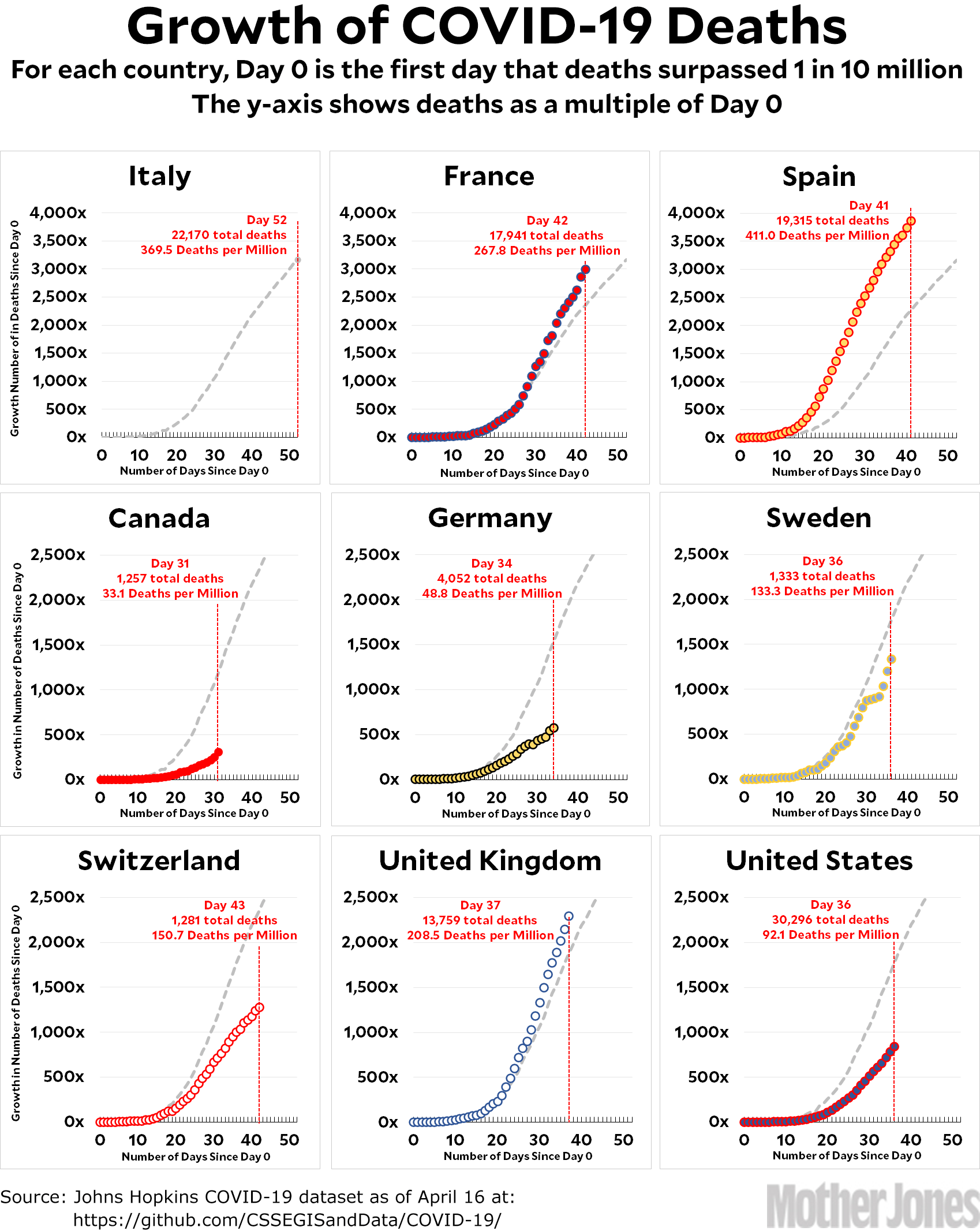
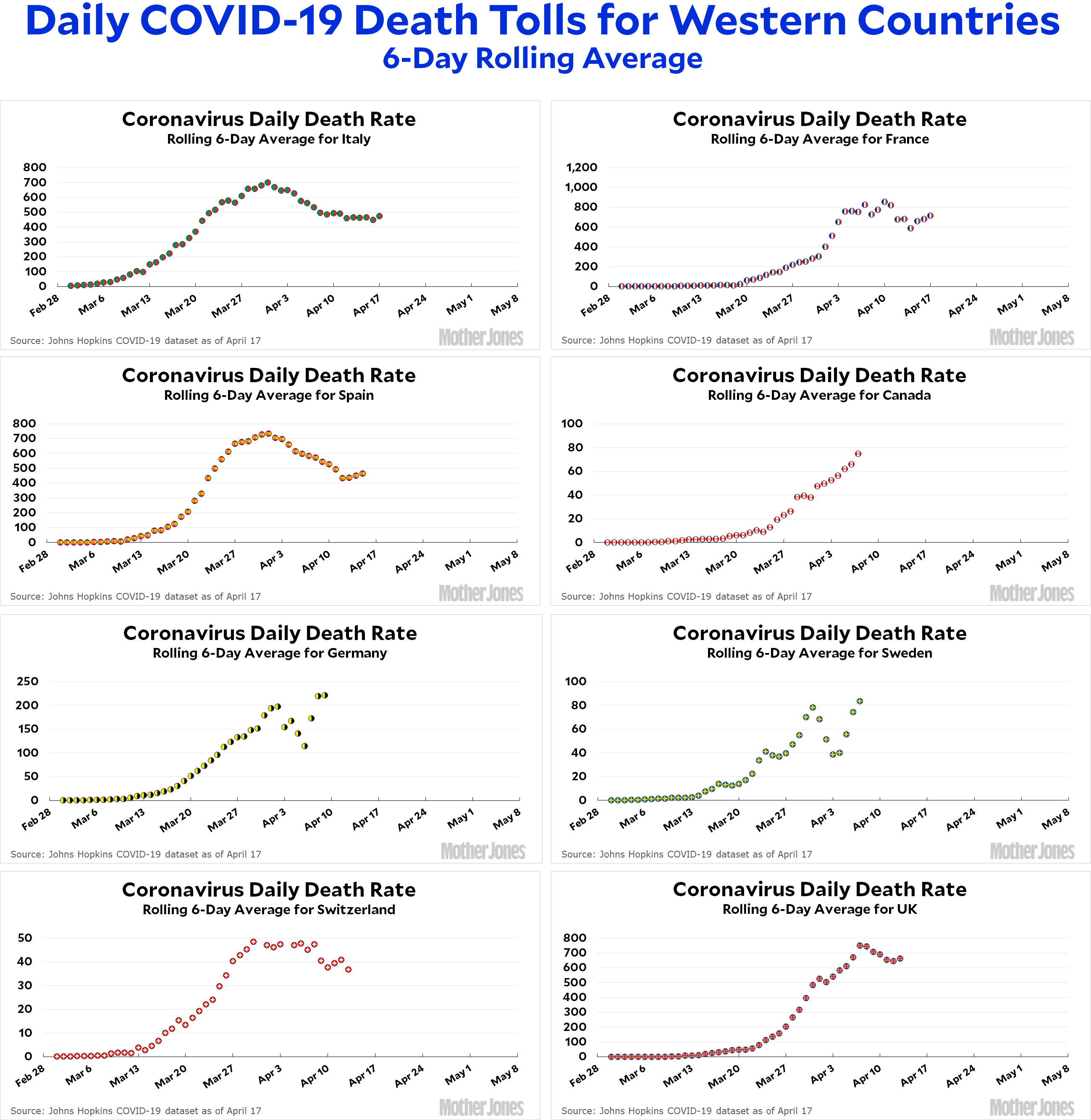
    Here’s the coronavirus growth rate through April 17. The regular daily charts are still here (just scroll down), but I want to show something different today. The charts below show the daily death toll in the usual nine countries that I track (smoothed using a 6-day rolling average). So what do they tell us?

    Italy is still stalling. France kinda sorta seemed like they might be peaking, but now they’ve stalled for a few days too. Spain is stalling. Canada is growing slowly, but still growing with no peak in sight. Germany is noisy, but also doesn’t seem to have peaked. Sweden is difficult to analyze because of their weekend bumps, but they don’t seem to be near a peak either. Switzerland looks good. The UK might—maybe—be at their peak, but it’s too early to tell. Italy didn’t start to stall until a week after their peak.

    And of course let’s not forget the United States:

    Are we peaking? Maybe. I tentatively think we are, but the evidence is pretty equivocal.

    Bottom line: We’re in a pretty dicey position. At least two countries that had definitely peaked are now stalled. Other countries that may be peaking based on case counts are hard to call based on deaths. Does that mean the case counts are inaccurate or that the death rates just need another week to catch up? Ask me in another week. In addition, we have news of new outbreaks in Singapore and China, and continued growth in Japan. South Korea has reported that some people who already had the coronavirus infection might be getting it again. In the United States, we need to worry about the possibility of new outbreaks from states that never locked down or are ending their lockdowns too early.

    At this point, I have no projections. There’s only so much you can do with the data at hand, and it points in different directions depending on what you do with it. We’re just going to have to wait and see.


    How to read the charts: Let’s use France as an example. For them, Day 0 was March 5, when they surpassed one death per 10 million by recording their sixth death. They are currently at Day 43; total deaths are at 3,117x their initial level; and they have recorded a total of 279.1 deaths per million so far. As the chart shows, this is above where Italy was on their Day 43.

    The raw data from Johns Hopkins is here.

  • The True CFR of the Coronavirus May Be 0.5% or Less

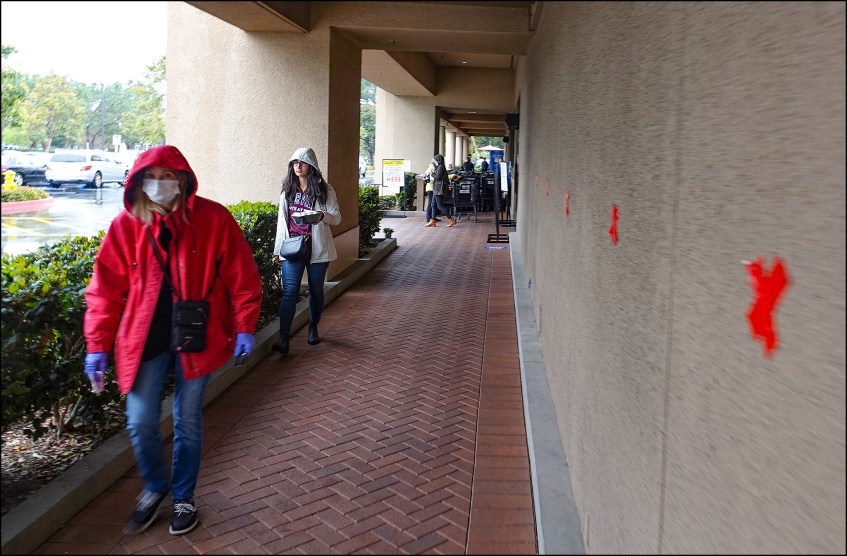
    Masks and testing are what we need to keep COVID-19 under control once the initial infection rate has been suppressed to a manageable number. Social distancing, by contrast, can probably be relaxed a bit.Kevin Drum

    NOTE: This study has been widely criticized for drawing conclusions that the data doesn’t support. In particular, the false positive rate of the antibody test is too high to guarantee a nonzero result, let alone the very high results the authors report. You can find critiques all over the internet, but Andrew Gelman has a very detailed write-up here.

    This doesn’t mean the conclusion of this study is wrong. Their point estimate is still what it is. However, we clearly need more antibody tests with larger sample sizes and more geographic diversity. I imagine we’ll get both before long.


    One of the key metrics for the coronavirus pandemic is the case fatality rate. That is, out of all cases of people infected with COVID-19, how many die? This is difficult to measure because we know that our measure of the number of infections is wildly unreliable. However, antibody tests are starting to become available that allow us to test an entire population and get a solid estimate of how many people have ever been infected. A team of researchers did this for Santa Clara County in California recently and came up with this:

    Our study included 3,439 individuals that registered for the study and arrived at testing sites. The total number of positive cases by either IgG or IgM¹ in our unadjusted sample was 50, a crude prevalence rate of 1.50%. After weighting our sample to match Santa Clara County by zip, race, and sex… the estimated prevalence was 2.49% under the S1 scenario, 4.16% under the S2 scenario, and 2.75% under the S3 scenario.

    ….After adjusting for population and test performance characteristics, we estimate that the seroprevalence of antibodies to SARS-CoV-2 in Santa Clara County is between 2.49% and 4.16%.

    The “official” number of confirmed coronavirus cases in the US is about 600,000. If we take a middle estimate of 3.3 percent from this study and extrapolate it to the entire country, the true number of cases is about 11 million.

    But what’s the death toll? The official number right now is about 30,000, but let’s be conservative and assume the real number is twice as high. This gives us 60,000 deaths out of 11 million cases, for a true CFR of 0.5 percent. This is much lower than previous estimates from around the world.

    A few days ago I suggested that the initial models of the death toll from COVID-19 may have been too high “for reasons we don’t yet understand,” but this might be the reason: the assumed CFR in these models was not just 2x or 3x too high, it was 10x or 20x too high. Using the correct CFR, the death toll projections should always have been much lower, and that in turn means the effects of social distancing measures have been overestimated. Maybe.

    As usual, this is armchair epidemiology, not to be taken too seriously. It’s also based on a single study. Further studies may show different results. Still, it’s pretty suggestive.

    ¹Hey! I recognize that. My particular version of multiple myeloma is IgG light kappa, which means it’s the IgG immunoglobulins that are cancerous.

  • Trump Never Wanted “Total Authority” Over the Pandemic

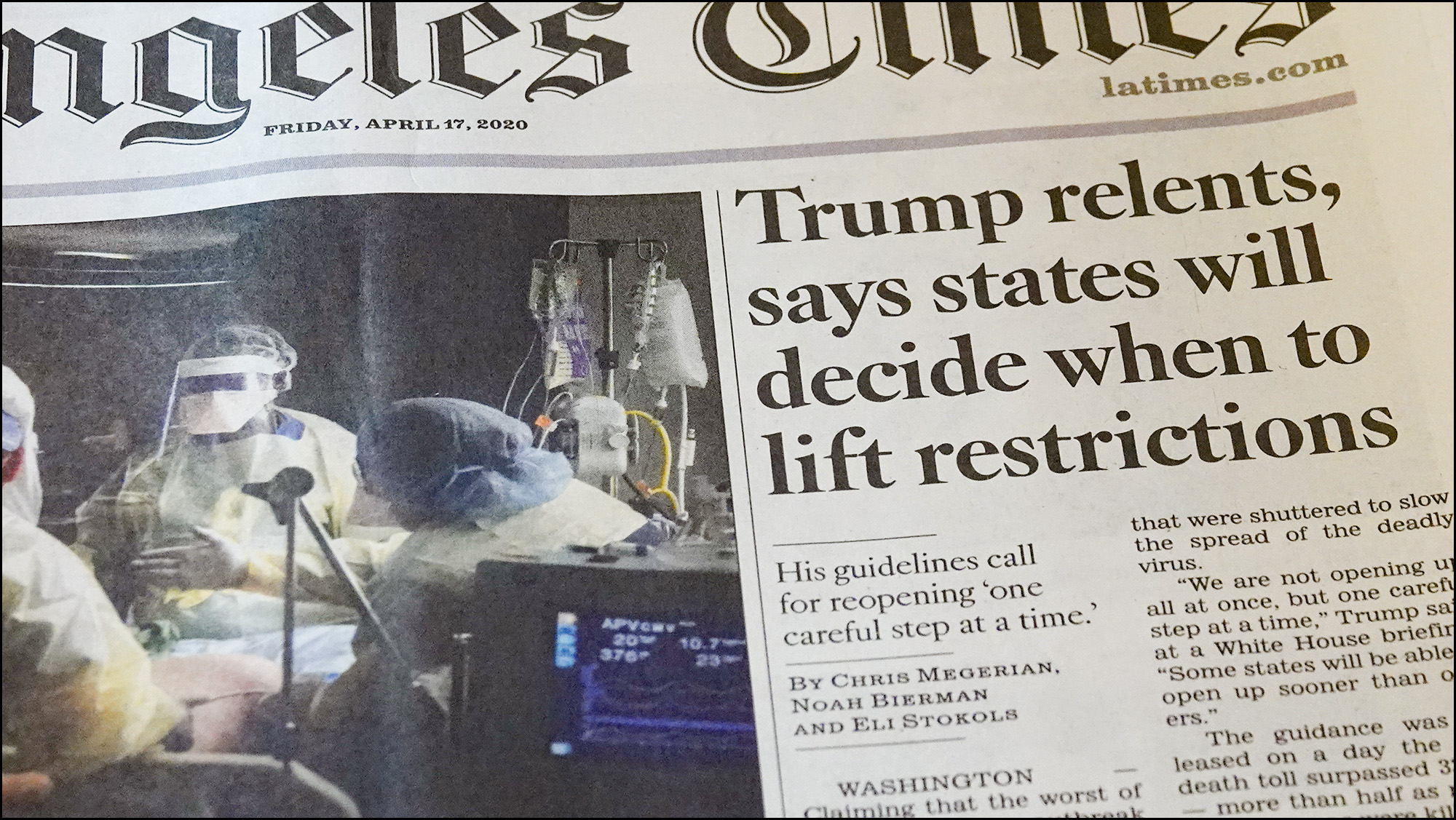
    This headline in my morning LA Times cracks me up:

    Trump “relents.” Sure. Does anyone think for even a minute that Trump ever wanted total control over reopening the economy—or any other aspect of the COVID-19 pandemic? He spent two months telling us it was no big deal, and ever since then he’s done nothing but blame it on other people. He’s blamed China. He’s blamed WHO. He’s blamed Obama. He’s blamed the states. He’s blamed unnamed experts who failed to tell him anything was going on. He’s blamed the media. He’s blamed General Motors. He’s blamed hospitals.

    In the meantime, the only concrete action he’s taken has been putting Jared in charge of a dodgy airlift operation that allows him to distribute medical supplies at his personal whim.

    Trump doesn’t have a clue what to do about a pandemic that can’t be removed from the front pages by simply distracting everyone with some random, outrageous comment. So all that’s left is to make sure that someone else gets the blame for it. To that end, his “total authority” comment worked great: it suckered everyone into being outraged and demanding that he acknowledge state control. Now he’s pretending to relent when that was almost certainly his goal in the first place. You wanted state control, you got it.

    Animal cunning, boys and girls. Always remember that. Trump may not be book smart, but his animal cunning quotient is off the charts.

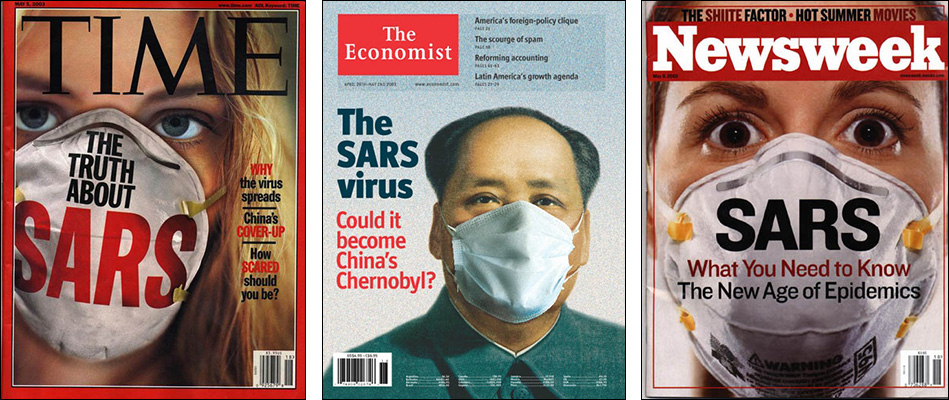
  • Here’s Why COVID-19 Is Worse Than SARS

    Dr. Fauci, demonstrating his superhuman patience, appeared on Laura Ingraham’s show yesterday:


    But wait. This isn’t a dumb question. Why did SARS “go away”? And if SARS went away, why can’t COVID-19 go away too? Is COVID-19 just easier to transmit? Yes indeed:

    SARS and MERS have significantly higher case fatality rates than COVID-19. Yet COVID-19 is more infectious — the underlying SARS-CoV-2 virus spreads more easily among people, leading to greater case numbers.

    COVID-19 is more infectious because the mechanism of transmission is different:

    Once SARS jumped to humans, it was transmitted from person to person. It is most virulent during the second week of infection when virus excretions through the mucus and stool peak. With SARS, most human-to-human infections occurred in health care settings that lacked robust infection control procedures. When infection control practices were implemented, the outbreak ended. Since then, the only occurrences have occurred through laboratory accidents. They have not spread throughout the community.

    COVID-19 appears to spread person-to-person, through droplets that are expelled when a person coughs or sneezes and then are inhaled by a nearby person. Less often, it may be spread by touching an infected surface and then touching one’s mouth, nose, or eyes. Transmission may also occur before a person becomes symptomatic. As the CDC cautions, “COVID-19 is a new disease and we are still learning how it spreads.”

    So the big difference is that COVID-19 spreads via coughs and sneezes in the general population, and that’s inherently much harder to control than mucus and stool transmission. If anybody has more to add to this, let us know in comments.

  • Coronavirus Growth in Western Countries: April 16 Update

    Here’s the coronavirus growth rate through April 16. Like Tuesday, Wednesday was not a great day. Italy is still stalled; Germany is up; Sweden is up; even Canada ticked up more than usual. This might be noise or it might be a sign that we’re not peaking soon after all.

    For the first time, I also have a serious data problem. As you know, it’s widely believed that COVID-19 deaths have been undercounted pretty much everywhere. However, this is not a big problem as long as the undercounting is consistent. The absolute numbers will be off, but you can still see growth rates and curve flattening just fine.

    Unfortunately, New York City decided on Tuesday to rejigger their numbers in midstream by 3,700. This means that their numbers going forward aren’t comparable to past numbers. And if those numbers get aggregated up to the state and national level, it means those counts are also no longer usable.

    The two main sources for the US death toll are Johns Hopkins and the COVID Tracking Project. It appears that Johns Hopkins is using the new, higher numbers, while the CTP isn’t. For the first time ever, these two sources disagree by a substantial amount.

    What to do? I don’t know, so I’m going to punt until things become clearer. I’m using the CTP numbers for now, which don’t include the New York City revisions. I’ll switch later if things clear up a little more.


    How to read the charts: Let’s use France as an example. For them, Day 0 was March 5, when they surpassed one death per 10 million by recording their sixth death. They are currently at Day 42; total deaths are at 2,990x their initial level; and they have recorded a total of 267.8 deaths per million so far. As the chart shows, this is above where Italy was on their Day 42.

    The raw data from Johns Hopkins is here.

  • It’s Not Clear Yet If COVID-19 Deaths Have Peaked

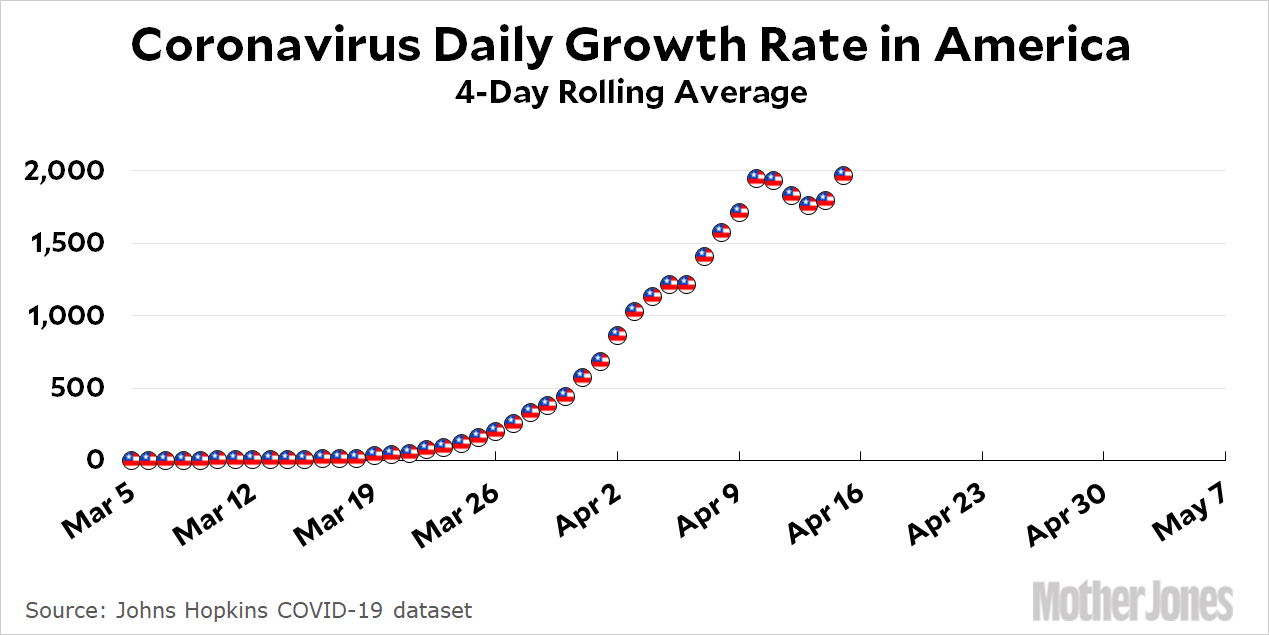
    “Now that we have passed the peak in new cases,” President Trump said today, “we are starting our life again. We are starting rejuvenation of our economy again.” Is this true?

    The data for cases is too unreliable to bother with, so let’s look at deaths instead. My usual 6-day rolling average is a little too coarse to show much of anything, so here’s a 4-day rolling average:

    Have we peaked? Tentatively, it seems like we might have. But it’s far from sure yet.

  • Donald Trump Has Discovered He Can Dial Up a Mob Whenever He Wants

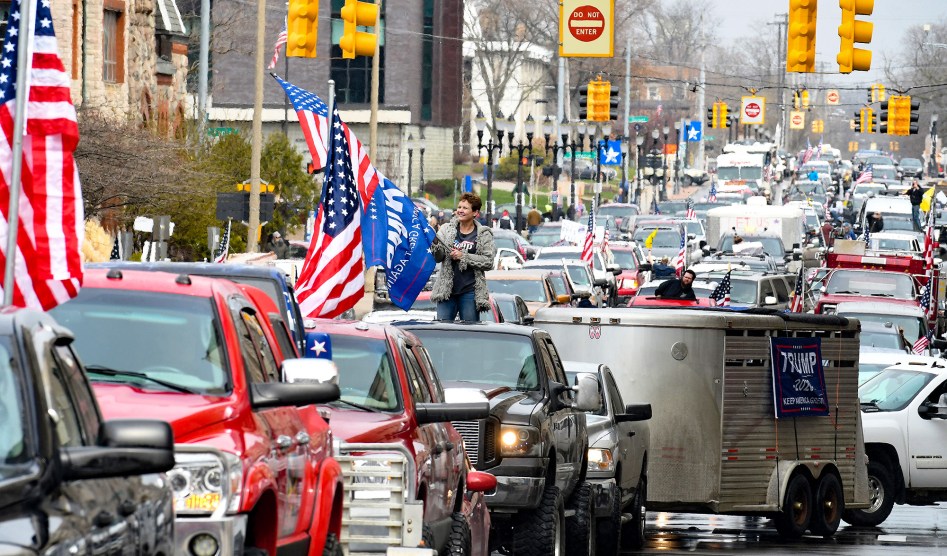
    Protesters block streets in Lansing, Michigan, to display their hostility toward the governor's stay-at-home order.TNS via ZUMA

    For the first time ever, I’m a little scared of what Trump might do later this year:

    The picture is from Joshua Bickel of the Columbus Dispatch, and it shows a swarm of protesters outside the Ohio statehouse. Roughly speaking, what happened is that Trump ordered up a mob, Fox News and Rush Limbaugh passed the order along, and local GOP groups happily ginned one up. Needless to say, this isn’t limited to Ohio:

    Across the nation, protests against the stay-at-home orders that health experts say are needed to save lives are taking place, with more set for the coming days….In Raleigh, more than 100 demonstrators gathered to protest Democratic North Carolina Gov. Roy Cooper’s stay-at-home order…. Kentucky, Utah and Wyoming also saw similar protests. More events are scheduled for Pennsylvania, Virginia, Texas, Oregon, Idaho and Washington state.

    The largest took place in Michigan on Thursday, where police said 3,000 to 4,000 people showed up at the state Capitol in Lansing to protest Democratic Gov. Gretchen Whitmer’s extended and expanded stay-at-home order, which was signed into law last week. The protests have had a tea party flavor to them, with demonstrators carrying “Don’t Tread on Me” flags and wearing “Make America Great Again” gear. Some have even waved Confederate flags.

    As always, the danger here is not so much Trump himself. It’s been obvious for a long time that he’s a sociopath who doesn’t care about—or maybe even understand—the consequences of his actions on other people. The danger is that the Republican Party, so far, is cheerfully going along with him. Even in the middle of a global pandemic that’s already killed more than 100,000 people, they are acting as Trump’s loyal spear carriers no matter how reckless or deadly he’s become.

    Even after three years of Trump, I guess I didn’t believe that Republicans would truly go so far. But even the prospect of bodies stacked endlessly in mass graves hasn’t brought them to their senses. I guess at this point nothing will.