Mother Jones illustration; Getty, Drew Angerer/Getty
A friend emails with a question:
Why is Trump so intolerant of Iran and yet so tolerant of Putin and Kim Jong Un?
This is an easy one. President Obama signed a treaty with Iran but treated both North Korea and Russia harshly. Trump is motivated largely by a hatred of Obama, so he always wants to do the exact opposite. That means hating on Iran but cozying up to North Korea and Russia. I think you’ll find that this simple heuristic accounts for pretty much all of Trump’s country-specific sentiments, including Saudi Arabia, Israel, Germany, Canada, Ukraine, Cuba, and so forth. Helluva way to run a railroad.
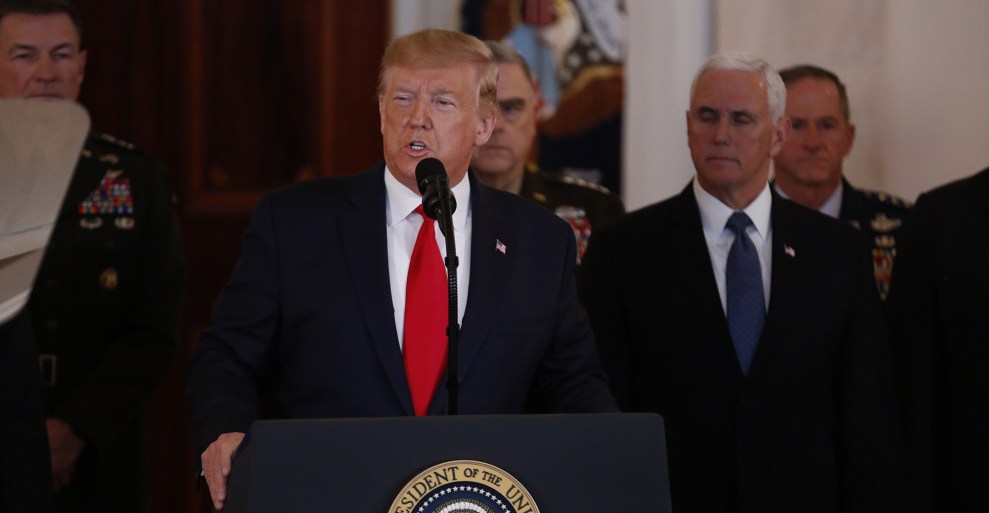
President Trump has addressed the nation following Iran’s missile strike last night against two American bases in Iraq:
So… that was it? No military response (good), new sanctions (there’s not much left to sanction), more NATO in the Middle East (???), ask China, Russia & E3 to leave JCPOA (won’t happen), some vague talk about diplomacy. Did I miss something?
I guess that’s that. The Iranians deliberately reined in their response and Trump decided to go ahead and use that as an excuse to call a halt to things. If both sides stick to this, then this whole affair will die out naturally.
But what about American troops in Iraq? My guess is that nothing will happen there either. After a few weeks of negotiation we’ll agree to some minor changes and that will be that. The whole thing will be forgotten within a few months.
And now, back to impeachment! And Democratic primaries!
Bob Somerby thinks I’ve gotten too gloomy about American education. Back in 2012 I wrote a piece for the magazine subtitled “Students today score better on tests than you did,” but lately I’ve been saying that although 4th and 8th grade kids have improved over time, “a lot of that improvement washes out in high school.” More recently, I also mentioned that the black-white score gap hasn’t gotten any smaller since the end of the ’80s. All of this was based on scores on the NAEP, the most widely respected national achievement test. What do I have to say about this?
First things first: I mentioned the stagnant performance of high school students way back in that first magazine piece. So this is nothing new. But Somerby thinks it’s wrong to focus on 17-year-olds because high school graduation rates have gone up over the past few decades. Higher graduation rates mean that more weak students are staying in school, and we should expect this to hurt their overall performance on tests like the NAEP.
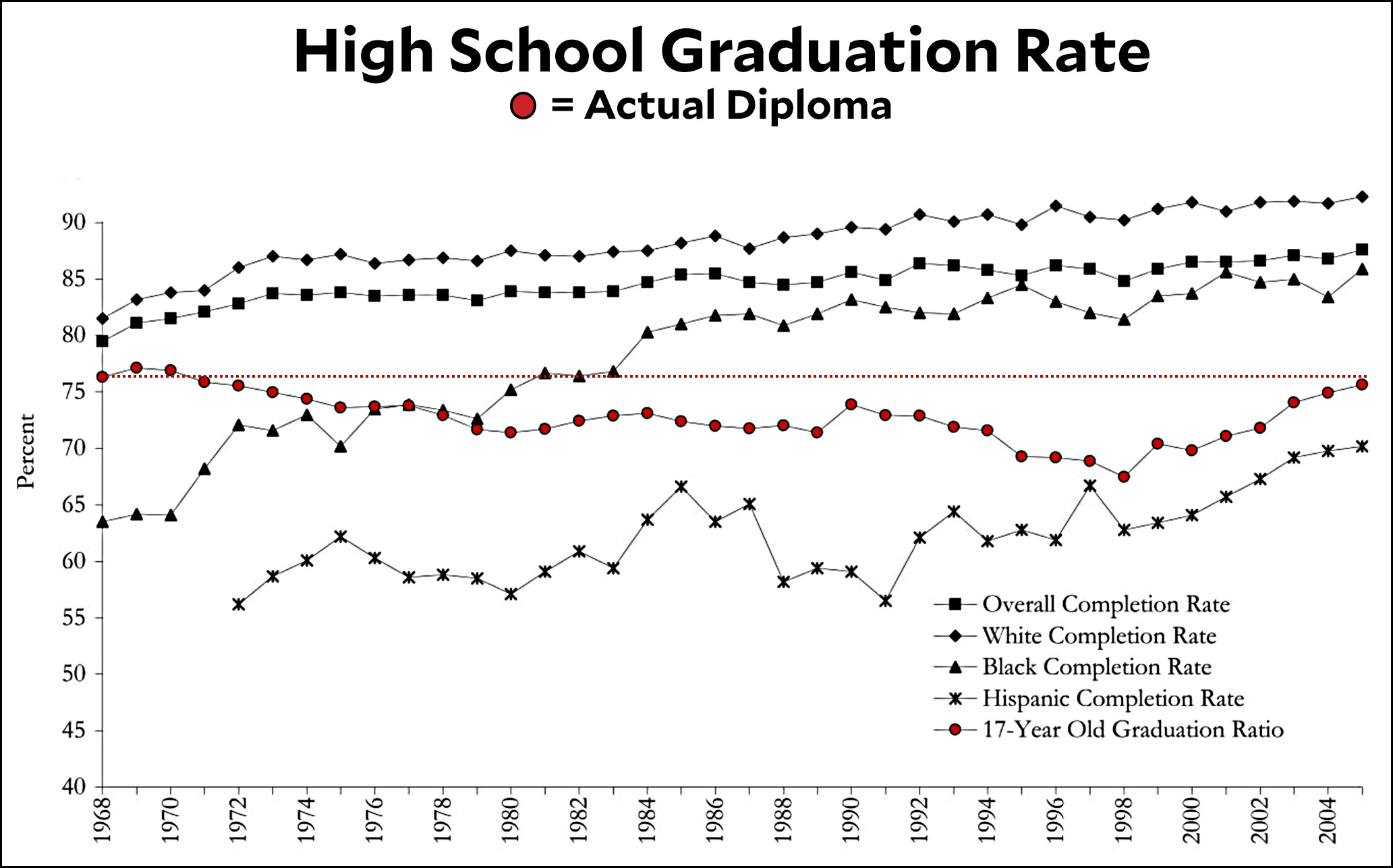
But it turns out that high school graduation rates haven’t really increased. In a seminal paper written in 2010, James Heckman and Paul LaFontaine looked very deeply into this issue and concluded that the increase was mostly a mirage due to a larger number of students who dropped out but eventually got a GED. If you look solely at students who get an actual high school diploma, the graduation rate has been pretty flat:
This chart goes only through 2005, and graduation rates have continued increasing since then. However, the best evidence suggests that this more recent increase is largely a statistical artifact. The actual number of kids who get a high school diploma has most likely remained flat or, at best, gone up a point or two. And since the NAEP is (obviously) taken only by students who are still physically in school, this means that the pool of test takers probably hasn’t changed much even in 12th grade.
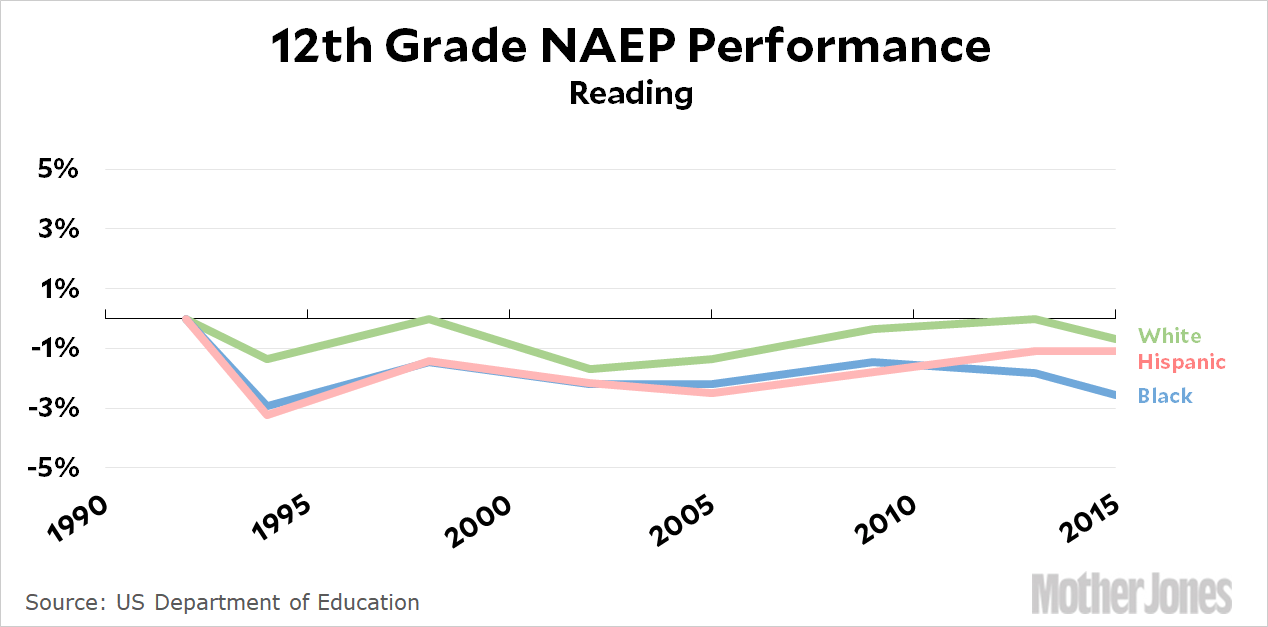
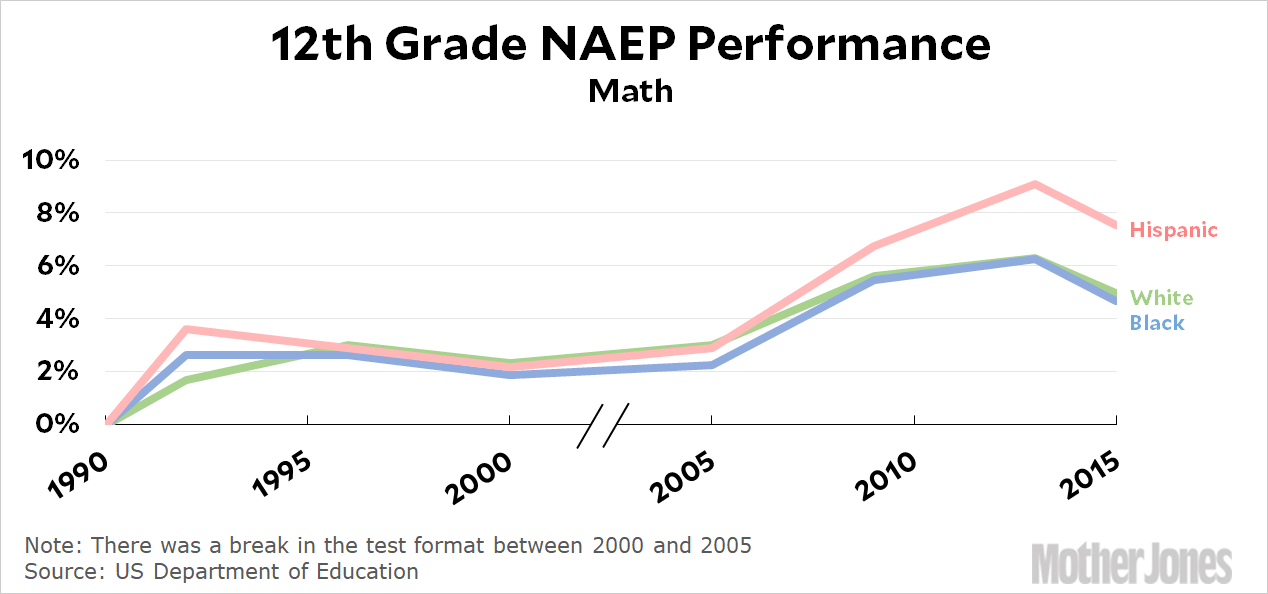
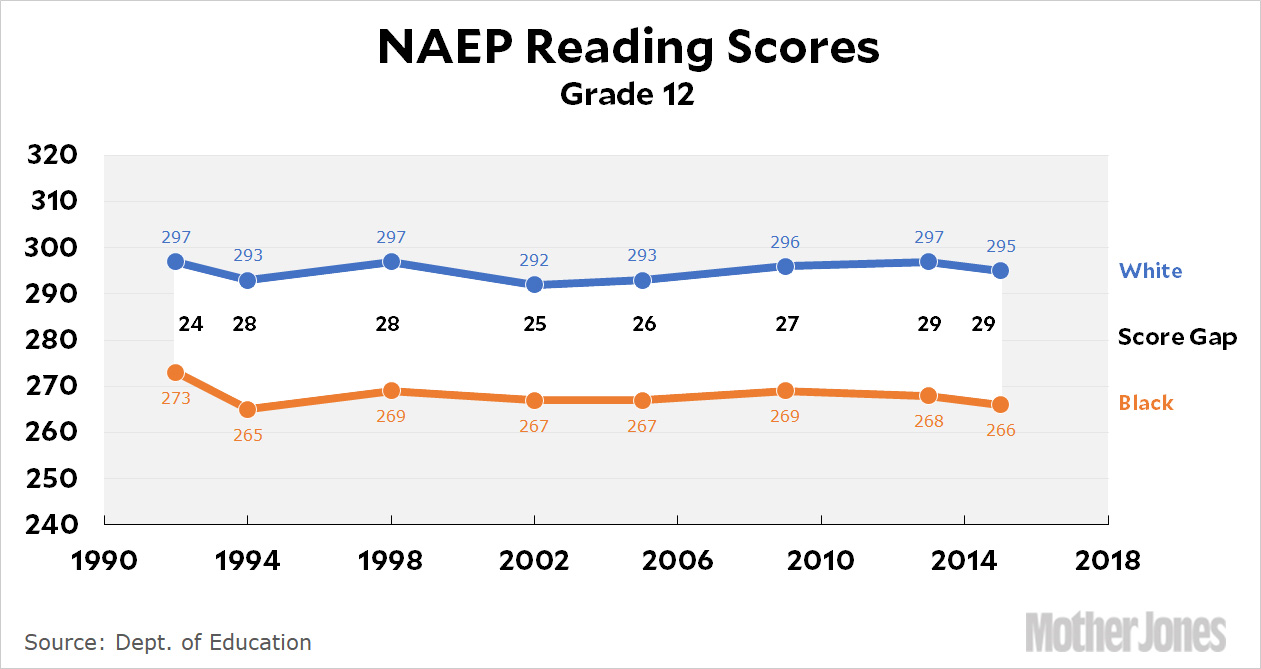
So with that out of the way, how are our high school students doing? Here are results over the past few decades for three racial groups:
Reading scores are down slightly and math scores are up slightly. Overall, there just hasn’t been much progress. As I’ve said before, gains in elementary and middle school tend to wash out in high school.
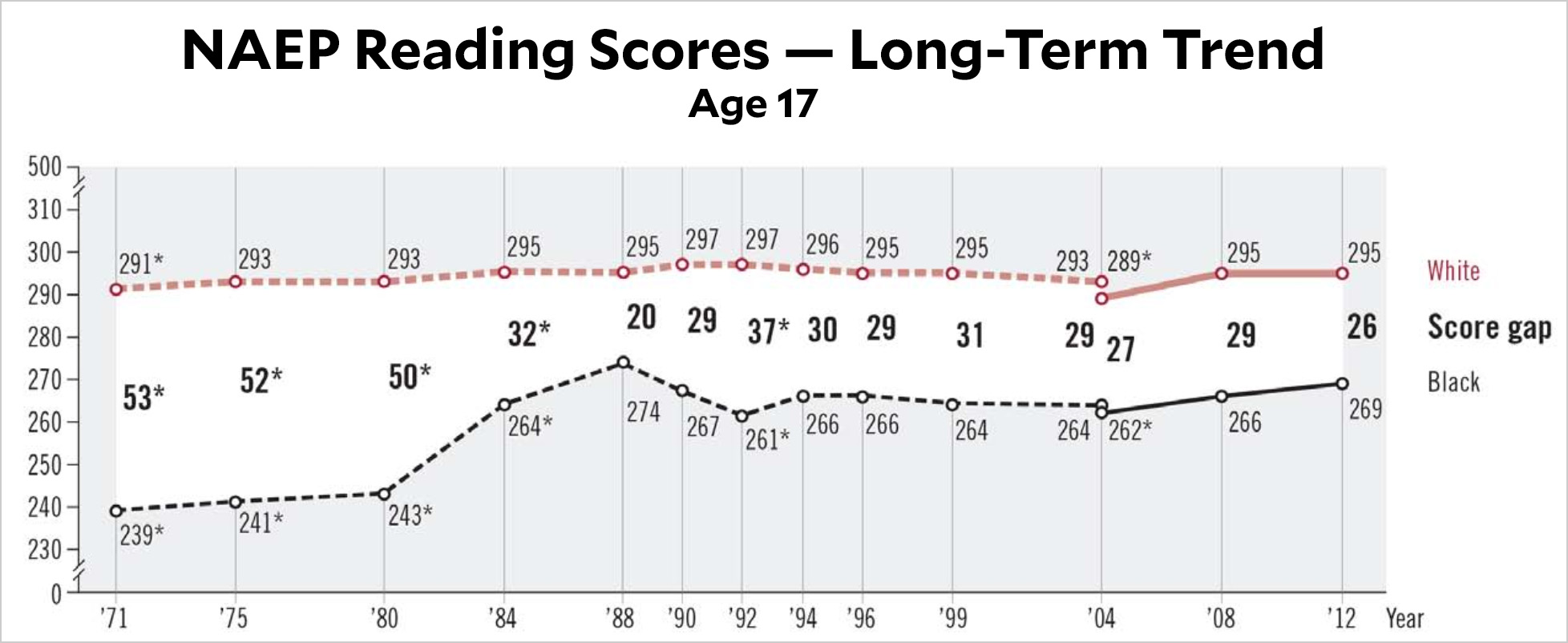
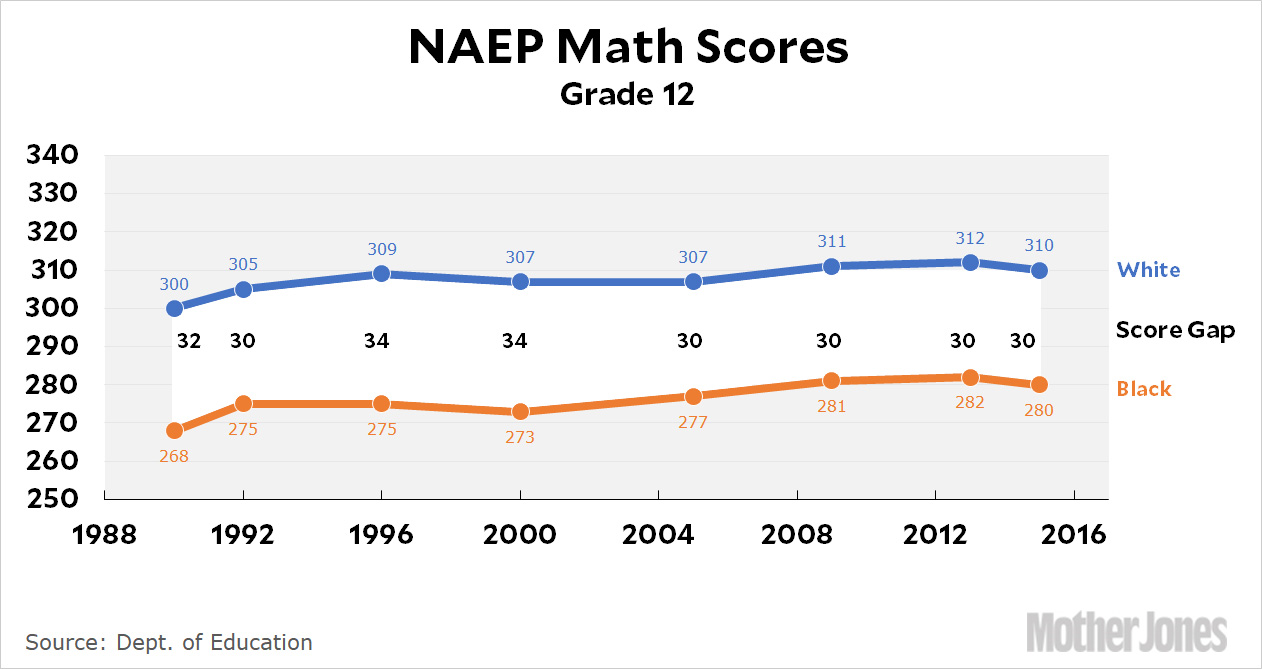
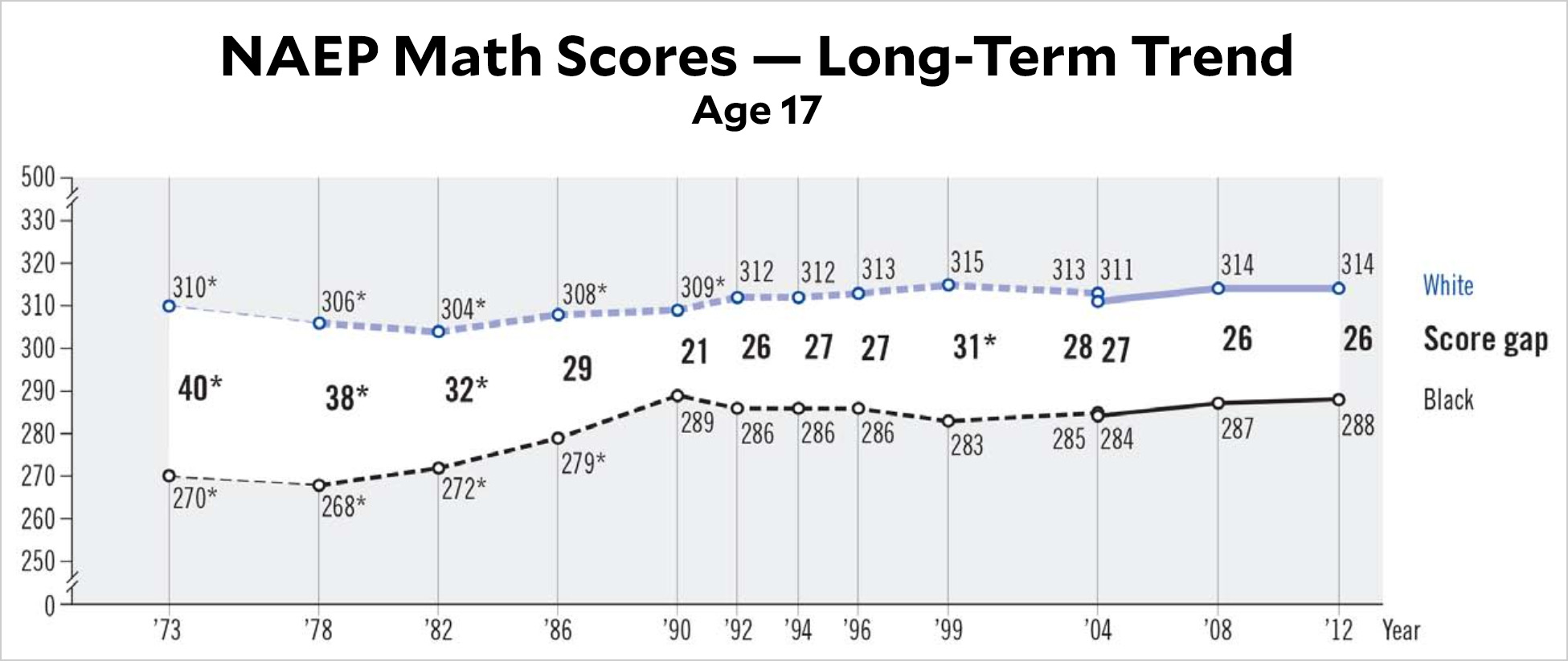
And what about the black-white score gap? Here are the results on both the main NAEP and the long-term NAEP, a special version of the test designed not to change over the years so that comparisons over time can be done more accurately:
The long-term test shows some progress in the ’70s and ’80s in closing the black-white gap, but all four charts show the same thing for the ’90s and beyond: no real progress at all.
There are reasons to be cautious about high school test scores, but we’ve been hearing those reasons for well over a decade now. At some point we have to start wondering what’s going on. How is it that 4th and 8th graders are doing considerably better than they used to, but then they go to high school and lose everything they’ve gained? Is it because those earlier gains aren’t real? Or because our high schools are doing a bad job of building on the more accomplished students they’re being given these days?
I don’t know. Either way, though, the only thing that matters in the end is how students are doing in the end. We can improve the scores of 8th graders forever, but if it all washes out and our high school grads are entering the workforce with the same skills they’ve always had, then we’re not making any real-world progress. And right now, that appears to be exactly the case.
It had become clear that the U.S. military presence in Iraq is growing increasingly untenable, at least in its current form, in the wake of the killing of Iranian Maj. Gen. Qasem Soleimani last week, which drew threats of retaliation from Iran and its regional allies against U.S. troops in Iraq and beyond….In comments to the Iraqi cabinet, broadcast on state television, Abdul Mahdi expressed exasperation with the conflicting signals coming from Washington. The letter he received “was clear,” he said, in its reference to a U.S. withdrawal from Iraq. “It’s not like a draft or a paper that fell out of the photocopier and coincidentally came to us,” he told the cabinet.
Two Iraqi officials said the caretaker prime minister had read the letter as a signal of a U.S. intent to withdraw and concluded that it was necessary in light of the spiraling tensions between the United States and Iran, which risk putting Iraq in the middle of a new war….Abdul Mahdi has asked the United States to put in place a timeline for a withdrawal, the official said.
The letter that we’ve all seen wasn’t signed by anyone, but apparently the copy Abdul Mahdi received did bear a signature. So it was a wee bit more than a “mistake.” I wonder how serious Abdul Mahdi is about following through with a complete American withdrawal?
This is not quite the way I envisioned us leaving Iraq, but I’ll take it. We shouldn’t be there, and if Donald Trump’s blundering is what it takes to get us out, then I’ll count it as an ugly win, but a win nonetheless.
America’s sky-high health-care costs are so far above what people pay in other countries that they are the equivalent of a hefty tax, Princeton University economists Anne Case and Angus Deaton say. They are surprised Americans aren’t revolting against these taxes.
….The U.S. health-care system is the most expensive in the world, costing about $1 trillion more per year than the next-most-expensive system — Switzerland’s. That means U.S. households pay an extra $8,000 per year, compared with what Swiss families pay. Case and Deaton call this extra cost a “poll tax,” meaning it is levied on every individual regardless of their ability to pay. (“Polle” was an archaic German word for “head,” so the idea behind a poll tax is that it falls on every head.)
Despite paying $8,000 more a year than anyone else, American families do not have better health outcomes, the economists argue. Life expectancy in the United States is lower than in Europe.
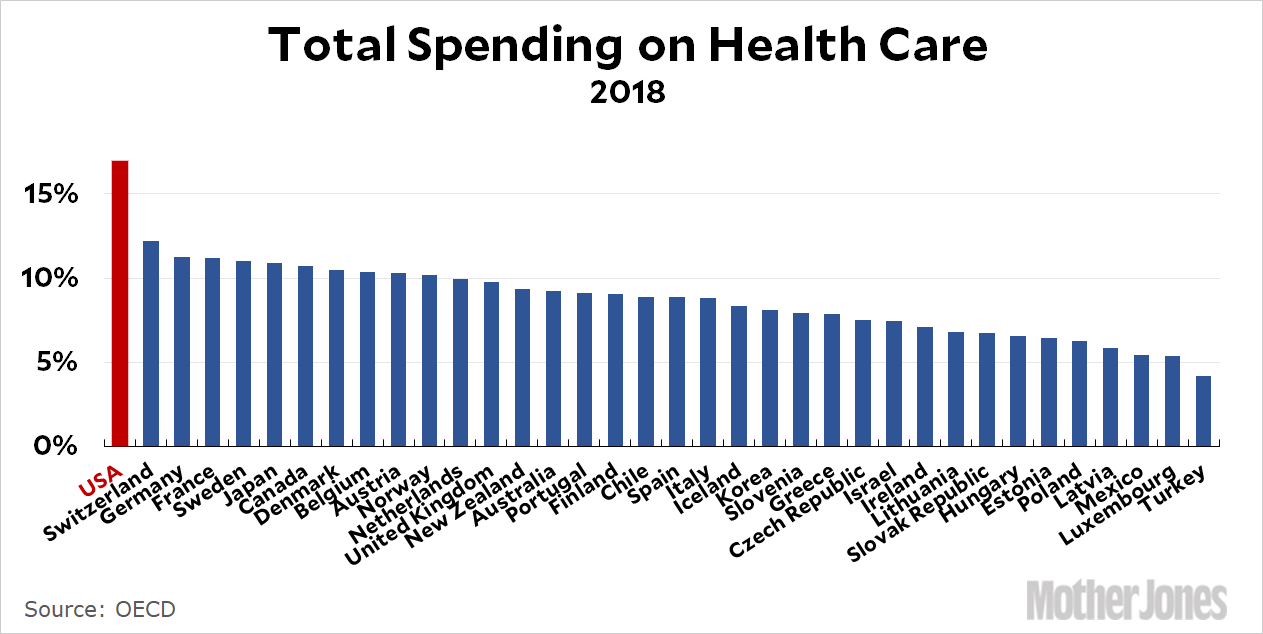
Quite correct. Here are latest 2018 health care spending numbers for all the developed countries of the world. The United States spends 16.9 percent of GDP on health care compared to 12.2 percent for Switzerland:
Let’s see. US GDP was $20 trillion in 2018. If we cut back to Switzerland’s level we’d reduce health care spending by 4.7 percentage points, or about a trillion dollars. There are roughly 128 million households in the US, so that comes to a savings of $7,800 per household. Case and Deaton have done their sums properly!
And that’s just Switzerland. If we spent at the OECD average level, we’d save more than $12,000 per family. How did our health care spending get so high?
That’s a complicated question, and it’s water under the bridge anyway. The real question at hand is: why don’t we make an effort to cut back to European levels? After all, they have perfectly fine health care even with much lower spending.
The answer to that is easier: It’s because most of our outsize expense comes from paying doctors more, nurses more, medical staff more, hospitals (and their workers) more, drug companies (and their workers) more, device makers (and their workers) more, and so forth. Thus, the only way to seriously cut back our health care spending is to pay people a lot less than they’re getting now, and this can be done only slowly if at all. You can’t suddenly tell doctors and nurses that they’re all getting 30 percent pay cuts. Hell, you can’t even do that to pharmaceutical companies, as much as we might like to. Aside from being massively disruptive, it would generate massive opposition. And in a democracy, massive opposition matter.
This is why I think Elizabeth Warren was right to say that if we’re going to adopt Medicare for All, we’ll need to phase it in. I just wish she were more forthright about it. The plain reality is that it will never happen unless we agree not to slash everyone’s pay and instead just put the brakes on future pay increases. Even that will hardly be popular, but it’s probably doable. It would mean that it’s a long time before we get anywhere near to European levels of spending, but that’s just the way it is.
Besides, it doesn’t really matter anyway. If we’re talking about a “long time,” our current spending patterns are meaningless. Within 20 years medicine will be revolutionized by robotics, artificial intelligence, CRISPR, and—who knows?—maybe even nanobots. When that happens, the cost of health care is going to plummet without Congress having to do anything at all. Hooray?
Over at National Review, Jim Geraghty joins in the mockery of all the lavish Christmas trips that the editors of British Voguewrote about last month:
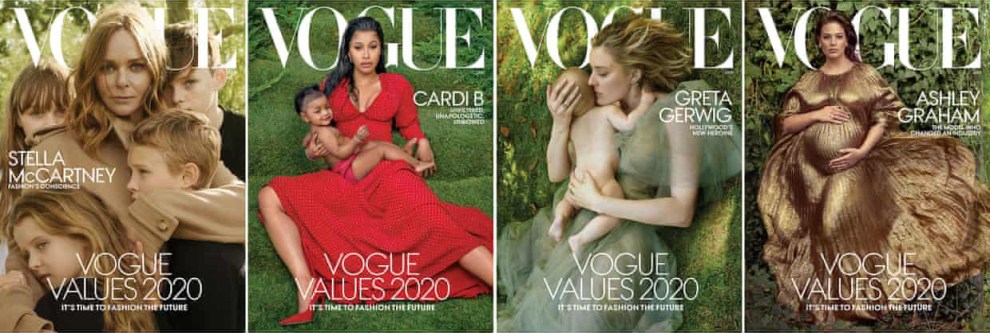
Those extravagant Christmas vacation plans are even more ironic with the arrival of the first issue of Vogue in 2020 which brings the declaration of “Vogue values.” The magazine declares, “in 2020, Vogue promises to live more sustainably every day, in every way.” The print magazine includes a letter from “all of the editors in chief of Vogue” declaring: “Vogue stands committed to practices that celebrate cultures and preserve the planet for future generations. We speak with a unified voice, across 26 editions standing for the values of diversity, responsibly, and respect for individuals, communities, and for our natural environment.” Again, in a matter of hours, these editors racked up more carbon emissions than the average American does in three weeks — and that’s just from the flights, not from anything else they did on their extravagant getaways. Just how loose are the standards for “living sustainably” at Vogue?
OK, fine. Vogue editors probably deserve all this just on general principles. If you can’t mock Vogue, who can you mock?¹
Still, this should stop. Personal contributions to fighting climate change are pretty near zero, and it’s not controversial to say that we should stop trying to guilt our way to saving the planet. Practically every serious environmentalist is on board with this. On a personal level, you should go ahead and do whatever you want. If that means making a difference by getting rid of your dryer and hanging your clothes on a line in the backyard, then do that. If it means flying to Bermuda, then fly to Bermuda. They’re both perfectly good choices—the first since every little bit helps, and the second since, nonetheless, the only way we’ll make a real dent in global warming is via massive collective action—that is, action at the national and international level.
Of course, this is National Review. The only time they mention climate change is when there’s a chance to mock people who take it seriously. Likewise, the only time they mention the plight of the poor is when there’s a chance to write about a program that doesn’t work or a beneficiary who cheated. The only time they mention African Americans is when there’s a chance to defend the police or mock some aspect of modern wokeness.²
If you ask them, they’ll say they take climate change seriously. They aren’t a bunch of idiot Trumpies who think it’s all a Chinese hoax. They’ll also say they truly want to help the poor. And they agree that racism is still a problem in America. That’s what they’ll say. But when it comes time to write about it, somehow it’s always on the other side. That’s not a coincidence.
All of us in the writing biz demonstrate our priorities by what we choose to write about. I think National Review shows its priorities by declining to write about the dangers of climate change; the genuine problems faced by the poor and homeless; and the racism that still afflicts America, especially in their own circle of movement conservatism.
That’s what I’d like to see them write more about—from a conservative perspective, of course. But what do they think we progressive writers ignore that we shouldn’t? Perhaps they think I should write more about ways to improve the military. Or ways to keep our borders secure. Or ways to keep universities open to conservative voices. Or something else. That is, I shouldn’t write about these things only when I have a chance to mock conservative hypocrisy or cite a study showing that conservatives are wrong.
And maybe so. But what should those subjects be? The three I chose for NR are off the top of my head, but they’re good enough. I’ll stick with them. What do they have for me?
¹This is going to get me in trouble. I should be getting a call from my sister shortly.
²This footnote is the obligatory “not all the time” acknowledgment. This isn’t 100 percent of their writing on these subjects. But I’d peg it at 90 percent or so.
As you may recall, economists who have studied Donald Trump’s tariffs have concluded that American consumers and firms are basically paying all of them. It’s just a big ol’ sales tax hidden slightly under the surface of products from China and elsewhere.
But that should change over time as importers adjust their supply chains and switch to other sources. By now, we should be seeing the effect of that and the prices borne by US consumers should be decreasing. A team of economists ran the numbers again to see where we are, and they concluded that—well, here’s the chart:
There’s been no change at all. American firms and consumers are still paying nearly 100 percent of the cost of the tariffs. The only exception, it turns out, is steel, where foreign manufacturers have lowered their prices in the face of increased competition.
So that’s that. Previous estimates that American households are paying nearly $1,000 per year in hidden tariff costs are still in effect. Have a nice new year.
I was doing a bit of research today for an article I have in the works and I happened to run across a great example of lying with statistics. That doesn’t happen to be part of the remit of the article, but I hated to let it go to waste. So here it is.
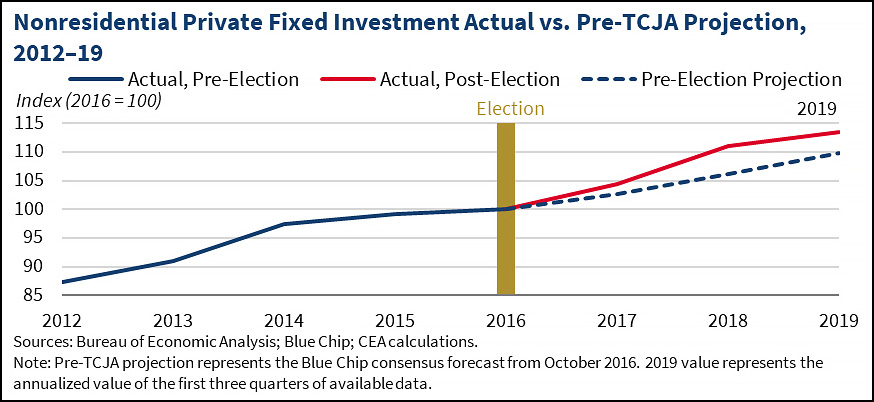
A couple of weeks ago the White House released a brief statement describing how great their 2017 tax cut has been for the economy. One of the predictions they made back at the time was that the tax cut would spur higher levels of business investment, which would then have knock-on effects on growth, productivity, and wages. According to the White House, this has been hugely successful:
Investment levels have been notably higher in the post-TCJA period than Blue Chip’s pre-TCJA projections from October 2016. In 2018, investment was 4.5 percent higher than the projections. In 2019, investment was 3.3 percent higher than the projections and the capital stock is on track to expand across each major asset class (equipment, structures, and intellectual property products).
And here’s the chart to prove it:
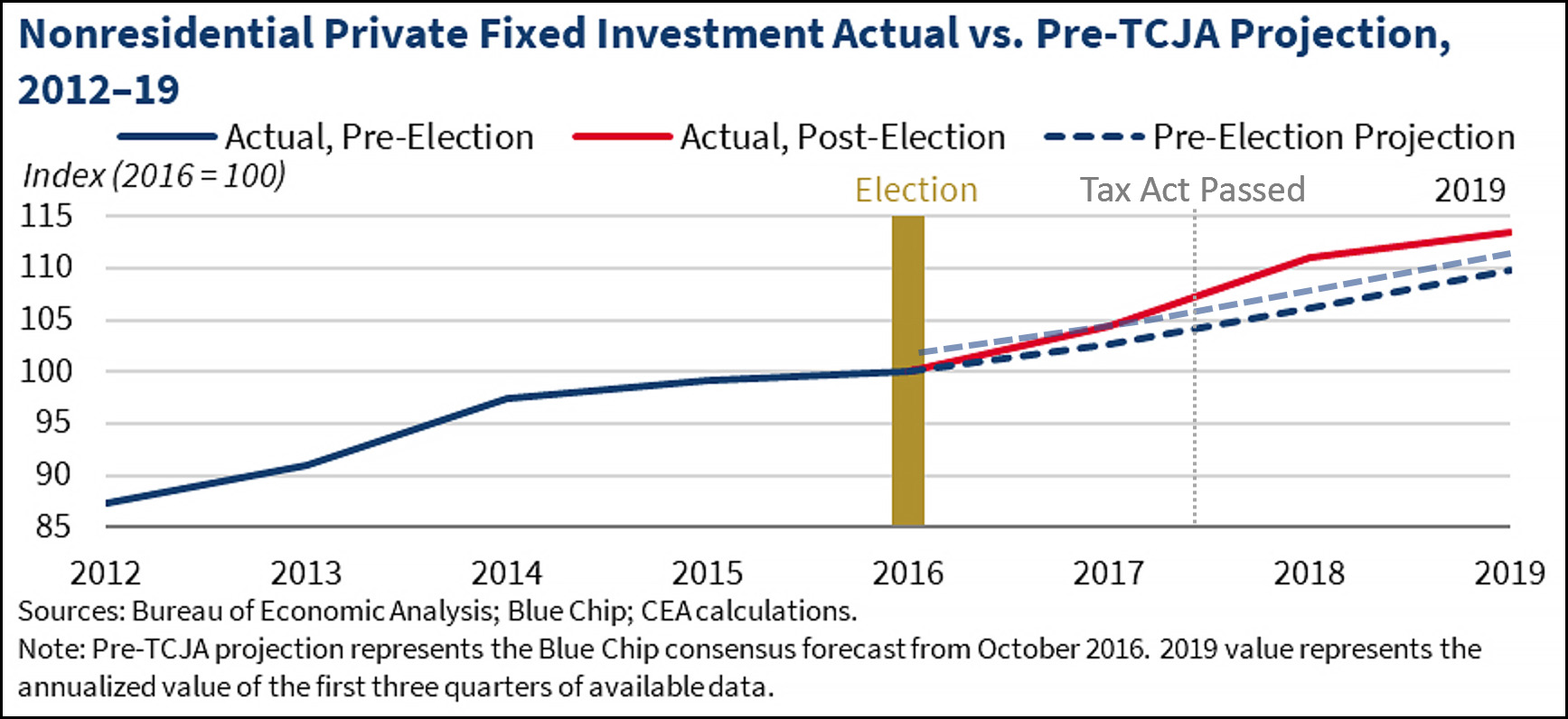
Huh. The starting point for the comparison between projected and actual is 2016. But who cares about growth between 2016 and 2017? That’s before the tax cut passed. What we should do is begin the comparison with the end of 2017. I have used my mad charting skills to do just that:
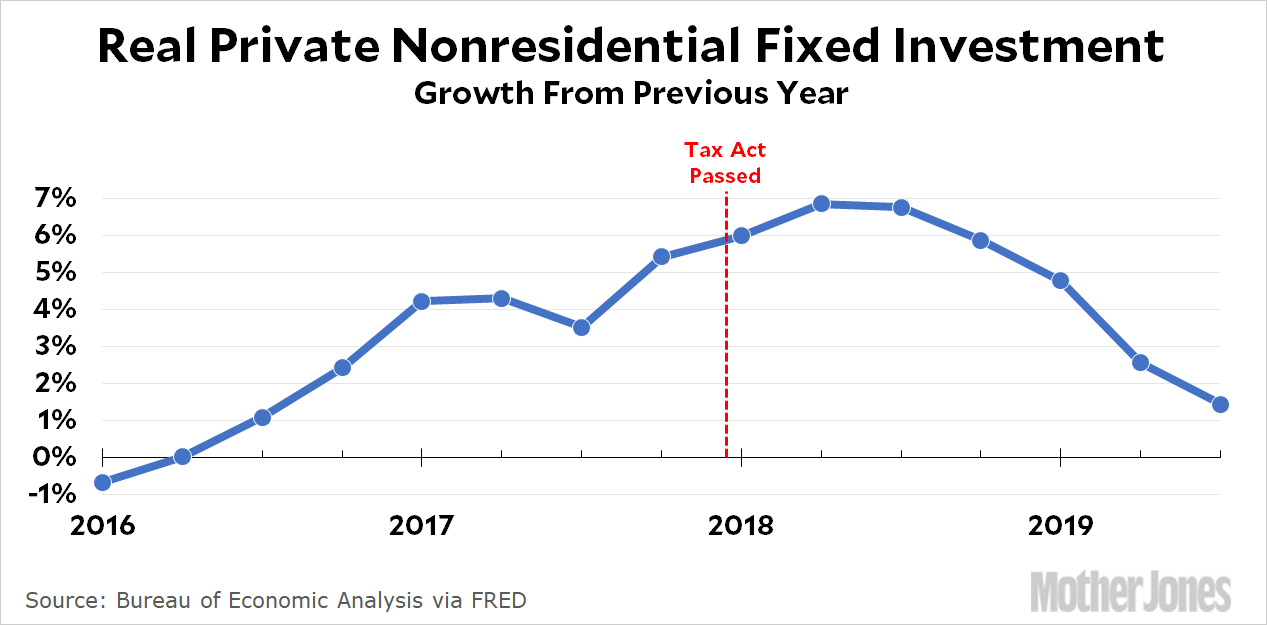
I moved up the blue dashed line so that it crosses the red line at 2017 and this cuts the effect in half right off the bat. But even this is merely a comparison of actual growth with an old consensus projection that may or may not mean anything. What’s more, it’s charted annually. There’s no need for either of those since we can calculate growth rates directly and BEA provides us with quarterly figures. Let’s look at that:
That . . . doesn’t look so great. The growth rate of business investment had been steadily rising for two years, but within six months of the tax cut it started to decline. In the most recent quarter it was barely more than 1 percent above the previous year.
The folks in the White House worked hard to dream up a chart that would make the tax cut look good, and they get three cheers for effort. Some bright young spark burning the midnight oil probably came up with the idea of using a comparison with an old forecast, and the old pros must have beamed with pride when they saw it. But even on its own terms their chart is a fake, and if you instead take a simple look at the growth rate of business investment then it’s obvious that the tax cut had no effect at all—except possibly for a negative one. Even the decline is a little hard to conclusively blame on the tax cut, however, since Trump’s trade war probably had something to do with it too.
Either way, however, business investment obviously didn’t skyrocket following the tax cut.
Which way are they going?Capt. Robyn Haake/Planetpix/Planet Pix via ZUMA
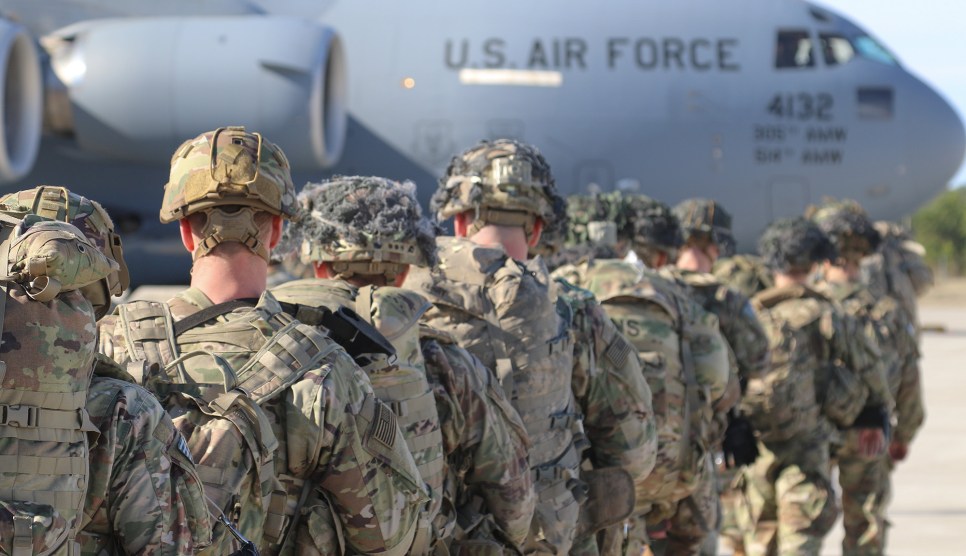
The Washington Post got hold of a draft letter this afternoon addressed to the Iraqi Ministry of Defense. It says that the US will be “repositioning forces over the course of the coming days and weeks to prepare for onward movement,” and ends by affirming that “We respect your sovereign decision to order our departure.”
Defense Secretary Mark T. Esper said during a briefing at the Pentagon that the United States has not made any decision to leave Iraq….Gen. Mark Milley, chairman of the Joint Chiefs of Staff, said the letter was a draft that the U.S. military sent to Iraqi military officials for coordination purposes but hasn’t been signed or finalized.
“That letter — it was a draft, it was a mistake, it was unsigned, it should not have been released,” Milley said. “And the first part of it, which says ‘repositioning forces over the course of the coming days to prepare for onward movement’ … [was] poorly worded, implies withdrawal. That is not what’s happening.”
My guess is that the letter was meant as a way to call Iraq’s bluff. You want us to leave? Fine, we’ll leave. Then we all watch as the Iraqis panic and start begging us to stay. It’s all very Trumpish.
On the other hand, it doesn’t serve that purpose very well if we immediately turn around and say that it was all just a mistake and we’re not going anywhere.
On the third hand, maybe it was meant to call Iraq’s bluff, but then we panicked when the letter was leaked.
And we respect that! But maybe you’re of a mind to support our work directly instead? We have until December 31 to raise the last $400,000 we need to keep our nonprofit newsroom running at full strength into 2026. Will you make a gift today?
We noticed you have an ad blocker on. Can you pitch in a few bucks to help fund Mother Jones' investigative journalism?
Billionaires own the media,
but they don’t own us.
At Mother Jones we know these aren’t conventional times, and they require unconventional coverage. That’s what deliver every day: fierce, independent journalism you can’t find elsewhere. Perhaps never in the history of our country has that been more necessary than now. But we can’t do it without reader support—your support. Please chip in today.
Billionaires own the media,
but they don’t own us.
At Mother Jones we know these aren’t conventional times, and they require unconventional coverage. That’s what deliver every day: fierce, independent journalism you can’t find elsewhere. Perhaps never in the history of our country has that been more necessary than now. But we can’t do it without reader support—your support. Please chip in today.