Still sick. I got better and then I got worse.

Kevin Drum
A blog of my opinions. Plus charts and cats.
-
Nobody is quite saying this outright, but I gather that the smart money now thinks that the whole whistleblower complaint centers on Ukraine. Namely that President Trump promised the new president of Ukraine $250 million in armaments if he’d reopen a criminal investigation involving Joe Biden and his son.
That certainly sounds very Trumplike, doesn’t it? He just doesn’t know when to quit.
-
This is the church at the top of Monserrate. I took the picture from the Bogotá-Choachi road, which reaches about the same elevation as Monserrate and is the only place where you can take a photo of the church at about eye level. At night they light up the church with rotating colors of red, green, and blue.

August 6, 2019 — Bogotá, Colombia
-
I am sick today, so no blogging. I should be back tomorrow.
-
Rich Lowry says the recent campaign against vaping is ridiculous. After all, vaping is a lot better for you than smoking cigarettes:
About 11 million adults vape, and some percentage of them are former smokers or would be smoking in the absence of e-cigarettes. A robust study in the United Kingdom found that vaping is twice as effective as other common nicotine replacements in getting smokers to quit. The flavors, according to surveys of users, are a big draw for smokers quitting traditional cigarettes.
Anything that pushes e-cigarette users back into conventional smoking (now at a new low of 14 percent of adults) is bad for public health. It’s manifestly absurd to ban vaping products and leave cigarettes, including flavored cigarettes, on the market.
There’s no question that vaping is less harmful than cigarette smoking. No one debates that. It’s also true that vaping can help smokers quit cigarettes. No one debates that either.
As usual, though, the question is: how much? No one can tell you for sure, but here’s a chart that provides a hint:
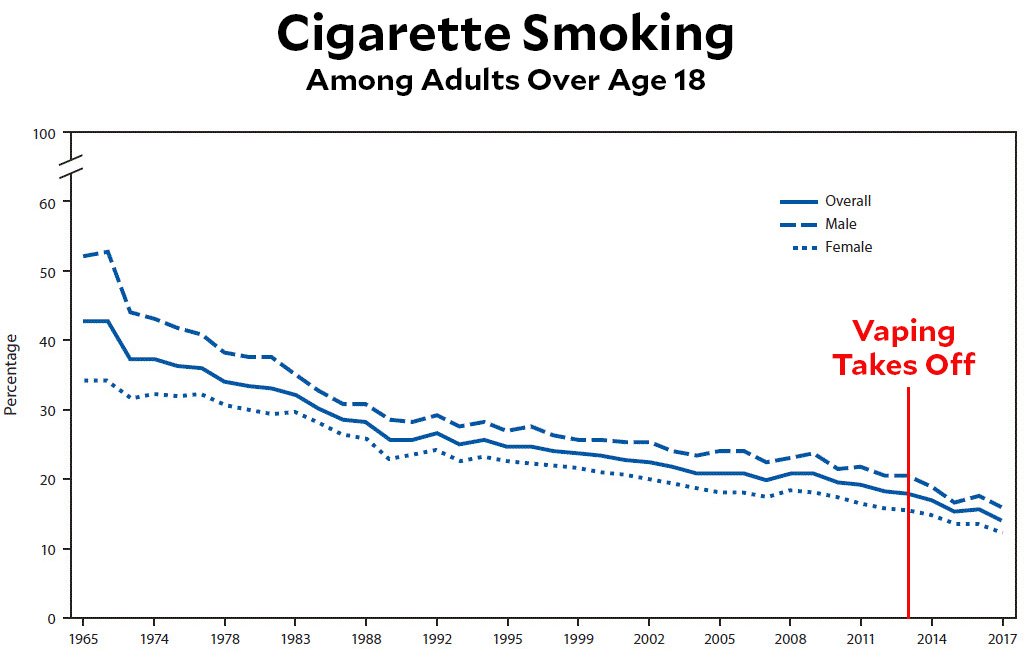
Cigarette smoking has been steadily declining in the US since the ’60s. Vaping products started to take off in the US in 2013 and have increased their popularity every year since then. So if vaping were really making a serious dent in cigarette smoking, you’d expect to see the trendline for smoking bend downward starting a few years ago.
But you don’t. That doesn’t mean vaping has had no effect on adult cigarette smoking, but it does mean that the effect has probably been tiny at best. Now compare that to the rise in teen vaping:
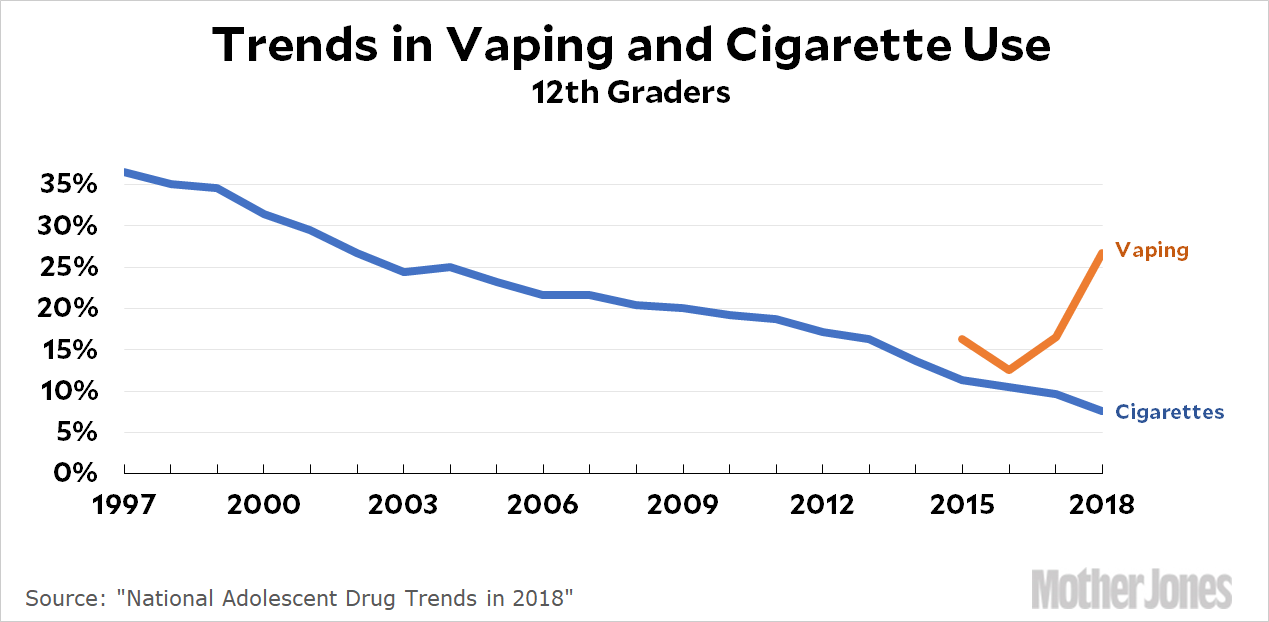
For many years the big question about vaping was its net health impact. On the one hand, it helps smokers quit cigarettes. On the other hand, it gets teens hooked on nicotine. The net impact depends on which effect is bigger.
There’s no serious question about that anymore: vaping overwhelmingly acts as a way of getting teens addicted to nicotine and has only a tiny impact on cigarette smoking. This doesn’t automatically mean that vaping should be outlawed, but it’s the factual background for making a decision about what to do. If it were up to me, I’d make vaping capsules available via prescription only. That’s unquestionably a smallish inconvenience for some, but worth it if it stops the huge rise in teens developing lifelong nicotine addictions for the benefit of corporate profits.
-
The whistleblower complaint that has triggered a tense showdown between the U.S. intelligence community and Congress involves President Trump’s communications with a foreign leader, according to two former U.S. officials familiar with the matter.
Trump’s interaction with the foreign leader included a “promise” that was regarded as so troubling that it prompted an official in the U.S. intelligence community to file a formal whistleblower complaint with the inspector general for the intelligence community, said the officials, speaking on the condition of anonymity because they were not authorized to discuss the matter publicly.
I can’t tell you how much I would like to never write or hear the name Trump ever again. I mean, an intelligence official filing a whistleblower complaint against the president? That’s insane. And yet, here we are.
-
This is a lovely violet tree dahlia on the road from Bogotá to Choachi. Normally I’d point out the bee crawling around in the center, but then I’d be corrected yet again and told that it’s actually a hoverfly. So let’s hear it for the hoverfly! You guys better not come back and tell me that this time it really is a bee.
UPDATE: It’s a honeybee. Sigh.

August 6, 2019 — Choachi, Colombia
-
What in the name of all that’s holy is this?
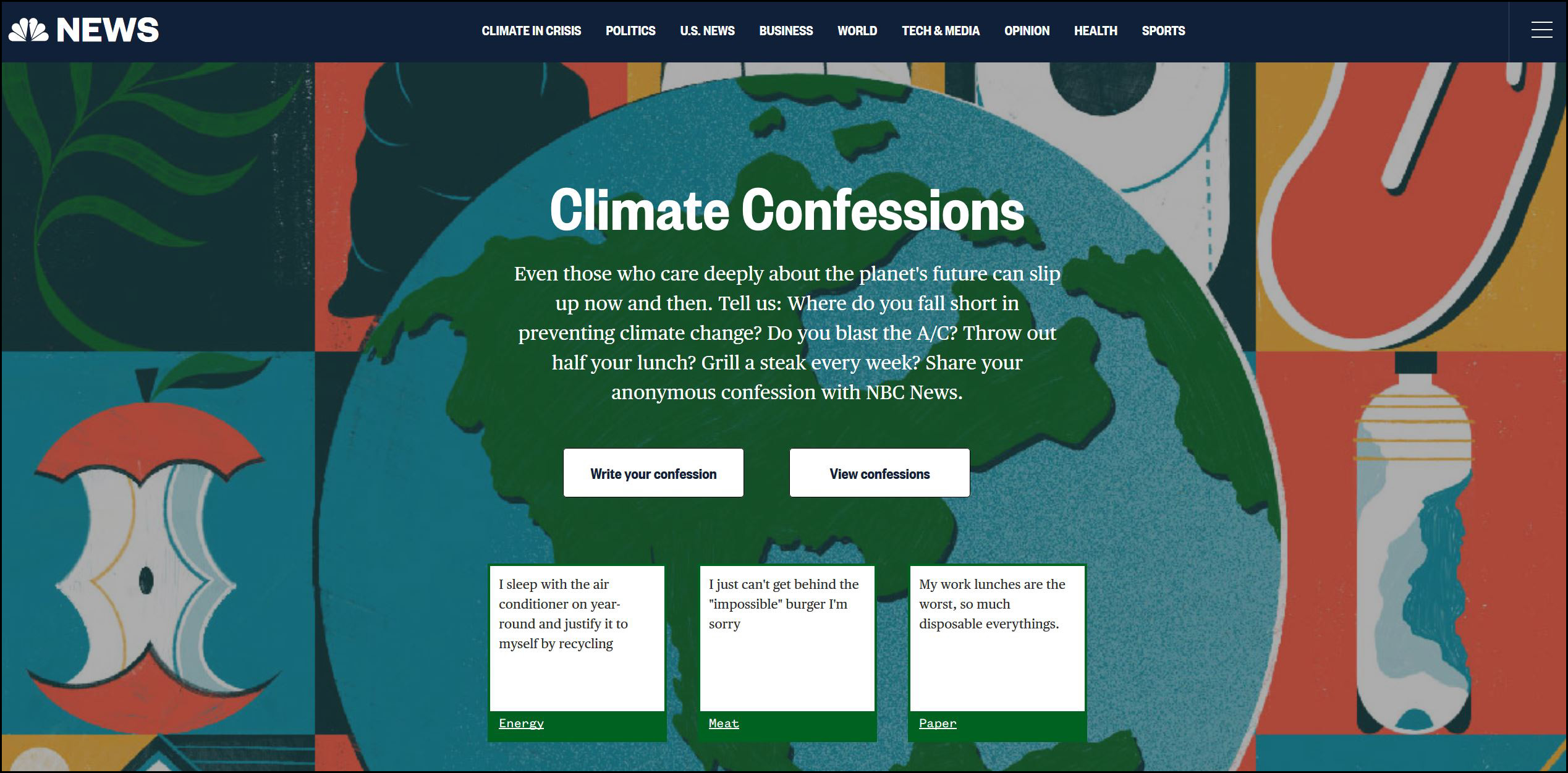
Seriously? Confess your climate sins? Are reeducation camps next?
Congratulations, NBC. This is probably the most efficient possible way to ensure that nothing gets done about climate change. In one stroke it:
- Perpetuates the myth that voluntary individual action makes much of a difference.
- Makes people feel guilty about ordinary, everyday activities.
- And then turns the whole thing into a game where we absolve ourselves with a public confession.
Climate change isn’t a game, and trying to make people feel bad about living their lives isn’t going to increase support for the kinds of things that really make a difference. It just gives people a reason to put climate change out of their minds in order to avoid having to feel guilty about it. Knock it off.
-
A loyal reader asks:
Abortion and lead: When are we getting that post?
Well…OK. Since you asked. But it might not be what you expect. The Guttmacher Institute reported this week that the abortion rate in the US has declined yet again and is now at its lowest level in decades. Here’s the chart:
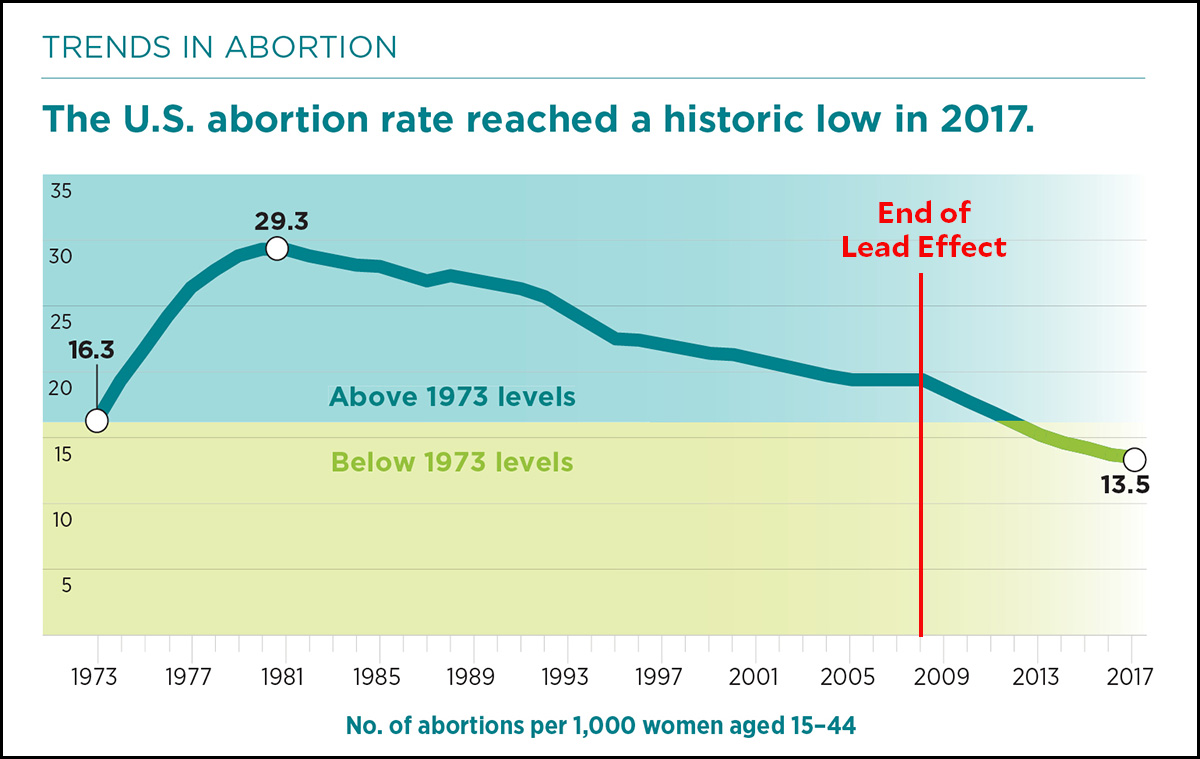
There is good reason to believe that some of this long-term decline is, in fact, due to the elimination of gasoline lead. However, the average age for an abortion is around 23 or so, and the primary effect of lead is on teen pregnancy. What this means is that if lead deserves some of the credit for declining abortion rates (by reducing the number of unwanted pregnancies), that effect would most likely last for about 20 years after lead had been effectively eliminated. That gets us to the late aughts.
But abortion rates have continued to drop since then, and it’s unlikely that lead has continued to have any significant effect over the past decade. This doesn’t say anything one way or the other about the impact of lead on abortion in the 90s and aughts, but it does suggest that something else has been at work since then.
The usual answer among liberals is that it’s due to better awareness of contraceptive choices. The usual answer among conservatives is that it’s due to restrictive new abortion laws. For various reasons I’m skeptical of both answers, but I don’t have a better one of my own.
-
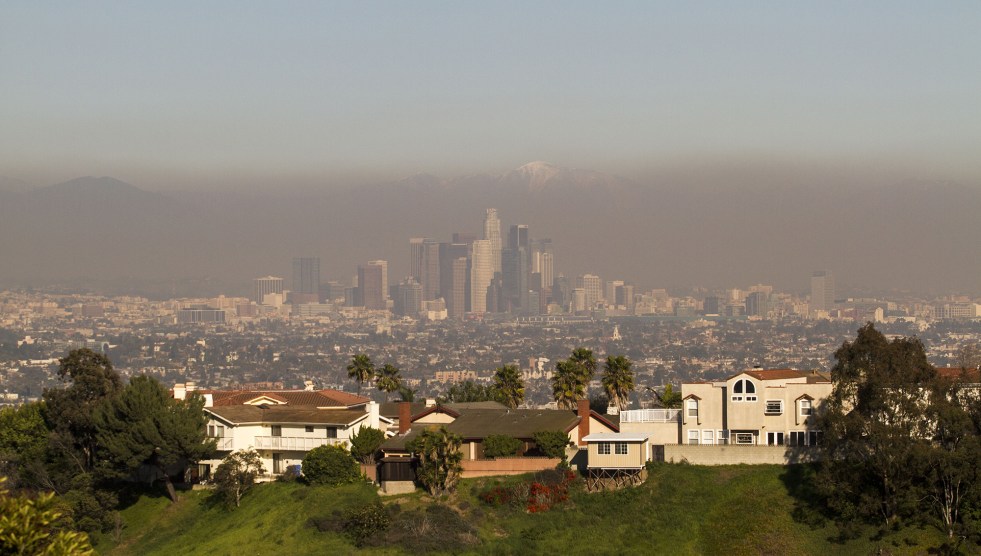
It's nowhere near as bad as it used to be, but yes, LA is still a pretty smoggy place.Ringo Chiu/ZUMA
Donald Trump, as part of his war against little ol’ California, says he is revoking the state’s waiver to set its own pollution rules under the Clean Air Act. Can he get away with it?
My very tentative guess is yes. This is hardly the first time it’s happened, after all. George Bush refused to approve California’s most recent waiver request in 2007, and only the election of Barack Obama saved it. The same thing might happen this time if Trump loses next year and President Harris instructs the EPA to stand down.
But what if Trump wins? The key phrase in the statutory text is that California must demonstrate that it needs a waiver “to meet compelling and extraordinary conditions,” and back in the day that was pretty easy. LA smog was legendary, after all, and California’s auto standards were aimed specifically at smog-causing pollutants.
Today things are different. California smog is still the worst in the nation, but not wildly so. What’s more, California’s latest auto mileage regulations are aimed more at CO2 than at smog, and it’s hard to make the case that California is uniquely vulnerable to global warming.
That’s not to say that the case can’t be made. But the relevant question isn’t whether the case can be made. The relevant question is whether the Supreme Court’s five Republican justices are likely to accept the arguments of America’s most Democratic state. Call me cynical, but I doubt it. If Trump is reelected, my guess is that California’s waiver is history.



