• Trump’s Budget Cuts Spending on Vets, Farmers, Students, Seniors and the Poor

    As long as we’re on the subject of the president’s budget, here’s the nickel summary in chart format:
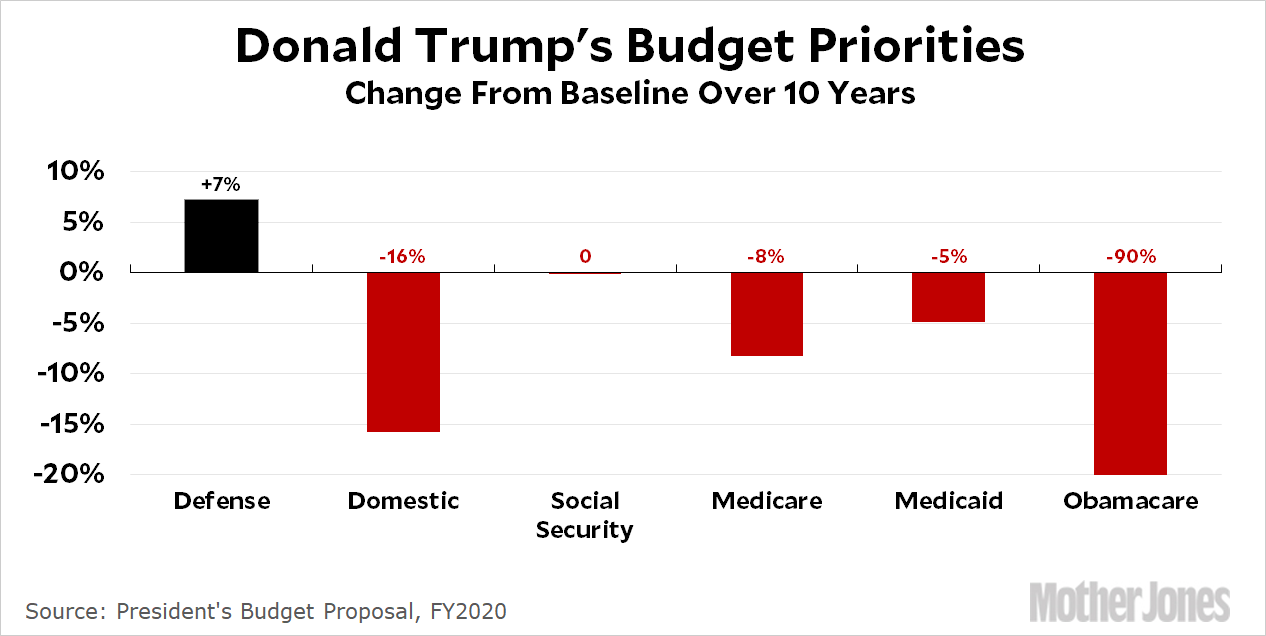
    There are more details in the full budget document. For example, Trump proposes to reduce crop subsidies by $22 billion. You betcha. Student loan “reform” will save $200 billion and “streamlining” conservation programs will save $9 billion. Tort reform will save $31 billion. Sure it will. “Enhancing” the VA pension program will save $3 billion. Eliminating manufacturers’ discounts will cut Medicare prescription payments by $75 billion and reducing payments to providers will save another $400 billion. Eliminating cost-of-living increases and raising contribution levels will save $135 billion in federal pension costs. “Reforming” SNAP will save $220 billion. “Testing new approaches” to disability will save $48 billion. The post office gets cut by $98 billion. Making it harder to apply for EITC and the child tax credit will save $68 billion.

    You get the idea. Give big tax breaks to the rich and then cut spending on vets, farmers, students, seniors, and the poor. What’s not to like?

  • Trump Wants to Cut Medicare By 10%

    Al Drago/CNP via ZUMA

    In real-world terms, the president’s budget doesn’t matter. It will be completely ignored by Congress and won’t even provide a baseline for discussions. Still, it does provide a look at the president’s priorities:

    The budget also calls on increased military spending [and] for the first time calls for cutting $845 billion from Medicare, the popular health care program for the elderly that in the past he had largely said he would protect.

    That isn’t peanuts: it’s about 10 percent of total Medicare spending. (As usual with budgets, this is a ten-year number, not a cut for a single year.) In fact, this is so far from being peanuts that it’s nearly insane. Did Mick Mulvaney put this in without Trump knowing about it? Or is Trump testing the theory that he could shoot someone in the middle of Fifth Avenue and his fans wouldn’t care?

    Anyway, this provides a great opportunity for creative attack ads from Democrats. We’ve already used images of pushing granny off a cliff, so we’ll have to come up with something different. Concrete shoes for granny?

  • Are Democrats Moving Dangerously to the Left?

    In the New York Times today, Jonathan Martin and Sydney Ember write:

    Bernie Sanders-Style Politics Are Defining 2020 Race, Unnerving Moderates

    Two months into the presidential campaign, the leading Democratic contenders have largely broken with consensus-driven politics and embraced leftist ideas on health care, taxes, the environment and Middle East policy that would fundamentally alter the economy, elements of foreign policy and ultimately remake American life.

    Dan Pfeiffer isn’t happy:

    I get Pfeiffer’s point, but it’s incomplete. If a topic polls at, say, 55 percent support, that doesn’t automatically make it bipartisan or mainstream. Maybe it means that 100 percent of Democrats support it and only 20 percent of Republicans. I think that would probably qualify it as a “leftist” idea.

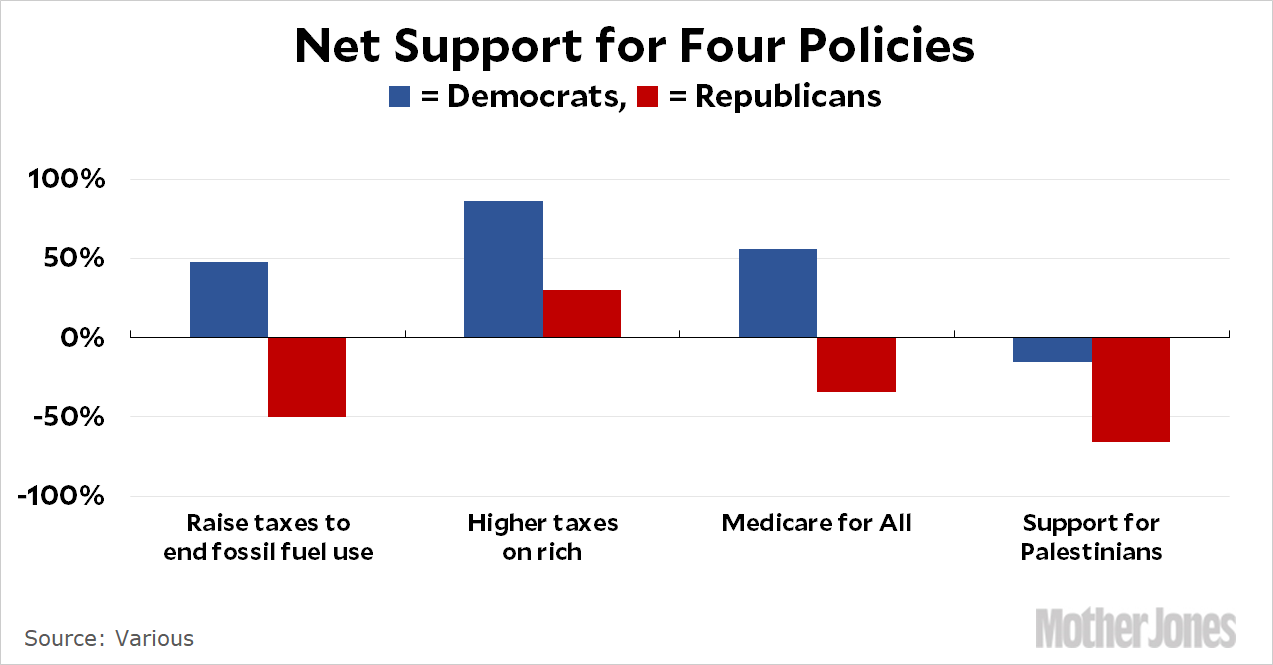
    So how do the four topics mentioned in the Times article poll? This is just a rough guesstimate based on recent polls I could find that broke out partisan affiliation, but it looks something like this:¹

    All of these are expressed as net support (i.e., percent support minus percent opposed). Higher taxes on the rich polls as genuinely bipartisan and mainstream. Support for Palestinians vs. Israel is polarized, but remains net negative among both parties. Medicare for All is clearly a leftist policy, as is raising taxes to end fossil fuel use.

    Of these four, then, the only one that you could call truly mainstream is raising taxes on the rich. The other three are legitimately leftist. None of this is to say that Democratic presidential candidates should or shouldn’t support them, just that it’s wise to remain clear-eyed about exactly what they mean.

    ¹Here are the polls I used. Medicare for All: Morning Consult. Fossil fuel use: YouGov. Higher taxes on wealthy: Politico/Morning Consult. Support for Israel: Gallup.

  • Young Families Are Buying Homes Again

    In the Washington Post, Andrew Van Dam notes that renters suddenly started becoming home buyers again in 2016. He says the primary change came among young families:

    It is now apparent demographic pressure had been building since the housing crisis. Millennials were hitting the age at which previous generations began buying homes, but had put off home-buying due to slow earnings growth, a tepid labor market and soaring student loan debt….In 2016, Millennials finally began to surmount the obstacles that sat between them and homeownership.

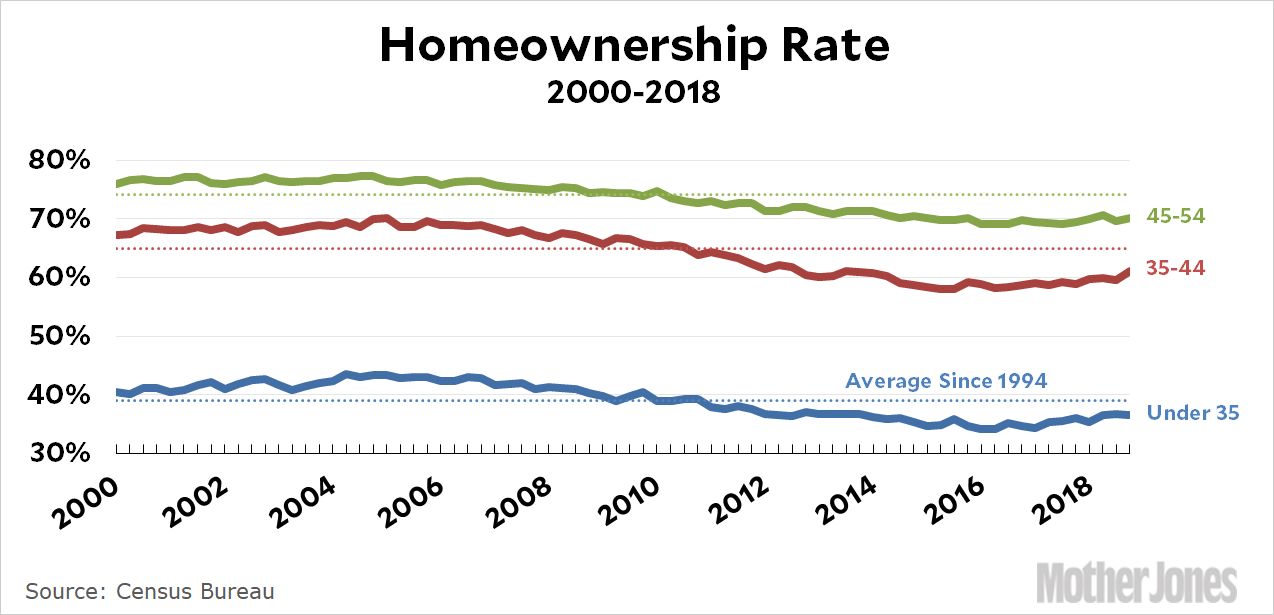
    Naturally that made me curious. So here’s the homeownership rate since 2000 for three different age cohorts:

    Millennials have indeed started buying houses again. Since the trough in their homeownership rate in mid-2016, homeownership has risen by 7 percent. Younger Gen Xers have increased their homeownership rate by about 5 percent, while older Gen Xers have gone up by only 1 percent.

    Homeownership rates are still below their average of the past 25 years but are clearly making a comeback. Anecdotally, new homes and condos seem to be everywhere I look here in suburban Orange County. The only question is whether the economic good times can last long enough for young workers to make up what they lost in the Great Recession.

  • Here’s Why Liz Cheney Voted Against the Anti-Semitism Resolution

    Alex Edelman/CNP via ZUMA

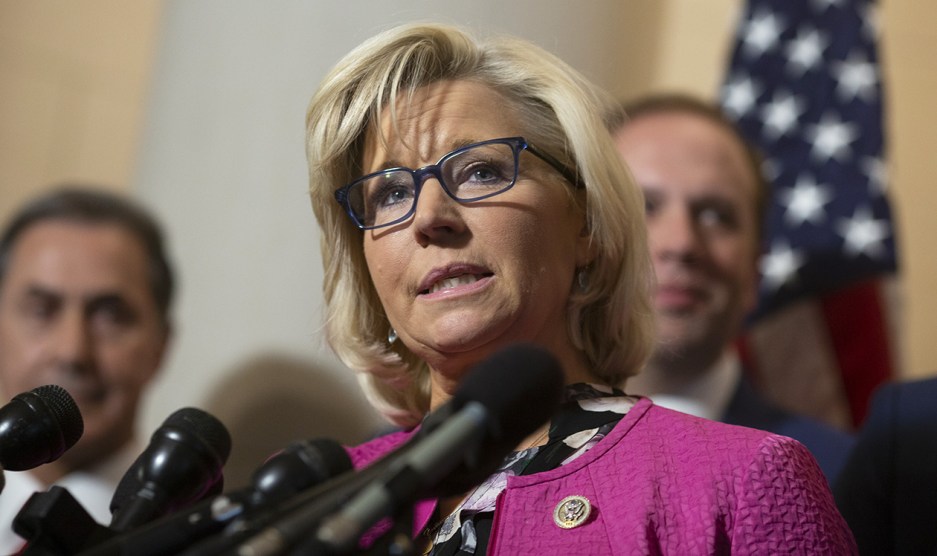
    On Thursday the House finally took up its resolution oppposing anti-semitism, and it passed unanimously among Democrats. However, 23 Republicans voted against it. Here is Rep. Liz Cheney explaining her vote:

    Today’s resolution vote was a sham put forward by Democrats to avoid condemning one of their own and denouncing vile anti-Semitism…. Rep. Omar’s comments were wrong and she has proven multiple times that she embodies a vile, hate-filled, anti-Semitic, anti-Israel bigotry. She deserves to be rebuked, by name, and removed from the House Foreign Affairs Committee so that there is no mistake about the values and priorities that the House stands for.

    You see, the original draft of the resolution was aimed solely at anti-semitism, and although Rep. Ilhan Omar was not identified by name, it was very plainly all about her. The final draft, however, also included language about Islamaphobia and white supremacism. Over at National Review, John McCormack comments:

    You might still disagree with how Zeldin and Cheney voted, but after reading and listening to their explanations it’s hard to see how anyone could think their opposition to the resolution — not the defenses of Omar made by  Nancy Pelosi, Jim Clyburn, and  2020 Democrats; nor Omar’s anti-Semitism itself — is the real scandal here.

    Quite so. Cheney made it clear that unless the resolution was specifically aimed at a Democrat, it wasn’t worth voting for. It’s hard to see why anyone wouldn’t see this as the principled stand that it is.

  • Luxury Canned Goods: A Response

    Atrios today:

    Luxury Canned Goods

    A weird thing about the US is that we don’t really have those. Yes, sure, you can go to a specialty shop and buy anything, including $50 imported marmalade or whatever, but mostly the idea that there’s a better caliber of canned goods is not a part of our food culture. In other countries, $20 cans of cockles, or similar, are a normal thing, as is opening up the tin and serving it to your impressed guests.

    I wouldn’t normally have anything to say about this except that it reminds me of an odd area where Americans do indeed believe in luxury canned goods: cat food. I mean, check this out:

    Hell, this looks more mouth watering than what I normally eat. And while I get that there’s a touch—just barely—of humor intended in these ads, cat food in general is advertised these days as if your cats routinely dine at Buckingham Palace.

    And what’s with the veggies? Very popular these days, but aren’t cats obligate carnivores? Is this solely to appeal to humans who think veggies = healthy, or is there some actual reason that leavening cat food with a few carrots is good for them?

    POSTSCRIPT: As for my personal opinion, in 60 years of cat-owning it’s clear to me that they couldn’t care less what their food looks like. I can buy any food in the market, and as soon as they hear the rustle of kibble or the whir of a can opener they gallop over as if they haven’t been fed since the Middle Ages. So don’t worry about it.

  • Chart of the Day: Net New Jobs In February

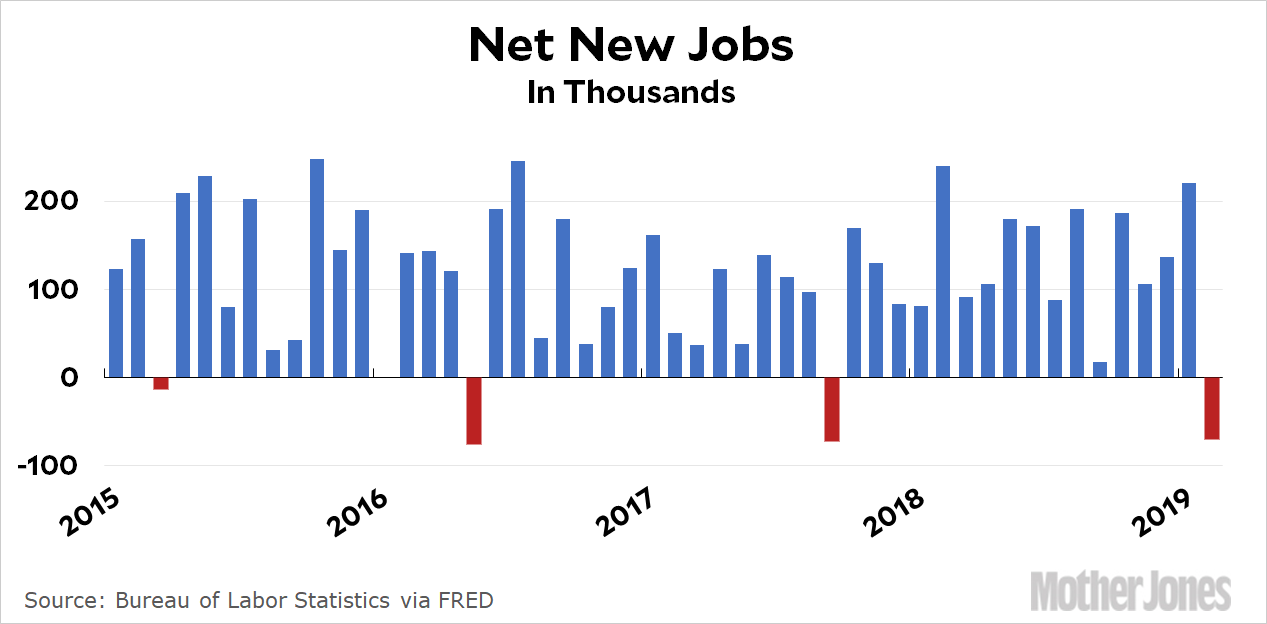
    The American economy gained 20,000 jobs last month. We need 90,000 new jobs just to keep up with population growth, which means that net job growth clocked in at -70,000 jobs. The unemployment rate declined to 3.8 percent.

    As bad as this looks, the underlying numbers are a little more comforting. The number of employed people went up by 255,000 and the number of unemployed went down by 300,000. On the other hand, nearly 200,000 people dropped out of the labor force, which is a pretty high number. The labor participation rate stayed steady.

    Wages were a mixed story. The hourly earnings of production and nonsupervisory workers went up at an annualized rate of 4.3 percent, which comes to about 2.8 percent when you account for inflation. However, weekly earnings went down by 3.1 percent, which comes -4.6 percent when you account for inflation.

    I don’t really know how to react to all this. The raw jobs picture is obviously terrible, but everything else—the rise in employment, the participation rate, wages for blue-collar workers—looks pretty good. I’m tentatively going to say that I think the jobs number is a blip and we’ll return to decent job growth next month. But my confidence in saying this is fairly low.

  • Lunchtime Photo

    Let’s close out the week with a hummingbird. Everyone loves hummingbirds.

    This picture looks like it was taken in a studio, but that’s actually just a blank, gray sky in the background. The bird itself, I think, is a young male Rufous Allen’s hummingbird, but I’m sure I’ll be quickly corrected about that if I’m wrong. In any case, he was astonishingly cooperative, sitting on this branch for quite a long time as I took pictures. He finally turned his head in just the right direction to get this striking view of his gorget.

    March 5, 2019 — Irvine, California