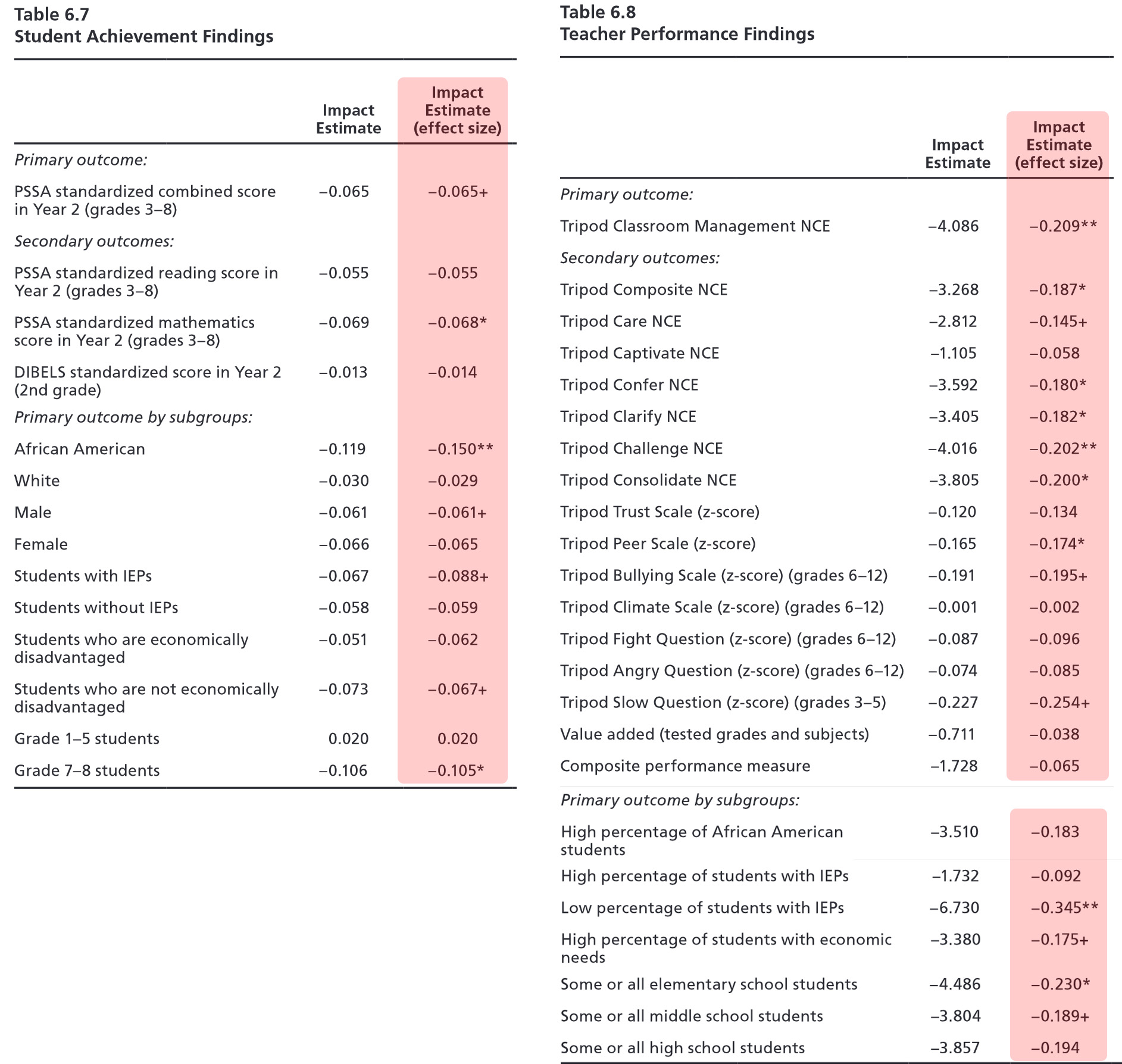
Here’s some unwelcome news. The usual caveat applies: it’s just one study in one place, so don’t take it too seriously. But in a large-scale test of “restorative practices” in the Pittsburgh Public School District, the results were disappointing. Half the district participated in a program to reduce disciplinary suspensions—especially the disproportionate use of suspensions among minority students—in an effort to improve both the atmosphere of the school and academic achievement. PPSD implemented a program from the International Institute for Restorative Practices called SaferSanerSchools Whole-School Change, and it did indeed reduce suspensions and improve school climates (as rated by teachers). However, there was also this:
Don’t worry too much about all the jargon in these tables. What’s important is that nearly all the numbers are negative. Student achievement (on the left) fell in all subjects and among all demographic groups. At the same time, student evaluations of teachers (on the right) declined on every single variable.
This was a large-scale test, so its results have to be taken seriously. At the same time, it ran for only two years, and that might not have been enough time for restorative practices to show any impact. The important thing, probably, is to take the results seriously enough to try to figure out how programs like this can be improved. We should give up on them only if we do that and they continue to fail.
We finally saw one of our monarch butterflies hatch! In the picture below, the butterfly is about five minutes old. As soon as it emerged from the chrysalis it began moving upward—toward the sunshine, I assume?—and had gotten only a few inches when I took this shot. It’s kind of amazing that something so big popped out of something so small.
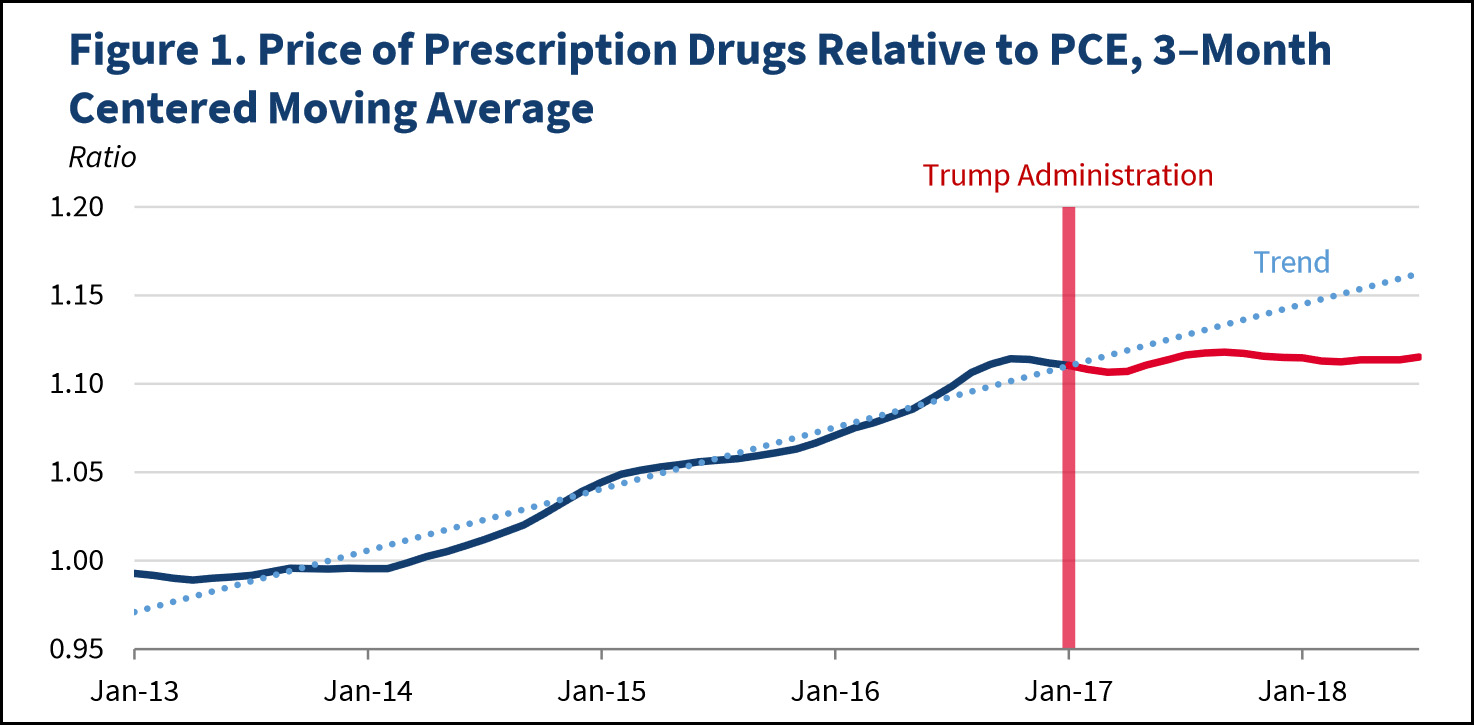
Already, as a result of my Administration’s efforts, in 2018 drug prices experienced their single largest decline in 46 years.
I’ve been puzzling over this ever since he said it. What does he mean? I assume he means prescription drugs, and most of the fact checkers think his statement is based on a report last October from the Council for Economic Advisers, which contained this chart:
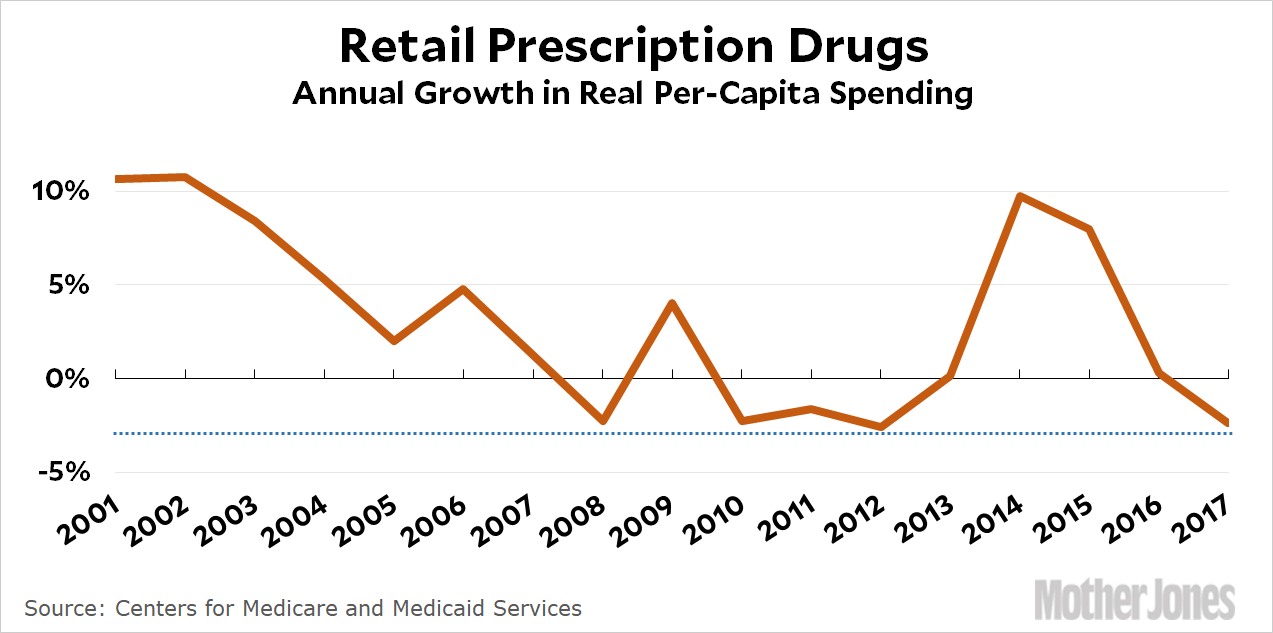
I don’t know if this is correct, but even if it is it only goes back five years. I tried doing a simple look at spending on prescription drugs, but even there I could only find annual data going back to 2000. I gave Trump every chance I could by adjusting for inflation and population growth, but even then I only got this:
Prescription drug spending fell 2.6 percent in 2012, and that’s the biggest drop in the past couple of decades. There’s no data yet for 2018, of course, so it’s not on the chart. It’s also unclear how Trump could have said anything about 2018 since he doesn’t have any data either.
I dunno. I guess he just made it up. But if anyone can clue me in about where he got the idea that drug prices declined more in 2018 than any year since 1972, I’d sure be interested to hear it.
House Speaker Nancy Pelosi (D-Calif.) said Wednesday that she would be willing to support any compromise border-security legislation that emerges from a bipartisan committee and that she has urged the White House to adopt the same “hands-off” posture….Pelosi said she relayed to Senate Appropriations Committee Chairman Richard C. Shelby (R-Ala.), one of the lead negotiators, that “whatever you all come to an agreement on, bipartisan agreement, I will support it.”
“I hope that the administration would have the same attitude and respect for the appropriations process,” Pelosi said. “And I know they can find agreement.”
She added that she had relayed her hope to Vice President Pence “that the White House will have the same hands-off policy as I have vis-a-vis the appropriators.” Shelby later said that Pelosi did not promise to put the committee’s possible work product on the House floor but “said she would like to see a legislative solution, the sooner the better.”
I’m not quite sure I get this. Pelosi says she’ll “support” anything that comes out of the committee but hasn’t promised to give it a vote on the House floor. What does this mean? What am I missing here?
In any case, if Pelosi is serious about supporting a bipartisan committee solution, does this mean she’s confident that the committee won’t agree to anything that gives Trump money for his wall? Or is she signaling that she’d be willing to accept a compromise wall expenditure in return for, say, a permanent DACA solution or something like that? This is all very vague, but then, most good legislative leaders are maddeningly vague so that they can keep as many options open as possible. We’ll find out in a few days.
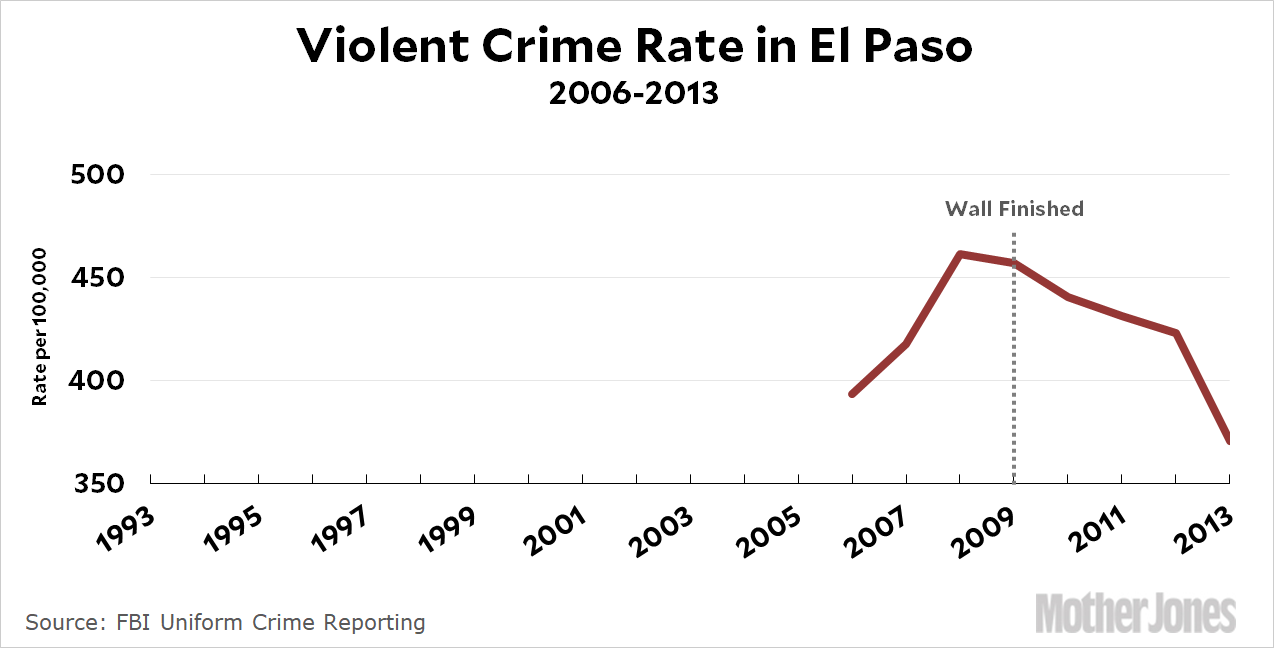
The border city of El Paso, Texas, used to have extremely high rates of violent crime — one of the highest in the country, and considered one of our Nation’s most dangerous cities. Now, with a powerful barrier in place, El Paso is one of our safest cities.
This is yet another great example of how to lie by cherry picking statistics. Here is the violent crime rate reported by the El Paso Police Department:
Trump was right! Crime was rising, and when they built the wall it suddenly began to plummet. Build that wall!
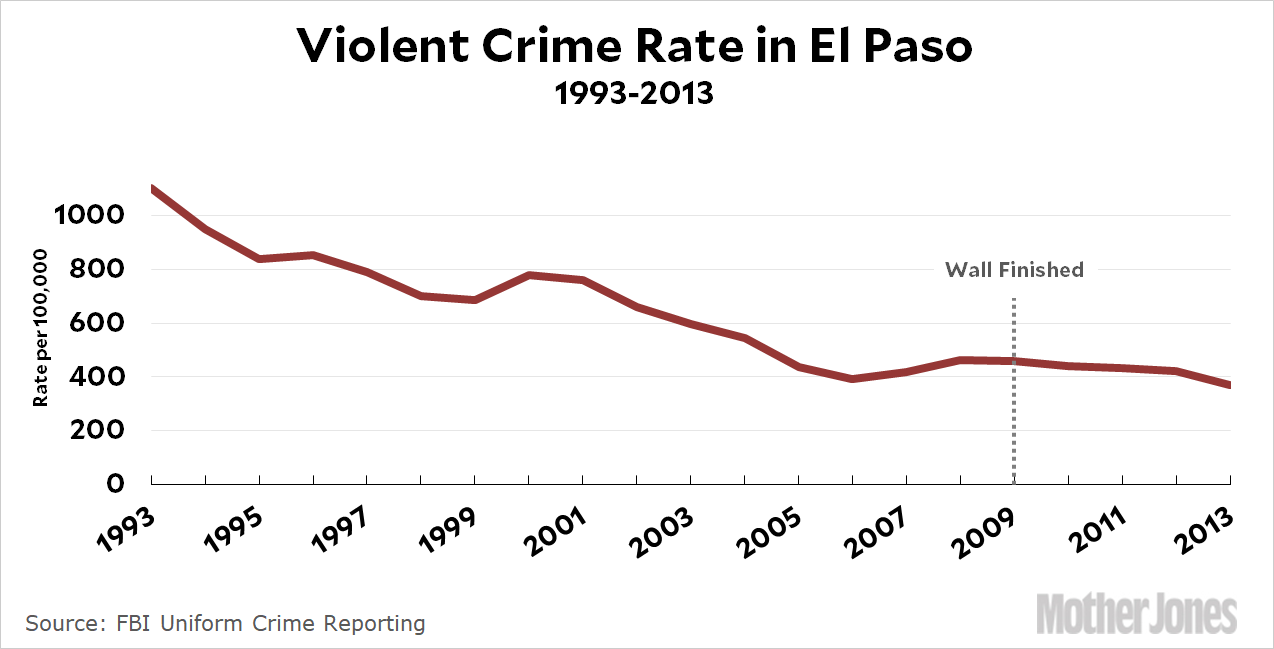
But wait. Let’s finish up the chart, shall we? Here is violent crime in El Paso since 1993:
With this broader view it’s easy to see that Trump was lying. As with all big cities, crime in El Paso dropped steadily for more than a decade from its peak in 1993. From 2006-08 it had a brief and minor rise—most likely just noise—and then stayed basically flat after that. Plainly the wall had next to no effect.
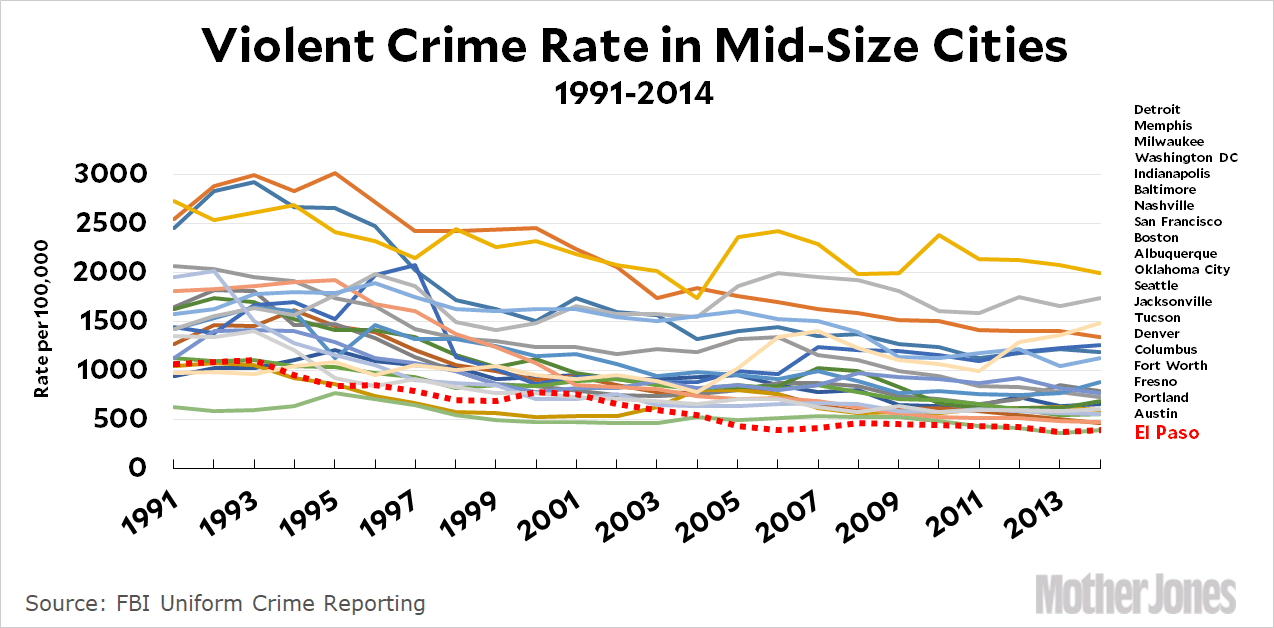
However, if you carefully pick your starting date at 2006 and then zoom in, you can make it look like the wall had a massive effect. That’s what Team Trump did. And to drive home what an outright lie this was, here’s a chart of the crime rate in every mid-size city in the United States tracked by the FBI:
El Paso has never had “one of the highest” crime rates in the country. In fact, it’s had the lowest crime rate in the country since 2005, and it’s been among the four lowest since 1991. There’s simply no excuse for pretending that El Paso was ever a high-crime city or that it took the construction of a wall to bring down its crime rate. It’s just flatly not true.
Hey, Donald Tusk, tell us what you really think of Brexit:
I’ve been wondering what that special place in hell looks like, for those who promoted #Brexit, without even a sketch of a plan how to carry it out safely.
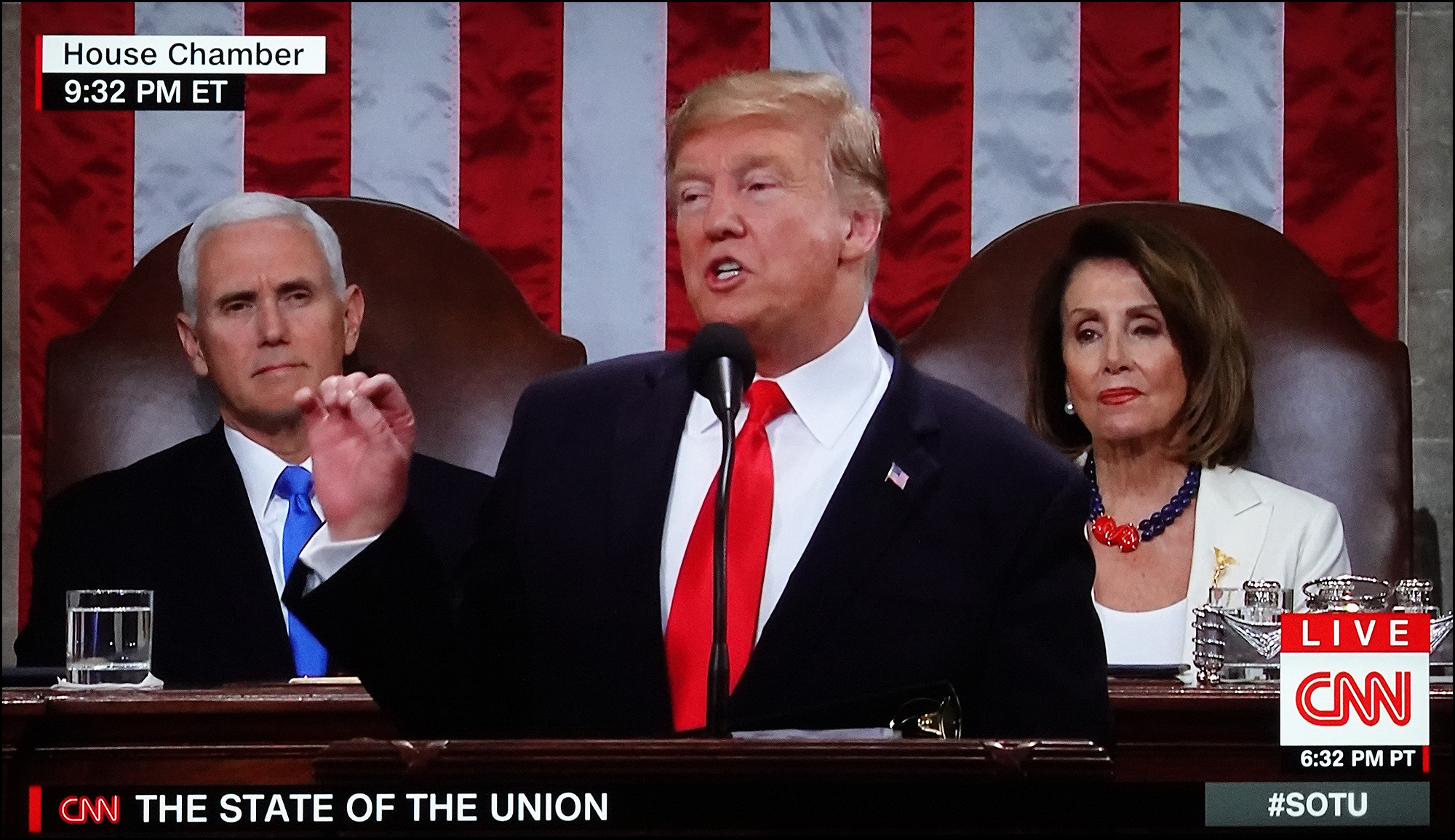
Mother Jones; Win McNamee/AP; Jim Bourg/AP; J. David Ake/AP
Do you feel unified now? No?
Me neither. But the State of the Union address is a fundamentally political speech, so no one should be surprised that it turned out to be a political speech. Besides, as near as I can tell, Trump’s idea of “unifying” is limited to not saying the word “Democrat” at any time. Even during the culture war part of the speech, Trump said only that “lawmakers” cheered the murder of unborn children, not Democrats.
On CNN, Van Jones called Trump’s speech “psychotically incoherent.” That seems a little rough, doesn’t it? But it’s true that he hopped back and forth between attacking first and then insisting that, really, we’re all one nation and we all believe in the same things. My favorite part was when he said we have to turn our backs on the “politics of revenge.” Donald Trump said that! Donald Trump!
On the truthfulness front, Trump mostly avoided citing specific facts but fudged dates with abandon. His remarks on the economy were typical: he simply declared that America was a hellscape when he took over and now it’s an economic paradise. His numbers weren’t wrong, but his implications were pretty plainly misleading. On the other hand, some of his claims were just untrue. For example, he said that prescription drug prices had fallen last year for the first time in 46 years. That’s just false. He’s said this before, and I really don’t know where it comes from.
On the marketing front, sex sells! Trump’s border comments focused over and over on sexual assault, slavery, and forced prostitution. And his abortion comments were as nasty as I’ve ever heard in a SOTU.
Overall, it was a fairly pedestrian speech. It hit the hot buttons Trump wanted to hit, and he kept the lies to a minimum. On the unification front, there were plenty of veterans, childhood cancer survivors, and Dachau survivors. However, it was weakly delivered, which is normal for speeches that Trump reads from a teleprompter. In the end, it will have no effect on anything.
10:31 pm – “We must always keep faith in America’s destiny: that one nation, under God, must be the hope and the promise and the light and the glory among all the nations of the world.” And that’s a wrap.
10:17 pm – Trump on Iran: “They do bad, bad things.” Roger that.
10:14 pm – Trump wants to declare victory and get out of Afghanistan. That’s OK with me, but make no mistake: as soon as we leave, the Taliban will take over. They’ll certainly try, anyway.
10:09 pm – Trump says if he hadn’t been elected we’d now be in a major war with North Korea. WTF?
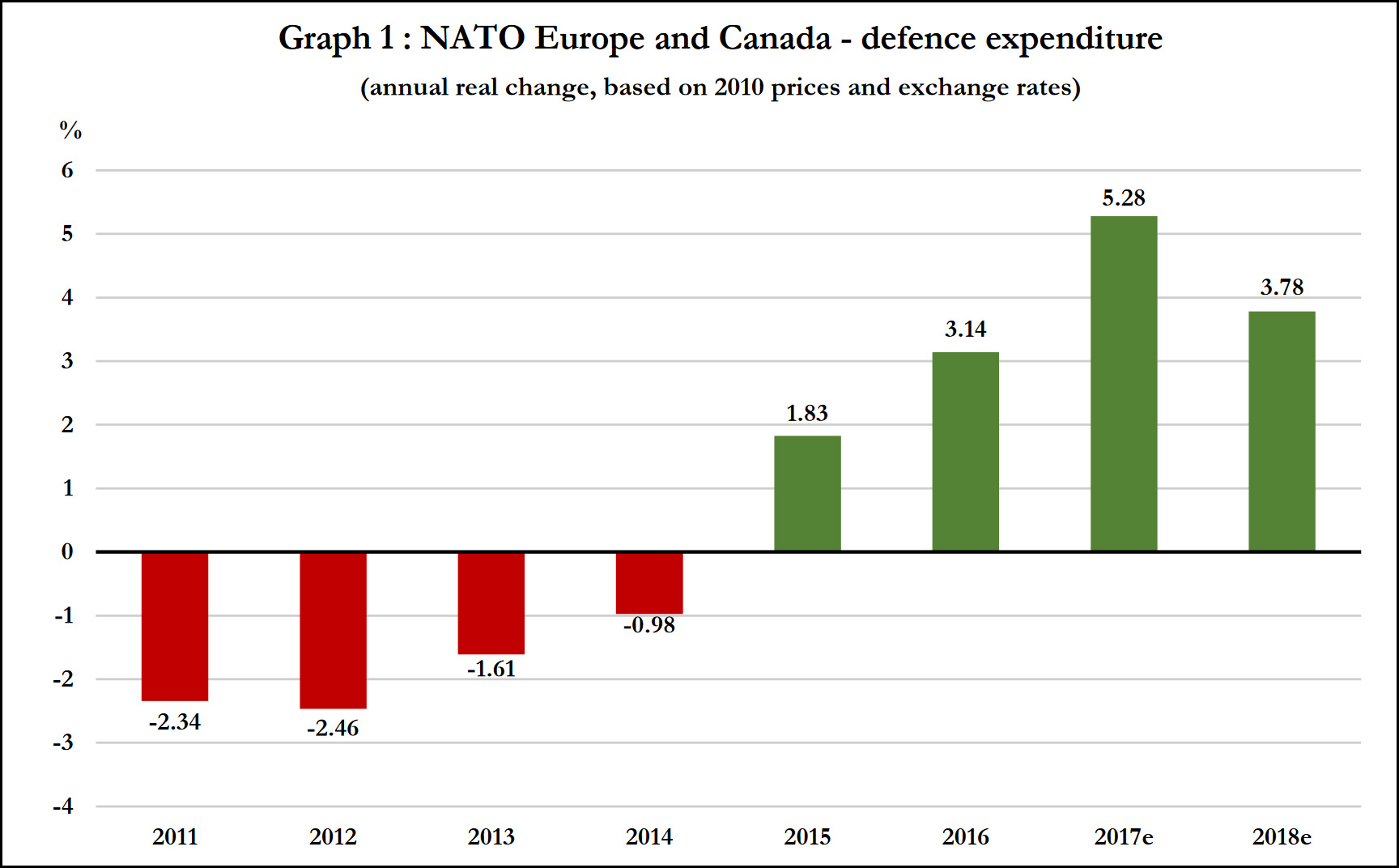
10:06 pm – Trump says other nations are finally paying their fair share of defense costs. Over the “past couple of years” we’ve secured $100 billion in new spending from NATO allies. I don’t know if that number is correct, but “past couple of years” is pretty slippery. This increase began in 2015, after Obama pushed NATO members to increase spending following Russia’s annexation of Crimea.
10:05 pm – And with that taken care of, let’s move on to national security.
10:02 pm – Trump says lawmakers in New York cheered after passing a law would “allow a baby to be ripped from the mother’s womb moments from birth.” I guess this is the culture war portion of the speech.
10:00 pm – OK, fine. Grace is cuter than me.
9:57 pm – Wait. Trump wants a new fight against childhood cancer? What about adult cancer?
9:55 pm – Trump says drug prices have declined more than they have in 46 years. What? That’s a new one on me.
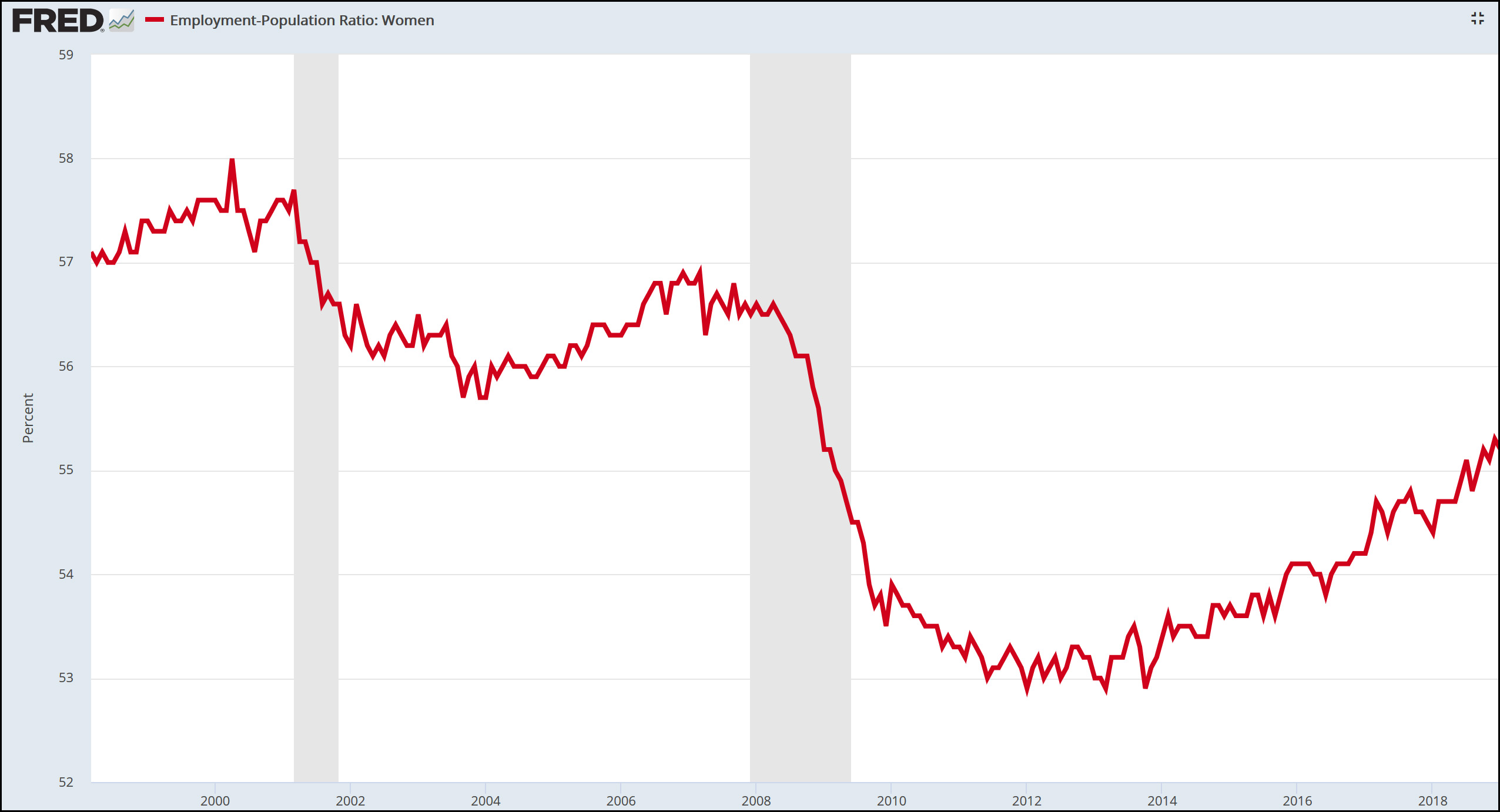
9:48 pm – “We have more women in the workforce than ever before.” In raw numbers that’s true, since our population keeps growing. But not in any sense that really matters. Here is EPOP for women:
9:46 pm – Trump is now explaining that we’ve already built fences at all the places that had high levels of illegal crossings. He doesn’t quite realize that’s what he’s saying, though.
9:43 pm – Build that wall! And not just a “simple concrete wall,” mind you. It’ll be way better than that.
9:41 pm – This section of the SOTU is basically a repeat of Trump’s border speech a couple of weeks ago. It’s a little more coherent, though, if no more truthful about the actual state of the border. It’s definitely more focused on sex crimes.
9:38 pm – MS-13, sexual assault, women sold into slavery, etc.
9:37 pm – Trump once again says crime is up thanks to illegal immigration. This is untrue.
9:36 pm – Politicians are pushing “open borders.” Which politicians? None that I know of.
9:33 pm – “Caravans are on the march to the United States.” More troops are being moved to the border to stop this “tremendous onslaught.” This is Trump’s best effort to make the border sound like it’s in crisis.
9:25 pm – No more witch hunts! “If there is going to be peace and legislation, there cannot be war and investigation.” That’s not quite “nothing to fear but fear itself,” but it’s about as poetic as Trump gets.
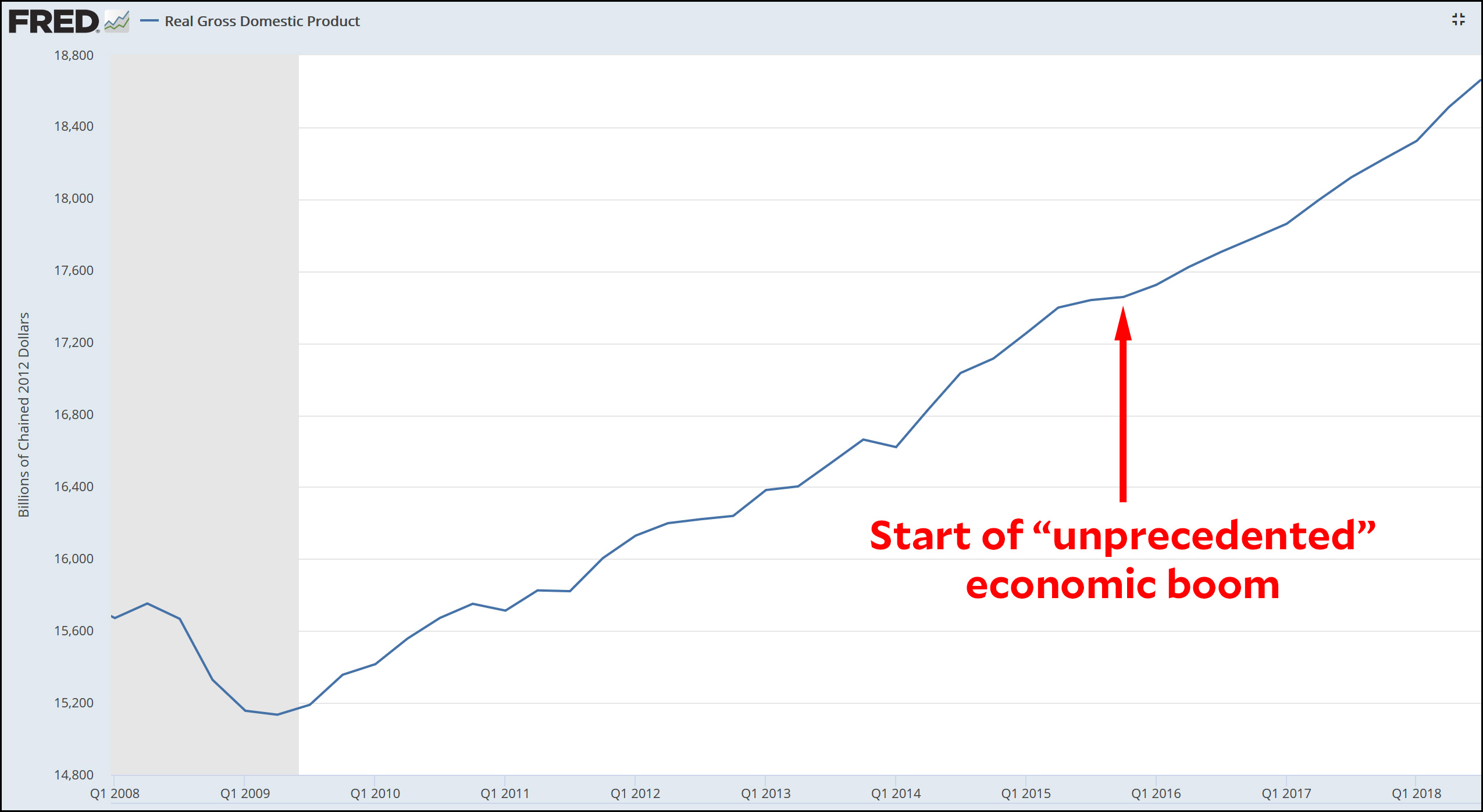
9:18 pm – “We have launched an unprecedented economic boom.” Aside from the fact that it started in 2010 and isn’t unprecedented, I guess that’s right.
9:16 pm – We must resist the politics of “revenge.” That’s a good one, Mr. Trump!
9:13 pm – More bipartisan blah blah. 2019 is the 75th anniversary of D-Day and the 50th anniversary of the first moon landing.
9:07 pm – Trump says millions are watching tonight, hoping we will “govern not as two parties but as one nation.”
9:05 pm – Trump’s tie is crooked. With any luck, this will be my pettiest comment of the evening.
9:00 pm – As a random pre-SOTU comment, can I just say that my least favorite recent innovation is the endless parade of politically motivated guests. This is a bipartisan complaint on my part, but surely this year’s presidential guest, a child who has been bullied because his name is Trump, proves that this tradition has now completely jumped the shark. UPDATE: This never happened. I’m not sure why.
8:50 pm – And with that out of the way, it’s time to begin the kumbaya portion of our evening.
8:49 pm – To set the stage for tonight’s speech about togetherness and comity, President Trump hosted a lunch for television anchors at which he called Joe Biden “dumb”; Chuck Schumer a “nasty son of a bitch”; ridiculed Virginia Governor Ralph Northam for “choking like a dog” at a press conference where he talked about a blackface photo in his medical school yearbook; and noted that John McCain’s book “bombed.” McCain, of course, died last August.
Today is the Chinese New Year, so here’s a picture of huge, brightly lit dragon from the “Moonlight Forest” show at the LA County Arboretum last December. Today marks the start of the Year of the Pig, but since I don’t have any pictures of pigs the dragon will have to do.
December 9, 2018 — LA County Arboretum, Arcadia, California
Top Nancy Pelosi Aide Privately Tells Insurance Executives Not to Worry About Democrats Pushing “Medicare for All”
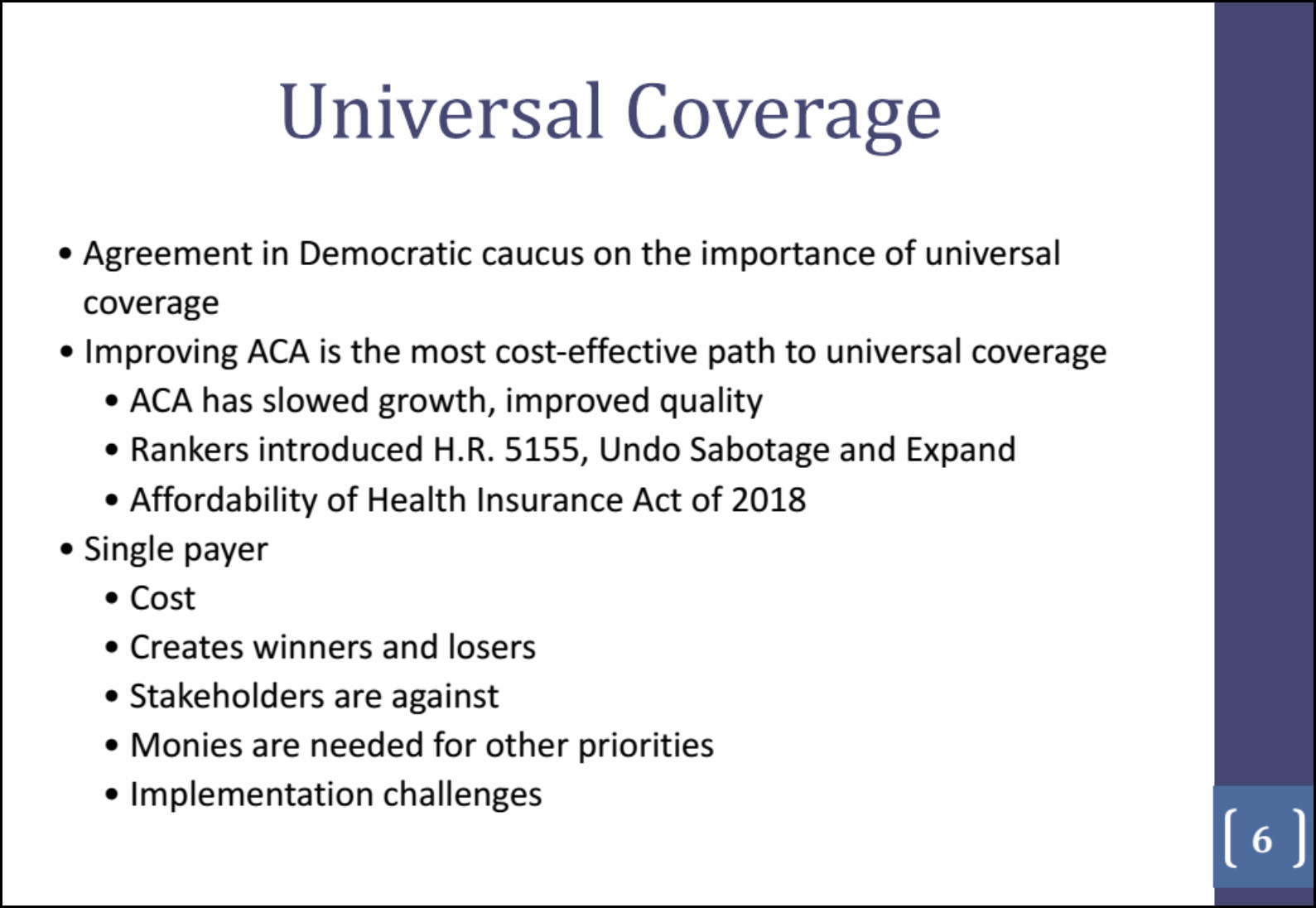
That’s from Ryan Grim at the Intercept, and it’s kinda sorta accurate. It’s based on a PowerPoint deck used for a presentation to Blue Cross Blue Shield executives, but let’s skip the opening slides on prescription drug costs, breast re-excision rates, and different-day elective upper and lower endoscopy rates. Here’s the slide on universal health care:
This is followed by some slides about ACA, Medicare, boomer retirement, and the opioid epidemic. There are a couple of reasons that none of it bothers me too much. First, it’s a presentation that sets out Democratic priorities for the next two years. We’re obviously not getting Medicare for All while Trump is in office, so it hardly matters if Pelosi’s people are downplaying it.
Second, and more important, this just goes to show the enormous malleability of the term “Medicare for All.” It can mean:
Literally, expanding Medicare to cover everyone.
Universal coverage of any kind.
Single-payer universal coverage.
Personally, I’m in favor of universal coverage and I don’t care much how we get there. Maybe we slowly expand the age limits for Medicare. Maybe we have a revolution and nationalize the entire American health care system. Maybe we keep expanding Obamacare until we get to 100 percent coverage. Maybe we expand both Obamacare and Medicare until they mush together and cover everyone. Maybe we adopt a German-style multi-payer system.
Some of these are inherently more efficient than others. Some of them are more politically feasible in the US given where we’re starting from. The politics is messy no matter how you approach it, and the key thing is to focus like a laser on universal coverage—as Democrats have—and not worry too much about how the sausage gets made. It looks to me like that’s what Pelosi is doing, and in the meantime she figures that there’s no point in pissing off the insurance industry to no purpose. That’s politics.
Reader Ben S. emailed last night to point me to a recent piece in Forbes about manufacturing employment. I was intrigued because it’s authored by Chuck DeVore, who just happens to be my former assemblyman. He ran for the US Senate in the Republican primary in 2010 but lost to Carly Fiorina and then abandoned California entirely for Texas. Apparently he’s now a vice president at the Texas Public Policy Foundation and he’s got something to say:
Over the past two years, with the encouragement of the Trump Administration’s red-tape cutting policies and the tax cut and reform law passed in December 2017, manufacturers added 467,000 jobs, more than six times the 73,000 manufacturing jobs added in Obama’s last two years.
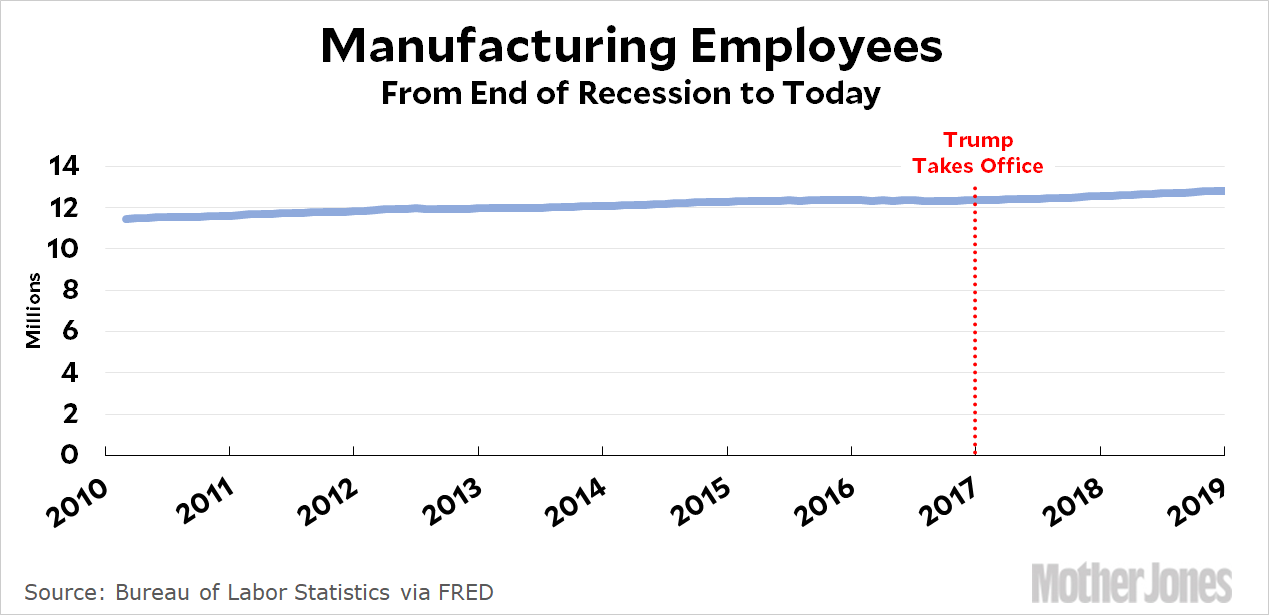
“If it is true it does seem fairly impressive,” says Ben. And I’ll eliminate the suspense right now: it’s true. But it’s also a great example of how to lie with statistics. I’m going to show you three charts. Here’s the first one:
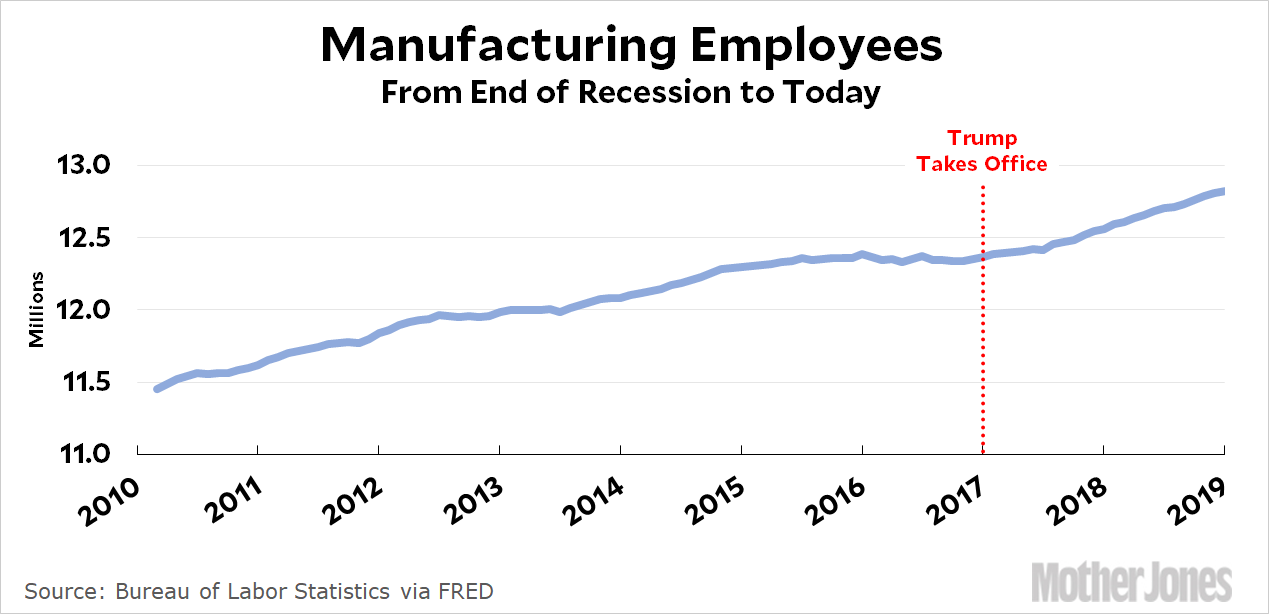
That doesn’t look like much, does it? Just a very slow and steady rise in the number of manufacturing workers. So where does DeVore get his claim that Trump is adding manufacturing jobs at 6x the rate of Obama? Here’s a second chart that zooms in a little closer:
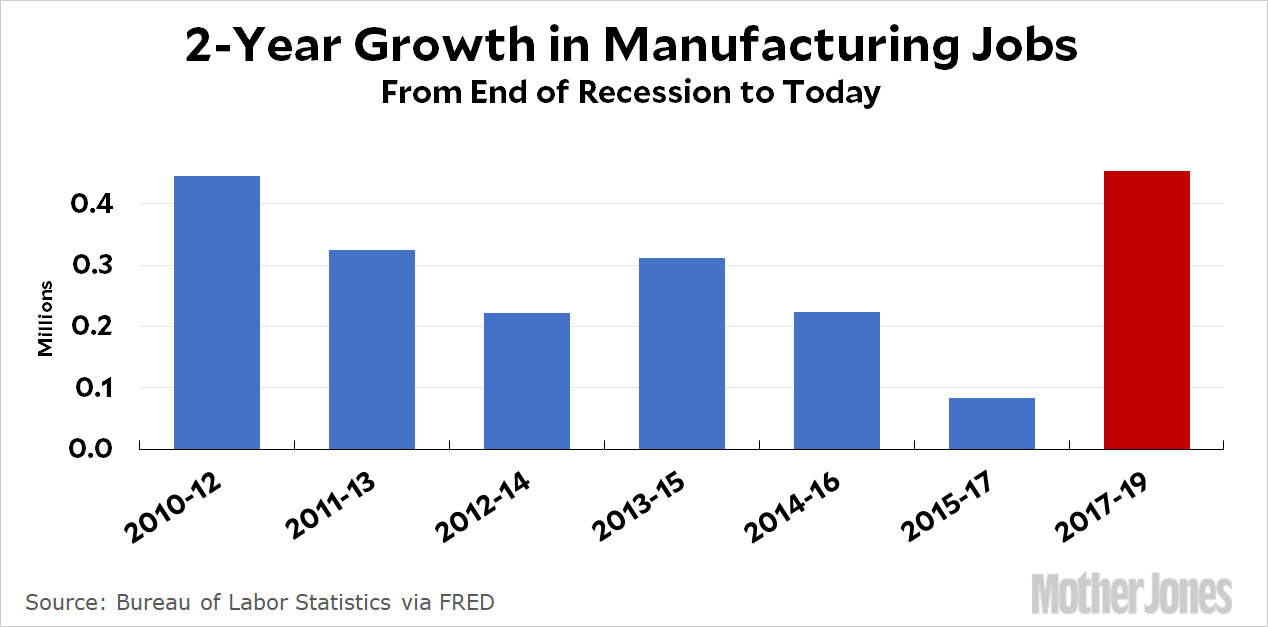
Hmmm. It does look like Trump has seen a nice upward bump during his first two years, but it’s obviously nowhere close to 6x Obama’s growth rate. So here’s yet another chart:
This finally makes it more obvious what’s going on. Obama had one bad period of manufacturing job growth: 2015-17. By cherry picking that period, DeVore gets his 6x ratio. If he had done it honestly, simply comparing Trump’s first two years to Obama’s entire post-recession record, he could have said that Trump’s growth rate was 70 percent higher than Obama’s. Not bad! But that’s never good enough for these guys. They always have to overdo it.
POSTSCRIPT: But wait a second. Even if it’s not 6x, why are manufacturing jobs growing faster under Trump than Obama? I don’t think there’s any answer to that. DeVore naturally chalks it up to “red-tape cutting policies and the tax cut and reform law,” but that’s nonsensical. There’s been no particular red tape that Trump has cut that affects manufacturing right now, and the tax cut—if it had any effect at all—wouldn’t have kicked in until mid-2018. But the growth rate has been pretty steady since December 2016. The same goes for Trump’s steel tariffs: they might have boosted domestic manufacturing employment a bit, but they didn’t kick in until mid-2018.
I doubt there’s any real answer at all. The numbers involved are small and noisy, and they can go up and down by a few thousand for no special reason. The economy has been fairly good for the past two years, and that’s helped manufacturing slightly. That’s probably all there is.
And we respect that! But maybe you’re of a mind to support our work directly instead? We have until December 31 to raise the last $400,000 we need to keep our nonprofit newsroom running at full strength into 2026. Will you make a gift today?
We noticed you have an ad blocker on. Can you pitch in a few bucks to help fund Mother Jones' investigative journalism?
Billionaires own the media,
but they don’t own us.
At Mother Jones we know these aren’t conventional times, and they require unconventional coverage. That’s what deliver every day: fierce, independent journalism you can’t find elsewhere. Perhaps never in the history of our country has that been more necessary than now. But we can’t do it without reader support—your support. Please chip in today.
Billionaires own the media,
but they don’t own us.
At Mother Jones we know these aren’t conventional times, and they require unconventional coverage. That’s what deliver every day: fierce, independent journalism you can’t find elsewhere. Perhaps never in the history of our country has that been more necessary than now. But we can’t do it without reader support—your support. Please chip in today.