• Are 2,000 US Trainers All That’s Holding Back Armageddon in the Middle East?

    Anas Alkharboutli/DPA via ZUMA

    As you know, President Trump has announced that he’s going to pull out all American troops from Syria. According to news reports, he made this decision without really telling anyone first, and the withdrawal will almost certainly be done in the worst, most slapdash way possible. That’s our commander-in-chief for you.

    That said, the response to his decision has been remarkably apocalyptic. For example, here’s Victoria Nuland:

    With his decision to withdraw all U.S. forces from Syria, President Trump hands a huge New Year’s gift to President Bashar al-Assad, the Islamic State, the Kremlin and Tehran … Everything about this mercurial decision imperils U.S. national interests as defined by Trump himself … As soon as the United States withdraws, the Islamic State will make three moves. It will claim victory over the U.S. infidels, turbocharging a recruiting binge across the Middle East and South Asia. It will pour fresh fighters into eastern Syria. And it will come out of the shadows to retake territory across eastern Syria.

    Iran will also flood the zone the United States is abandoning … Iran will also gain control of the major oil fields in Deir al-Zour protected by U.S. forces and the SDF, allowing it to self-finance its land grab … Moscow is celebrating, too … Maybe it will allow Tehran to split the spoils from the Deir al-Zour oil fields; maybe all that cash will go back to Moscow.

    Of course, both the Islamic State and the beleaguered SDF will fight for that territory, too, setting off another cycle of bloodshed and Iranian weapons shipments into Syria. That, in turn, will draw Israel’s concern and kinetic response.

    This is, believe it or not, fairly typical, even among liberals. If the Weekly Standard were still alive, it would probably spontaneously burst into flames on newsstands across America.

    So I’d like to take this chance to remind everybody of something: We’re talking about 2,000 troops. That’s it. And they aren’t fighters, they’re trainers. They were there to train 40,000 or so allied fighters, something that we’ve never, ever shown ourselves very competent at in the first place.

    To step back a bit then, we’re supposed to believe that withdrawing 2,000 troops, performing a job we’re not very good at in the first place, will open up Syria and the entire Middle East to hellfire and Armageddon. Seriously?

    Look: if 2,000 troops are the only thing holding back the forces of hell in the Middle East—well, let’s just stop there. They aren’t. Can we all just settle down a bit over this?


  • Here’s the Letter of Intent for the Trump Moscow Project

    Just for the record, here’s a copy of the letter of intent that Donald Trump signed on October 28, 2015, expressing his interest in building a “first class” Trump-branded development in Moscow:

    This was signed four months into Trump’s primary campaign, and we now know that the Moscow project stayed alive at least until the summer of 2016 and quite likely until November—a period during which Trump was insisting that he had no interests, no loans, no deals, no nothing going on with Russia. He was, obviously, lying, and this goes a long way toward explaining why he was being so obsequious toward Vladimir Putin at the time (“I’d get along great with him,” “He’s a leader,” “I’ve always had a good instinct about Putin,” etc.).

    UPDATE: The first sentence of the last paragraph has been revised for accuracy.

  • Lunchtime Photo

    This is Huntington Beach—“Surf City”— on a hazy winter morning a little before 8 am, about time for most of the surfers to pack up and go home. I was actually there for a practice session taking pictures of surfers in the water, but it was a failure. My camera just isn’t up to the job. My guess is that you need at least a 1000 mm lens to get a good picture. My camera might be able to take a barely acceptable picture on a brighter, sunnier morning in the summer, and perhaps I’ll try again then. Luckily, I took a few other pictures while I was there, so the trip wasn’t a complete waste. I like this one a lot.

    December 18, 2018 — Huntington Beach, California
  • Vaping Is Better Than Smoking, But It’s Still Very Bad

    My post yesterday about vaping among teens produced some feedback. First, here’s an email from reader JB:

    I have three kids between 6th and 11th grade and I can say that vaping is a huge issue. I am old enough to remember the smoke-filled bathrooms in high school and the ubiquitousness of cigarettes everywhere. I remember riding dirt bikes out to the middle of nowhere and turning green smoking Marlboro (in the box, naturally). Hell, I remember really creative advertising for smokes. Juul makes the old penis/camel ads look ancient and boring. The kids laugh at the new ads with prominent adult voices. The flavors (are gross and) are aimed at kids. The devices are incredibly small and easy to hide.

    Kids master how to vape in class or take a quick pop walking in the stairs. I have no doubt that I have had kids vape in my large lecture classes. Twenty-five rows deep means the back of the room is the wild west. With smokes, you had the issue of the smell that stuck to you. With Juul, that is not an issue. What we have seen here is how this has spread across the groups in high school. While smoking at school was mostly for a narrow demographic back when I was in school, vaping shows up across a broad swath of kids. I think Juul and similar products have altered the terrain for years to come. From a policy perspective, the ship was way out to sea before there was any response.

    On the other side, a few readers have asked about the benefits of vaping. There’s obviously one huge benefit: e-cigarettes don’t contain tobacco and therefore won’t give you lung cancer. That’s not to say they’re completely safe, but they’re certainly safer than smoking tobacco. The big caveat is this: they’re only safer if you give up cigarettes when you begin vaping. The evidence so far is unclear about how common this is. Some vapers stop smoking, while others just end up smoking and vaping.

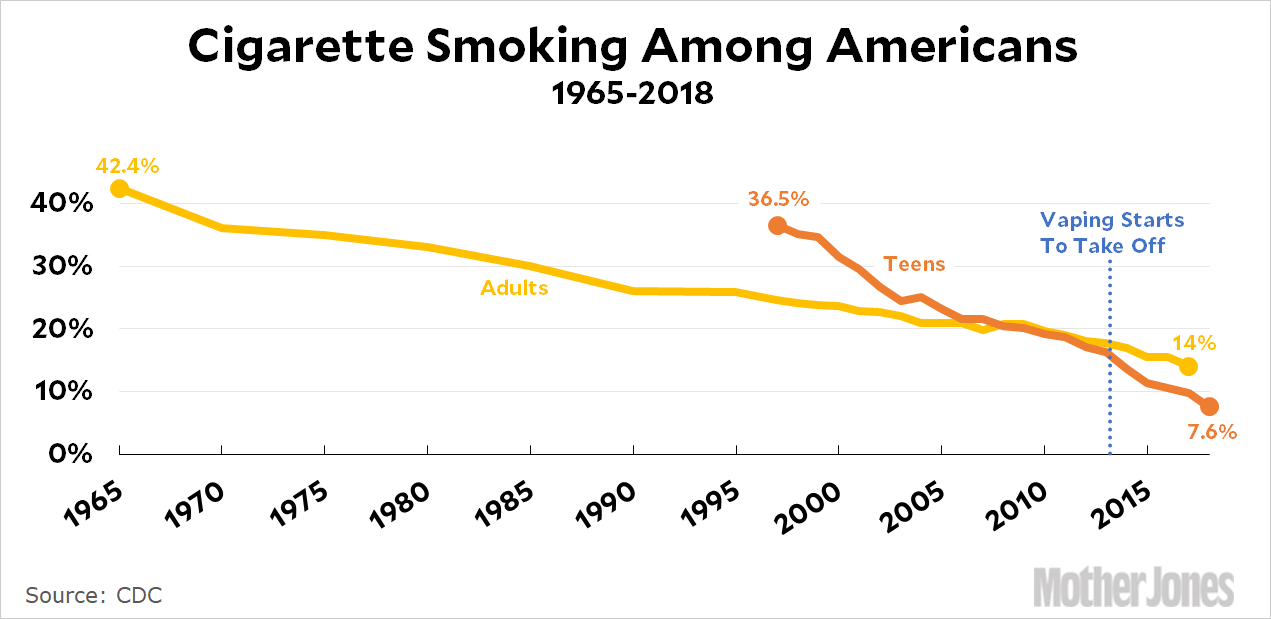
    Still, there’s no question that at least some number of current smokers give up cigarettes in favor of vaping, and for these people it’s a clear improvement. But the really big question is how many people do this vs. how many teens take up vaping as a brand new thing and get addicted. For them, this is a clear net loss. Nobody can provide you with exact numbers about this, but here’s a very basic chart of cigarette smoking in the US:

    Smoking among both teens and adults has been on a long-term decline ever since the Surgeon General’s report in 1964. Did vaping contribute to making that decline even steeper? Among adults it doesn’t look like it, but among teens it took a 4 percent annual decline and turned it into an 11 percent annual decline since 2014.

    On net, then, vaping has probably had very little effect one way or the other on adult smoking. Vaping is beneficial if it helps get you off tobacco, but it looks like that hasn’t happened much.

    Among teens, however, vaping looks like it’s taken the place of tobacco to some extent. A rough look at the data suggests that about 25 percent of teens vape, and perhaps 4-5 percent of this is done as a substitute for tobacco smoking. The other 20 percent is made up of kids who did nothing before and took up vaping as a brand new thing. The majority of these kids are vaping nicotine and will almost certainly become lifelong addicts. This is why cigarette companies have shown so much interest in acquiring vaping companies, and it’s why Altria, the maker of Marlboro, is close to deal to take a 35 percent stake in Juul.

    On net, then, I’d call vaping a huge net negative. It appears to have, at most, a tiny beneficial effect on adults, and among teens it attracts lots of new addicts while having only a modest effect on tobacco smoking. If vaping were harmless, that would be one thing. But anything as addictive as nicotine should be kept far, far away from children and teens.

  • Yes, the Working Class Is Better Off Than the Poor

    Over at National Review, Michael Strain makes a very peculiar argument:

    There is a growing consensus that the working class is in crisis following years of difficult economic change and due in part to their being ignored by Washington….I am struggling to find empirical support for this narrative when the working class is compared to lower-income Americans.

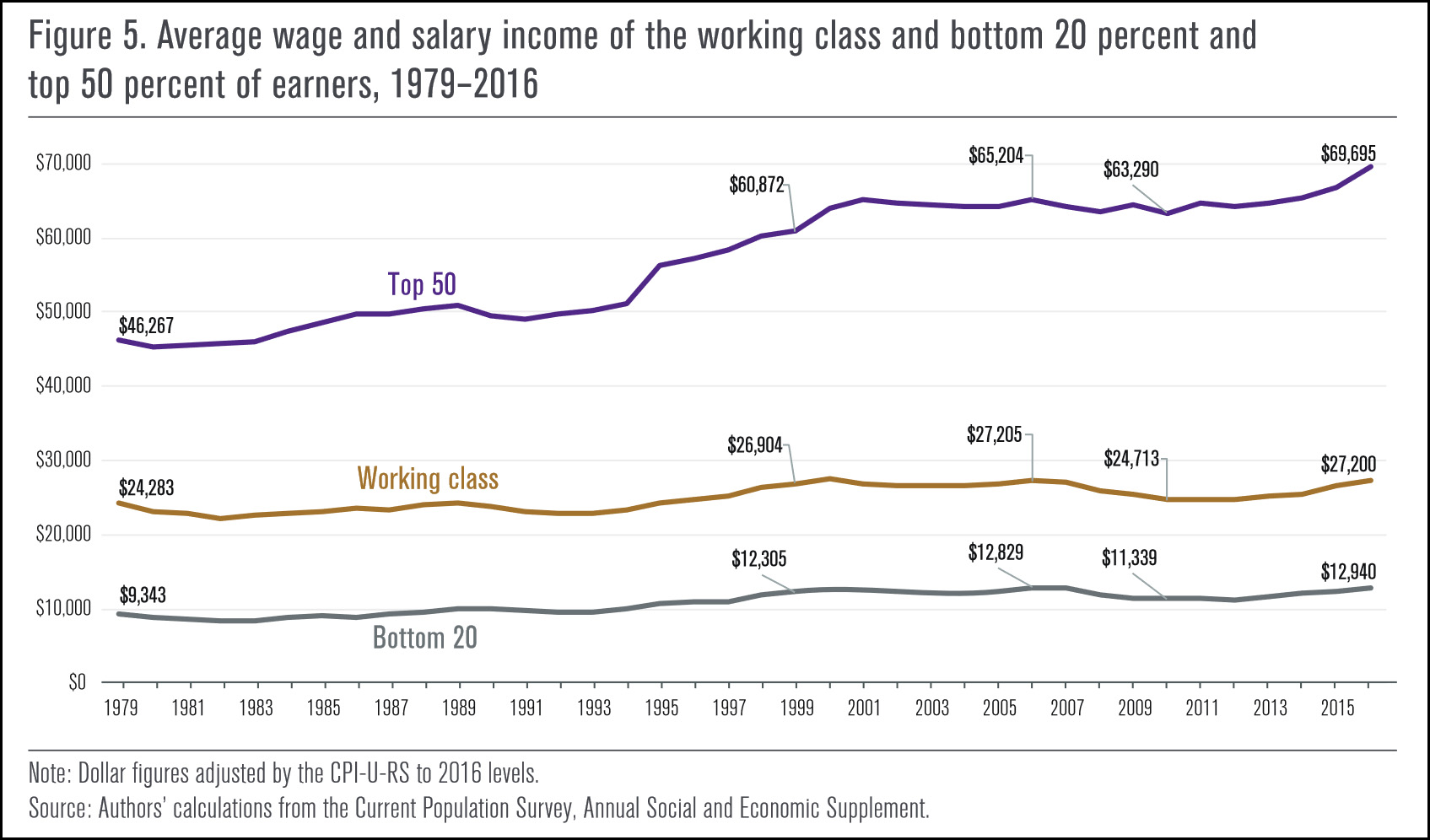
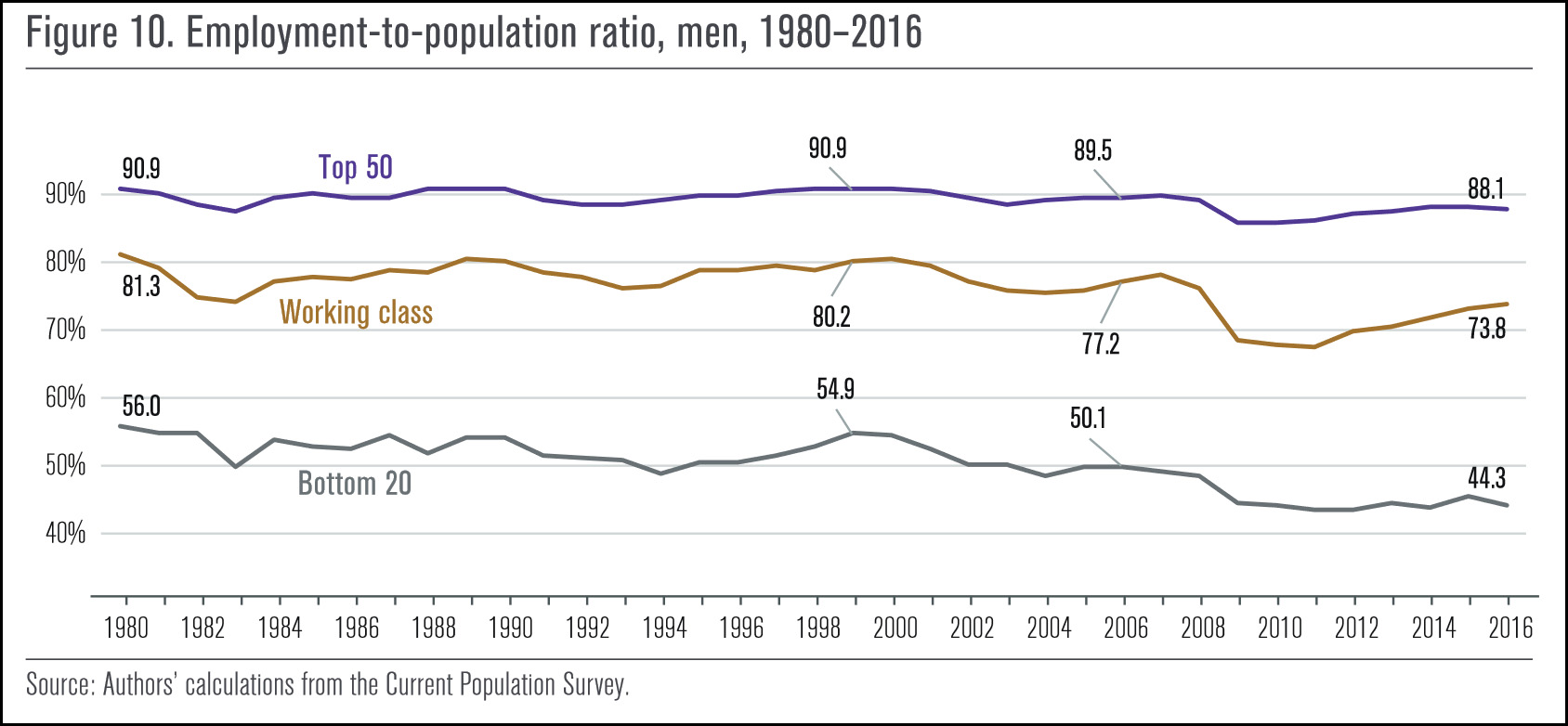
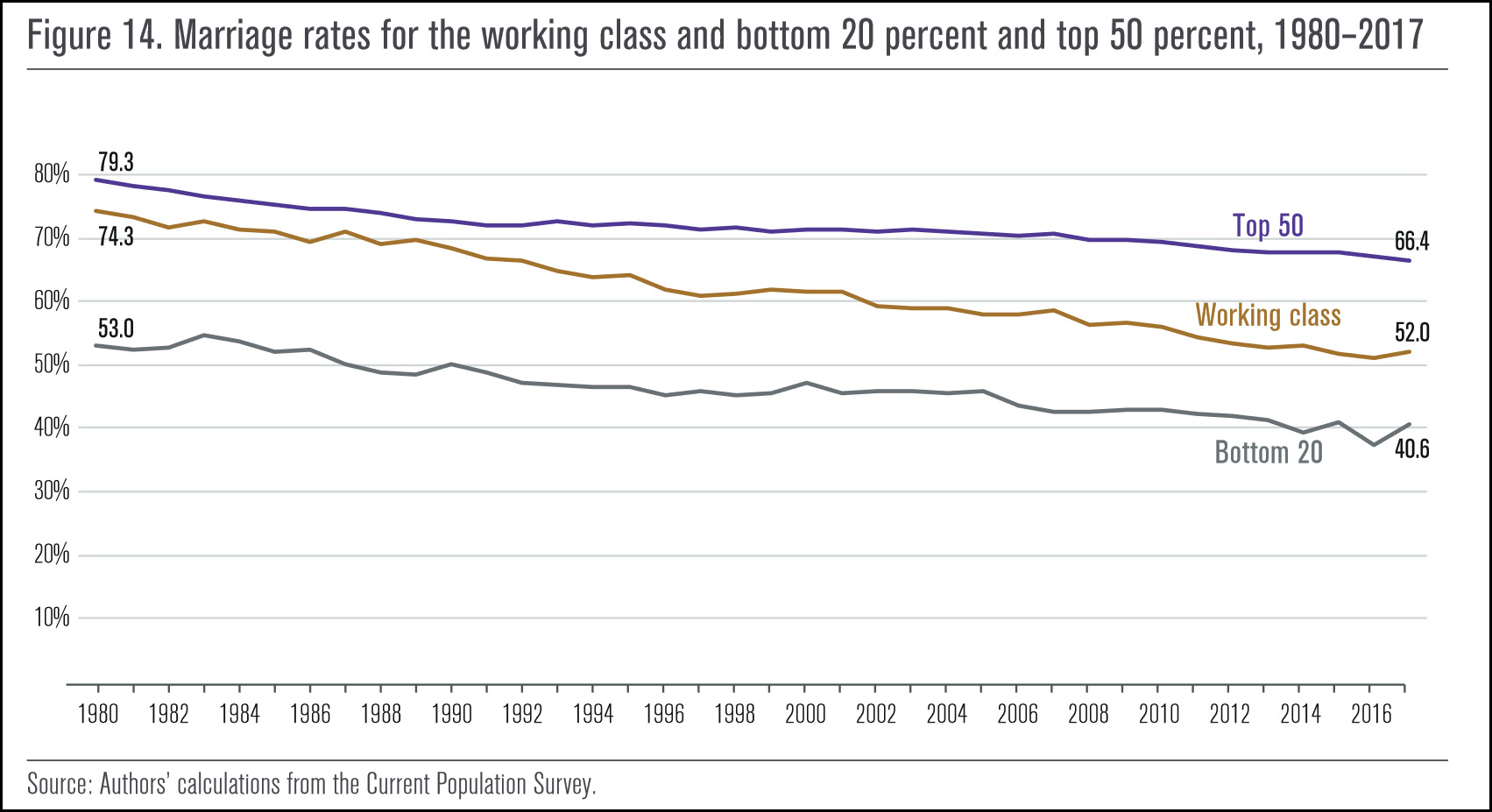
    Over the past four decades, the average wage-and-salary income for the working class has consistently been more than double that of the poor. In 2016, 74 percent of working-class men were employed, compared to 44 percent of poor men. The rate of employment for the working class has fallen by 9 percent since 1980, compared to a drop of 21 percent among poor men. Both groups have seen significant drops in marriage rates. One-third of working-class women are single mothers, compared to 60 percent of poor mothers. Members of the working class are 25 percent more likely than the poor to participate in a religious organization.

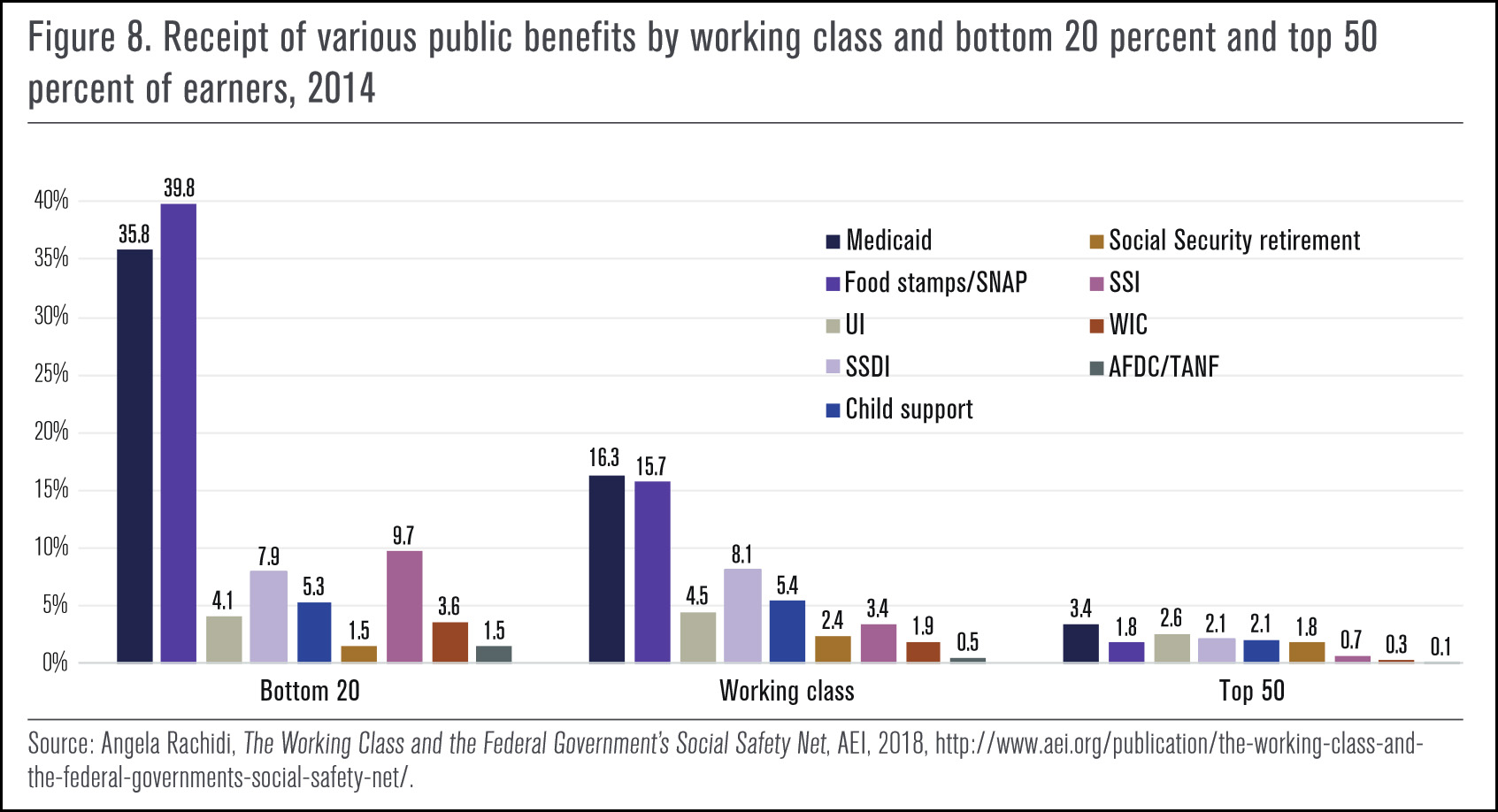
    Strain draws on data from a Brookings/AEI report published this year, which includes charts like these:

    It’s true that these charts show that the poor are worse off than the working class. Of course they are—by definition. Metrics of income and education are how we define the two classes in the first place.

    But all the evidence I’ve seen suggests that people simply don’t care that other people are worse off than they are. What the working class sees from these charts isn’t that they should thank their lucky stars they aren’t poor. What they see is that their incomes have been stagnant for 20 years; a lot more of them aren’t working; they’re getting married a lot less; and as a result they have to rely on government welfare a lot more. The fact that the poor have it even worse is no more meaningful than the fact that Vietnamese peasants also have it worse.

    Strain has a longer version of this argument in Bloomberg today, which concludes like this:

    Though the group’s struggles are real, the working class is not made of candy glass….They are not helpless victims of economic change, and should not be treated or discussed as such….Leaders should stop feeding them a narrative of victimhood and grievance. And at least some of the conversation about them should include how they can better help themselves.

    Maybe so, but here’s the thing: unlike the poor, the working class votes. This political reality explains why politicians pay attention to them—at least a little bit—and nothing will ever change that. If you vote, you get things. If you don’t, you don’t.

    And of course the real change in the American economy over the past few decades is the rise in the top 10 percent and especially the top 1 percent. Pitting the working class against the poor is just a way of evading the real conversation we should be having.

  • After Three Decades, Congress Finally Figures Out That Crime Has Plummeted

    Finally!

    After years of delays and a strenuous effort to derail it led by Senator Tom Cotton and abetted by Mitch McConnell, the Senate passed a modest prison and sentencing reform bill appropriately called the First Step Act by a margin of 87-12.

    I don’t mean that finally this bill has passed. I mean that finally someone has called it what it is: a modest bit of reform. I’ve been reading headlines for the past couple of days and shaking my head at the number of times I see it described as groundbreaking, historical, a miracle, etc. Even Mother Jones calls it “the biggest federal prison reform in a generation.” But come on. The thing is named the First Step Act. Doesn’t that tell us something?

    Now, it’s true that this bill is the biggest federal prison reform in a generation, so technically I have no beef with the MoJo copy desk. But that says less about this new bill and more about the past generation: namely that we did squat about criminal justice reform that entire time. Here is Samantha Michaels’ rundown of what we’re getting:

    Among the bill’s biggest impacts is the measure to retroactively reduce a major disparity between crack and powder cocaine sentences, allowing roughly 2,600 prisoners to petition for quicker release, the majority of them people of color. The bill would also curb some mandatory minimum sentences, reducing the federal three-strikes penalty for drug felonies from life in prison to 25 years. And it would give federal judges more discretion to avoid handing down mandatory minimums to people with limited criminal histories, which could help an estimated 2,000 people annually.

    In addition to sentencing reform, the bill would encourage some prisoners who participate in rehabilitative programs to spend more of their sentences in halfway houses or home confinement. It would make more elderly and sick inmates eligible for compassionate release, and it would clarify that federal inmates can earn more time off their sentences each year for good behavior. It would ensure prisoners are not held beyond 500 miles from their homes, allowing them to stay closer to their families, and it would prohibit prisons from shackling pregnant inmates.

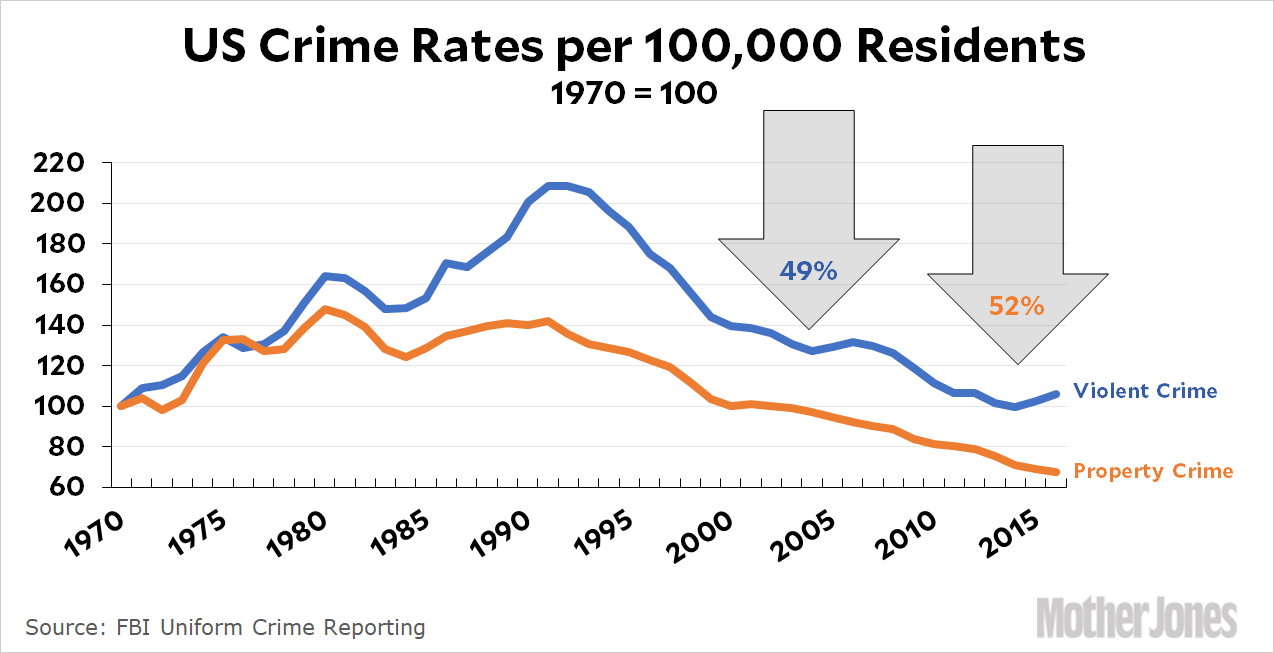
    So it might affect a few thousand prisoners, mostly in fairly modest ways. Which is fine. I’m a pretty firm pragmatist, and if it took forever to get even this bill passed thanks to the idiot hardliners in Congress, then you pass it and take a small victory. Considering that violent crime has been plummeting since 1991 and shows no signs of returning to its old levels, it’s about damn time we responded.

    BY THE WAY: People use the old “Only Nixon can go to China” line a lot, but there aren’t really all that many examples of it. However, this is one. It’s pretty much unthinkable that this bill could have passed during an Obama presidency.

  • Elon Musk Opens Short, Bumpy, Slow, Tunnel for $10 Million

    The Boring Company

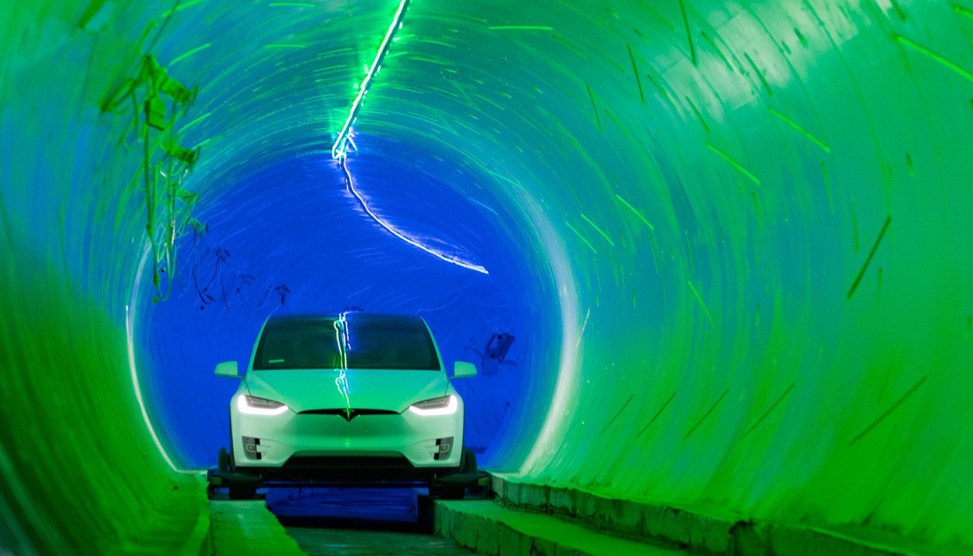
    After a year-and-a-half, Elon Musk has finally opened his one-mile tunnel in Los Angeles. It’s bumpy, requires a specially fitted electric car, and operated at a top speed of 58 mph even with a professional driver at the wheel. “We kind of ran out of time,” Musk explained. Other than that, though, it was a huge success:

    Building the 1.14-mile tunnel took about 18 months and cost about $10 million, Musk said. The figure does not include the costs of research, development or equipment, the company said, and it is not clear whether it includes the money spent on property acquisition or labor. Still, the $10 million is orders of magnitude lower than a typical subway project, Musk said. Part of the Boring Co.’s goal, he said, is to create a tunneling process that will be 15 times faster than the “next best” option.

    This is ridiculous. If all you want is a tunnel, the Faroe Islands can build one for about $20 million per mile—and that’s a two-lane tunnel that has to bore about 500 feet undersea. Plain-Jane tunneling just isn’t that expensive.

    Now, if you want to build an urban subway, that’s a whole different thing. You have to build lots of big stations, you have move utility lines out of the way, you have to be able to transport more than a few hundred people per hour, and you have to follow a whole bunch of safety and seismic guidelines. And don’t forget the lawsuits! For some reason Musk doesn’t ever seem to talk about this stuff.

  • Trump Plans to Pull Out of Syria

    Sharifulin Valery/TASS via ZUMA

    President Trump has gotten tired of Syria:

    The U.S. military is preparing to withdraw its forces from Syria, people familiar with the matter said Wednesday, a move that marks an abrupt reversal of the American military strategy in the Middle East.

    The move follows a call last week between President Trump and Turkish President Recep Tayyip Erdogan, who has threatened to launch an assault on America’s Kurdish partners in Syria. Mr. Erdogan steadfastly opposed the American partnership with Kurdish forces in Syria that he views as a terrorist force intent on destabilizing Turkey. But the U.S. has relied on the Kurdish forces as the most effective fighting force in Syria against Islamic State, which has been pushed to the brink of defeat.

    From day to day, I can’t tell whether we like Turkey or hate them. In any case, now that we’ve used the Kurds to accomplish our own goals, we’re leaving them to Erdogan’s tender mercies. However, I don’t think the Kurds thought we planned to stick around forever, and they’ve been fighting Erdogan for years without our help. It’s probably best to let everyone get on with things without American troops being in the middle.

  • What Happens When You Double Blind Astronomers?

    NASA

    Most of you probably know about the famous test of blind auditioning for symphony orchestras, in which every candidate performs behind a curtain: after it was adopted, suddenly a whole lot more women got hired. The folks running the auditions—almost all men—had previously made up endless excuses for choosing men over women: their style was “more muscular,” they “presented themselves” better, etc. But it all turned out to be plain old gender bias. Behind a curtain, the women magically all sounded just as muscular as the men.

    Needless to say, the same thing happens in other fields. Take astronomy. Every year hundreds of researchers submit proposals for time on the Hubble Telescope, and every year proposals from men get accepted at a higher rate than proposals from women. Finally, last year, the Telescope Allocation Committee decided the only solution was genuine double-blind reviewing: neither the applicants nor the reviewing committees know each other’s names, and proposals have to follow a style that hides the identity of the proposer. Guess what?

    Statistically, 138 of the 489 submitted proposals (28%) were led by female PIs—as a comparison, in Cycle 25, female PIs led 46 of 167 Medium and Large proposals (27.5%). Twelve of the 40 proposals selected for execution are led by female PIs, a success rate of 8.7% (12/138); for male PIs, the success rate is 8.0% (28/351). This reverses the trend seen in the past 15 cycles. Specifically, in Cycle 25, 13% (6/46) of Medium and Large proposals submitted by female PIs were approved while 24% (29/121) of proposals submitted by male PIs were successful. Given the special circumstances involved in the Cycle 26 ΔTAC it would be premature to draw broad conclusions, but the results are encouraging.

    How about that?