• Deficit Crisis Countdown: 20 Days to Armageddon

    Bruce Bartlett makes a prediction:

    And just in time, look who’s here to help!

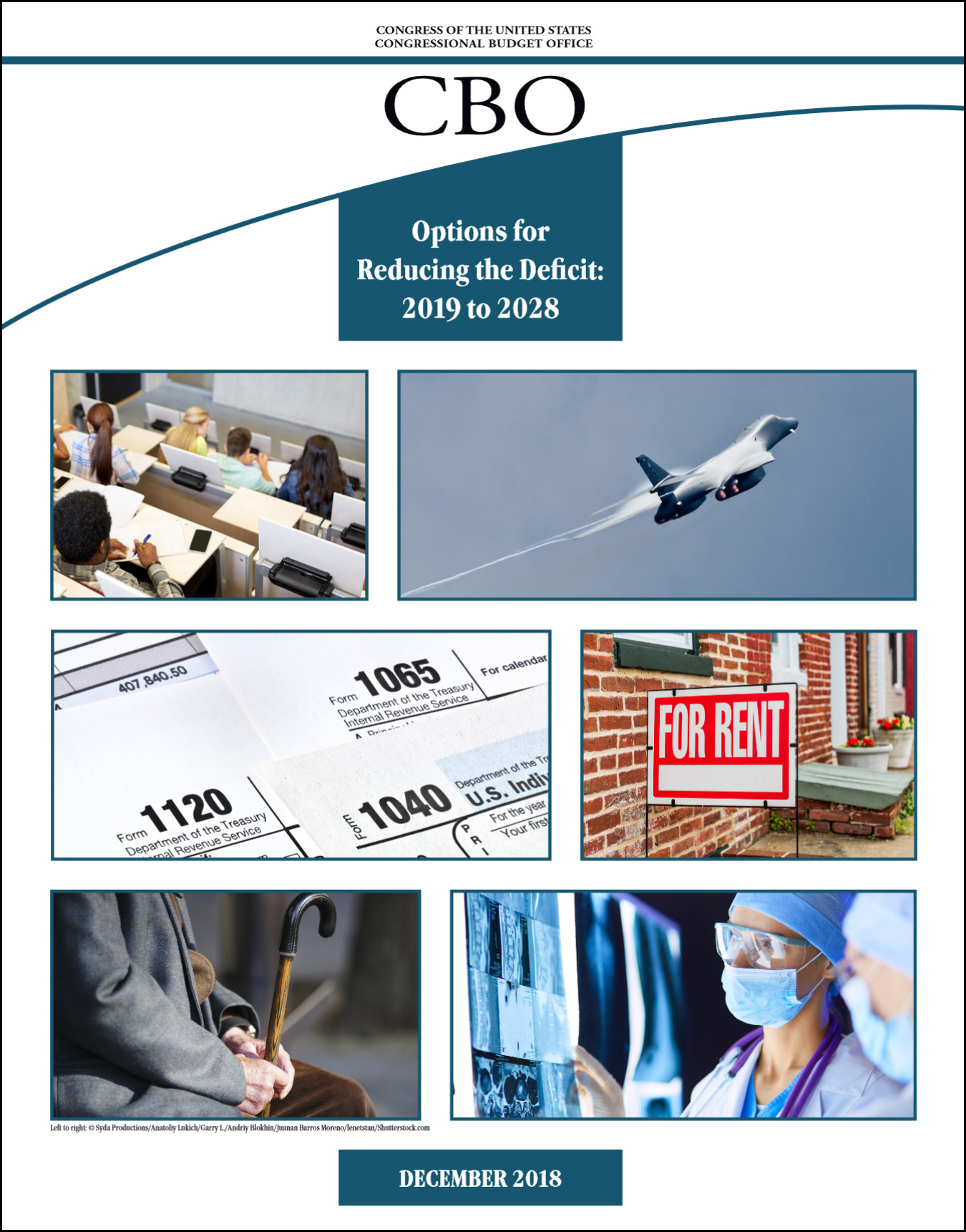
    CBO says there are 121 options in this report, but that’s not really correct. For starters, we can eliminate all the ones that raise taxes. That’s just crazy talk. Then there’s military spending, and obviously we can’t afford to cut that. And there are nine that are so small they’re relegated to an appendix. We can skip those.

    So that leaves 56 options. Those include cuts to Medicare and Social Security, and I think we all know they’re going nowhere. So now we’re down to 41 options. If we adopted every single one of them, it would cut the federal budget by somewhere between 2.6 percent and 3.8 percent.

    My prediction, of course, is that we’ll adopt zero of these. But I guess the game must be played. After two years of being in power and ballooning the deficit, Republicans must pretend that now the deficit is suddenly urgent again. Just like it suddenly became urgent on January 20, 2009.

    It’s all such dumb, kindergarten-level stuff. But Bartlett is right: everyone will pretend to go along with it. Sigh.

  • Lunchtime Photo

    Here are some lovely pink roses¹ hanging from our trellis after our once-per-year rainstorm last week.² I love pictures of flowers with raindrops on them, and they’re surprisingly hard to fake. I’ve tried various ways of tossing water on flowers, but somehow I never get quite the same effect as genuine rain. Does anyone know why?

    ¹Hang on a second and I’ll ask Marian what variety they are. Tick… tick… tick. I’m back. She doesn’t remember.

    ²That’s what it feels like, anyway.

    December 6, 2018 — Irvine, California
  • Three Cheers For New Jersey’s Appalling Gerrymandering Law

    Bill Clark/Congressional Quarterly/Newscom via ZUMA

    New Jersey Democrats are showing some of the same political ingenuity that we’ve typically seen only from Republicans in the past:

    Legislative power brokers across the country have long designed district lines in back-room deals that entrenched their control for years, if not decades. But now, Democratic lawmakers in New Jersey are carrying out a power grab in an unusually public fashion: They are seeking to make Republicans a permanent minority by essentially writing gerrymandering into the State Constitution.

    [blah blah blah]

    Typically, a proposed constitutional amendment requires a three-fifths majority in the state legislature before it can get on the ballot. But since no Republican supports the redistricting plan, it seems unlikely that it would ever succeed in either chamber in Trenton. Instead, Democratic leaders are digging deep into the state’s laws and using a provision allowing an amendment that passes the state legislature with a simple majority in two consecutive calendar years to be placed on the ballot.

    Democrats have scheduled a vote on the redistricting plan for Monday, the final day the legislature is to meet this year. Then they are likely to bring it up again in early January, satisfying the two-year requirement in less than a month. Should the measure pass in both instances, the proposal could be put on the ballot in November.

    I am all for this. Is that because I’m a political hack who eagerly looks forward to giving Republicans a taste of their own medicine? Of course not. It’s more that … it would … oh hell. Yes, that’s part of it. The prospect of watching Republicans whine and moan about this is really pretty delightful.

    But here’s the real reason: this is the only thing that will ever get the Supreme Court off its butt to do something about gerrymandering. I’m dead serious here. Conservatives on the Supreme Court aren’t likely to ever address gerrymandering until it’s crystal clear that Democrats can be every bit as ruthless and shady as Republicans. As long as red-state Republicans pass bill after bill screwing Democrats, while blue states like California and New Jersey and New York do nothing, there will always be a majority on the Supreme Court to shrug it off as a “political” question and do nothing.

    The Supreme Court is likely to hear a gerrymandering case later this year that merges a suit over Democratic gerrymandering in Maryland with a suit over Republican gerrymandering in Wisconsin. That’s a good start to getting them to take gerrymandering seriously, and the New Jersey stunt might force a bit of rethinking too. I hate the fact that I believe this, but I do, in fact, believe pretty strongly that conservatives on the Supreme Court will never strike down even the most egregious gerrymanders unless Democrats prove that they can play the game too. So let’s play.

  • Marco Rubio Has Some Fresh New Ideas For Us

    Tom Williams/Congressional Quarterly/Newscom via ZUMA

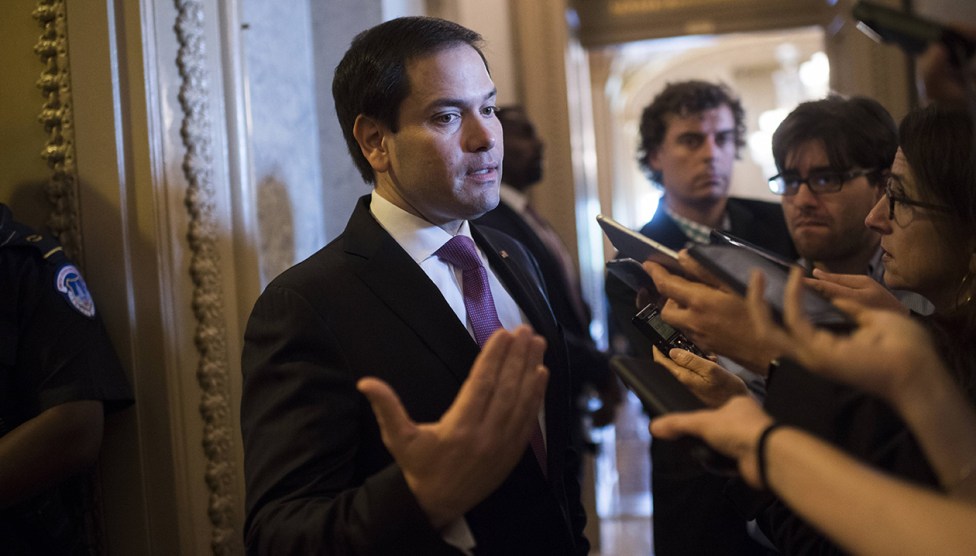
    Marco Rubio wants to bring back the American Dream. Here are three excerpts from his essay in the Atlantic today:

    More business tax cuts: I will soon introduce a plan to expand and make permanent the full-expensing provisions from last year’s tax-law effort and end the tax code’s favoritism for companies that spend their tax cuts on stock buybacks.

    Higher education reform: We count ridiculous classes on pop culture as credits toward college degrees, but not wood shop. We subsidize high-end universities’ tuitions and endowments, but tax the paychecks of young workers gaining experience in the field….The Higher Education Innovation Act…proposes an alternative accreditation system that would allow new institutions to meet students’ needs with innovative educational products. Imagine some high-school seniors interested in becoming aircraft mechanics. Hands-on learning supplemented by low-cost online engineering courses might suit them better than a more expensive traditional degree built around a core curriculum.

    Unions: The backbone of labor law remains the National Labor Relations Act of 1935, and many of the law’s major provisions have remained unchanged since 1947. It enshrines a model of labor relations that pits worker against manager….Federal labor law should be reformed to make possible a more productive relationship between workers and employers.

    Not bad for a Republican! I mean, sure, it’s a little galling to hear Rubio going on about stock buybacks when he voted just 12 months ago for a business tax cut that Republicans swore would produce massive investment and skyrocketing growth, but instead has mainly produced massive stock buybacks. But hey, we all make mistakes, amirite? Having learned their lesson, I’m sure a second Republican tax bill will focus like a laser on making things better for workers and definitely won’t sprout a million giveaways for industry by the time it’s done.

    As for the “four-year-degree-industrial complex,” which insists on producing both left-wing students and left-wing science, perhaps a good dose of wood shop is just what they need. Of course, we already have a “for-profit-college-industrial-complex” that teaches stuff like aircraft mechanics and hair coloring. How about reforming that scam-infested industry instead of starting all over with welding classes at Harvard? Or maybe we should increase federal aid for community colleges, which also offer more vocationally oriented training? Obama gave this a try during his presidency, but I don’t recall much Republican support for either of those ideas. Maybe Rubio can change their minds.

    And unions. Unions! But make no mistake: Rubio doesn’t want any of those old-school unions that make life hard for business owners. Instead:

    This could take the form of new labor “co-ops” in the model of Germany’s sectoral workers’ groups, which negotiate wages and benefits, and provide training and apprenticeships for their workers. These voluntary, dues-paying organizations and their associated worker representatives could receive federal charters that would allow them to administer benefits such as unemployment insurance and worker-training programs. They would be banned from the kind of institutional political organization Big Labor has become bogged down in and would have the flexibility to negotiate beyond the extent of federal labor law in some areas.

    Well now. I don’t know much about German worker co-ops, but I do know a little bit about German unions. For example, do you know why the German economy has been so competitive over the past couple of decades? It’s because worker compensation has grown very slowly. Why is that? It’s because in the 1990s—shortly after reunification with East Germany produced a torrent of low-paid workers who were willing and eager to move to the west for higher wages—businesses suddenly had greater leverage. Long story short, they used that leverage to force agreement from unions for a more “flexible” wage-setting process—and I don’t need to say much more about what “flexible” means, do I? So that’s the German model.

    Still, like I said, not bad for a Republican. I’m in a good mood today, so I’ll give it a C-.

  • We’re Returning to the Middle Ages

    Canada’s detention of Huawei CFO Meng Wanzhou is turning out well:

    China has significantly upped the ante in its diplomatic standoff with Canada, not just detaining two Canadian citizens but accusing them of serious crimes — charges that could result in their imprisonment for months with no outside contact….China could hold Michael Kovrig, an analyst with the International Crisis Group think tank, and Michael Spavor, who runs tours and promotes investment in North Korea, in “black jails” for as long as six months without allowing them access to lawyers or their families.

    ….China is outraged over Meng’s detention and continues to call for her complete release. But rather than risk derailing efforts to resolve the trade war with the United States, it is directing its ire at Canada.

    If memory serves, this was a fairly common way of conducting foreign affairs during the Middle Ages. Maybe this is finally the key to unraveling Donald Trump’s personality: He conducts politics about the same way a not-too-bright medieval king would. I will check out this theory over the next few months.

  • Why Won’t Republicans Cut an Immigration Deal?

    K.C. Alfred/San Diego Union-Tribune via ZUMA

    Steve Benen reminds us that about a year ago Democrats offered President Trump a pretty spectacular deal that would have fully funded his border wall:

    Though this doesn’t come up much anymore, Senate Minority Leader Chuck Schumer (D-N.Y.) met privately with Trump at the White House in January, and the two had what was described as the “Cheeseburger Summit.”…The basic contours of the deal were straightforward: Schumer was willing to accept funding for a border wall in exchange for DACA protections for Dreamers.

    After Trump negotiated the terms, the White House balked: Chief of Staff John Kelly called Schumer soon after to explain the plan wasn’t far enough to the right for Republicans. Trump himself declared that he’d need far more in any deal, including significant cuts to legal immigration.

    It’s confounding that Trump didn’t take the deal, Benen says.

    But it’s not, really, and it has nothing to do with Trump’s lousy dealmaking skills. This is the same thing that happened in 2006. And 2013. And now 2018. Every time, Democrats are willing to make a deal on immigration. Moderate Republicans are on board. But every time, the immigration hardliners object, and they get the entire right-wing noise machine on their side. The result is that Republicans cave and there’s no deal.

    If there was a difference this time, it was only that Democrats were offering a truly breathtaking deal: Full $25 billion funding for a border wall, and all they wanted in return was permanent DACA protection. Hell, most Republicans like DACA. Even the hardliners don’t really hate it that much. Their hot buttons are mostly elsewhere. So why wouldn’t you take this deal that gives you everything you want in return for giving up virtually nothing?

    I’m not sure. I think the immigration hardliners have just jumped the shark. They’ve backed themselves into a corner where the only deal they’ll accept is one that gives them their entire laundry list of demands and gives up nothing. And for some reason, the not-totally-crazy wing of the Republican Party allows them to call the tune instead of just cutting a deal and getting the whole thing off the table. This bullheadedness has produced massive election losses every time, so it’s a little unclear to me why they keep allowing Rush and Fox and the Freedom Caucus to kick them over a cliff. It’s produced no immigration deal, no enduring benefit for the party, and pushes them ever closer to following the California GOP down a path to demographic extinction.

    But I guess it’s good for fundraising.

  • My Biannual Prop 187 Mythbusting Post

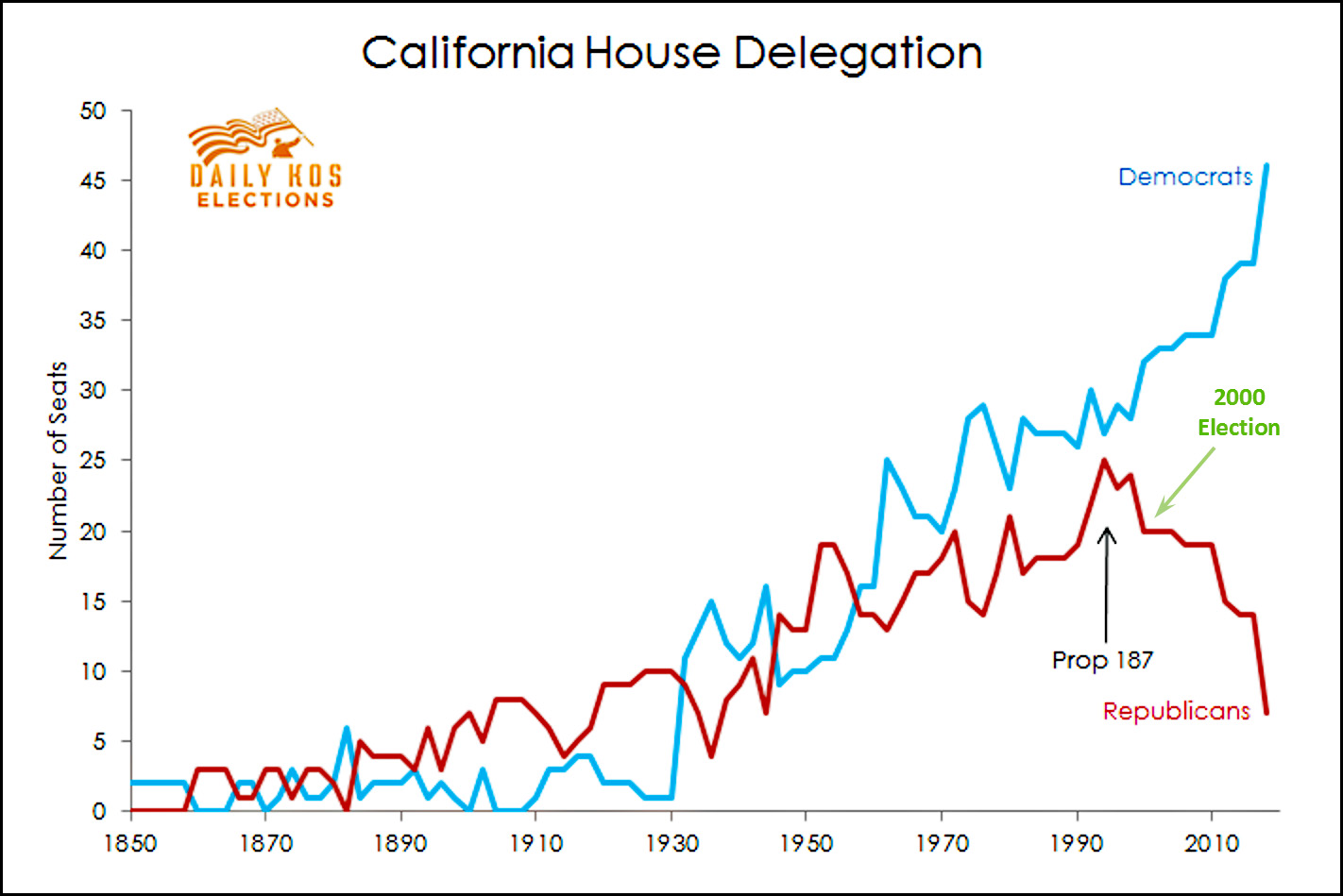
    I guess it’s time for my biannual Prop 187 mythbusting post.¹ This one is prompted by Daniel Donner over at Daily Kos, who says that California’s infamous Proposition 187, passed in 1994, was responsible for the decline and eventual death of the Republican Party here:

    The high point for the California GOP came with the re-election of Pete “I Am Not A Racist” Wilson as governor as he campaigned for the indisputably racist Proposition 187, in 1994, the year of the Angry White Male (oh, hindsight). Prop 187 coincided with a shift in the political preferences of Latinos even more toward Democrats, and an increase in Latino political participation; while causation is difficult to prove, alternate explanations are hard to come by.

    But there is an alternative explanation, and it’s really simple. First, though, here is Donner’s chart. I’ve added the arrow in green:

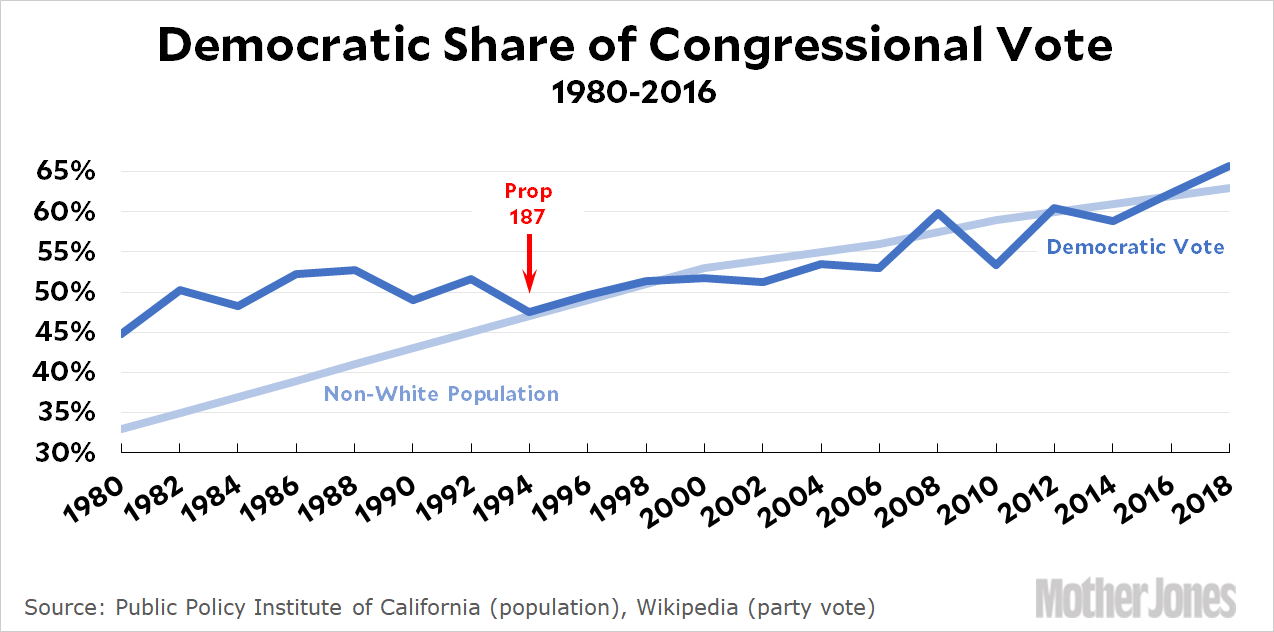
    The main thing to notice here is that the black arrow distracts you from looking at the chart properly. In fact, nothing much happened in the two elections following Prop 187. The first big drop for Republicans came in 2000, six years later. So what’s going on? The answer is pretty simple: The non-white share of the population steadily increased starting around 1970 and the Democratic share of the congressional vote increased along with it. Here’s a chart:

    As you can see, the Democratic share of the congressional vote increased along with the non-white population from 1980 to 1988, then dipped for a few years, and then closely followed the population trend again from 1994 to the present. Aside from the odd 1990-94 dip, the only explanation you need for this is the growth of the non-white population. More about that here.

    It’s likely that Prop 187 helped cement Latino opposition to the Republican Party, and might well be responsible for a few additional points of Democratic vote share. In fact, I have a hard time believing that’s not the case. But you really can’t see it in the numbers. Basically, the more non-whites there are, the bigger the Democratic vote share. And that’s all there is.

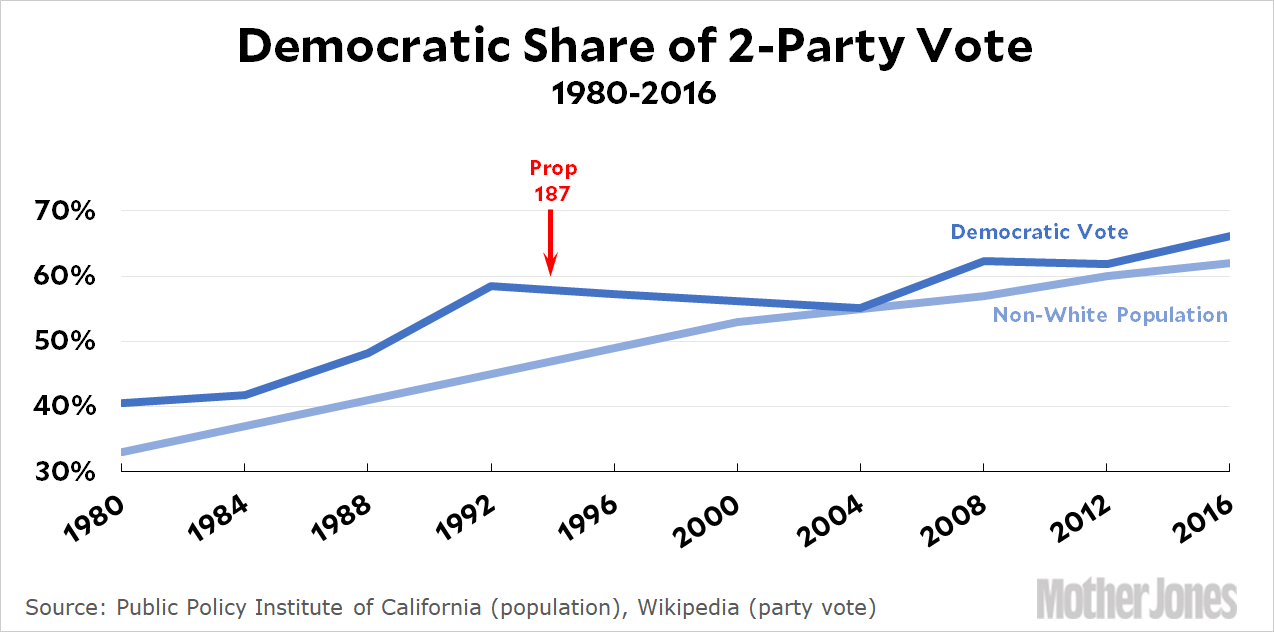
    POSTSCRIPT: In case you’re interested, you can see pretty much the exact same thing if you look at presidential vote shares:

    ¹Prop 187 denied public services to undocumented immigrants. It passed in 1994 with the overwhelming support of the Republican Party, but it was eventually struck down by the courts.

  • The First “True” Word Processor Was Invented By … IBM

    Jay Nordlinger points me to an obituary in the New York Times a couple of days ago:

    Evelyn Berezin, a computer pioneer who emancipated many a frazzled secretary from the shackles of the typewriter nearly a half-century ago by building and marketing the first computerized word processor, died on Saturday in Manhattan. She was 93.

    ….In an age when computers were in their infancy and few women were involved in their development, Ms. Berezin (pronounced BEAR-a-zen) not only designed the first true word processor; in 1969, she was also a founder and the president of the Redactron Corporation, a tech start-up on Long Island that was the first company exclusively engaged in manufacturing and selling the revolutionary machines.

    ….Ms. Berezin called her computer the Data Secretary. It was 40 inches high, the size of a small refrigerator, and had no screen for words to trickle across. Its keyboard and printer was an I.B.M. Selectric Typewriter with a rattling print head the size of a golf ball. The device had 13 semiconductor chips, some of which Ms. Berezin designed, and programmable logic to drive its word-processing functions. Later versions of Redactron word processors came with monitor screens for text, separate printers, greater memory caches, smaller consoles, faster processing speeds and more programmed features to smooth the writing and editing tasks.

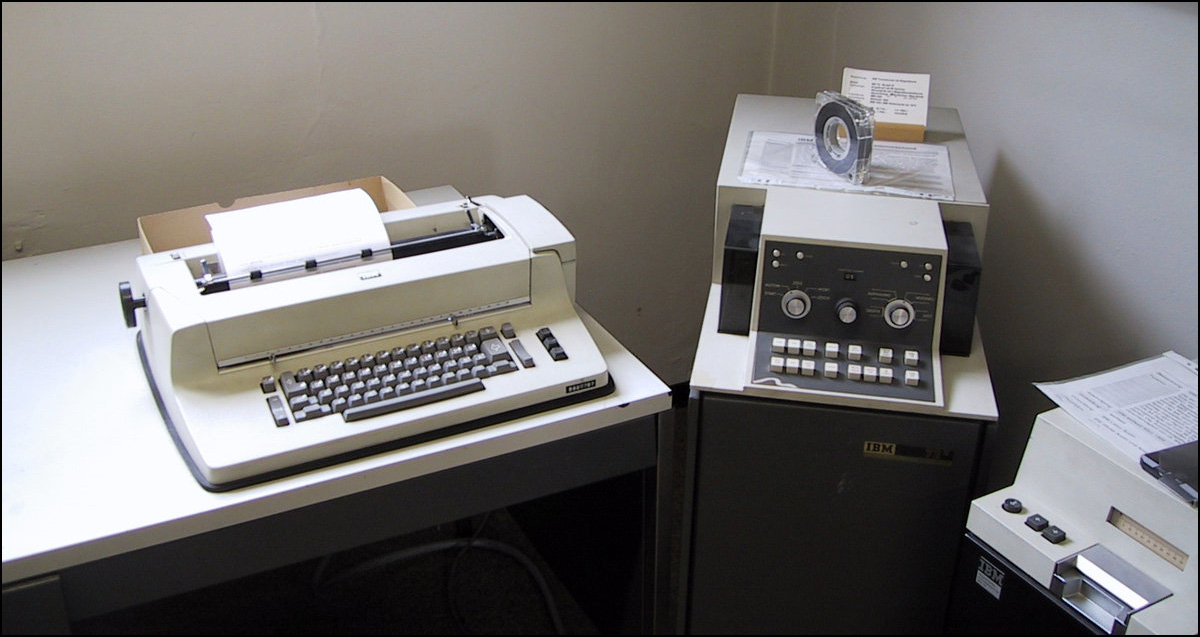
    This…does not compute. The Data Secretary was functionally identical to the IBM MT/ST, introduced in 1964. Like the Data Secretary, it was not a modern word processor that allows you to type an entire document and then print it out. You typed one line at a time on an IBM Selectric typewriter—fixing typos along the way—and then saved each line on a device that used quarter-inch magnetic tape. When you were done, you put a blank piece of paper in the typewriter and told it to spit out all the lines you had typed. Here’s a picture:

    If all this sounds like a pain in the ass, I assure you it was. I used one of these devices—nicknamed Molly—as the front end of an IBM typesetting machine—nicknamed Hal—back in the 70s to publish the student newspaper at Caltech. However, I also occasionally used it in standalone word processing mode to write term papers.

    Evelyn Berezin’s Data Secretary was the first computerized word processor only if you use the word “computerized” very narrowly: the MT/ST was originally electromechanical and only later used circuit boards in its main processing unit. The Data Secretary used ICs from the beginning.

    I understand that the Times obit section is trying to be more conscious these days of women who didn’t get credit for their accomplishments back in the day. In this case, however, they’ve overreached. Berezin didn’t invent the concept of word processing; or the term “word processing”; or the first actual word processing machine. IBM did all those things. She did, however, invent the first standalone word-processing machine driven by electronic components. It was an important evolution that lowered the cost of word processing and made it more reliable,¹ but it doesn’t mean that Berezin “built the first true word processor.”

    ¹The MT/ST broke down constantly. I became very familiar with the IBM service folks during the two years I made heavy use of Molly.

  • Lunchtime Photo

    This is a row of abandoned pay phones at the corner of Parkside and Ocean in Brooklyn. Here’s my question: why are they there? Why haven’t they been torn down and tossed away? Is it because of bureaucratic sluggishness? Telephone company apathy? Or is there some great “only in New York” kind of story behind this?

    September 14, 2018 — Brooklyn, New York