Donald Trump will never cop to it, but I imagine this is what he looked like on Tuesday night as he was watching CNN on the sly and finally realized that he was getting shellacked and there was nothing he could do about it.
In reality, this is a golden lion tamarin at the Prospect Park Zoo. It’s an endangered species. Hopefully Trump is too.
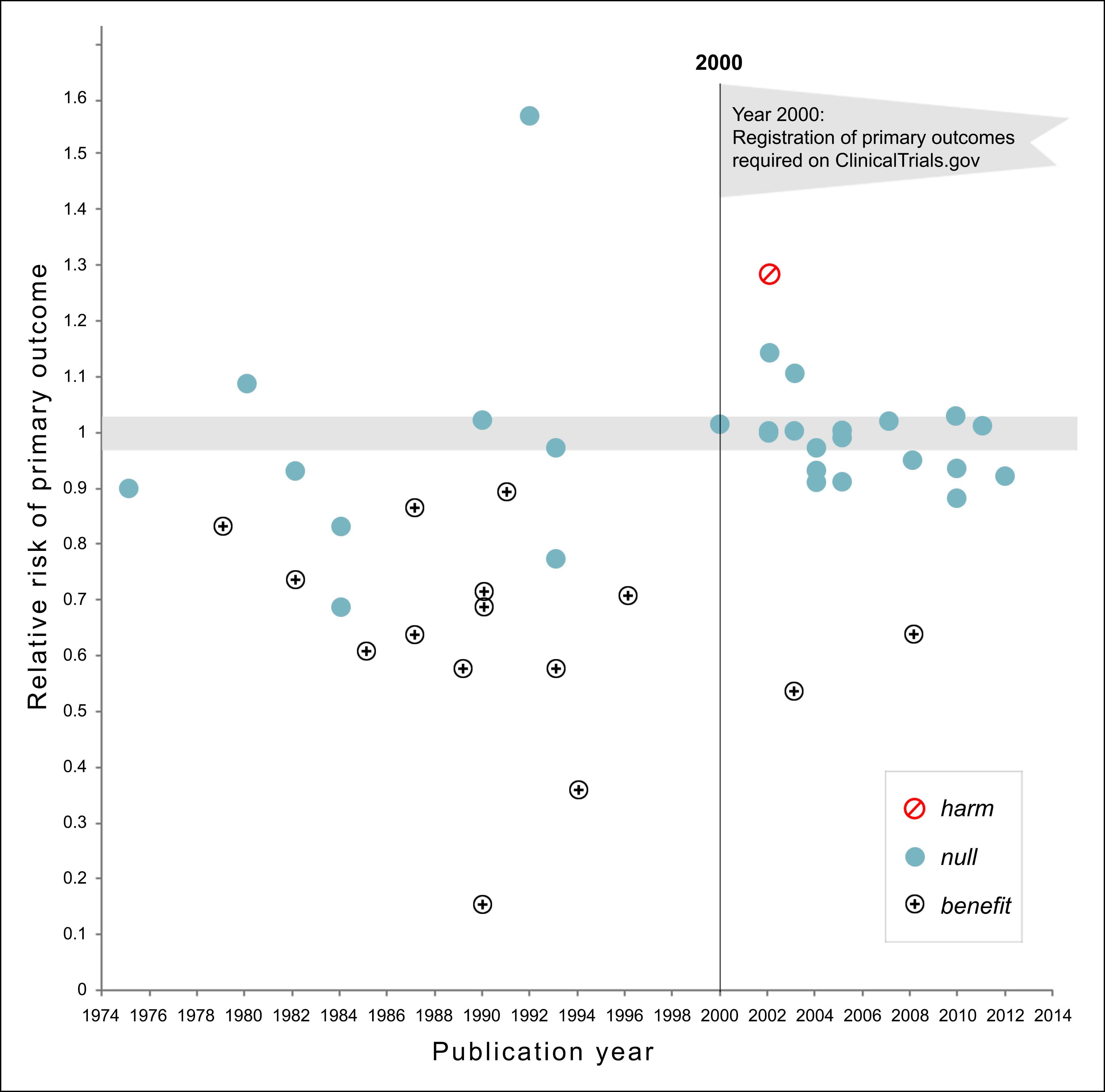
This chart is three years old, but it may be one of the greatest charts ever produced. Seriously. Via John Holbein, here it is:
Let me explain. The authors collected every significant clinical study of drugs and dietary supplements for the treatment or prevention of cardiovascular disease between 1974 and 2012. Then they displayed them on a scatterplot.
Prior to 2000, researchers could do just about anything they wanted. All they had to do was run the study, collect the data, and then look to see if they could pull something positive out of it. And they did! Out of 22 studies, 13 showed significant benefits. That’s 59 percent of all studies. Pretty good!
Then, in 2000, the rules changed. Researchers were required before the study started to say what they were looking for. They couldn’t just mine the data afterward looking for anything that happened to be positive. They had to report the results they said they were going to report.
And guess what? Out of 21 studies, only two showed significant benefits. That’s 10 percent of all studies. Ugh. And one of the studies even demonstrated harm, something that had never happened before 2000
Reports for all-cause mortality were similar. Before 2000, 5 out of 24 trials showed reductions in mortality. After 2000, not a single study showed a reduction in mortality. Here’s the adorable way the authors summarize their results:
The number of NHLBI trials reporting positive results declined after the year 2000. Prospective declaration of outcomes in RCTs, and the adoption of transparent reporting standards, as required by clinicaltrials.gov, may have contributed to the trend toward null findings.
Let me put this into plain English:
Before 2000, researchers cheated outrageously. They tortured their data relentlessly until they found something—anything—that could be spun as a positive result, even if it had nothing to do with what they were looking for in the first place. After that behavior was banned, they stopped finding positive results. Once they had to explain beforehand what primary outcome they were looking for, practically every study came up null. The drugs turned out to be useless.
Is this because scientists are under pressure from pharmaceutical companies to show positive results, and before 2000 they did exactly that? Or is it because scientists just like reporting positive results if they can? After all, who wants to spend years of their life on a bit of research that ends up being a nothingburger? I guess we’ll never know. But one thing we do know: we need to keep as sharp an eye on scientists as we do on anyone else, especially if there’s a lot of money at stake. When we don’t, they’re just as vulnerable to pressure and hopeful thinking as anyone.
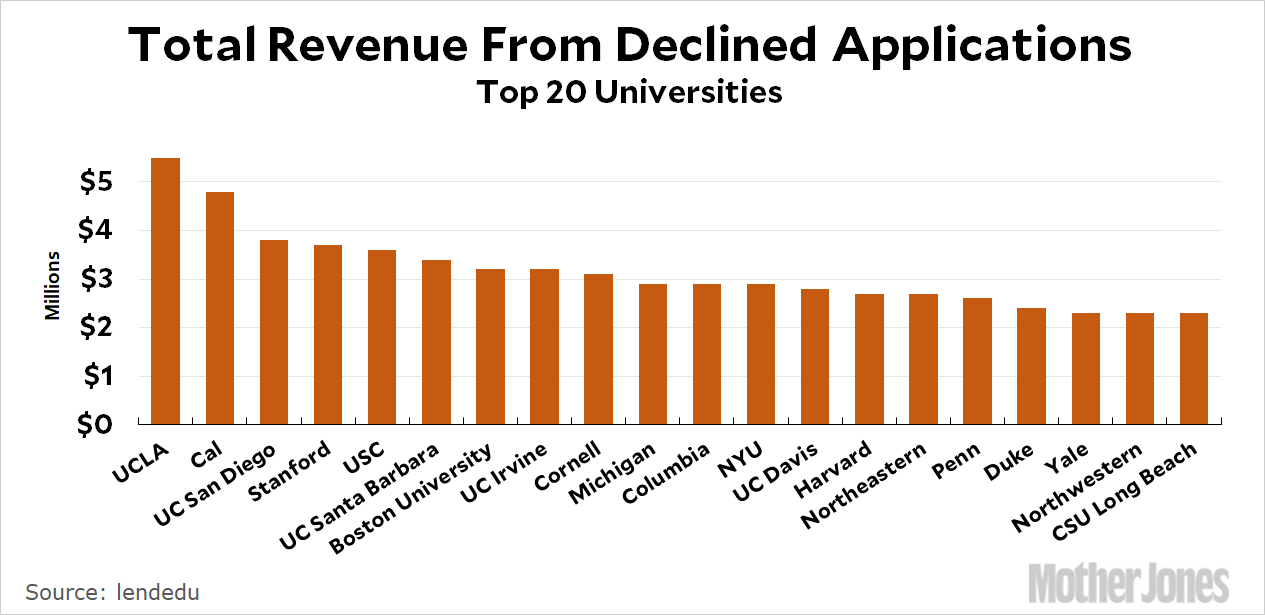
I’ve gotten a couple of emails from an outfit called lendedu, which I guess is some kind of loan broker or something. Anyway, as an enticement to people like me, they have calculated which universities make the most money from declined applications. Here’s the top 20:
They suckered me into this because my alma mater made the list, over on the far right. My puny little state university makes loads of money from declined applications! Apparently CSU Long Beach receives 62,000 applications per year (!) but admits only about 20,000. That makes for 42,000 applicants annually who paid $55 but were eventually turned down. I have to say that I had no idea The Beach was such an exclusive institution. But times change.
Anyway, most of the disappointed applicants haven’t really wasted their money, since I assume they mostly end up at CSU Fullerton or CSU Dominguez Hills or some other nearby campus.
Another interesting factoid: All of the top six and nearly half of the top 20 are in California. Is this because UC has such a great reputation? Or because our weather and partying have such a great reputation? Or both?
How do you illustrate a blog post about moderates? Beats me, but I gave it a shot by searching our photo service for "moderate" to see what I could get. This one popped up because it's a picture of Kashmir after "moderate snowfall." Good enough!Saqib Majeed/SOPA via ZUMA
Moderate Democratic candidates were the big winners of swing congressional districts in the 2018 midterm elections, flipping most of the 28 key House districts from Republicans’ control and winning key gubernatorial races, including Michigan, Wisconsin, Kansas, and Illinois. Democrats’ net gain in the House was 26 seats.
Progressive candidates flipped few of those seats. For the most part, the biggest upsets for the left occurred during the summer primaries; most of those districts were already blue and primed to elect Democrats. Many of the left-wing candidates who tested the theory of turning out their base, even in more conservative districts, lost on election night.
On Tuesday, there were signs of a shift back toward the politics that had long defined the region. Though Republicans remain the more powerful party in the center of the country, voters flipped governor’s offices back to Democrats in those four states and sent Democrats to Congress in several suburban districts that had long been firmly Republican. Moderation plays well in the Midwest.
….What happened in the Midwest this week, bringing an end to total Republican control in three state capitals, was in some cases less a sharp shift on matters of national ideology and more a return to the once-familiar political middle. For at least some voters, the choices seemed less about fiery debates over illegal immigration or who ought to be on the Supreme Court and more about meat-and-potato matters like repairing potholes and paying for schools. Some voters said they simply did not care for too much of one thing — red, blue or otherwise.
This is what I was talking about a couple of days ago. When parties expand, they almost always expand into the center, thus becoming a bit less conservative or progressive in practice. The opposite happens to the losing party. Democrats have been more progressive since 2010 after losing all the blue dogs, and are now set to become a bit more centrist with the addition of lots of new moderate members. Likewise, Republicans became a nearly ungovernable coalition after 2010 thanks to the addition of lots of moderates, and now they’re set to become “more Trumpian”—as many reporters put it—with the loss of all those moderates.
This is the eternal conundrum: your party can be small and pure or large and noisy. In a two-party democracy like America there’s not really a third option unless you can somehow convince more than half the country to adopt extreme political views. Good luck with that.
This was the hot topic on my Twitter feed just as I was falling asleep last night, but today is a new day:
White House press secretary Sarah Sanders on Wednesday night shared a video of CNN reporter Jim Acosta that appeared to have been altered to make his actions at a news conference look more aggressive toward a White House intern.
The edited video looks authentic: Acosta appeared to swiftly chop down on the arm of an aide as he held onto a microphone while questioning President Trump. But in the original video, Acosta’s arm appears to move only as a response to a tussle for the microphone. His statement, “Pardon me, ma’am,” is not included in the video Sanders shared. Critics said that video — which sped up the movement of Acosta’s arms in a way that dramatically changed the journalist’s response — was deceptively edited to score political points. That edited video was first shared by Paul Joseph Watson, known for his conspiracy-theory videos on the far-right website Infowars.
Watson said he did not change the speed of the video and that claims he had altered it were a “brazen lie.” But side-by-side comparisons support claims from fact-checkers and experts such as Jonathan Albright, research director of the Tow Center for Digital Journalism at Columbia University, who argued that crucial parts of the video appear to have been speeded up or altered so as to distort the action.
Acosta was refusing to give up the mic because he wanted to ask a followup question, and you can decide for yourself if that demonstrates bad manners. But of course the White House couldn’t just stop there. Sarah Huckabee Sanders revoked Acosta’s press pass, saying they would “never tolerate a reporter placing his hands on a young woman just trying to do her job as a White House intern”—a nasty implication that’s plainly untrue. Then she posted the doctored video:
We stand by our decision to revoke this individual’s hard pass. We will not tolerate the inappropriate behavior clearly documented in this video. pic.twitter.com/T8X1Ng912y
The intern’s reach for the mic is slowed down, and the “chop” motion is accelerated. Here’s an annotated side by side comparison: pic.twitter.com/wLCG5GVdo1
It’s subtle, but it does indeed appear to be doctored to make Acosta’s action look more like a deliberate “karate chop.” I wonder how this is being handled over at Fox News? I don’t have the foritude to turn on the TV and find out.
I just woke up from one of my dex-induced 3-hour naps to learn that this has been a bad week for people named Sessions. The first to go was Rep. Pete Sessions, son of former FBI director William Sessions, and today it was the turn of Attorney General Jeff Sessions, former senator from the great state of Alabama. Both are Eagle Scouts.
So Jeff Sessions has finally been fired. For the nonce, he has been replaced by his chief of staff, Matthew Whitaker. It doesn’t appear that Whitaker was ever an Eagle Scout, but he did play in the Rose Bowl for Iowa. In any case, this will all change whenever Trump gets around to nominating a permanent replacement—unless Trump decides to stick with Whitaker. Whoever it is, I think one thing we can be sure of is that it won’t be someone who will recuse himself from the Russia investigation.
By the way, the Washington Post reported on this three weeks ago:
President Trump talked recently with Jeff Sessions’s own chief of staff about replacing Sessions as attorney general, according to people briefed on the conversation, signaling that the president remains keenly interested in ousting his top law enforcement official….On a long list of indignities that Sessions has endured from his boss, Trump’s discussing replacing him with his own top aide stands out.
I imagine this was fake news at the time, but whaddayaknow? It turned out to be real news after all. Trump just didn’t want to announce it before the election, when it might have pissed off some of his supporters, who were big Jeff Sessions fans.
I wonder who else Trump is itching to fire? Rod Rosenstein maybe? Does anybody have a pool going?
There were, obviously, a lot of losers last night: Donald Trump, the Republican Party, Steve Bannon, several Democratic senators, and rent control. And there were a bunch of winners: the Democratic Party, Mitch McConnell, Nancy Pelosi, and planet Earth.
But there were two very particular big winners and losers:
Biggest Winner: Obamacare. Democrats ran on health care and won. Several red states passed Medicaid expansion. The GOP’s lies about pre-existing conditions obviously didn’t stick. And Obamacare itself is now safe for another two years from Republican attempts to repeal it. I hesitate to say this since I’ve said it before, but I think this is the final hoorah. By 2020, Obamacare will be six years old. Republicans will have tried multiple times to repeal it and failed. They will have taken on pre-existing conditions and pre-existing conditions will have walloped them.
By 2020 Obamare will be just a standard part of the social safety net, available to anyone who loses a job or simply can’t afford free-market insurance. There will be no more juice in opposing it. Obamacare is here to stay.
Biggest Loser: Racism. Trump ran on racism and lost. He ran on the wall. He ran on the caravan. He ran on nationalism. He ran on hate and xenophobia and bigotry. He turned the volume up to 11 and became increasingly desperate as the campaign neared its end. The rest of the Republican Party either joined in or held their tongues, but they knew: in the suburbs of America, where Republicans once ruled, they were losing votes. In 2016, after eight years of Barack Obama and Fox News, a lot of suburbanites were willing to tolerate just a little more racism than they normally would, and Trump won. In 2018, with Obama long gone and two years of relentless racial ugliness fresh in their minds, their tolerance was gone. They voted against the racism and the hate, and Trump lost.
Racism did not get crushed as definitively as I’d hoped. But there’s not much question that Republicans have now learned that there really is a limit to how far it can take you in the 21st century. They’ve now hit that limit, and if they want to win national elections in the future they’re going to have to rely on something else.
NOTE: This post is totally wrong. A corrected post is here.
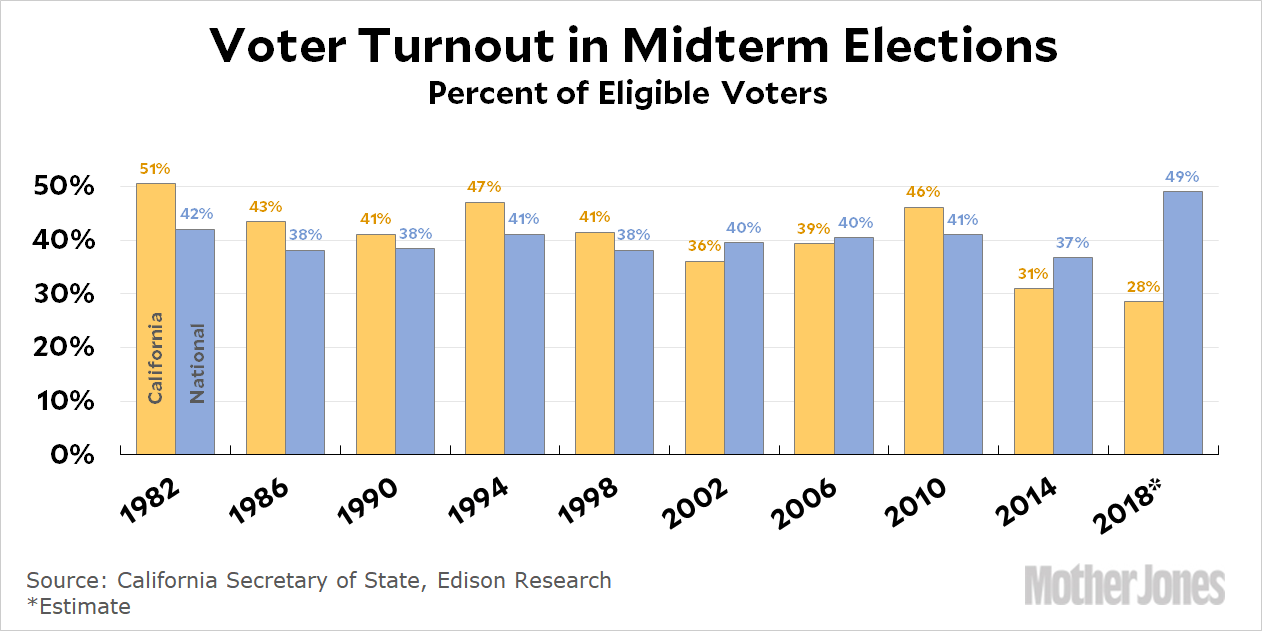
For the past two months I’ve heard nothing except hoots and hollers about how voter turnout this year is going to be amazing. Excitement is sky high! Early voting is tremendous! Lines to vote are miles long!
And apparently everyone was right. Edison estimates that voter turnout reached 49 percent in 2018, the highest in a midterm election in the past 40 years:
On the other hand, here in the center of the Resistance voter turnout was dismal, the worst in 40 years. This is almost certainly because of our crappy top-two primary, which makes most of our statewide offices completely uninteresting. We had plenty of good local races and plenty of ballot initiatives this year, but it wasn’t enough to make up for the fact that both the Senate race and the Governor’s race were foregone conclusions.
[UPDATE: I’m reliably told that the California numbers only include the ballots counted so far. The final number will probably be at least 3-5 points higher than it is in my chart. This is still not great, but at least it’s better than 2014.]
Moral of the story: If you want people to turn out to vote, you need to give them something interesting to vote for. Here in California we rarely do that anymore. We should go back to an ordinary primary system that allows Democrats and Republicans to pick their candidates separately. Maybe then we could persuade people to get out and vote.
I want to repeat what I said last night. The midterm results probably seem disappointing to Democrats because they lost so many high-profile races: Bill Nelson and Andrew Gillum in Florida, possibly Stacey Abrams in Georgia, Beto O’Rourke in Texas, and Claire McCaskill in Missouri. Plus a bunch of shaky House members won: Devin Nunes, Steve King, Duncan Hunter, and here in my own district, Mimi Walters. What’s more, it looks like Dems are going to lose all three of the razor-close Senate races: Montana, Arizona, and Florida.
But! Dave Brat lost. Scott Walker lost. Kris Kobach lost. Barbara Comstock lost. Dana Rohrabacher finally lost. And Dems picked up seven governorships.
But most important, Democrats flipped dozens of congressional seats and took control of the House despite running against a terrific economy. The last time we had an economy this good during a midterm was in 1998, when the party in power actually picked up seats in the House. The fact that Democrats did so well in face of such huge headwinds is a rebuke to Donald Trump and no one else. Suburban voters simply got tired of his racist and xenophobic schtick and turned on him en masse. The result was a historic victory for progressives.
So celebrate! The odds of doing this well when the economy was in great shape were tiny. Don’t let the perfect be the enemy of the good. Progressives kicked ass this year, and no amount of spin from the White House can change that. Donald Trump will try, but he’s got nothing:
I will be doing a news conference at The White House – 11:30 A.M. Will be discussing our success in the Midterms!
And we respect that! But maybe you’re of a mind to support our work directly instead? We have until December 31 to raise the last $400,000 we need to keep our nonprofit newsroom running at full strength into 2026. Will you make a gift today?
We noticed you have an ad blocker on. Can you pitch in a few bucks to help fund Mother Jones' investigative journalism?
Billionaires own the media,
but they don’t own us.
At Mother Jones we know these aren’t conventional times, and they require unconventional coverage. That’s what deliver every day: fierce, independent journalism you can’t find elsewhere. Perhaps never in the history of our country has that been more necessary than now. But we can’t do it without reader support—your support. Please chip in today.
Billionaires own the media,
but they don’t own us.
At Mother Jones we know these aren’t conventional times, and they require unconventional coverage. That’s what deliver every day: fierce, independent journalism you can’t find elsewhere. Perhaps never in the history of our country has that been more necessary than now. But we can’t do it without reader support—your support. Please chip in today.