• With the Election Over, Trump Doesn’t Care About Vets Anymore

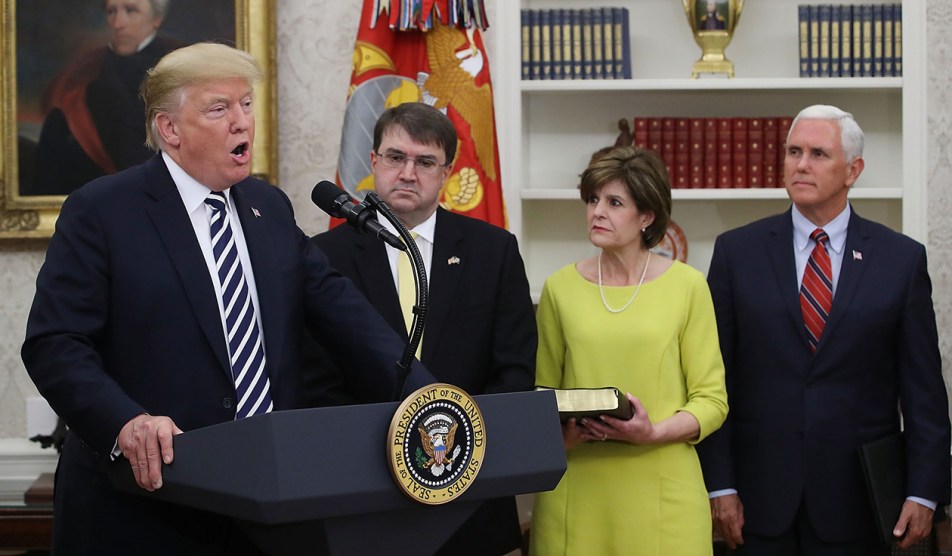
    Donald Trump and new VA Secretary Robert Wilkie. So far, the Trump administration has been too busy trying to obsessively outsource care to its private sector pals to bother giving any thought to how service might be improved.Mark Wilson/CNP via ZUMA

    Back in 2016 Donald Trump maintained a hard line on problems in the VA. “I will instruct my staff that if a valid complaint is not addressed, that the issue be brought directly to me,” he said. “I will pick up the phone and fix it myself if I have to.”

    Tough words. The reality is a little different: Trump hired 60 customer service agents in a small office in West Virginia to take messages and pass them along:

    “We’re going to try to get you some help,” Mary said to the man on her line now, an Air Force veteran who had erroneously received a bill for $350.18. He did not have $350.18….But for now, the only person trying to fix it was Mary, a 44-year-old widow with blond hair, a cross around her neck and long lavender nails that clacked on her keyboard. She had learned so much about VA that she wished she had known when her husband, an Army veteran, had been alive. But still, she could not make the $350.18 bill go away.

    She could not see why it was sent. She could not access benefits or medical records, even with the man’s permission. She wasn’t allowed to call his provider. All she could do was type his problem and send it to a different team in a different place that would respond in approximately 60 business days, if it responded on time.

    Listen. Type. Send. This was what the 60 customer service agents could do for the 107,000 calls that had come in since June 2017. On this day, there would be 584 more.

    Promises made. Promises ignored. Typical Trump.

  • Just Stop It. The Elderly Are Doing Fine.

    I’m so tired of this stuff. Here is yet another new study of bankruptcy, which the New York Times describes like this:

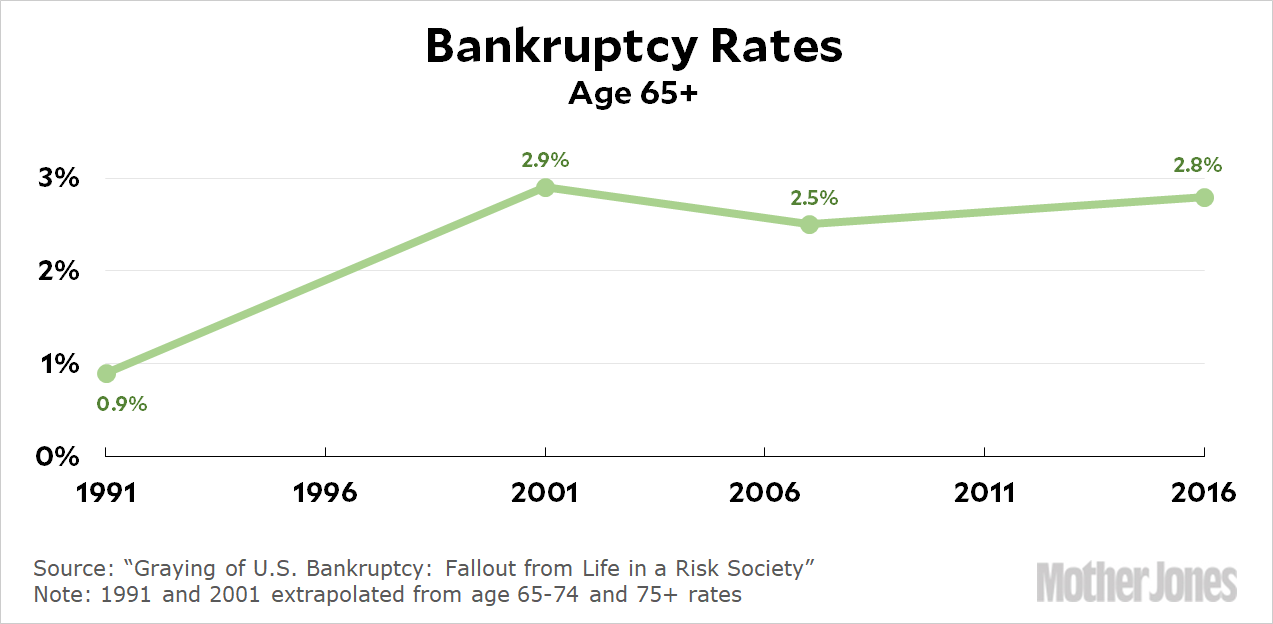
    For a rapidly growing share of older Americans, traditional ideas about life in retirement are being upended by a dismal reality: bankruptcy. The signs of potential trouble — vanishing pensions, soaring medical expenses, inadequate savings — have been building for years. Now, new research sheds light on the scope of the problem: The rate of people 65 and older filing for bankruptcy is three times what it was in 1991.

    And here’s the abstract of the study itself:

    We find more than a two-fold increase in the rate at which older Americans (age 65 and over) file for bankruptcy and an almost five-fold increase in the percentage of older persons in the U.S. bankruptcy system….For an increasing number of older Americans, their golden years are fraught with economic risks, the result of which is often bankruptcy.

    And here is the actual data:

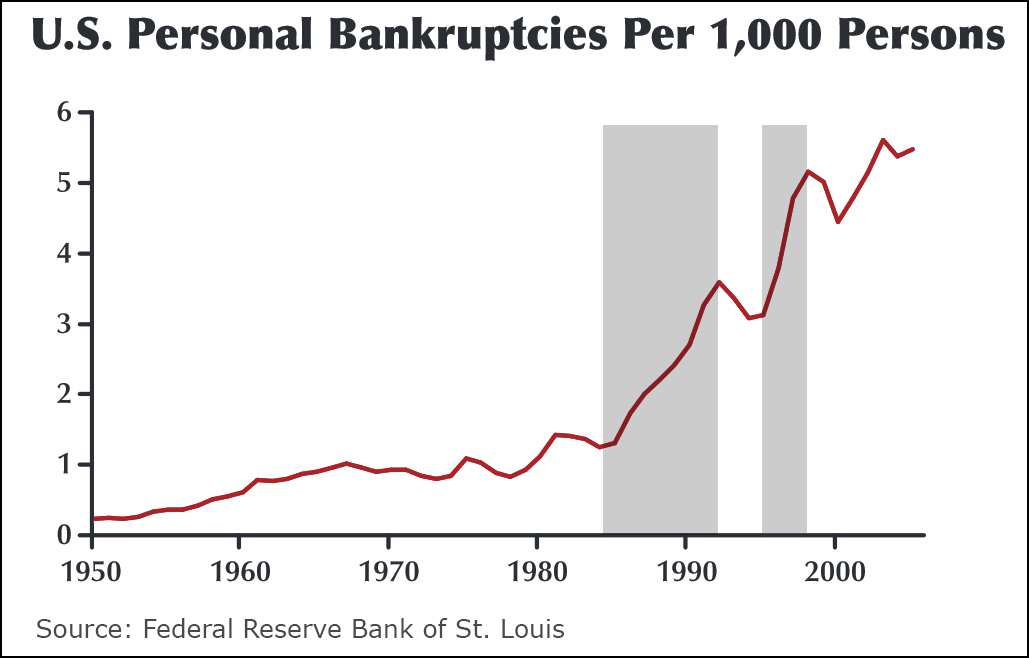
    Something happened between 1991 and 2001. But what? Here’s a longer-term look at all bankruptcies over the past 70 years:

    Something happened very broadly during the mid-80s and mid-90s, and whatever it was affected everyone, not just the elderly. Since 2001, however, bankruptcies haven’t changed much among any age group, including the elderly.

    This is the story. Credit card debt, the dotcom bubble, the housing bubble, the 2005 bankruptcy law, the rising cost of long-term nursing care—these are all stories. If you want to dig deeper and tell them, fine. But can we drop this endless scaremongering about a massive increase in elderly bankruptcies obtained solely by cherry picking the starting year and providing no surrounding context?

    The elderly are basically doing fine.¹ It’s everyone else we should be more worried about.

    ¹The main exception is long-term nursing care, which is the biggest financial risk for those aged 65+. We’ve been taking stabs at solving this problem since the Reagan era, but we’ve made little progress because we always try to do it on the cheap.

  • Trickle-Down Economics Is Working About As Well As Usual

    From the Wall Street Journal:

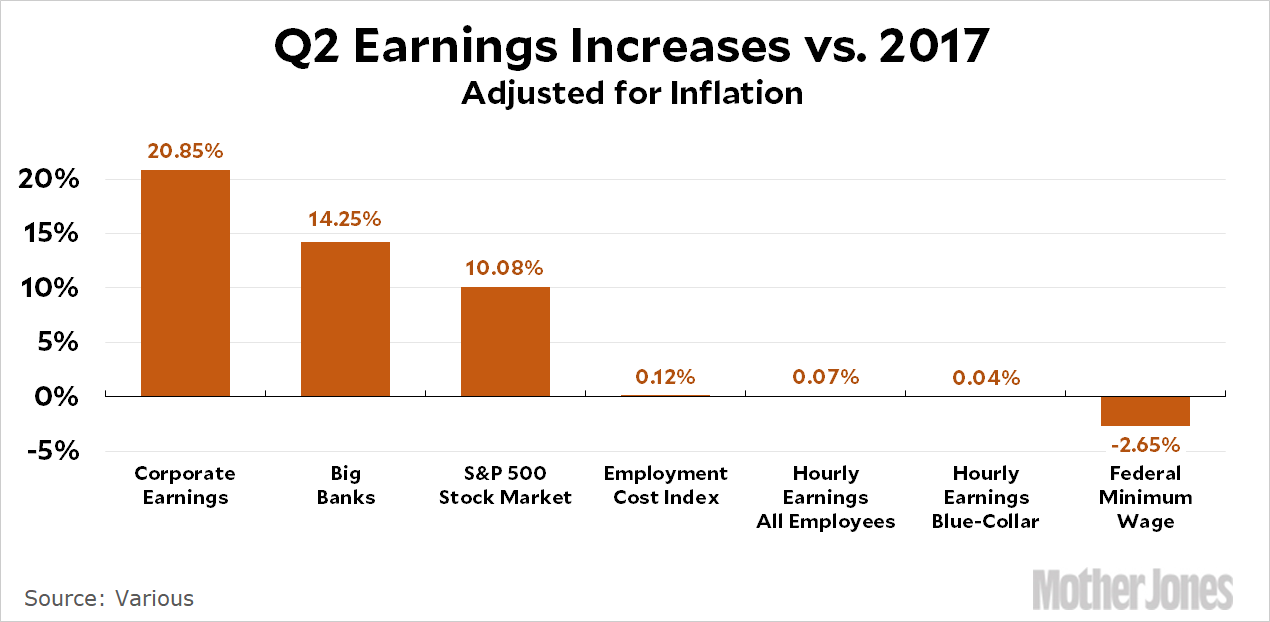
    Profits at S&P 500 companies jumped an estimated 23.5% in the three months through June, according to data from Thomson Reuters, more than two and half times revenue growth in the same period….“Companies are coming out unapologetically with pricing increases,” said Jim Russell, portfolio manager at Bahl & Gaynor. “That is one of the more optimistic things we see for keeping [profit] margins high in 2018 and into 2019.”

    Happy news indeed. Here’s a handy chart so that you can see how this is trickling down to all the rest of us:

    I recommend you pass this around to all your friends and ask them to tape it to their refrigerator doors until November 6.

  • Impending Execution Has Concentrated Republican Minds Wonderfully

    James Borchuck/Tampa Bay Times via ZUMA

    The Wall Street Journal proves once and for all that Republican politicians are brain dead:

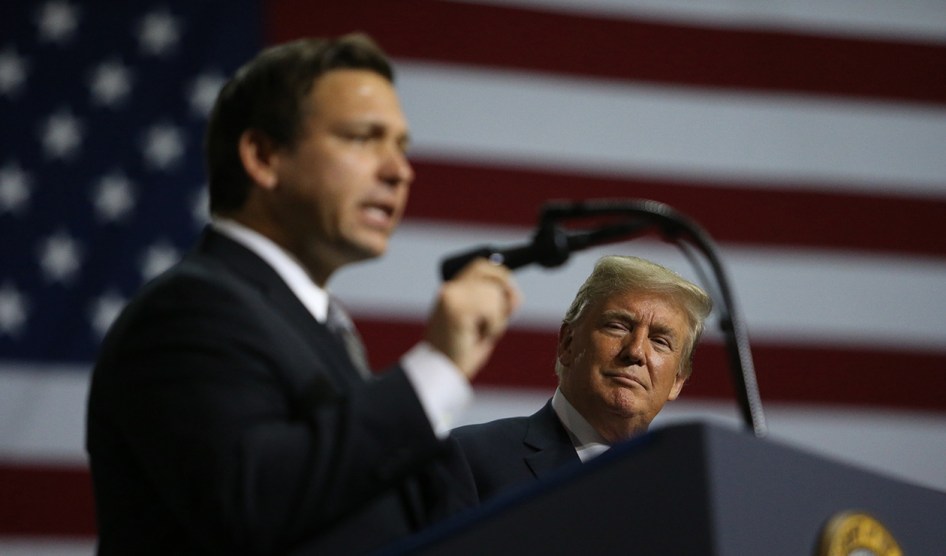
    President Trump, unaccustomed to campaigning for others, has settled into a new rhythm with Republican candidates who have found the key to securing a vigorous endorsement from their party’s leader….At rallies in the past two weeks, Republican contenders appear to have figured out how to captivate the party’s leader less than 100 days before the midterm elections. The formula: Cram compliments for the president into a few minutes in the spotlight, and exit the stage with a valuable, superlative endorsement from a beaming president.

    They just figured this out? How is this possible? Are they really so obtuse that until recently they didn’t understand the most basic personality characteristics of the guy they and their entire party voted for? Or have they always known but retained slightly too much self-respect to publicly abase themselves thoroughly enough for Trump’s liking—until, that is, the prospect of losing an election concentrated their minds sufficiently? Or both?

  • Trump’s Tweets Don’t Really Mean Anything

    This is even better than the orginal G7 picture that made the rounds in August. Check out Shinzo Abe. This is an all-time classic eye roll.Pignatelli/Euc/Ropi via ZUMA

    Remember when Donald Trump got pissed off and decided to pull out of the G7 communique? Well, um, BuzzFeed reports that it never happened:

    “The White House and State Dept. are actively ignoring the tweets of the president,” one of the sources said. “It’s like there’s a reality TV president, in his own bubble, thinking he controls stuff. It’s like The Truman Show.” Trump’s tweet, the source explained, wasn’t sufficient to pull out of the communique itself because “the G7 has a suite of diplomatic tools for communications, and Twitter isn’t one of them.” The lack of a formal US notification means the G7 communique remains intact as agreed by the seven leaders in Quebec, the source added.

    Twitter isn’t a formal diplomatic tool for the G7! Imagine. Steve Benen comments:

    This G-7 story isn’t the first example we’ve seen of U.S. officials choosing to disregard Donald Trump’s orders….It’s an alarming dynamic, of course, because our system of government isn’t supposed to work this way, but it’s nearly as troubling that Trump doesn’t seem to notice. He seems to make official declarations, assuming his orders will be followed, but he fails to do any follow up.

    Right. There are two things about this:

    • Trump doesn’t notice whether his tweets are carried out because his tweets aren’t meant as executive orders. They are meant as messages to his base. This is how you should read and interpret every Trump tweet. You have to look elsewhere to figure out if Trump is serious about something he’s tweeted.
    • Beyond that, though, it’s true that Trump doesn’t follow up much. That’s been true since his first day, when he all but sabotaged the White House hiring office and, in consequence, appointed hardly anyone to subcabinet posts out in the executive agencies. Every student of government knows that controlling the bureaucracy is crucial, and to do that you need your own people in as many jobs as possible. Everyone knows this. But Trump didn’t care, and apparently no one on his staff bothered to push him on it. I don’t know if this is because he hired such inexperienced staffers or if it’s because his staff was just as happy not to have lots of Trump true believers wreacking havoc in the outer provinces.

    Is this good or bad? Probably good, especially if Trump serves only one term and a new president can clean up the wreckage in 2021. But if Trump serves two terms? Erk.

  • Are We No Longer Allowed to Mock White Men?

    Welcome to the New York Times, Sarah! Now, instead of random fuckwits on Twitter, you have to put up with smarmy, extremely well-paid fuckwits on Fox News. Life is such a bowl of cherries, isn't it?Fox News Channel

    The latest identity politics micro outrage is about Sarah Jeong, a technology writer who will soon be joining the New York Times editorial board. She went to Berkeley and Harvard Law, where she edited the Harvard Journal of Law & Gender, and probably has an IQ of a million or so. Basically, she’s the kind of person who was crafted in a test tube from birth to join the New York Times editorial board.

    But she’s also been in lots of Twitter fights over the years and she has a pretty acid sense of humor. Naturally this means she has a huge archive of tweets saying things like, oh, “White men are bullshit.” That’s really the only example you need. The other zillion or so tweets, mostly in response to bullshit white men who were trolling her, are along the same lines.

    Now, I couldn’t really care less about this. It’s just more right-wing faux outrage culture, and I guess all my outrage is focused like a laser on Donald Trump and the Republican Party these days. The rest of you can do whatever you want as long as you clean up after yourselves. Unfortunately, Sarahgate’s life has been extended a few extra minutes because it’s Friday and Andrew Sullivan decided to write about it. Unlike the rest of you, I kind of like reading Sullivan even if he does sometimes write the most cackhanded stuff imaginable, and naturally he decided to make the case that Jeong is an unrepentant racist who has no place at the Times. I mean, what if she had said all that stuff about black people?!?

    But the alternative view — that of today’s political left — is that Jeong definitionally cannot be racist, because she’s both a woman and a racial minority. Racism against whites, in this neo-Marxist view, just “isn’t a thing” — just as misandry literally cannot exist at all. And this is because, in this paradigm, racism has nothing to do with a person’s willingness to pre-judge people by the color of their skin, or to make broad, ugly generalizations about whole groups of people, based on hoary stereotypes. Rather, racism is entirely institutional and systemic, a function of power, and therefore it can only be expressed by the powerful — i.e., primarily white, straight men.

    Now, everyone take a deep breath. I know you hate Sullivan, but try to put it out of your mind and pretend that this text emerged fully written from the forehead of Zeus. Also, put Jeong out of your mind. The rest of this post is generic and has nothing to do with her. So here’s the question: Is Sullivan correct?

    Personally, I think he’s 180 degrees backward. Anybody can be racist. This is so obvious that I hardly feel like wasting words explaining it. However, you can only really be racist toward nonwhites.¹ Within limits, you can say just about anything you want about whites—and especially white men—and it’s not racist. It’s just mockery of the ruling elite, the second-oldest pastime of the human race. Unfortunately, one of the big problems of our grand and tolerant era is that we can no longer say that white men are universally part of the dominant clan in America—unlike the past, when all but the very lowliest white man could still consider himself at least a tiny affiliate of the ruling class. Maybe his domain extended no further than the ability to call a shoeshine guy “boy,” but that was something, at least.

    But this isn’t true anymore. Sure, white men all have a certain amount of racial privilege that they may not even be aware of, but that’s not the be-all of human existence. You can have this modest amount of privilege and still have it overwhelmed by the fact that you really are at the bottom of the food chain. You don’t get to boss your wife around just to show who wears the pants in the family. Maybe you don’t even have a wife. You don’t automatically get a job at the factory before any of the blacks or Hispanics. The Asian guy across the street might make more money than you and his kid might be captain of the basketball team. The local Elks club allowed blacks in long ago, but they don’t want you because you don’t pay your dues or your bar tab reliably. If you have a job, your boss might well be a black guy. Or even a black woman. Ditto for your landlord, the cop who pulls you over for speeding, or the owner of the store who has to decide whether to give you a break and put some groceries on credit.

    So who can you mock these days? The answer is that punching up is OK but punching down isn’t, so you’re free to mock all the white men who still run the country. But who are they? What’s the word for them?

    This is the problem. God knows, white men generally deserve some mockery. But no matter how bigoted or stupid they are, it’s not kosher to mock folks who are several rungs down the social and economic ladder from you. You can discuss them, you can analyze them, you can criticize their views, and you can debate about how best to enlighten them. But mockery really is just a hair too close to the whole basket of attitudes that comprise standard issue de facto racism.²

    So how do you mock white men without including an awful lot of narrow-minded punching down? I’m not sure it’s possible anymore. Any ideas?

    ¹Needless to say, all of this is in the context of American racism. Other countries have all kinds of other tribal intolerances.

    ²Not de jure racism. Jim Crow, apartheid, and other legally enforced regimes of racism are a whole different thing.

  • Trump Trade Deficit Keeps Soaring

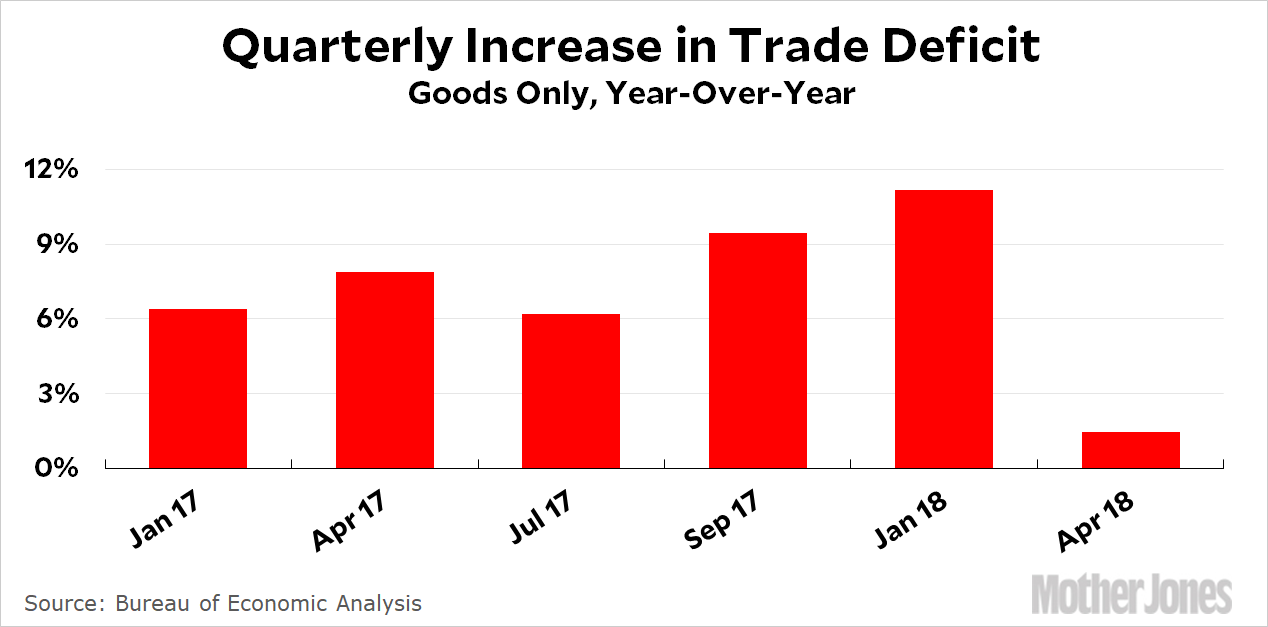
    Ha ha ha. The latest trade deficit numbers are out for the second quarter, and Donald Trump still can’t get it right:

    It keeps going up and up! Other countries are laughing at us! Even that weakling Obama had a better trade deficit! What a pathetic performance from Donald Trump. He’s just making America weaker and weaker.

    POSTSCRIPT: This is a joke. Nobody should really care if the trade deficit is going up a bit. What’s more, if Trump were ever smart enough to look at the complete figures for goods and services, it turns out that the trade deficit went down slightly this quarter. Of course, that would force Trump to admit that (a) services are actual things (b) our annual trade deficit is about $500 billion, not $800 billion, (c) our trade deficit with China is closer to $300 billion than $400 billion, and (d) we have a trade surplus with Canada

  • Friday Cat Blogging – 3 August 2018

    Here’s Hopper, rolling around in the morning sun right after a nice workout with the scratching post. Her right eye looks like the Eye of Sauron from the LOTR movies. I wonder if that’s where they got the idea?

    UPDATE: Reader AP emails to say: “Christopher Tolkien recently released Beren and Luthien, which tracks the evolution of one of Middle Earth’s central legends. It’s one of the earliest, chronologically, and I think also the first one in which Sauron appears. It turns out that in the earliest versions Tolkien wrote, the character that eventually became Sauron was Tevildo, Prince of Cats.”

    I think that’s appropriate. It’s a good thing we have them all totally tame these days with the evil completely bred out of them, right?

  • Raw Data: US Steel Production Since the End of the Recession

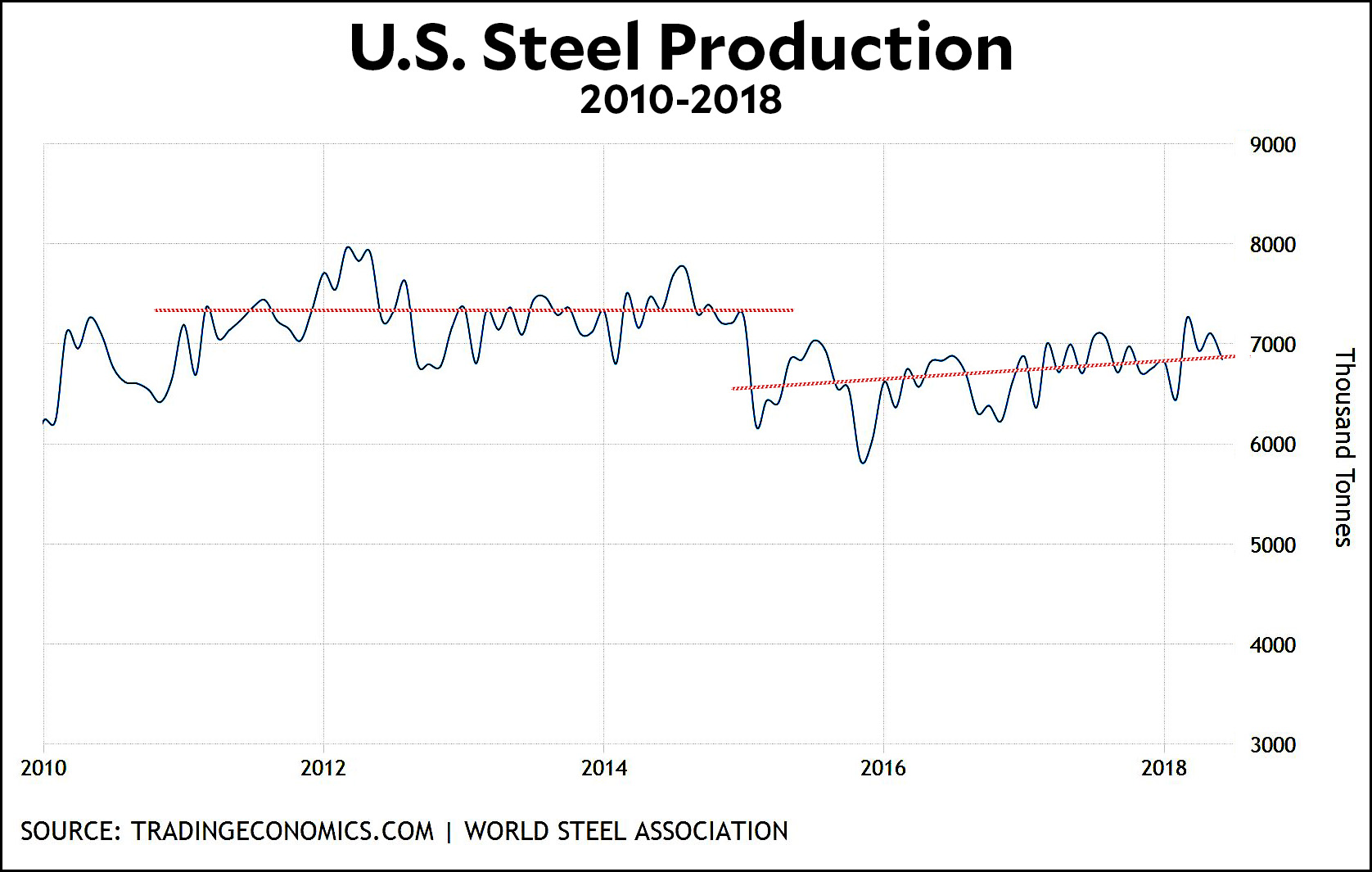
    Here is monthly raw steel production in the United States since the end of the recession in 2009:

    The US averaged about 7.3 million tonnes of steel production per month between 2010-2014. That dropped to about 6 million tonnes in 2015, and we’ve been slowly working our way back upwards ever since. We’ve continued making small increases over the past year, but total production is still barely 6.9 million tonnes per month, which is considerably less than in the entire 2010-2014 period.

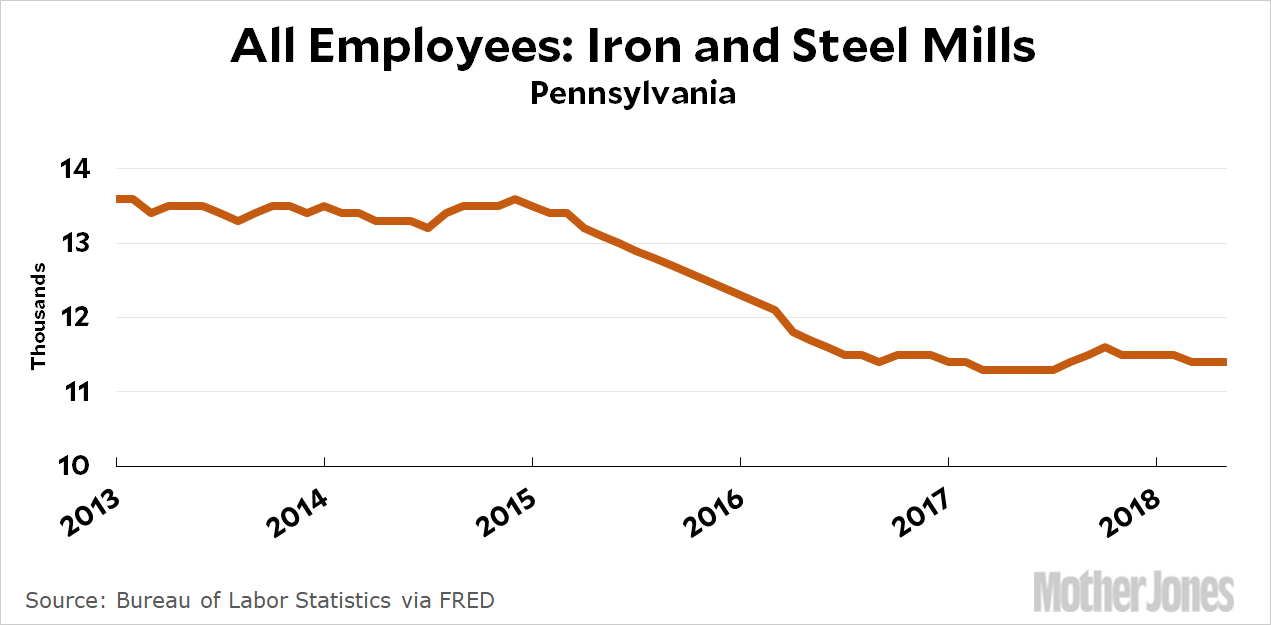
    Here is iron and steel mill employment in Pennsylvania through May 2018:

    To summarize: Overall steel production in the US has been increasing steadily but very slowly since its collapse in 2015. Capacity utilization has been running between 60-70 percent since the end of the recession and is currently at 76 percent, which suggests there’s unlikely to be a major boom in new plant construction. Employment in the steel industry in Pennsylvania has declined by about 2,000 over the past three years and has been dead flat since Donald Trump became president. Despite all this, Trump still fantasizes that he’s the steel king:

    Kinda sad.

  • Chart of the Day: Net New Jobs in July

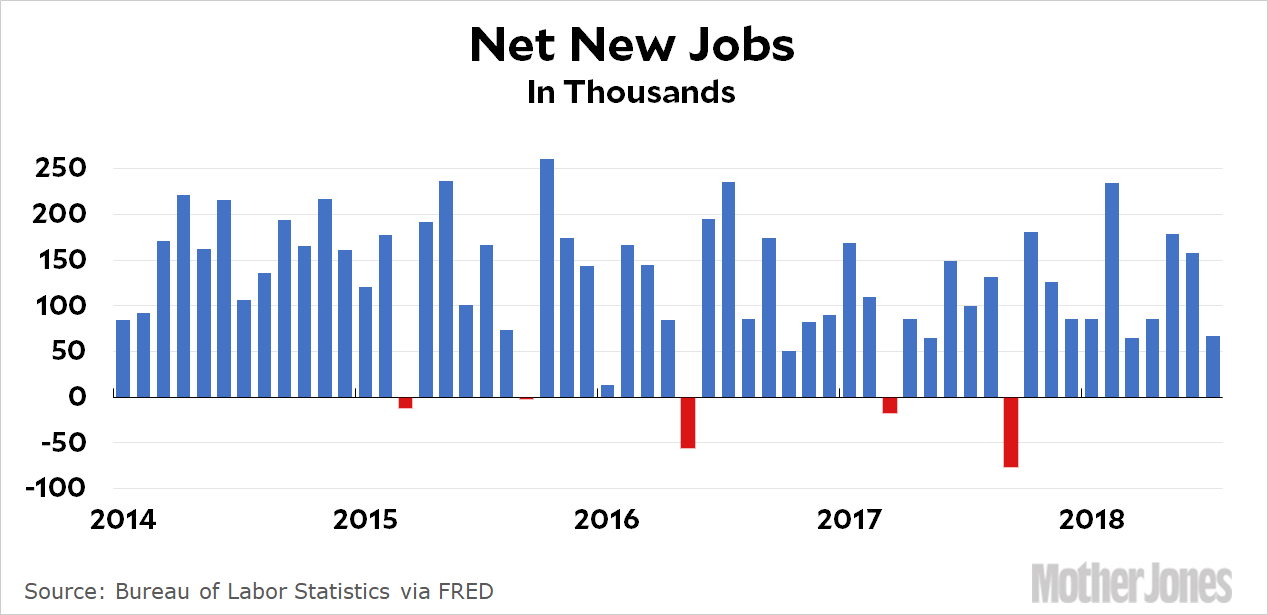
    The American economy gained 157,000 jobs last month. We need 90,000 new jobs just to keep up with population growth, which means that net job growth clocked in at a sluggish 67,000 jobs. The headline unemployment rate declined to 3.9 percent for solid reasons: the size of the labor force stayed about the same, but the number of people without jobs declined by an impressive 284,000.

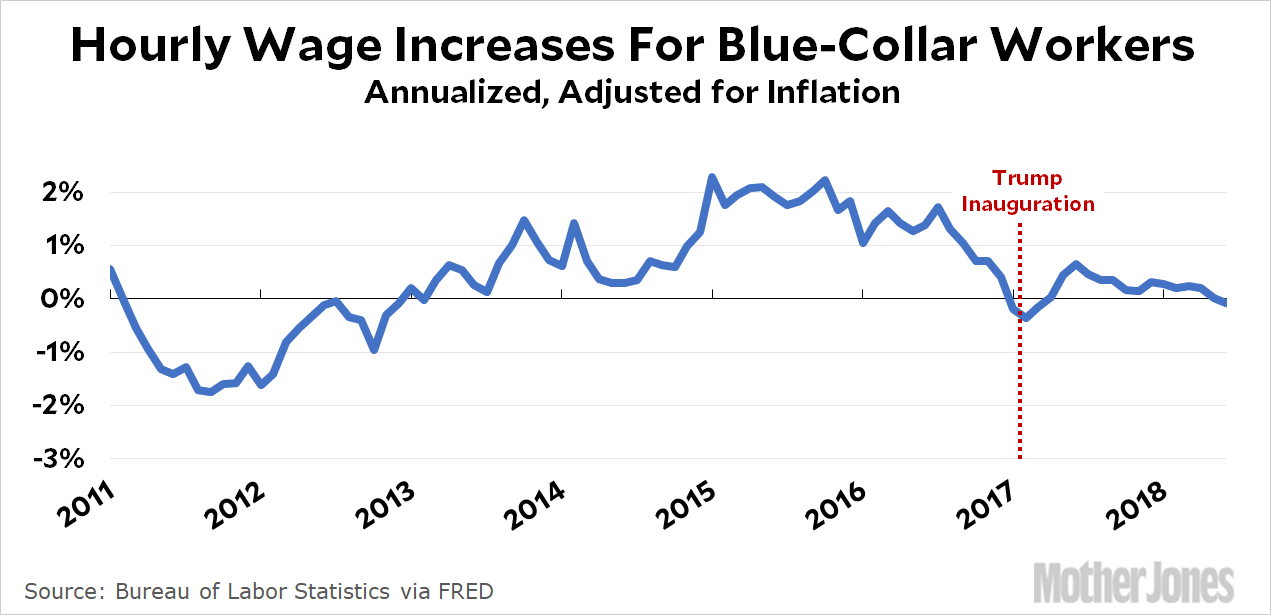
    Wages of production and nonsupervisory workers were up at an annualized rate of 1.7 percent. Unfortunately, the latest CPI report shows inflation running at an annualized rate of 1.5 percent, which means workers saw only a minuscule pay raise. Looking at the entire past year, hourly wages increased 2.7 percent while inflation has increased 2.8 percent. Over the past twelve months average worker wages have been dead flat.

    This is the new normal: decent but not great job growth, and no wage growth at all for blue-collar workers. An awful lot of people seem to think this is a sign of an economy that’s continuing to do great, but that’s not how it looks to me. It looks to me like a 21st century version of stagflation, where economic growth is OK but blue-collar workers are just dog-paddling along.

    Over the past two years, blue-collar wages have increased 0.3 percent annually. That’s $150 per year—about the cost of a replacement pair of work boots. I guess you can decide for yourself if that’s the sign of a robustly growing economy.