• Intel Community Says North Korea Is Deliberately Deceiving Us

    Yonhap News/Newscom via ZUMA

    After the summit in Singapore, reporters asked President Trump how fast we could expect progress on denuclearization. “It will go pretty quickly,” he said. “The timing will go quickly….it’s going to go very quickly. I really believe that it’s going to go fast.”

    So how’s that prediction panning out?

    In recent months, even as the two sides engaged in diplomacy, North Korea was stepping up its production of enriched uranium for nuclear weapons, five U.S. officials say, citing the latest intelligence assessment….While the North Koreans have stopped missile and nuclear tests, “there’s no evidence that they are decreasing stockpiles, or that they have stopped their production,” said one U.S. official briefed on the latest intelligence. “There is absolutely unequivocal evidence that they are trying to deceive the U.S.” Four other officials familiar with the intelligence assessment also said North Korea intended to deceive the U.S.

    The Wall Street Journal reported something similar a couple of days ago, but I got busy and never wrote about it. Today’s report from NBC News is considerably more detailed and considerably clearer. There’s simply no evidence that North Korea is doing the slightest thing to demonstrate any kind of good faith.

    As usual, what’s interesting here is both the actual news—North Korea is still going full speed ahead—and the underlying news of why this got leaked. On that score, it’s obvious that Trump is, as usual, not paying any attention to his intelligence briefings, and a bunch of people at the CIA and elsewhere have finally gotten fed up. If the only information he takes seriously is what he sees each morning on Fox & Friends, then the only way to get his attention is to leak stuff in the hopes that it will show up there eventually. Helluva way to run a railroad.
  • Health Update

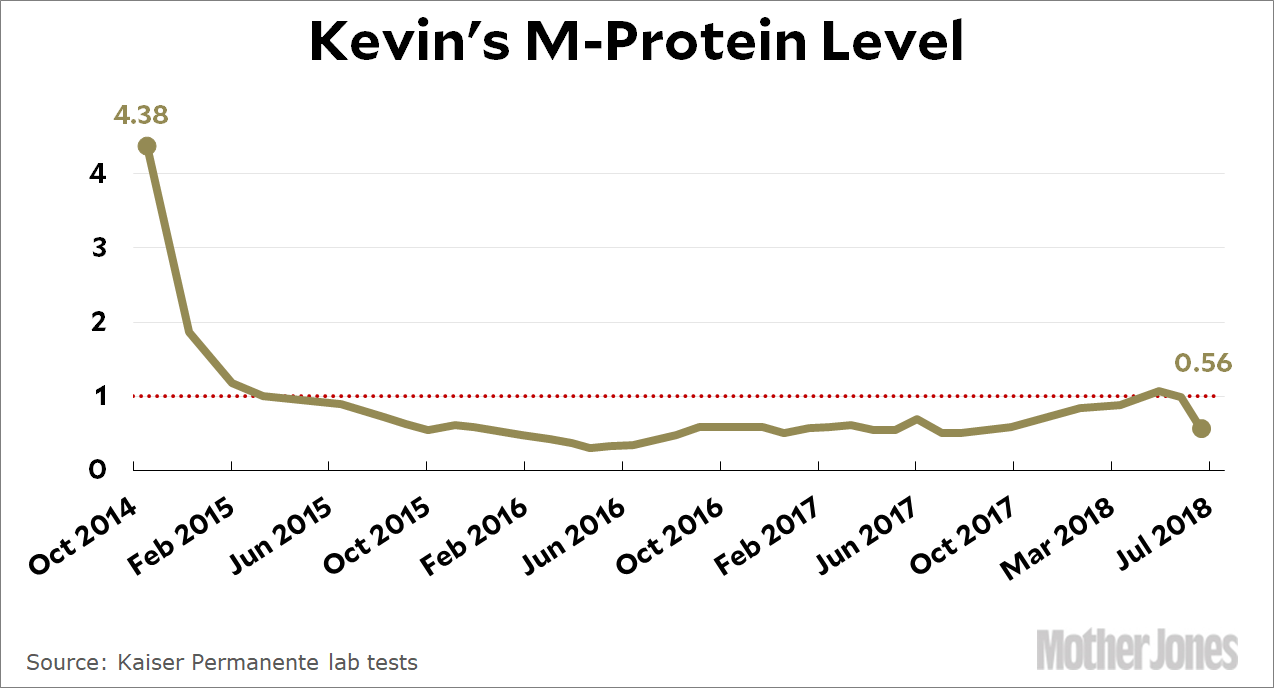
    The news is all good this month. Here’s my M-protein level, which is a marker for the total cancer load in my bone marrow:

    This is a significant drop, and I’m only through five weeks of an 8+8 chemo round (weekly for 8 weeks, then biweekly for 8 weeks). It’s almost certain to keep dropping over the next 11 weeks. And that’s not all:

    The old chemo med compromised my immune system, and by the start of 2018 I was either at or below the danger level regularly. After I stopped that med and started the new one, my neutrophil level immediately jumped to around the 2000 level, which is perfectly healthy. That’s great news.

    Considering all this, it’s worth explaining in a single place what’s going through my head these days. As I’ve mentioned, multiple myeloma is incurable. You can control it, but you can’t kill it off. Eventually it wins.

    But not anymore. First of all, there are a bunch of new multiple myeloma drugs that hit the market a couple of years ago. The med I’m taking now is one of them. My first round of chemo lasted for about 3½ years, which isn’t bad, and there’s every reason to think the new drug will give me another two years. Then another will add a year or two to that. By the time I’ve worked my way through all the drugs that are likely to help, it’s now almost a dead certainty that a new form of treatment called CAR-T will be out of clinical trials and available to anyone who needs it (and who’s insured for the vast price it costs). There are several versions of CAR-T already available for other forms of cancer, and several that are in clinical trials for multiple myeloma. My current favorite is a Chinese treatment that was recently picked up by Johnson & Johnson for the North American market. The results so far have been pretty spectacular: a large share of patients appear to be in total remission, which is nearly unheard of. The side effects are sometimes painful, but they’re temporary (a few weeks) and doctors now know how to fight them.

    Bottom line: Four years ago multiple myeloma was basically a death sentence. There was no telling how long it would take, but five years was average and ten was the outside range for 99 percent of patients. Today, it looks like I’ll end up going through five or ten years of various annoying rounds of chemo, and then stand a good chance of a total cure. I’ll still die eventually, just like everyone, but probably from tripping and falling down the stairs or something.

    So that’s the story. Multiple myeloma is no fun, but I now fully expect a high chance of complete recovery. Thank you, medical researchers.

  • Friday Cat Blogging – 29 June 2018

    Meet Elvis. He’s the German Shepherd peering through our fence and pondering what to make of Hilbert. It turns out that Elvis and his owner walk by our house daily, and when Hilbert is around they try to make friends. The remarkable thing, as you can see, is that apparently it’s working. I would never have guessed that Hilbert would come within a mile of someone outside the yard—especially someone with a very large dog— but he’s doing it. This guy must have the magic touch. As for Elvis, his owner says he’s a huge coward, so I imagine Hilbert can sense that he’s in no danger. My sister-in-law is visiting today with her (very old and sedentary) dog, so we’ll see what Hilbert makes of that.

  • Up Is Down and Red Is Black: Federal Deficit Edition

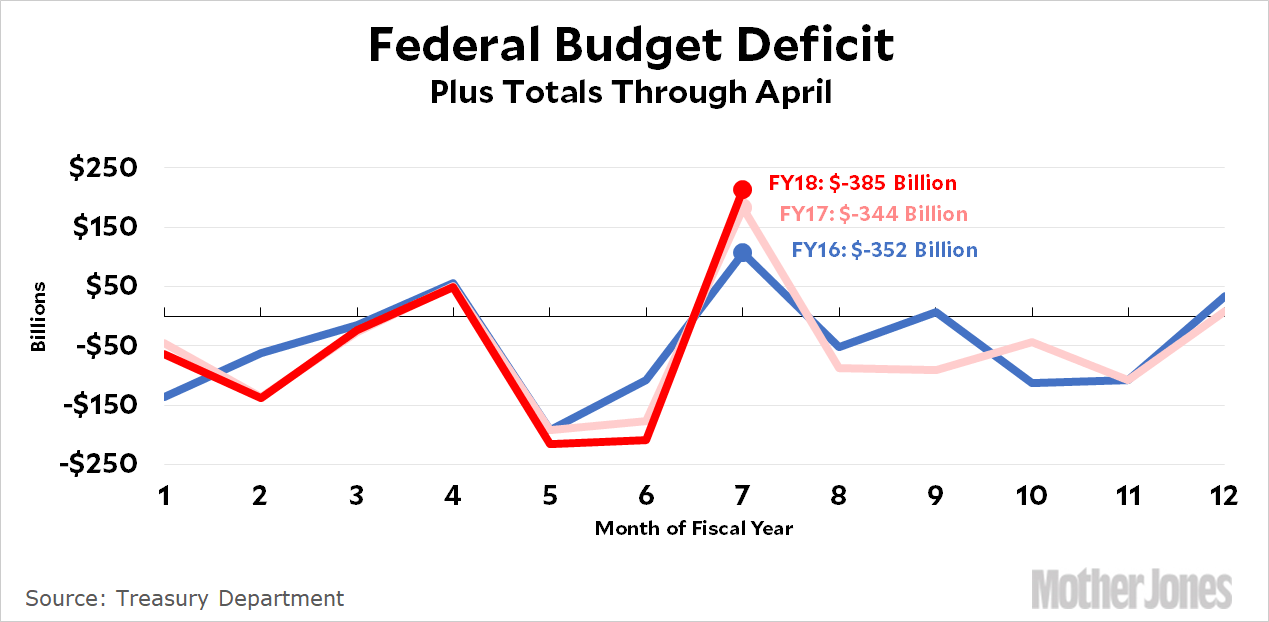
    Here’s the federal deficit by month for the past three years:

    As you can see, the deficit through April is bigger than both of the last two years—and since a strong April (tax collection month) masked some of the ongoing weakness, the FY18 year-end deficit is likely to be even worse.

    This is common knowledge, so why bother with it? Because the Trump administration, as usual, is lying about it on national TV:

    Larry Kudlow, director of the White House’s National Economic Council, said on Fox Business that stronger economic growth was creating enough new tax revenue to bring down the deficit.

    ….It’s hard to know where Kudlow is getting his numbers. The deficit from January through April was $161 billion, according to Treasury, up from $135 billion at the same point last year. And it will deteriorate further from here, since the Treasury collects a large amount of tax revenue during April when taxes are due for most Americans.

    ….Commenting specifically on the 2017 tax law, the CBO said it would increase deficits by $1.27 trillion over the next decade, even when including the positive effects of the law on the economy.

    ….Official White House data suggest deficits are increasing, too. The White House’s Office of Management and Budget says the deficit is rising from $665 billion in 2017 to $832 billion in 2018, and will approach $1 trillion annually in 2019.

    Strong April tax collections helped out the deficit picture a bit, but that’s a one-off thing. The rest of the year is still forecast to produce deficits considerably higher than the past two years. So Kudlow’s comment that stronger growth is “throwing up enormous amounts of new tax revenue” sure doesn’t seem to be true so far. Plus, as Dean Baker tirelessly tells us, the theory behind the tax cut was that it would produce a huge boom in investment, but so far the numbers for new capital goods orders just haven’t borne that out.

    But those are just facts. Who cares? Kudlow is telling his fans what they want to hear, and he knows they’ll believe it. Certainly no one on Fox Business will bother challenging him. Kudlow has learned Donald Trump’s golden rule mighty fast: “Billy, look, you just tell them and they believe it. That’s it: you just tell them and they believe. They just do.”

    UPDATE: The original version of the deficit chart had all the numbers backward. It’s now correct.

  • Even the Trump Administration Agrees: Separating Children From Their Parents Is Appalling and Cruel

    Ripping children apart from their parents can cause serious developmental problems:

    Removal of a child from the family should only be considered as a temporary, last resort….Yet, about eight million children worldwide live in these facilities, even though an estimated 80 to 90 percent of them have at least one living parent. The physical and psychological effects of staying in residential institutions, combined with societal isolation and often subpar regulatory oversight by governments, place these children in situations of heightened vulnerability to human trafficking.

    ….Even at their best, residential institutions are unable to meet a child’s need for emotional support that is typically received from family members or consistent caretakers with whom the child can develop an attachment. Children are especially vulnerable when traffickers recognize and take advantage of this need for emotional bonding stemming from the absence of stable parental figures. In addition, the rigid schedules and social isolation of residential institutions offer traffickers a tactical advantage, as they can coerce children to leave and find ways to exploit them.

    This comes from Donald Trump. That is to say, it comes from a State Department report published yesterday by his Secretary of State and promoted by Ivanka Trump. It is, in theory, Trump’s official opinion.

    The good news, such as it is, comes in the next section of the report, which describes the administration’s dedication to trauma-informed care. A friend of mine has been promoting and implementing trauma-informed care throughout California’s state hospitals, and she has convinced me that this is both necessary and the best form of treatment we know. Separation of children requires this kind of care because, among other things, it can lead to permanent neurological damage in young brains.

    It would be nice if this approach were adopted for all children separated from their parents. Or better yet, not separating them in the first place.

  • Not All Undercover Stings Are Covered Equally

    Dania Flores in 2015. She visited 43 "crisis pregnancy centers" throughout California and was routinely presented with false information.NARAL Pro-Choice California/YouTube

    Robin Abcarian writes about an undercover sting operation from a teenager working for NARAL Pro-Choice California three years ago:

    In 2014, a recent high school graduate named Dania Flores, posing as a pregnant teenager, visited 43 crisis pregnancy centers in California. What kind of care would they offer? How medically competent would they be?

    As Flores discovered, most crisis pregnancy centers are thinly disguised anti-abortion Christian ministries….At every clinic, Flores said, she was told that abortion leads to breast cancer. (It does not.) She was told that birth control pills cause headaches and, as she told me, “put hormones in your body you don’t need.” She was told that condoms “have a bunch of little holes you might not know about.” In two clinics, staffers told her how guilty they felt about their own abortions. During a free vaginal ultrasound, a technician in Mountain View mistook her IUD for a fetus and told her it did not have a heartbeat.

    Perhaps you haven’t heard about this? That’s because Flores didn’t take undercover video of her encounters, since that’s prohibited by California law. Needless to say, that didn’t stop David Daleiden or any of the rest of his merry band of pranksters who achieved widespread notoriety with their stings of ACORN and Planned Parenthood. There are two points to make here:

    • The conservative sting-meisters got in a lot of trouble for what they did. The liberal ones didn’t because they obeyed the law.
    • The press gave a ton of coverage to the conservatives but not much to the liberals. Their video recordings—legal or not and edited unfairly or not—got plenty of attention. Conversely, mere descriptions of the visits from the liberals—which were both legal and fairminded—produced only yawns.

    What does this say about our media?

  • Chart of the Day: Inflation Continues to Rise in May

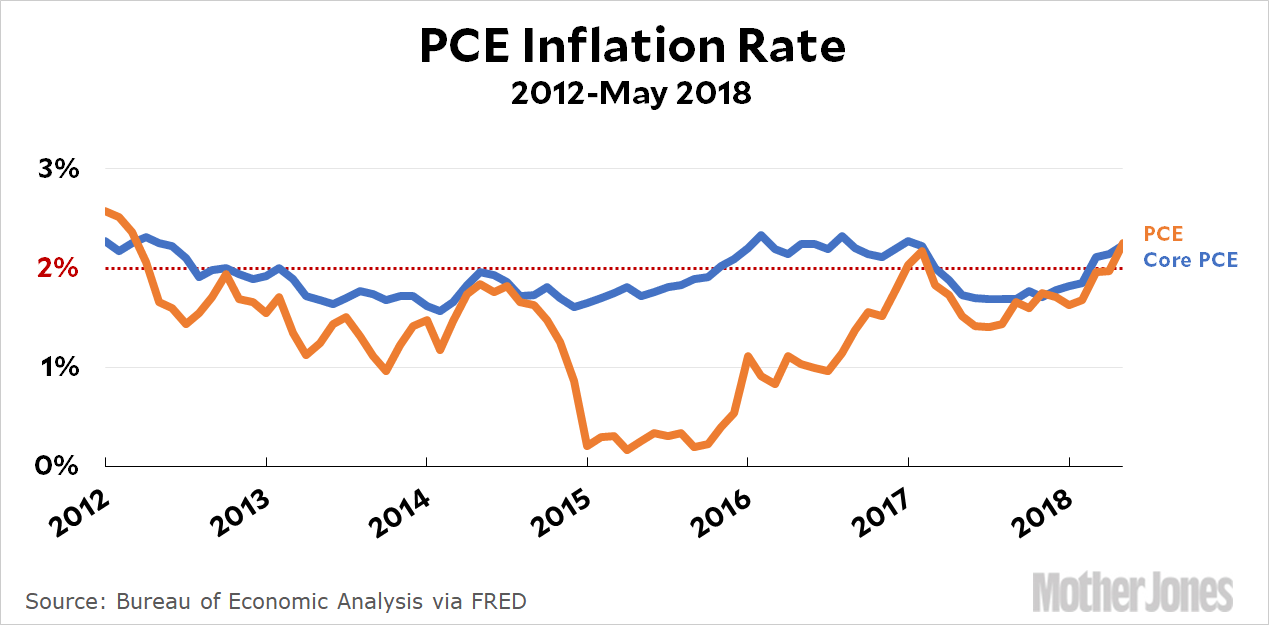
    The PCE inflation rate jumped again in May:

    The core PCE rate, which excludes food and energy, is now above 2 percent for the first time since…15 months ago. So maybe this means there really is some inflationary pressure in the economy, or maybe it doesn’t mean very much at all. It will take the rest of the year to find out. In the meantime, however, this will confirm the Fed in its plan to continue raising interest rates steadily. I suppose I can’t blame them at this point, although given that the average core PCE over the past five years is only 1.9 percent, I still wish they’d be more willing to tolerate a higher upside value for a little longer.

    Actually, I wish they’d been more willing to engineer a higher upside back in 2009-12, but they either couldn’t or wouldn’t. At this point, the economy is back to normal enough that tolerating only a smallish upside probably makes sense again.

  • Chart of the Day: The Cheese Storage Index

    For some reason, everybody is reporting today about our record cheese stocks. Apparently our cheesemakers had 1.39 billion pounds of cheese in cold storage at the end of May, the largest amount ever.

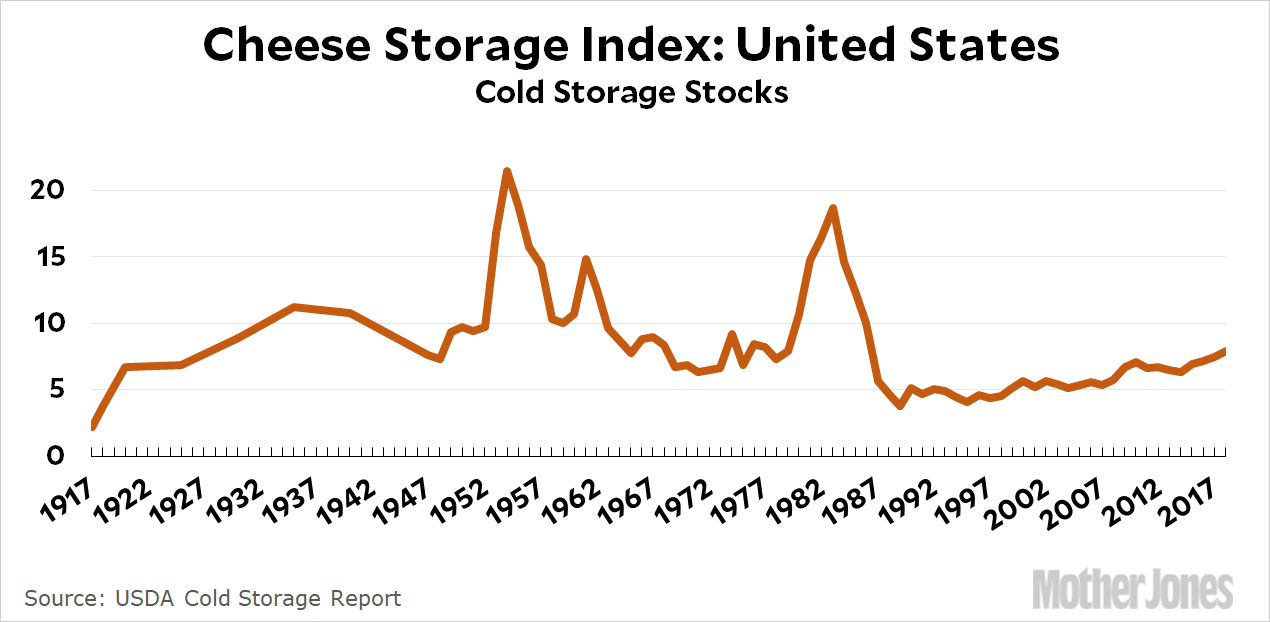
    But is this really a record? I decided to create the Cheese Storage Index: United States (CSI: US™) that adjusted the tonnage of cheese for the size of GDP. Once you do that, our current cheese inventory doesn’t look quite so spectacular:

    The real high points were the Korean War era and then again during the early Reagan era. The Reagan cheese became famous as “government cheese,” which caused widespread criticism when the public discovered that huge amounts of cheese were rotting in vaults at the same time that the food stamp program had been cut during a severe recession. In 1981 Reagan signed a bill to distribute free cheese to nonprofits, and eventually the government gave away 300 million pounds of cheese. This ended the massive cheese inventory of the early 80s.

    As for the Korean War, I’m not sure what the deal was there. Leftovers from the Marshall Plan? Several years of really good weather? Cheesemakers hoping to make a killing if the war continued and soldiers needed more fondue?

    Anyway, today’s cheese mountain is, relatively speaking, a minor foothill. If we ever declare war on Denmark, we’ll wish we had more.

    UPDATE: On Twitter, David Fickling writes: “I’m a little alarmed by the longer-term implications of @kdrum suggestion here that cheese consumption should grow in line with GDP rather than population.”

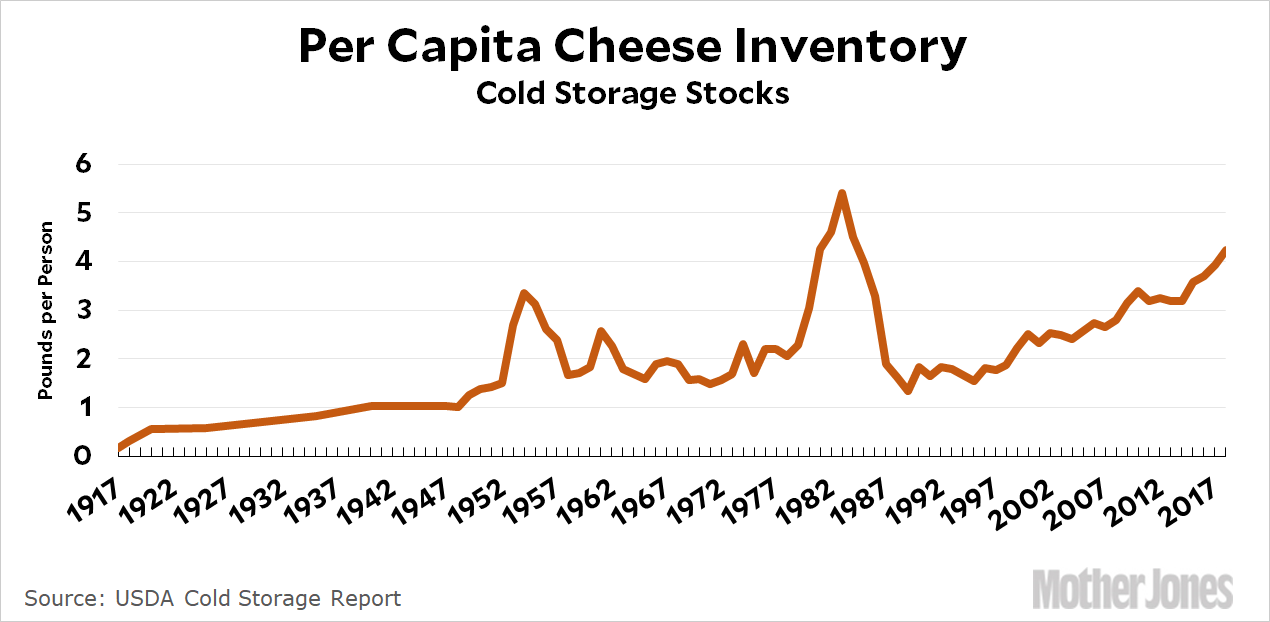
    That is alarming, isn’t it? Sadly, using a per-capita measure sort of ruins my joke. Nonetheless, here it is:

    The funny thing is that it doesn’t change the story all that much. You still have two big spikes during the Korean War and the early Reagan years, though they’re a bit smaller than in the original chart. And you have a steady increase since 1990, this time a little bigger than in the original chart. On a per-capita basis, our cheese stocks are now bigger than the Korean War spike, and three-quarters the size of the Reagan spike instead of less than half as big. Still not a crisis, perhaps, but definitely a trend moving in the wrong direction. I blame Canada.

  • Should Democrats Go to the Mattresses Over the Supreme Court?

    Evan Golub via ZUMA

    I’m in a quandary. Last night I suggested that Anthony Kennedy’s retirement from the Supreme Court would energize progressives and produce a huge turnout in the November midterms. My thinking behind this was:

    • On the conservative side, the replacement would already be in place by Election Day, so it wouldn’t have any special effect on Republican turnout.
    • On the progressive side, Kennedy’s replacement would put Roe v. Wade in such obvious danger that Democrats would flock to the polls.

    Obviously I could be wrong about either of these things, but put that aside for now. It turns out that the controversy of the moment among progressives is whether Democrats should put up a titanic fight to prevent a replacement from being confirmed. My assumption had been that Dems would fight, but mostly pro forma since they have no feasible way of stopping Republicans. They could try to persuade a couple of centrist Republicans to vote against anyone who might overturn Roe, but that’s pretty unlikely—and the other ideas I’ve heard go downhill from there. Republicans are going to win this fight, and the Democratic leadership knows it.

    Like I said, that was my assumption behind all this. But what if Democrats do go to the mattresses? Block the doorways, disrupt quorum calls, put gum in all the locks and sugar in the gas tanks. Whatever. If that’s the case, then it becomes an all-out war and conservatives will be at least as energized as progressives. Maybe more so. That means a pro forma fight is probably the best bet.

    On the other hand, the midterms are all about the Resistance. They’re all about the fight, showing a spine, and turning out the base. Wouldn’t a pro forma fight deflate all that? If Dems don’t blow up a few things, the base might get disgusted and just stay home. That means we need to declare war.

    This alternative hadn’t really occurred to me. Rationally, a pro forma fight is almost certainly the best bet. But politics isn’t about rationality. It’s about inspiring your own side and deflating the other side. Unfortunately, there doesn’t seem to be a single strategy which accomplishes that here. Any ideas?

  • Lunchtime Photo

    I think we all need something soothing to end the week, so here’s a nice photograph of Half Dome taken from near the base of Lower Yosemite Fall. Nothing fancy. Just a pretty picture.

    February 15, 2018 — Yosemite National Park, California