To finish up the week, here’s a picture of a little girl having a ball feeding the coots. I know you’re not supposed to feed animals in the wild these days, but kids love it so much that it’s easy to see why we all still do it. And anyway, our local lake is manmade and the coots haven’t truly been wild for a very long time. They might as well be in a zoo, so there’s probably not much harm in this.
This is a composite photo. I had one picture where the girl looked excited and cute, and another where the coots were all staring upward waiting for a treat. Neither one was very good by itself, so I stuck them together to make one great picture.
The Department of Justice is meeting with a bipartisan group from Congress today to brief them on the Trump-Russia investigation. In theory this is OK since this group gets briefed on all sorts of sensitive intelligence matters and can be trusted not to blab about it.
But DOJ is also holding a pre-meeting for a very special group of VIPs who just happen to be all Republicans. That’s mighty suspicious, isn’t it? What kind of information is so super-sensitive that it can’t be divulged to Democrats? I will leave that as an exercise for the reader. But now it’s gotten even worse:
Emmet Flood, WH attorney dealing with the Russia probe, attended the the start of the DOJ meeting on confidential FBI source, I am told. He left meeting shortly after. He was spotted by @LauraAJarrett leaving DOJ with John Kelly
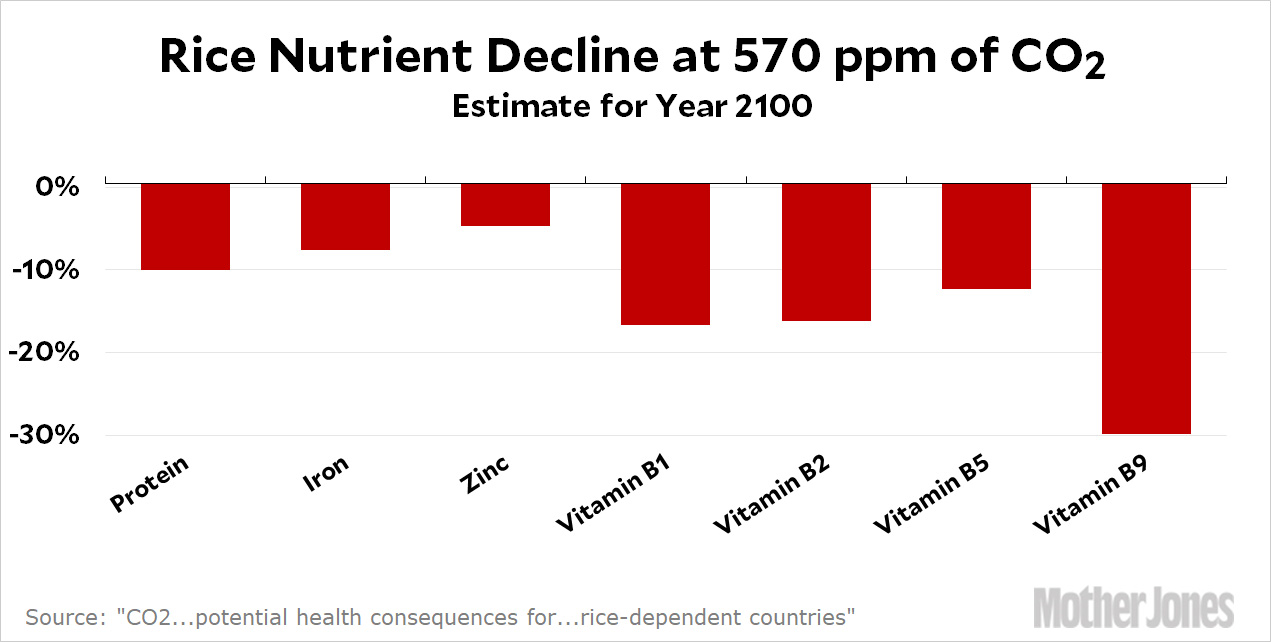
You may have heard about a new study that predicts reduced nutrient levels in rice as CO2 levels rise. Since a picture is worth a thousand words, here are are all their results:
And here’s the projected effect, with the poorest countries suffering the worst consequences:
Of course, all these countries might get richer and stop relying on rice so much. Alternatively, maybe the boffins in the DNA labs will construct new rice varieties that get more nutritious at higher CO2 levels. Or maybe lots of people will die. You never know.
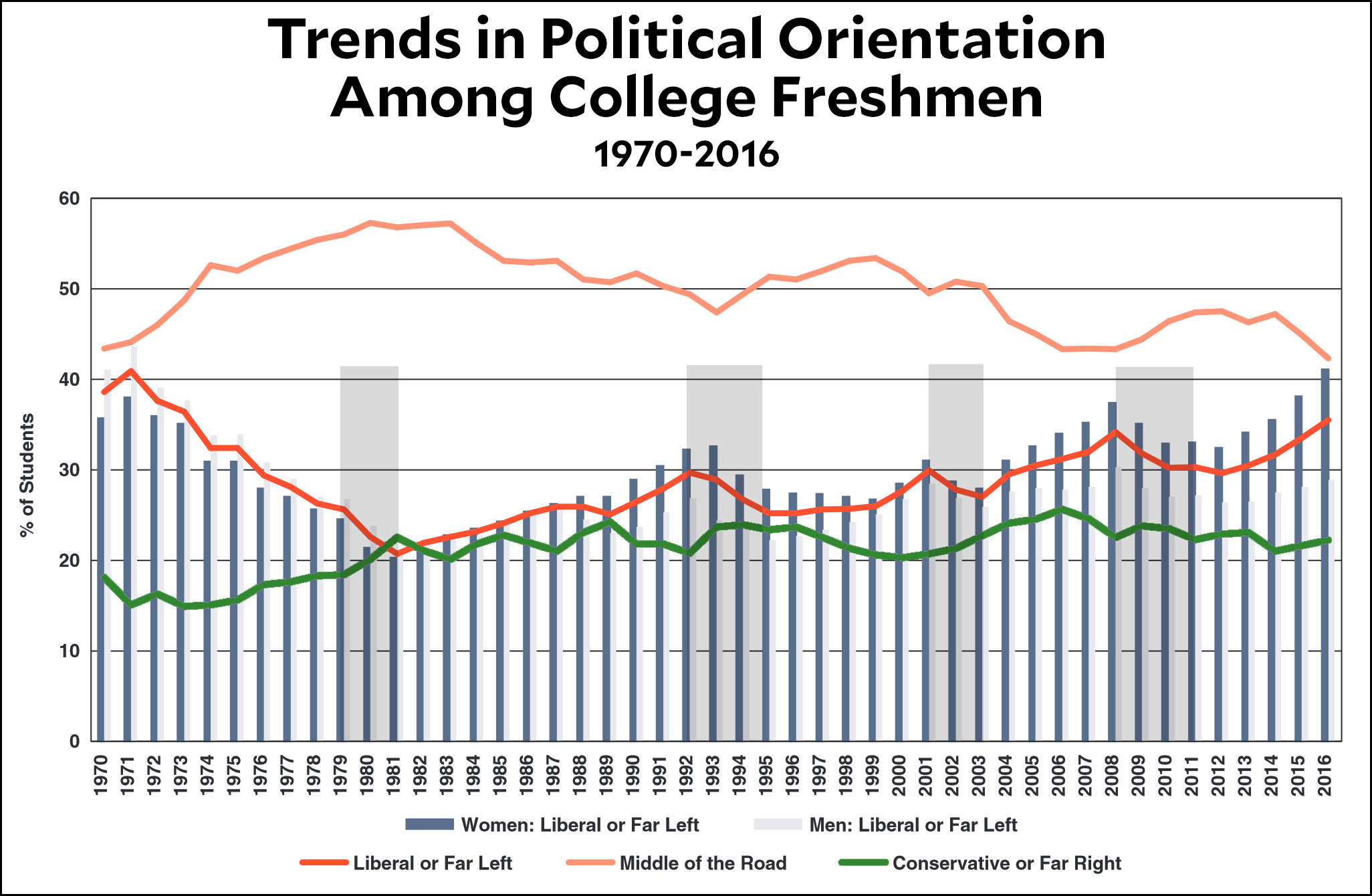
I don’t really have anything to say about this chart from the UCLA Higher Education Research Institute. I just ran across it by accident while I was looking for something else. As late as 1996, there were about equal numbers of liberals and conservatives among incoming university freshmen, but liberals have steadily made gains since then. It’s not that there are fewer conservatives, though. It’s because there are fewer freshmen in the squishy middle.
But wait. Just as I was writing that, I noticed something: during the last four recessions, the number of freshman identifying as liberal went down.¹ That’s actually kind of interesting, isn’t it? Their numbers recover over the next few years, and the secular trend has been rising ever since the early 80s, but there’s definitely a pattern to the hills and valleys.
¹Last five, actually, but I’m not counting 1973 since liberals were already in a post-60s swoon.
President Trump has canceled his summit with North Korea. I suppose this isn’t a big surprise, and there’s not much to say about it. But this is sure a weird letter he wrote to Kim Jong-un about it.
READ President Trump’s letter to North Korean leader Kim Jong Un canceling their summit. pic.twitter.com/3xXYHwQwTC
We all know that Donald Trump is “tough” on the border. He wants to separate families, keep out Muslims, deport Mexicans, conduct flashy raids, and build a wall. These things range from heartless to useless, but there’s a funny thing missing from the list:
In President Trump’s many vocal pronouncements about stopping illegal immigration, one solution he promoted during the campaign has been conspicuously missing — a requirement that employers check whether workers are legal.
Eight states require nearly all employers to use the federal government’s online E-Verify tool for new hires, but efforts to expand the mandate to all states have stalled, despite polls showing widespread support and studies showing that it reduces unauthorized workers….With the unemployment rate at a 17-year low and the Trump administration cracking down on foreign workers, lawmakers are reluctant to champion a measure that could exacerbate the labor shortage and hurt business constituents — even one that is popular among a broad swath of Americans.
House Republicans are forging ahead with a debate over the future of young undocumented immigrants who arrived in the United States as children, but the fate of an E-Verify provision remains in limbo.
I occupy a weird spot these days: somewhere in the middle on immigration. That doesn’t sound like it should be weird—it’s the middle!—but at least in public discourse it seems to be entirely missing. On the right they’re all arguing about how big the crocodiles should be in the moat they’re going to build next to the razor wire wall. On the left there seems to be almost no appetite for enforcing immigration laws at all. But for various reasons, most of them practical, I favor limiting immigration. However, I don’t want to stop it dead, and I don’t want enforcement to be flamboyantly inhumane. I just want people to know that there’s a fairly reasonable way to apply for legal entrance, but if you’re in the country illegally you’ll eventually end up back where you came from. That’s all.
The best way to do this is to attack the problem at its source. With a few exceptions, the reason that immigrants cross the southern border is economic: they can get better jobs in America than they can in Mexico or Guatamala. So the obvious answer is not a bigger fence or more raids: it’s cutting off the jobs. And the best way to do that is to force employers to follow the law when they hire people, and to apply enough resources to it that they know there’s a good chance of getting caught if they don’t.
The benefits of this system are legion. First, it’s American law enforcement dealing with American employers. Second, the fines levied help pay for most or all of the enforcement. Third, ICE agents don’t need to demand papers from people who are doing nothing but speaking Spanish. Just leave them alone and arrest people who commit crimes. Fourth, you don’t need to separate families or even spend much time deporting people. If they can’t get jobs, they’ll move back home on their own.
Now, I’m well aware that E-Verify isn’t perfect. It needs to be improved, and the appeal procedure needs to be quick and accurate. But that can be done, and it can probably be done for a lot less money than building a stupid wall or taking kids away from their parents. No system built by humans is perfect, but E-Verify could probably be 99.9 percent accurate if it were designed properly, and that would be good enough.
So what’s the holdup? The answer is that no matter how much social conservatives think they own the Republican Party, they don’t. Corporations and rich people own the party, and they don’t want ICE agents raiding them. They don’t really care very much if Trump screws around with a wall, because they know a wall won’t make much difference. But they do care about E-Verify, because it would work and it would cost them money. So it lies around unloved, even though it’s almost certainly the best immigration enforcement option we have. And when I say “best,” I mean it’s both the most effective and the most humane.
Now, there’s still the question of what the basic immigration law should be. Guest workers? Higher quotas? Lower quotas? Quotas based on labor needs? For my money, I’d want something that allows in more immigrants, but not a lot more immigrants. Whatever it is, though, it has to be decided no matter what the enforcement mechanism is. And once we’ve done that, E-Verify is the way to enforce it.
I dunno guys. Sure, it’s a dog whistle. But MS-13 really is a deadly group that takes considerable pleasure in theatrical cruelty and revenge killings. The entire gang is roughly 10,000-strong in the United States, and it’s a pretty serious threat as these things go.
A few days ago Trump called them “animals,” and liberals went through a painfully contorted effort to demonstrate that Trump was talking not just about MS-13, but about everyone deported from the country. Trump finally made it clear that he was talking only about MS-13, so then the conversation shifted. It was now bad even to call MS-13 gang members animals. They’re human beings too after all.
And I guess that’s true, in the sense that we’re all equally children of God. But I suspect God is going to have some fairly sharp words for them on Judgment Day. In the meantime, do we really want to expend our energy in defending MS-13 just because Trump doesn’t like them? That’s kind of crazy, isn’t it? And speaking solely for myself, I’m perfectly happy to call them animals. It seems pretty accurate in their case.
This kind of stuff does nothing but waste our own time, make other people think we’re nuts, and give Trump terrific ammunition to use against us. How about if we dial down the political lens on every last thing and just agree that MS-13 is a bunch of very bad folks? They are, you know.
Why yes, I am blogging a little earlier than usual. Thanks for noticing. It turns out, unsurprisingly, that the evil dex had exactly the same effect this time around that it had last time: it kept me up all night.
And today I get to take some more! The first infusion is a two-day affair, so I’ll be off at the infusion center all day again. Yesterday everyone was pleased that I had no negative reaction to the Darzalex, even though I did have a reaction to the Darzalex. About an hour after the IV started, my throat got scratchy, I started coughing, and my nose started to drip. The dripping went away after a couple of hours; the coughing went away after three or four hours; and the scratchy throat isn’t quite totally gone even now. Also, my stomach is slightly upset. Apparently this is what counts as “no reaction.” This must mean that it really hits some people hard.
But in truth it really isn’t much of a reaction. I can probably control the allergic symptoms with the Zyrtec they told me to get, and there are plenty of options for my stomach. Probably Pepcid, which is what they gave me last time. So things should go more smoothly next week.
Anyway, this will last eight weeks, then it goes to every other week for eight weeks, and then to once a month for some undetermined length of time. I suppose the effects will accumulate over time, but probably not too much since they seem fairly modest. We’ll see.
Anyway, that’s why you’re getting early morning posts. Whether you get any late morning posts depends on how I feel after today’s second round of fine pharmaceutical products. I can’t wait.
Officials may cite national security grounds to justify a 25 percent tariff on imported vehicles, a senior administration official said….An announcement of a formal investigation into the purported need for such industrial protection could come as soon as Wednesday evening, one industry executive said.
Wednesday evening, the White House announced that Trump had directed Commerce Secretary Wilbur Ross to consider launching a formal investigation of the possible need for such industrial protection. Eighteen minutes later, Ross said he had done so. “Core industries such as automobiles and automotive parts are critical to our strength as a Nation,” the president said.
What’s next? A national security exemption for avocados and bell peppers? Pharmaceuticals? Diamonds? With the process now in hand, it shouldn’t take Ross more than ten minutes each to declare them a key military requirement.
Anyway, this is not going to happen. Can you imagine the howls from Trump’s rich voter base when they suddenly have to pay more for their BMWs, Porsches, and Jaguars? I’m reminded of this famous presentation from Ross a couple of months ago defending the new tariffs on steel and aluminum:
The price of a can of Campbell’s soup would only go up six-tenths of a cent! But what’s he going to do now? Haul in a Porsche on a crane and declare that a 25 percent tariff would only raise its price by a paltry $30,000? And what about the other end of the Trump base? They’re going to have to shell out an extra $10,000 for their Toyota Tundras and Nissan Armadas. That’ll do wonders for Republicans in the upcoming midterms.
So it’s not going to happen, and everyone knows it’s not going to happen. What possible negotiating benefit can this provide? It’s like trying to bluff on a low pair while your cards are laying up on the table. As usual with Trump, this is just another mysterious emanation from deep within his lizard brain. Nobody knows what it really means.
The St. Louis Fed published a short note today comparing the net worth of millennials in 2016 vs. Gen Xers in 2001. Here it is:
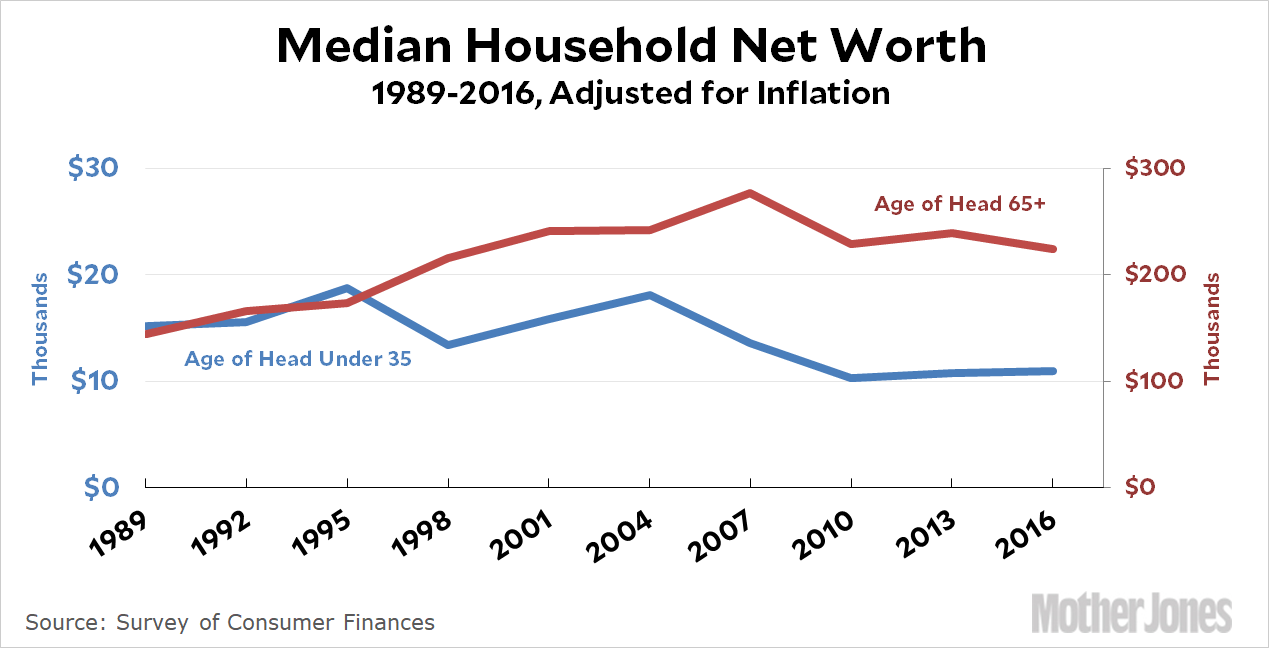
Today’s millennials have fewer assets and more debt, and their net worth is therefore considerably lower than Gen Xers at the same age. That’s bad, but let’s make it worse. Here’s a chart from the same data that shows net worth over time:¹
This is median net worth, and it’s practically zero for young households. That’s not really a surprise: people tend to take on lots of debt when they’re young and they haven’t had the time or the income to build up much in the way of assets.
The real problem is that it’s gone down from $15,000 to $11,000 over the past 25 years. Conversely, the median net worth of retirees has gone up from $145,000 to $224,000. That’s a 17 percent drop vs. a 55 percent gain.
This is one among many reasons that I keep harping on the proposition that liberals should stop obsessing over the “retirement crisis.” There are two very specific problems with retirement, and those are worth addressing.² But as a general proposition, there just isn’t a retirement crisis. You can calculate it any way you want, but unless you torture the data into a pretzel, most retirees today are pretty well off. Their 401(k)s don’t allow them to live on yachts, but old-school private pensions didn’t either.
So retirees are basically fine, and will probably be more than fine in the future. It’s younger generations that are in trouble and that’s who we should be laser-focused on. The reason for obsessing over retirees, I think, is that our two big retiree programs are Democratic creations and liberals are proud of them. They’re also pretty easy to identify and improve. But that’s like looking for your lost keys where the light is good. It’s not nearly as easy to identify concrete ways to help young families, so we tend to mumble and tap dance around them. That’s lousy policy and lousy politics.
It might be harder, but we should be looking at ways to help young families with at least the same intensity that we bring to Social Security and Medicare. Instead of allowing kids to stay on their parents’ health policies until age 26, how about just offering them free Medicare until they’re 30?³ Not everyone has parents with health insurance, after all. Free public college of all kinds is a good idea too, even though it’s difficult since this stuff is all done at the state level. But if we do it, our main focus should be on trade schools and community college, not 4-year universities. Or how about a rent subsidy? Maybe the feds offer to pay a percentage of your rent: say, 20 percent at age 20 sliding down to zero at age 30? Or an income subsidy that works the same way?
I’m just tossing stuff out here. They might be bad ideas. But if we want to help the people who really need help, we should focus on non-college-educated young people. They’re the real forgotten demographic. They’re also the ones who we badger about not voting. So let’s give them a reason to vote.
²The first problem is the meager income of the lower third of retirees who depend solely on Social Security. Their benefits should be increased by about a third. The second is long-term nursing care. A one-year stay in a nursing home—which is not uncommon—can easily wipe out the retirement savings of a middle-class family. This should be covered by Medicare.
³This is also a not-especially-sneaky way of moving in the direction of Medicare for all.
And we respect that! But maybe you’re of a mind to support our work directly instead? We have until December 31 to raise the last $400,000 we need to keep our nonprofit newsroom running at full strength into 2026. Will you make a gift today?
We noticed you have an ad blocker on. Can you pitch in a few bucks to help fund Mother Jones' investigative journalism?
Billionaires own the media,
but they don’t own us.
At Mother Jones we know these aren’t conventional times, and they require unconventional coverage. That’s what deliver every day: fierce, independent journalism you can’t find elsewhere. Perhaps never in the history of our country has that been more necessary than now. But we can’t do it without reader support—your support. Please chip in today.
Billionaires own the media,
but they don’t own us.
At Mother Jones we know these aren’t conventional times, and they require unconventional coverage. That’s what deliver every day: fierce, independent journalism you can’t find elsewhere. Perhaps never in the history of our country has that been more necessary than now. But we can’t do it without reader support—your support. Please chip in today.