• Middle-Age Death Rates Have Skyrocketed in Some States

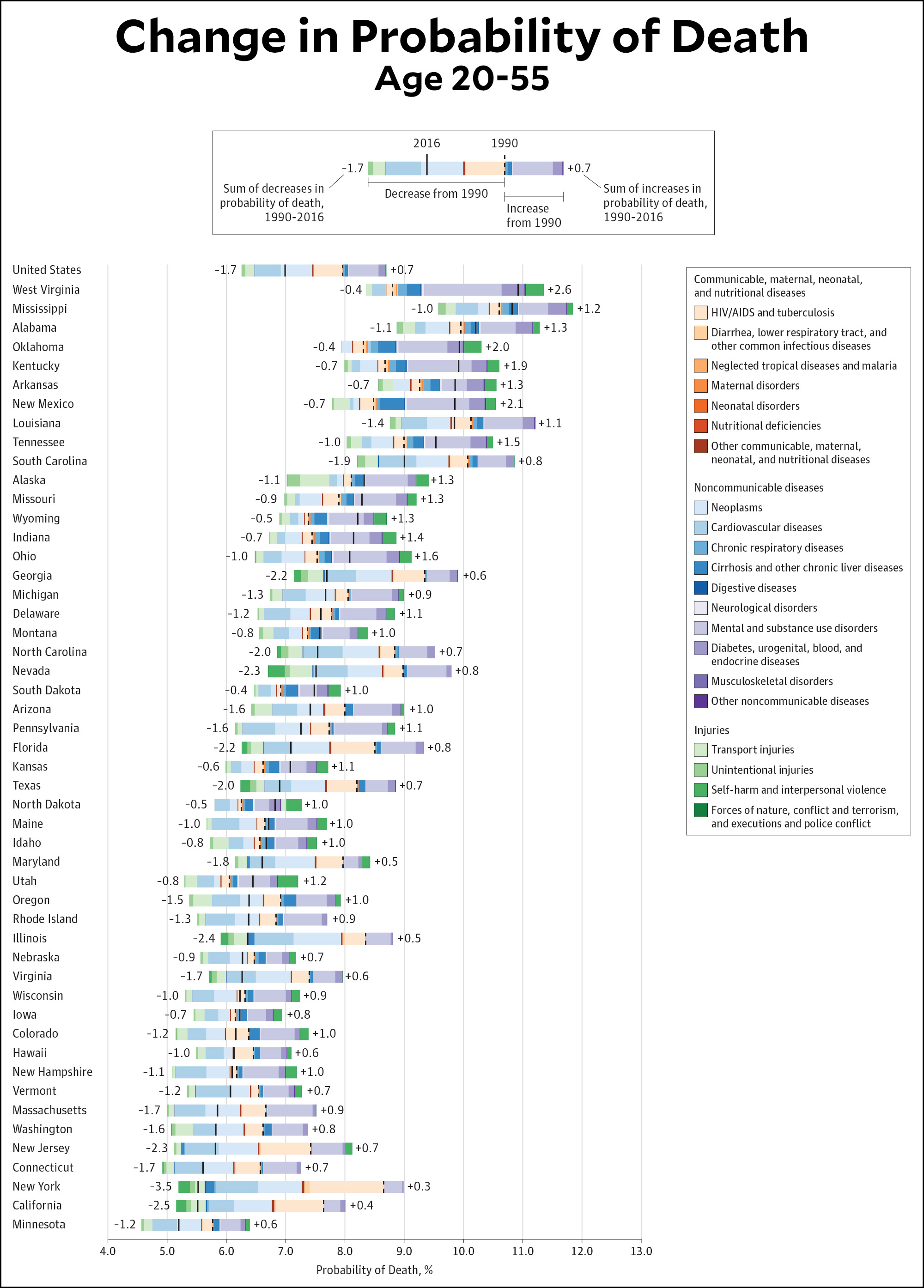
    Via Eric Topol, here’s an interesting chart from a new report in JAMA. It shows how the probability of death during middle-age has changed from 1990-2016 in all 50 states. In the country as a whole, there’s been a 1.7 percentage point decrease in the probability of death from various causes and a 0.7 point increase, for a net change of -1.0 percent.

    Southern states tend to have the highest probability of death and the biggest increase since 1990. In Mississippi, for example, you have an 11 percent chance of dying between ages 20-55, and that’s gone up 0.2 points since 1990. Kentucky has gone up by 1.2 points, Oklahoma by 1.6 points, and West Virginia by 2.2 points.

    In California and New York, by contrast, the probability of death is about 5.5 percent, and that’s gone down by 3.2 points in New York and 2.1 points in California.

    The differences here are huge and are “strongly linked to the burden of substance use disorders, cirrhosis, and self-harm.” I imagine they’re also linked to the effort each state has put into improving its health care system. There’s more at the link, including the same chart for ages 0-20 and ages 55-90.

  • Oh Yes, Let’s Talk About Self-Awareness Regarding Syria

    Samer Bouidani/DPA via ZUMA

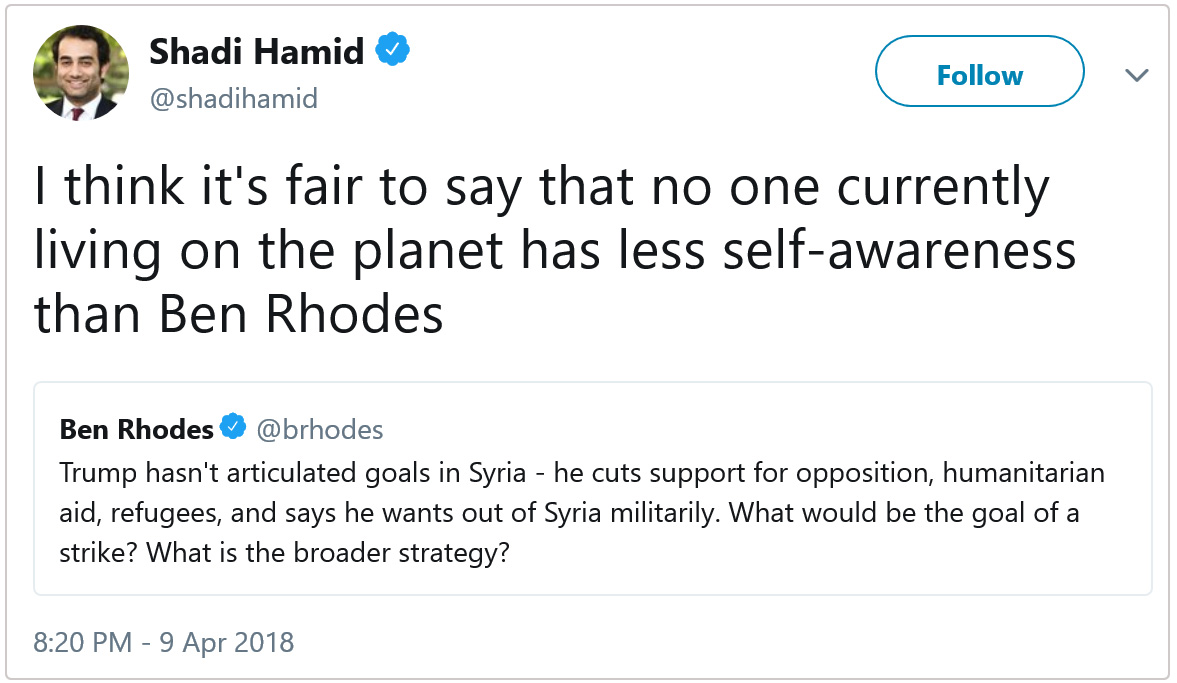
    Syria is back in the spotlight this week, and Shadi Hamid has harsh words for Ben Rhodes, a speechwriter and foreign policy advisor to President Obama:

    I don’t want to pretend that Obama’s approach to Syria was a model of foreign policy precision, but in the end he did the right thing: nothing. Syria was a lose-lose situation for the US from the start. It’s unlikely that any intervention would have “worked”—whatever that means—and it’s almost indisputable¹ that even the slim possibility of an effective intervention would have required a massive military effort. A bit of bombing and some arms delivered to our allies-of-the-moment never had a chance.

    So whether or not you like Obama’s strategy, he did have a goal in Syria: to keep America out. And he did that. Not as crisply as he could have, but he did it.

    And of course Rhodes is right about Trump. He wants out but he also wants to stay in. He favors letting Putin fight in our place but he opposes Putin’s growing influence. He hates Assad but doesn’t want to arm the opposition. And what about the Kurds? It’s not clear if Trump even knows what a Kurd is. Frankly, it’s not clear if Trump could even find Syria on a map.

    It’s not Obama or Ben Rhodes who lack self-awareness about Syria, it’s the Middle East hawks who continue to champion intervention but seemingly lack the recognition that America has never successfully intervened in the Middle East. The closest we came was in 1991, and in the long run even that turned out to be a disaster. I know it’s hard to accept that sometimes a region simply has to fight its own wars, but that doesn’t make it any less true. American military power can help on the margins, and it can protect American interests, but it’s simply not a tool for mediating a complex, decades-long contest between regions, tribes, and sects. After half a century of constant intervention and equally constant disaster, it’s the height of folly to criticize one of the few people on the planet who seems to get this.

    ¹I am keenly aware that many people nonetheless continue to dispute this.

  • Epic Series of Rage Tweets Probably Coming Tomorrow From the Leader of the Free World

    President Trump delivered an epic rant today about the FBI raid of his lawyer’s office, calling it a “disgrace,” a “witch hunt,” an “attack on our country,” and “a whole new level of unfairness.” He also declared, yet again, that he was pissed off about Jeff Sessions recusing himself (“he should have certainly let us know if he was going to recuse himself, and we would have put a different attorney general in”) and also pissed off that arch-criminal Hillary Clinton continues to avoid a life sentence at Sing Sing. And he’s pissed off that this is taking attention away from whatever manly action he decides to take against Syria. Presumably this means we can expect a truly epic storm of rage tweets either tonight or tomorrow morning. Whatever lawyers he has left must be cowering in fear while they wait to see if Trump manages to make it through tomorrow without incriminating himself.

    While we wait for all this, the New York Times ran a piece over the weekend about people having trouble quitting antidepressants because of horrible withdrawal symptoms. JSA Lowe was unhappy about it:

    Back in my younger days I occasionally got pedantic with people about the difference between addiction and habituation. I suppose I learned it from my father. But eventually it seemed like the word habituation just disappeared. Everything was an addiction, regardless of its etiology. So I gave in and referred to everything as an addiction too.

    That was a long time ago, and this tweet is, I think, the first time I’ve come across the word habituation in decades. Of course, I don’t hang around in psychology circles, so maybe that’s no surprise. But I guess I’m curious about whether professionals still draw a sharp distinction between addiction and habituation, and whether it makes much difference to a layman anyway. Any psychology pros out there care to comment?

  • Where Did Michael Cohen Get $130,000 to Pay Stormy Daniels?

    The FBI raided Michael Cohen’s home and office today, seizing records related to Cohen’s payment of $130,000 to Stormy Daniels during the 2016 campaign. Susan Simpson has a question:

    My guess is that this probably really is a coincidence. But then again, maybe not. It seems worth investigating.

  • Lunchtime Photo

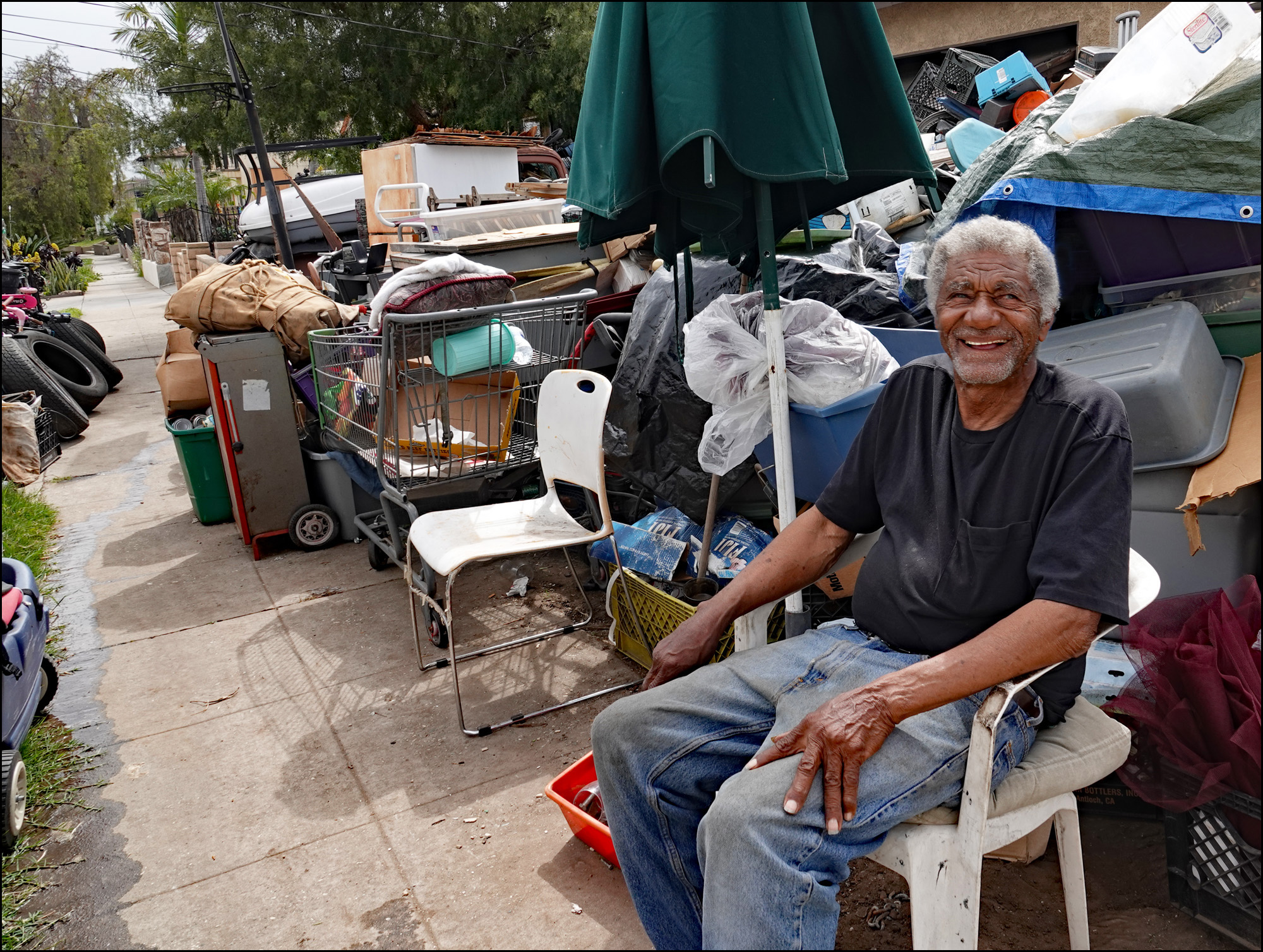
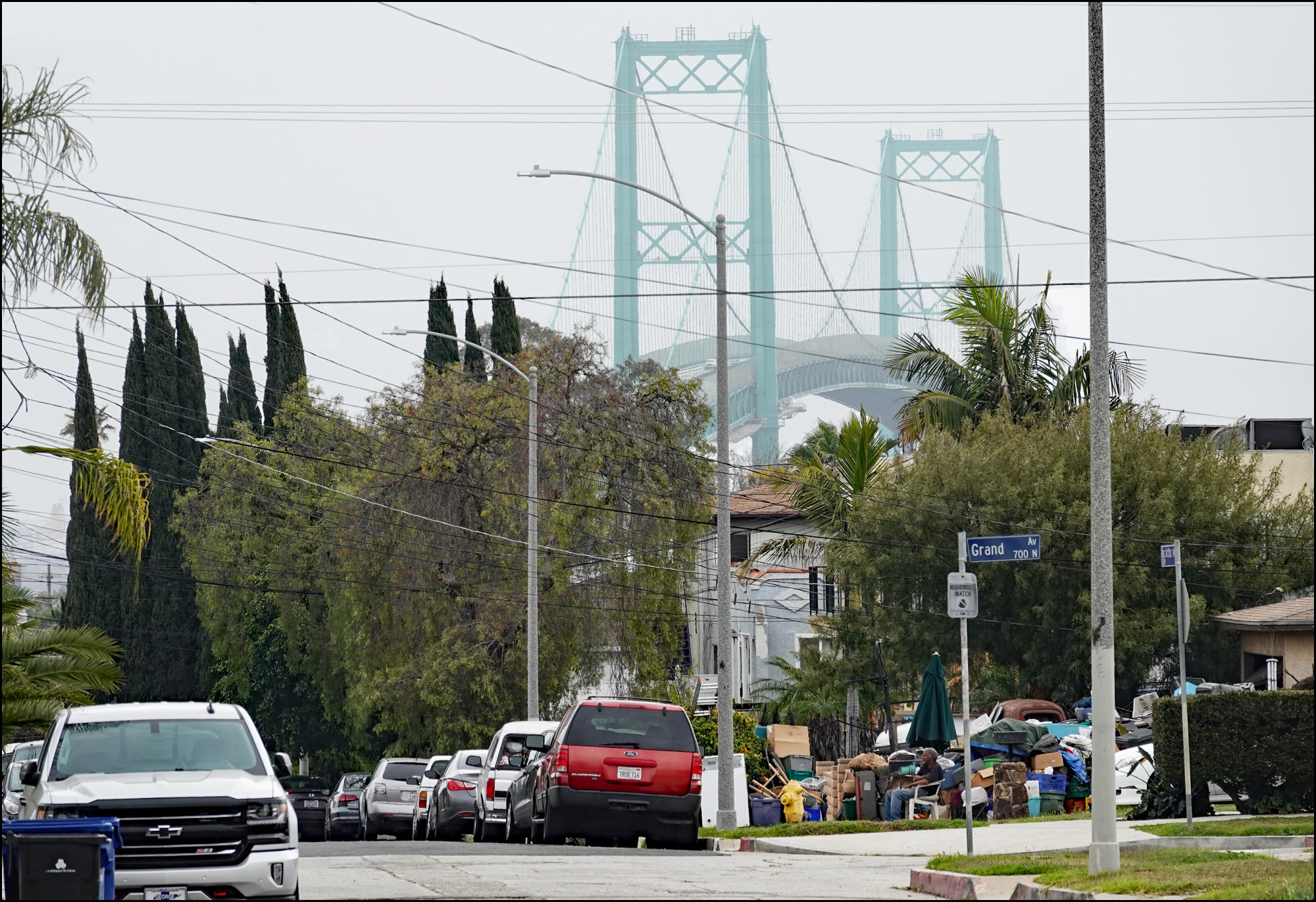
    This is Bill. He moved to San Pedro in 1952 and has lived in this house for the past 45 years. He worked at the port for 15 years and is now retired.

    He told me he was outside “doing a little cleaning up.”

    BY THE WAY: The top picture is a composite. I had one photo that showed the junk pile well but I liked Bill’s expression better in another one. So I lifted it out and copied it onto the first photo. This is the kind of Photoshopping that got Brian Walski fired from the LA Times a few years ago. Luckily, I’m not a photojournalist, so I can get away with stuff like this.

    April 7, 2018 — San Pedro, California
  • CBO Projects $1.5 Trillion Trump Tax Cut Will Cost $1.9 Trillion

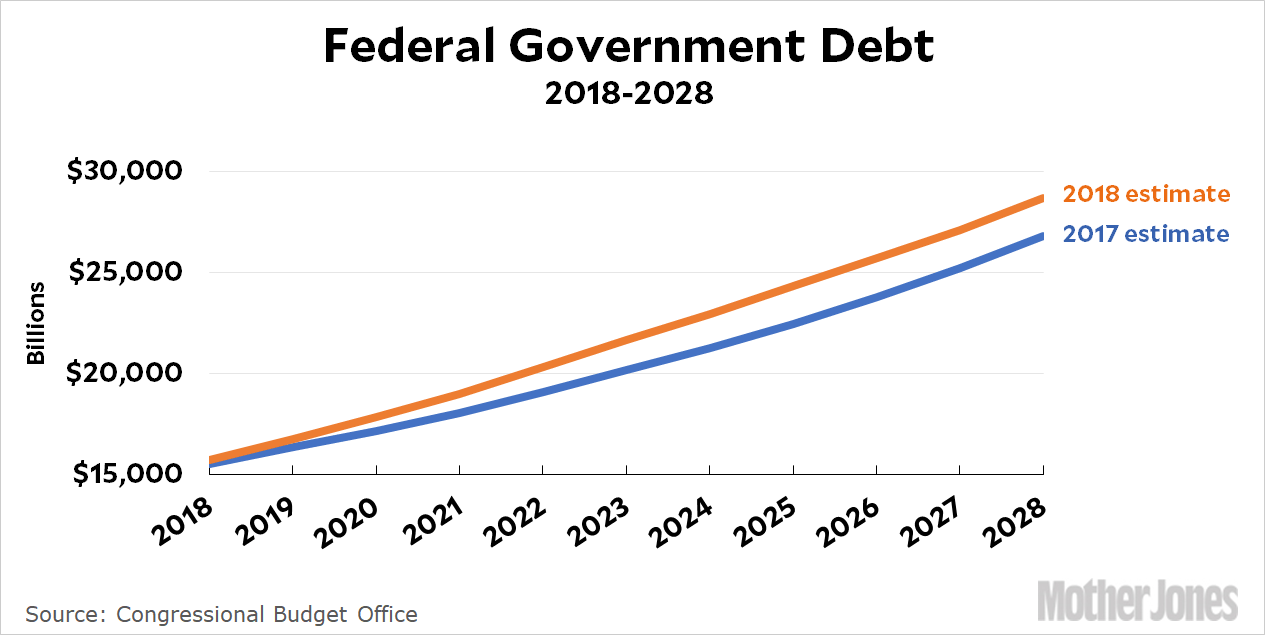
    Today’s CBO budget report is out, and it tells us that the Republicans’ $1.5 trillion tax cut will increase the federal debt by…$1.9 trillion:

    This comes from Table B-3 in the report. In other words, the tax cut doesn’t pay for itself. It doesn’t even partially pay for itself. It does have some positive economic feedback, but not very much, and nowhere near enough to make up for the lost revenue and the increase in interest payments:

    This is not the CBO’s long-term budget report, so it only goes through 2028. During that period, spending goes up only modestly. In other words, spending still isn’t the problem. The problem is tax cuts for the rich that slash revenue and increase debt service. Put those together, and even with a modest supply-side economic benefit the tax cut still costs more than the static revenue estimate. Maybe it’s time to finally put the Laffer Curve to rest, boys.

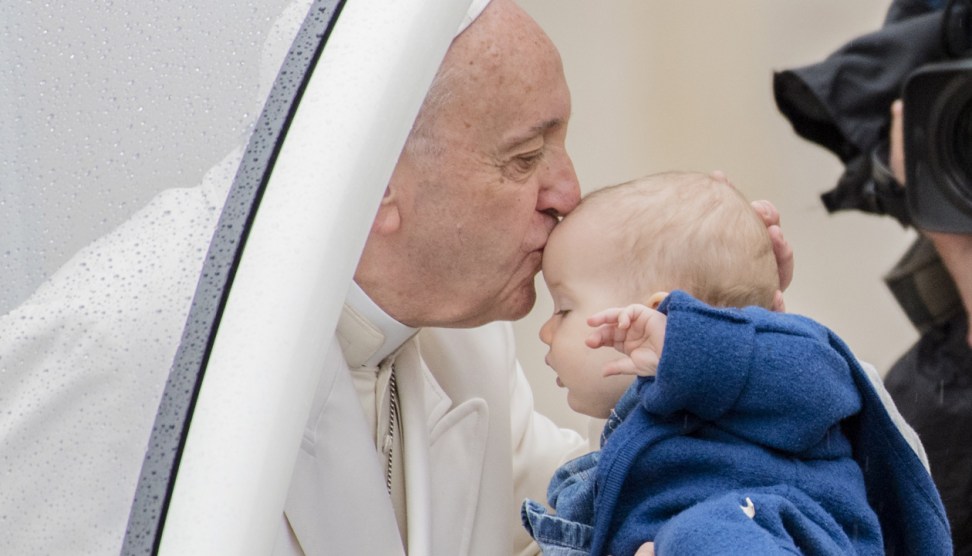
  • Pope Annoys Traditionalists With Call to Holiness

    Massimo Valicchia/NurPhoto via ZUMA

    Pope Francis offers up some words on holiness today:

    95. In the twenty-fifth chapter of Matthew’s Gospel (vv. 31-46), Jesus expands on the Beatitude that calls the merciful blessed. If we seek the holiness pleasing to God’s eyes, this text offers us one clear criterion on which we will be judged. “I was hungry and you gave me food, I was thirsty and you gave me drink, I was a stranger and you welcomed me, I was naked and you clothed me, I was sick and you took care of me, I was in prison and you visited me” (vv. 35-36).

    ….100. I regret that ideologies lead us at times to two harmful errors. On the one hand, there is the error of those Christians who separate these Gospel demands from their personal relationship with the Lord.

    ….101. The other harmful ideological error is found in those who find suspect the social engagement of others, seeing it as superficial, worldly, secular, materialist, communist or populist. Or they relativize it, as if there are other more important matters, or the only thing that counts is one particular ethical issue or cause that they themselves defend. Our defence of the innocent unborn, for example, needs to be clear, firm and passionate, for at stake is the dignity of a human life, which is always sacred and demands love for each person, regardless of his or her stage of development. Equally sacred, however, are the lives of the poor, those already born, the destitute, the abandoned and the underprivileged, the vulnerable infirm and elderly exposed to covert euthanasia, the victims of human trafficking, new forms of slavery, and every form of rejection. We cannot uphold an ideal of holiness that would ignore injustice in a world where some revel, spend with abandon and live only for the latest consumer goods, even as others look on from afar, living their entire lives in abject poverty.

    The Washington Post reports that “traditionalists” are not going to be happy with this. Apparently it’s disgraceful to suggest that the things Jesus cared the most about were the things he talked the most about. I guess poor Francis is just too simpleminded to see past the actual words Christ uttered.

  • GAO Reports That Some Students Are Disciplined More Than Others

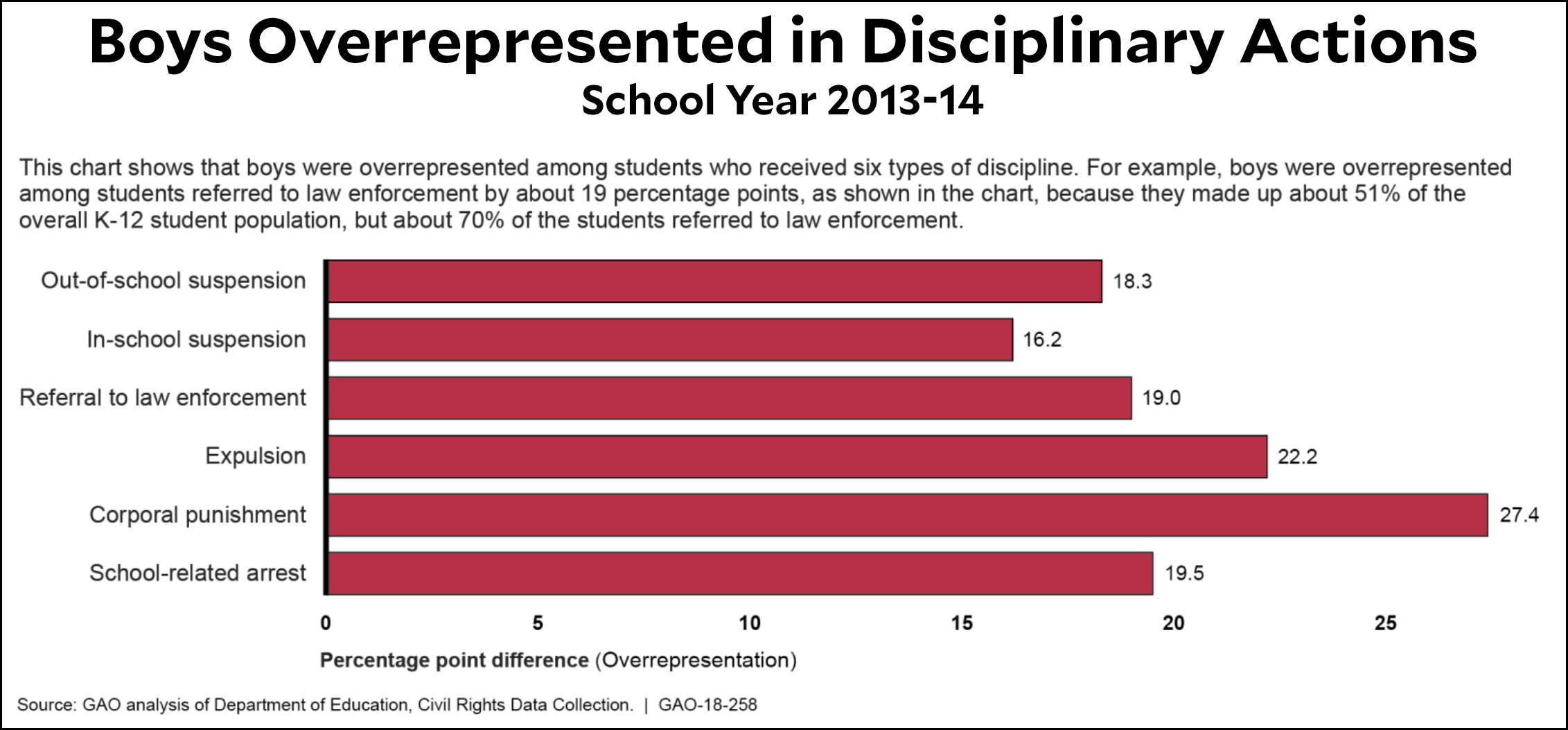
    A recent GAO report on school discipline came to a startling conclusion: boys are punished far more than girls. This is true for all types of discipline, and the effect is the same for schools of all types and income levels:

    Do you find this shocking? My mother the former fourth-grade teacher probably wouldn’t. Boys are generally less mature than girls and they act out more. It’s not really too surprising that they get disciplined more. This finding would only be outrageous if there were some way to independently measure the behavior of boys and girls and then determine that boys are disciplined more even though they don’t break the rules any more than girls do.

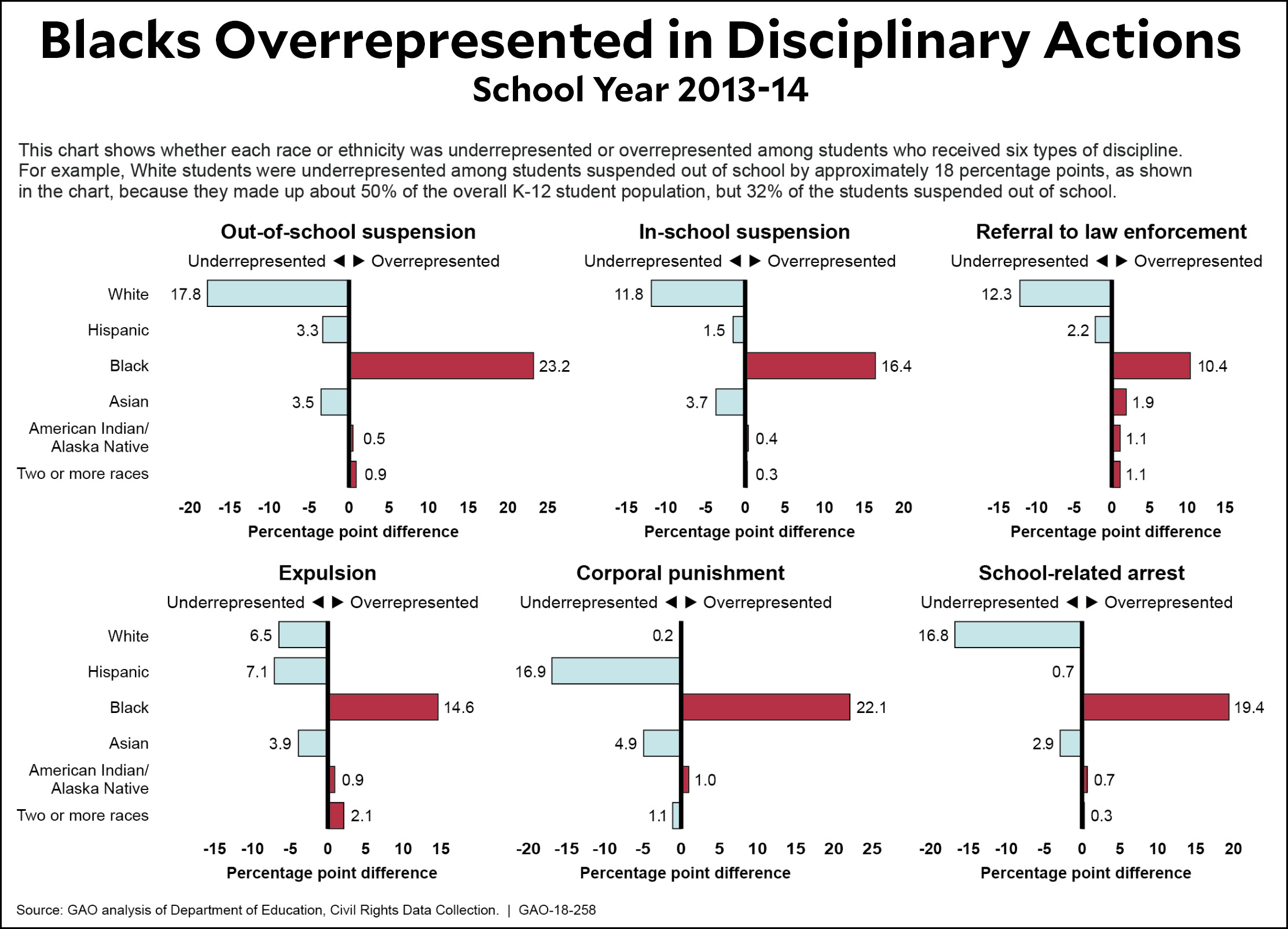
    This GAO report was brought to my attention by German Lopez at Vox, and I’m just kidding about the whole boy-girl thing. Nobody really cares about that. What people care about is that the report also finds that black students are disciplined more than white students:

    This is about the hundredth report to find that black students are disciplined more than white students, so I don’t think there’s any doubt that the numbers are basically correct. But this chart includes a footnote:

    Disparities in student discipline such as those presented in this figure may support a finding of discrimination, but taken alone, do not establish whether unlawful discrimination has occurred.

    That’s because there’s no independent measure of black student behavior compared to white students. There’s not even any control for poverty or for parental education, two obvious possibilities for behavioral differences.

    So is this disciplinary divide a result of racism? It’s impossible to say. Hispanic students are underrepresented, which suggests something else might be at work. But again: you simply can’t draw any conclusions from this report aside from the fact that there is a difference—which we already knew—and that more detailed study is needed to determine the causes. Unfortunately, more detailed study is profoundly tricky. How do you objectively measure classroom behavior? And even if you do—and you still find a difference in rates of discipline—how do you know if it’s something intrinsic to the students or something extrinsic caused by different treatment by teachers? Or is it caused by something else entirely? Household composition? Racial disparities outside of school? Concentrated poverty? Does it differ by state or region?

    This is a wickedly tough problem to measure. We know that black students are disciplined more than white students. That’s very well established. But we still don’t know why.

  • No, It’s Not Spending That’s the Problem

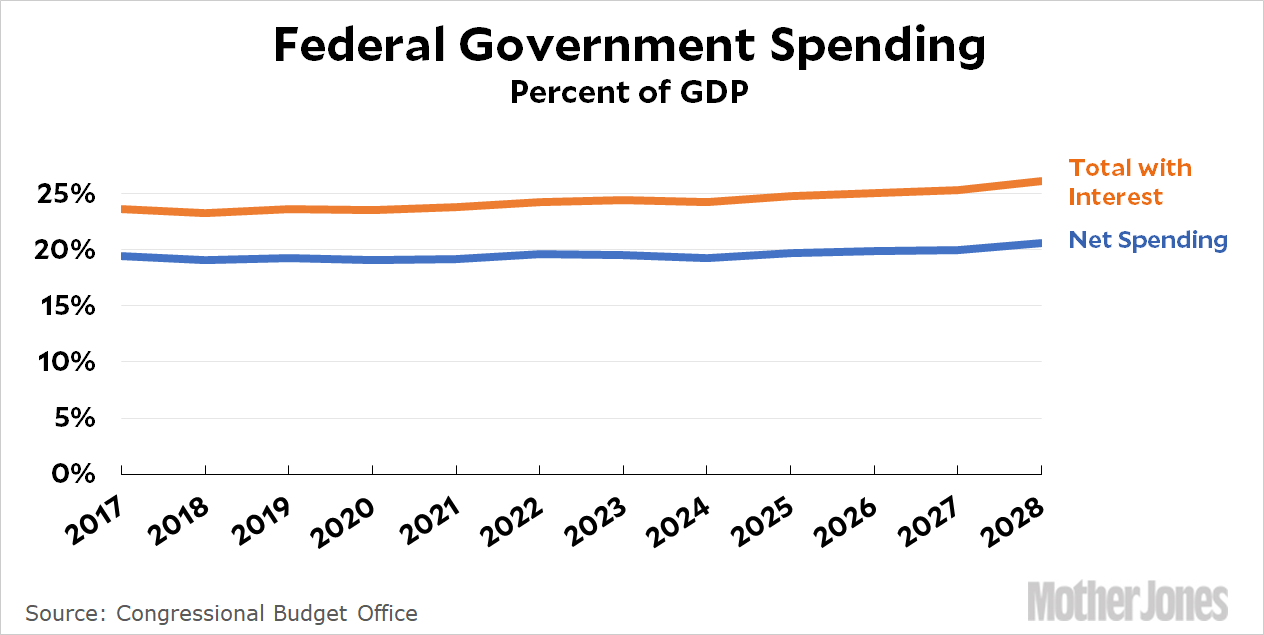
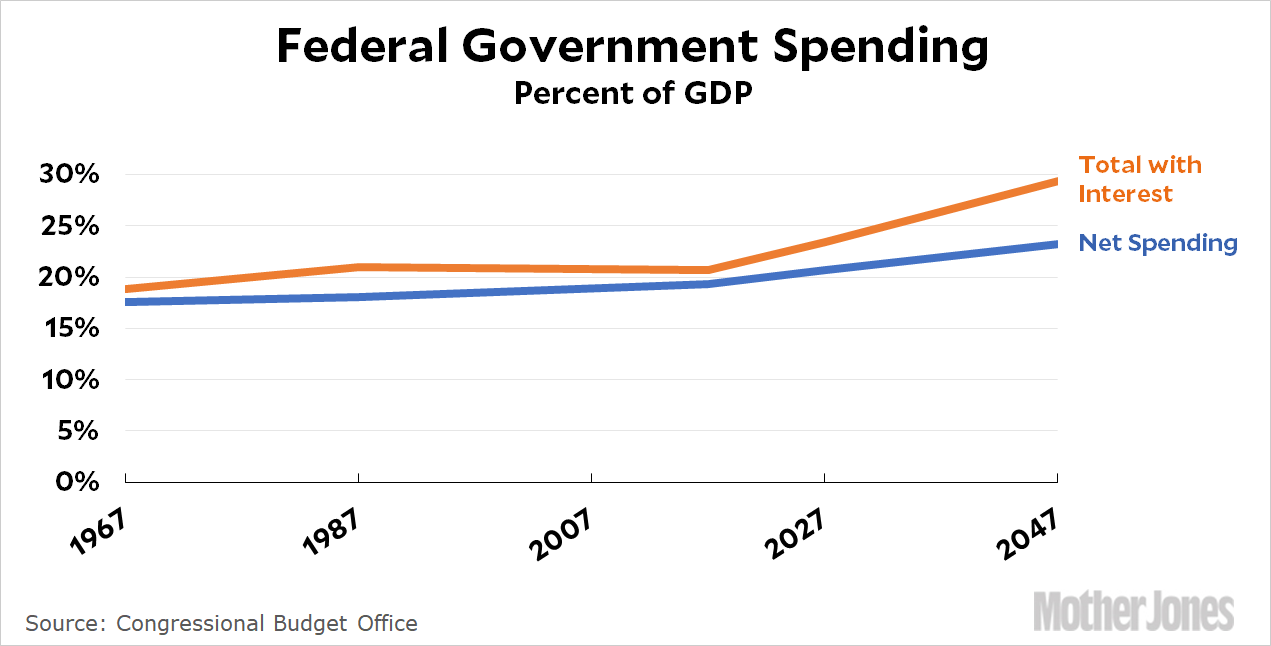
    We should shortly be getting the CBO’s latest budget outlook, which includes the effects of the Trump tax cut. To prepare ourselves, here’s the projection from last year’s long-term budget outlook:

    Over the next 30 years, net spending increases from 19.3 percent of GDP to 23.2 percent. That’s about one percentage point per decade, mostly due to rising health care costs. In other words, it’s not a lot. What’s more, if technological advances slow down health care spending—something I find likely even if it seems hard to believe right now—spending won’t go up even that much.

    But if you add interest on the national debt, spending goes up nearly 9 percentage points. That’s the killer, and there’s no technological advance that can change this. In the 2018 version of the CBO report, this will get even worse thanks to last year’s tax bill.

    Despite what conservatives say endlessly, spending is not the problem. We can easily manage an increase of 1 percent per decade for the next few decades. It’s only if we refuse to pay for it that the national debt explodes.

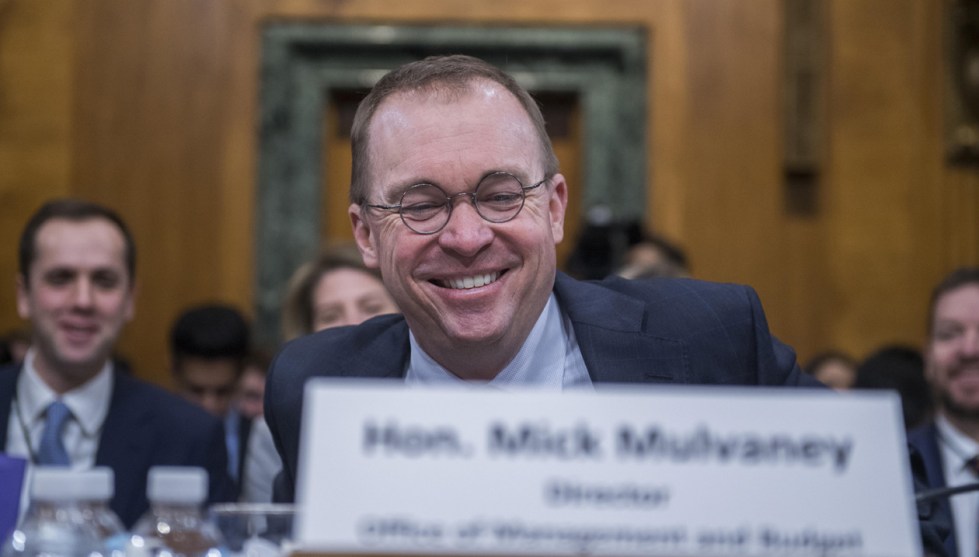
  • Add Mick Mulvaney to the List of Big Spenders With Other People’s Money

    Tom Williams/Congressional Quarterly/Newscom via ZUMA

    It appears that Scott Pruitt isn’t the only conservative who rails against overpaid bureaucrats unless they’re his overpaid bureaucrats:

    Mick Mulvaney, President Donald Trump’s appointee to oversee the Consumer Financial Protection Bureau, has given big pay raises to the deputies he has hired to help him run the bureau, according to salary records obtained by The Associated Press. Mulvaney has hired at least eight political appointees since he took over the bureau in late November. Four of them are making $259,500 a year and one is making $239,595. That is more than the salaries of members of Congress, cabinet secretaries, and nearly all federal judges apart from those who sit on the Supreme Court.

    ….Kirsten Mork, Mulvaney’s chief of staff, got a significant bump in pay for going to work at the CFPB. She made $167,300 in her job working for Rep. Jeb Hensarling on the House Financial Services Committee, according to LegiStorm, a website that tracks congressional salary data. She now makes $259,500 as chief of staff of the CFPB, according to bureau records….Another former congressional staffer, Brian Johnson, who also worked for the House Financial Services Committee, made $164,600 in his role there before going to the CFPB, according to LegiStorm. He now makes $239,595 as a “senior advisor” to Mulvaney, a position that did not exist under Cordray.

    Eric Blankenstein, who oversees supervision, enforcement and fair lending for the bureau, previously was a lawyer for the Office of the U.S. Trade Representative making $153,730, according to federal salary data website FedSmith. He now makes $259,500, according to bureau records. Another Mulvaney appointee, Sheila Greenwood, who used to work in the Department of Housing and Urban Development making $179,700 a year, now makes $259,500. Anthony Welcher, who worked outside government before becoming a director of external affairs for the bureau, is also making $259,500 a year. His position also did not exist under the previous administration, according to bureau records.

    I hardly even know how to react to this stuff anymore. The federal government under Trump is apparently just a big pot of spoils to be divvied up. Do any Republicans even care about this anymore?