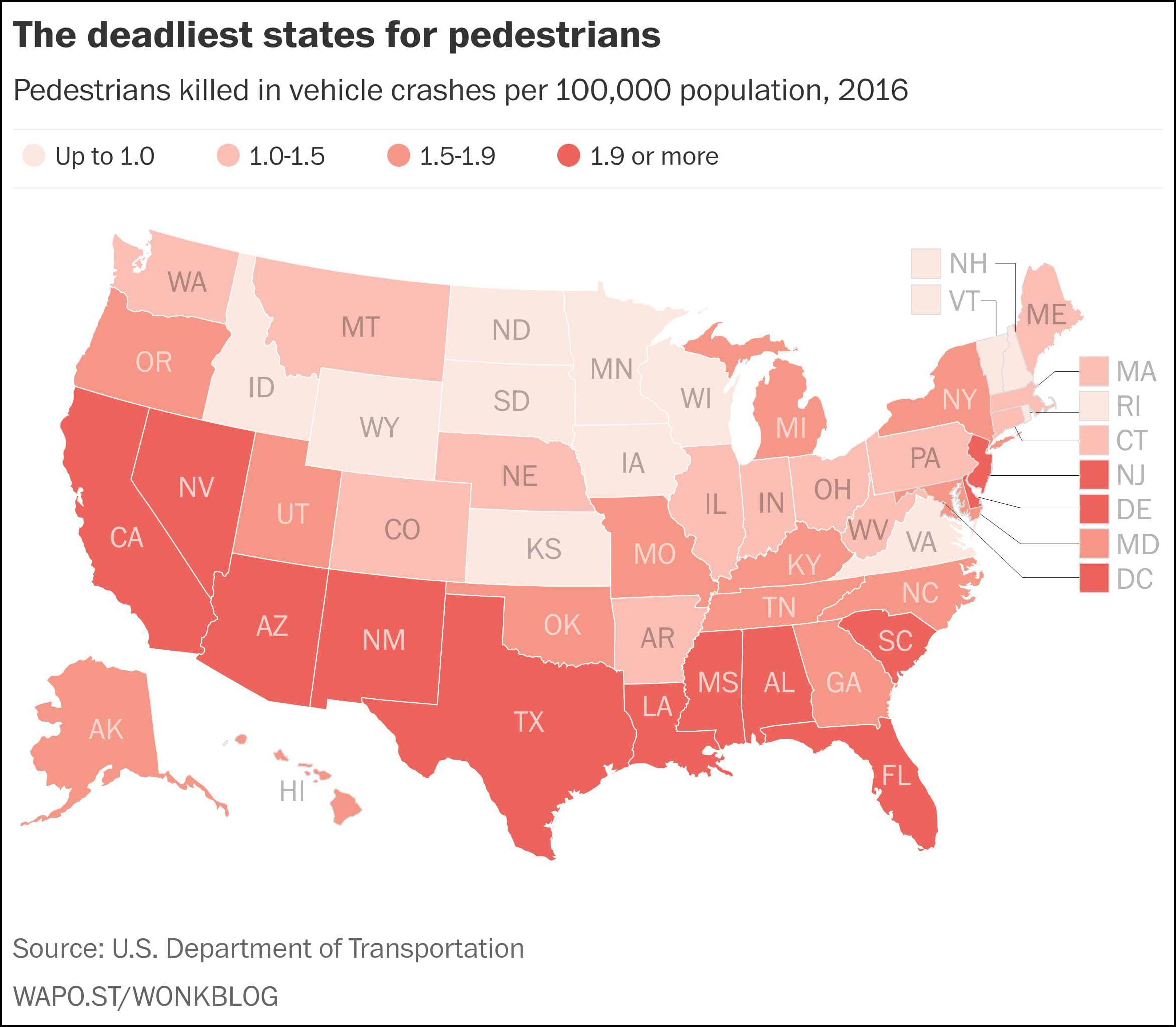
The Washington Post reports today that after declining for decades, pedestrian deaths started rising in 2010. Fatalities are now 46 percent higher than they were eight years ago and nobody really seems to know why. But here’s the real mystery:
With just a few exceptions, the deadliest states for pedestrians are all in a well-defined southern band stretching from California to Florida. What’s up with that? What does California have in common with Alabama? Or New Mexico with Florida? Or Nevada with Texas? What’s going on here?
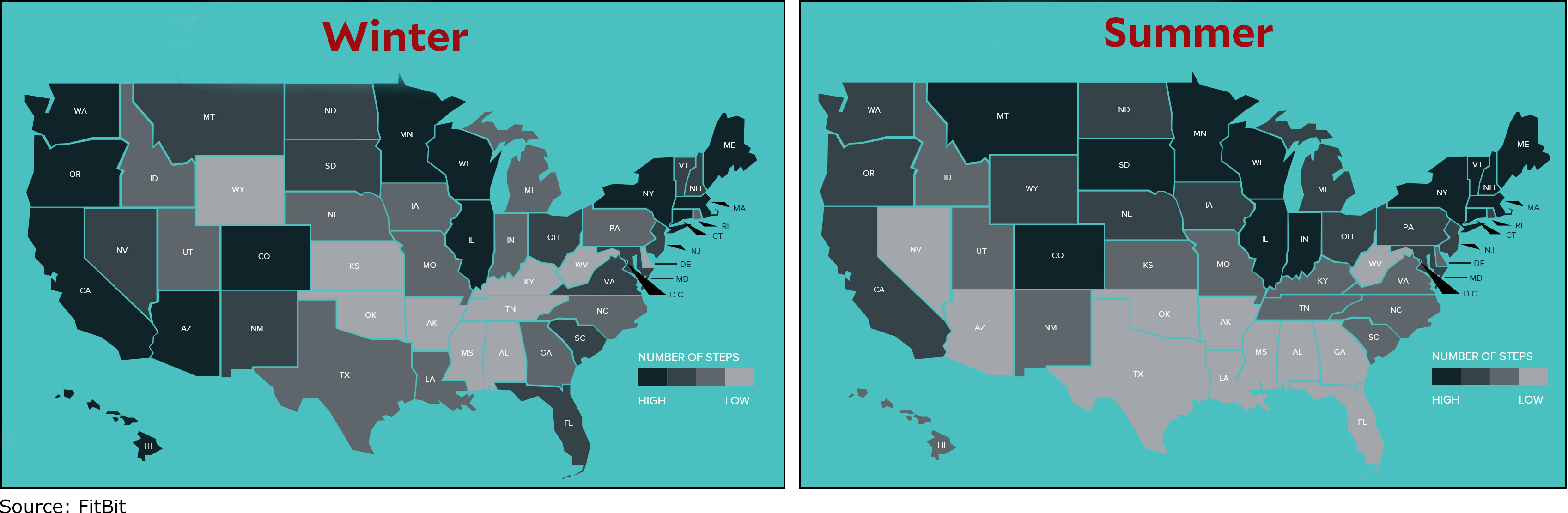
UPDATE: The consensus seems to be that sunbelt states have a lot of pedestrian deaths because they’ve got great weather and people walk more. That seems reasonable. However, this map from FitBit suggests that the exact opposite is true:
Now, maybe all those northerners are walking in the gym or something. Who knows? But it sure looks like Southerners (a) don’t walk much and (b) get killed a lot when they do. The mystery grows!
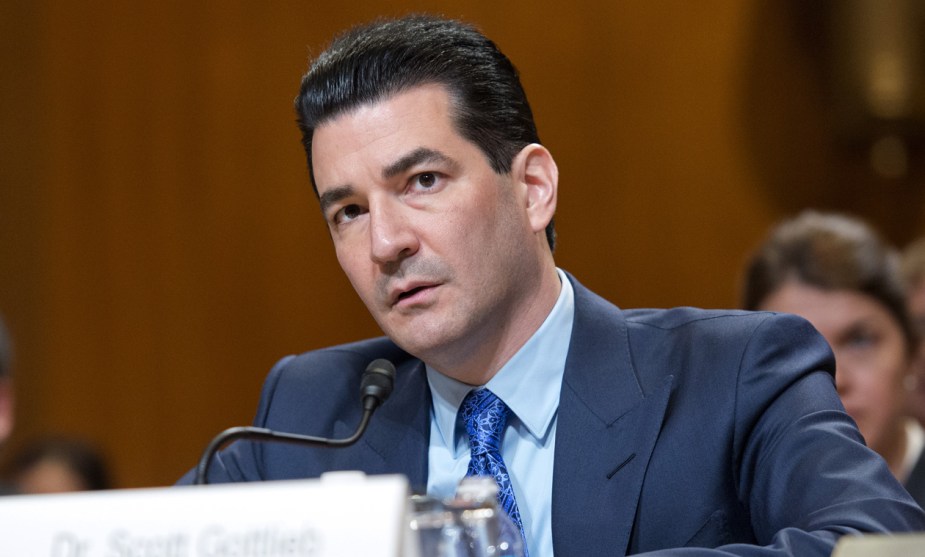
Scott Gottlieb, commissioner of the FDA, spoke today to a meeting of the insurance industry’s main lobbying group. He basically accused them of conspiring to keep prices high on expensive biosimilar drugs:
Too often, we see situations where consolidated firms — the PBMs,¹ the distributors, and the drug stores — team up with payors [i.e., insurance companies]. They use their individual market power to effectively split some of the monopoly rents with large manufacturers and other intermediaries rather than passing on the saving garnered from competition to patients and employers….And so, we continue to see a backlash against these Kabuki drug-pricing constructs — constructs that obscure profit taking across the supply chain that drives up costs; that expose consumers to high out of pocket spending; and that actively discourage competition.
Patients shouldn’t be penalized by their biology if they need a drug that isn’t on formulary….After all, what’s the point of a big co-pay on a costly cancer drug? Is a patient really in a position to make an economically-based decision? Is the co-pay going to discourage overutilization? Is someone in this situation voluntary seeking chemo? Of course not. Yet the big co-pay or rebate on the costly drug can help offset insurers’ payments to the pharmacy, and reduce average insurance premiums. But sick people aren’t supposed to be subsidizing the healthy. That’s exactly the opposite of what most people thought they were buying when the bought into the notion of having insurance.
….Patient access to these innovations will depend on reforms that require every incumbent in the drug supply chain to take greater restraint for putting patients at the heart of their decision-making process….We’re not there today. Instead, we have a lot of finger pointing that ignores shared complicity for pricing practices that are eroding trust in both payors and innovators. I hope that you’ll act before that trust is eroded completely.
Good for Gottlieb. Pharmacy benefit managers were originally a good idea intended to truly manage the complicated business of negotiating drug prices. As usual, though, things got out of hand when everyone realized they could be used to enrich themselves instead. These days they accomplish little except to make the entire procurement process so opaque that no one can reasonably figure out what the real cost of a drug is. That’s good for just about everyone except patients.
And since consolidation is one of my bugbears, it’s worth noting Gottlieb’s raw data: “The top three PBMs control more than two-thirds of the market; the top three wholesalers more than 80%; and the top five pharmacies more than 50%.” In the past, the mere fact of market power this strong would have been enough to spur antitrust action. But after the Bork revolution, size didn’t matter. What mattered was whether big companies could argue that bigness was good for consumers. Needless to say, big companies are very, very good at making this argument, and so antitrust actions have dwindled to a trickle. It’s long past time for a counter-revolution that returns us to the era in which consolidation beyond a certain size is ipso facto a reason for antitrust action.
¹PBM = pharmacy benefit managers. Insurance companies hire PBMs to negotiate formularies and drug prices. As Gottlieb notes, two-thirds of the PBM market is controlled by three giant players: ExpressScripts, CVS Caremark, and OptumRx. PBMs are widely believed to abuse their position by negotiating obscure rebates and endless fees that end up increasing costs for patients.
China has been asked to develop a plan for the year of a One Billion Dollar reduction in their massive Trade Deficit with the United States. Our relationship with China has been a very good one, and we look forward to seeing what ideas they come back with. We must act soon!
Is this a Dr. Evil parody? Last year we ran a $375 billion dollar trade deficit with China. This year it will be—who knows? $400 billion? How would you even know if it had gone down by a quarter of a percent?
Donald Trump frequently makes no sense, but this makes even less than no sense. What the hell is he talking about? Was this seriously a formal request to the Chinese government? They must be laughing their asses off.
Via Robert VerBruggen, I learn today of a new study about Naloxone, the anti-overdose drug being used to combat the opioid crisis. The authors look at overdose deaths in states before and after they adopted laws making Naloxone more easily available, and they conclude that Naloxone doesn’t help. In fact, it might even increase overdose deaths. The mechanism is quite plausible: if you know that Naloxone is around, you’re more likely to take opioids without worrying about overdosing. So Naloxone increases the number of people using opioids, but then saves some of the ones who overdose. In the end, it’s a wash—or maybe worse.
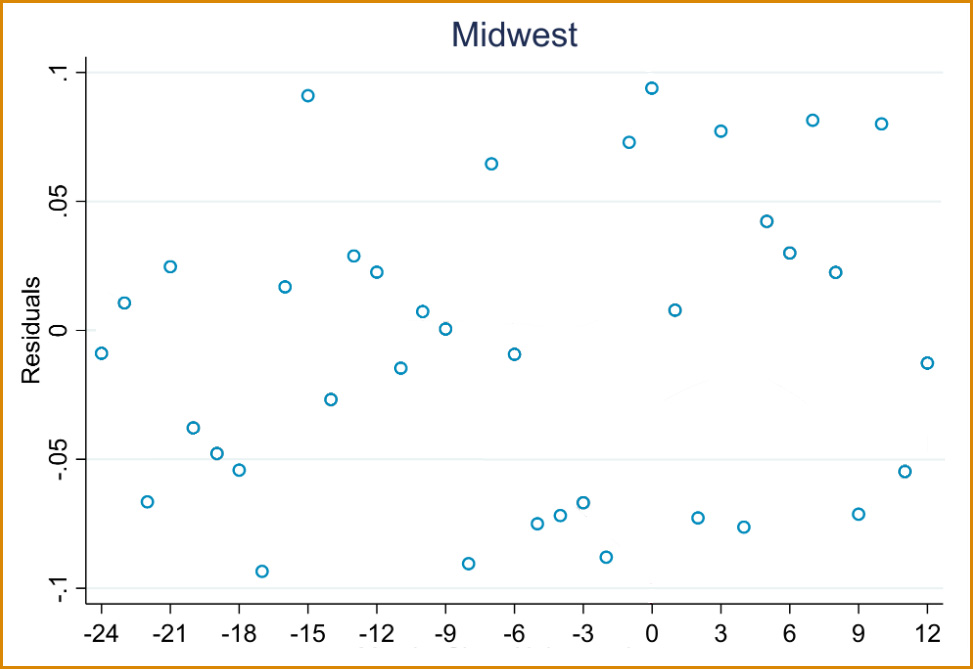
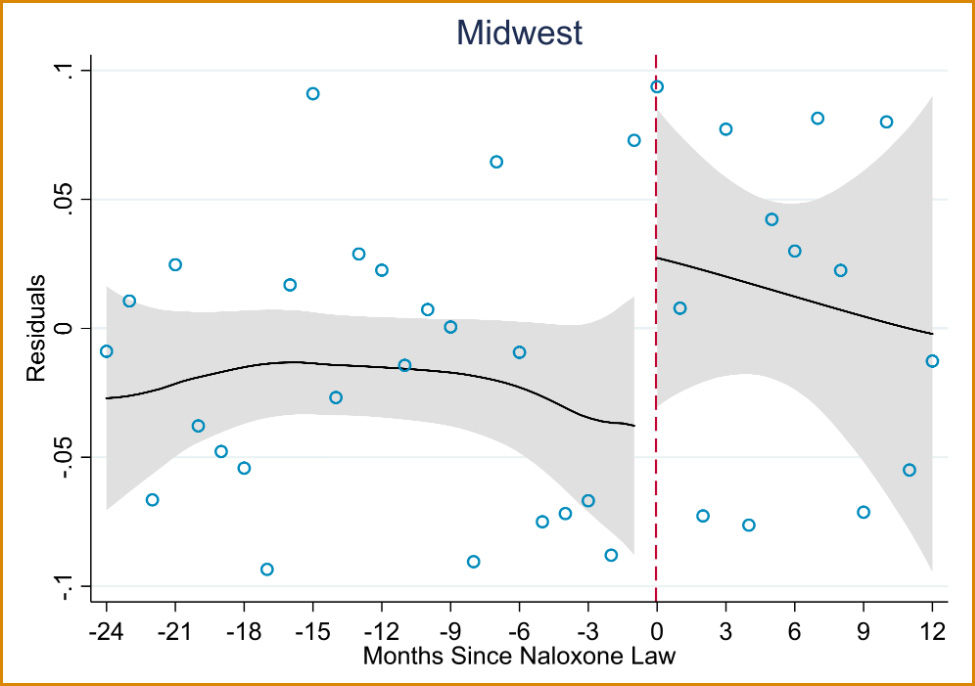
But I’m skeptical of these findings. To see why, take a look at this scatterplot of opioid deaths in the Midwest:
I’ve removed all the labels so you can take a look at it without any biases. Do you see any trends? Or any breaks in the data? I can’t say that I do. The data is all over the place. You can draw a regression line through it, of course, because you can draw a regression line through anything. But it sure doesn’t look like it would mean much.
Now take a look at the original version of the chart:
The authors draw a red line at the point where a Naloxone law was passed, and then draw regression lines separately for before and after. The “before” line is … something. I can’t even tell what. A cubic? The “after” line is … a line. But come on. Technically, the “after” trendline might start high and go down, but do you really believe that? There are only 12 data points and they vary wildly from month to month. This data just doesn’t mean anything.
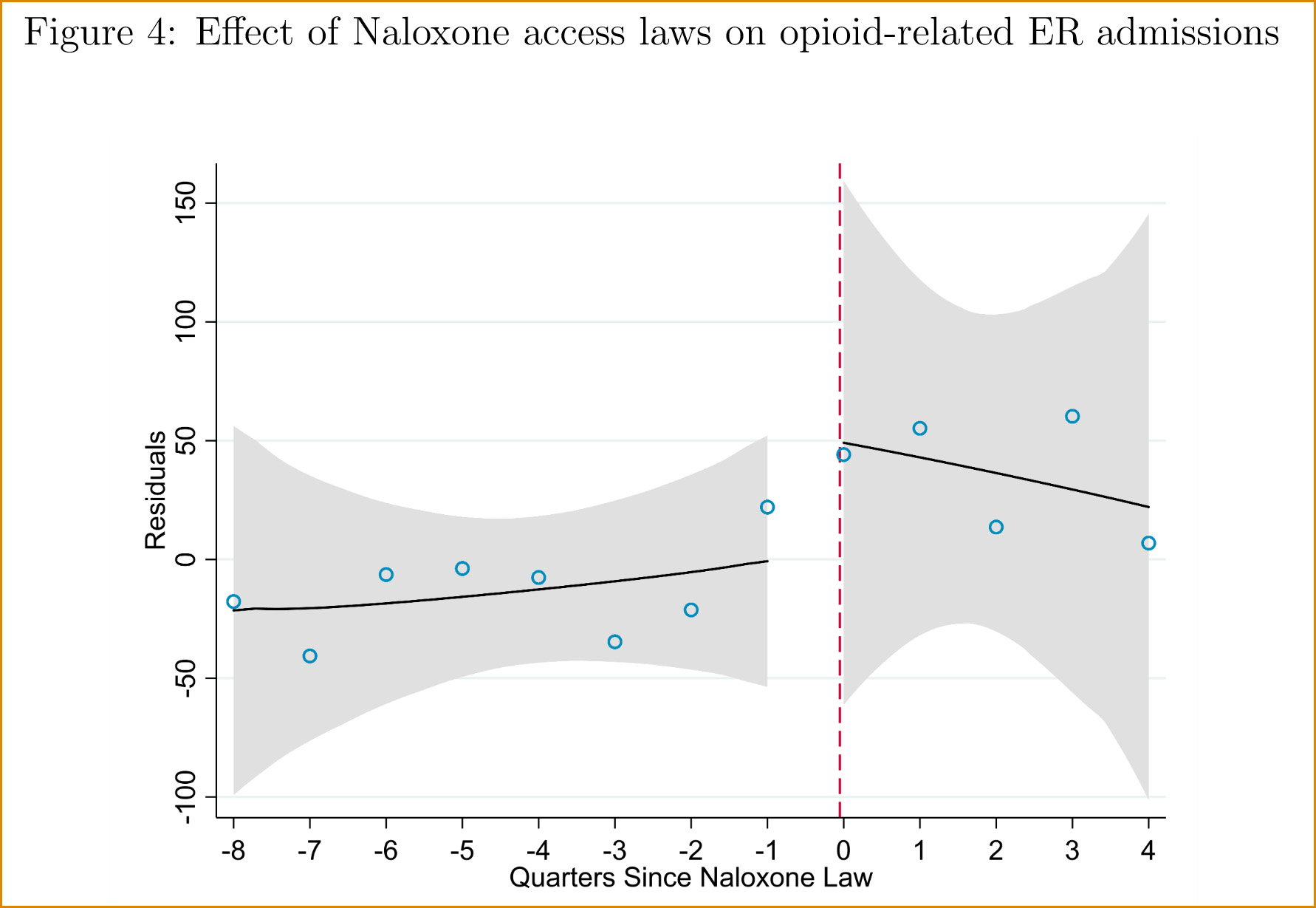
I chose their scatterplot for the Midwest because it was especially noticeable that the separate trendlines were wholly artificial. But the other charts aren’t much different. Here’s one for ER admissions:
You’ll have to use your imagination to remove the labels, but I think it’s pretty easy to see that there’s nothing here. In fact, the error bars make this crystal clear: in the “after” half of the chart, they’re nearly as big as the entire chart! My eyeball estimate is that this simply shows opioid-related ER visits steadily increasing through the entire period. And yet the authors say this:
We find that Naloxone laws increased the quarterly number of visits by 266 per 100,000 residents (15%, p < 0.05). This effect is large and consistent with the hypothesis that Naloxone access increases the abuse of opioid drugs.
This is large? The only thing that looks large to me is the error bars.
Based on the data the authors collected, I’m perfectly happy to say that Naloxone laws, on average, have no effect on overdose deaths. Or at least no provable effect yet. But I’d sure be hesitant to say anything more than that.
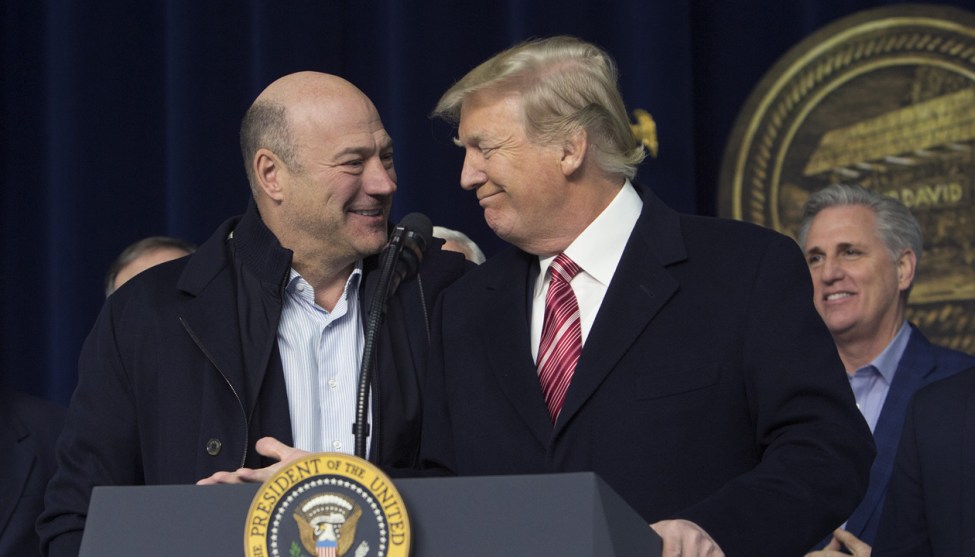
Gary and Donald in happier times. Eight weeks ago.Chris Kleponis/CNP via ZUMA
Gary Cohn has resigned from the Trump administration, apparently because the idiocy of Trump’s steel tariffs was finally too much for him. Besides, he already got the big corporate tax cut he wanted, so there wasn’t much reason to stay. This means that rather than listing all the top aides who have left the White House, it’s much easier to list the very few who are still around. We’re now down to five:
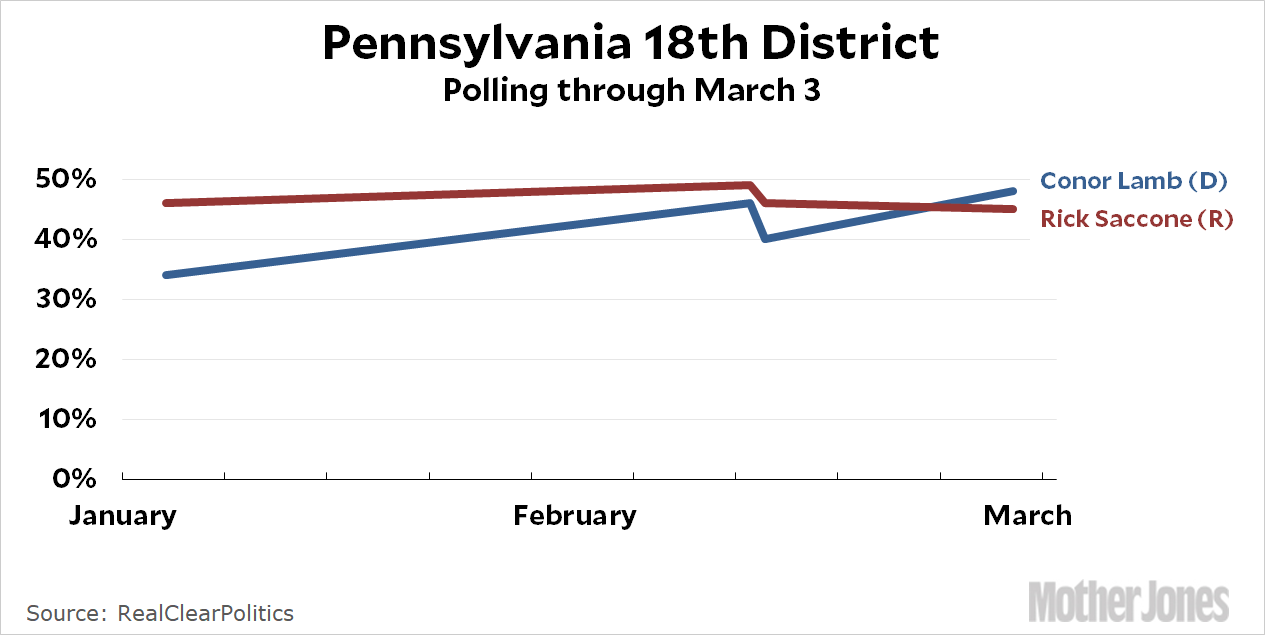
Perhaps you’ve heard that Republicans are in a panic over the special election in Pennsylvania’s 18th district. In a nutshell, here’s why:
The 18th is a strong Republican district, one that Donald Trump won by 19 points. Even a centrist Democrat shouldn’t have much of a chance. But Conor Lamb has been steadily gaining ground since the start of the year, despite Republicans outspending Democrats by $9 million to $1 million.
Also: this is one of those gerrymandered districts that a judge tossed out a couple of weeks ago. Under the new map, neither candidate will live in the new 18th district, which means that winning this election has no real long-term effect.
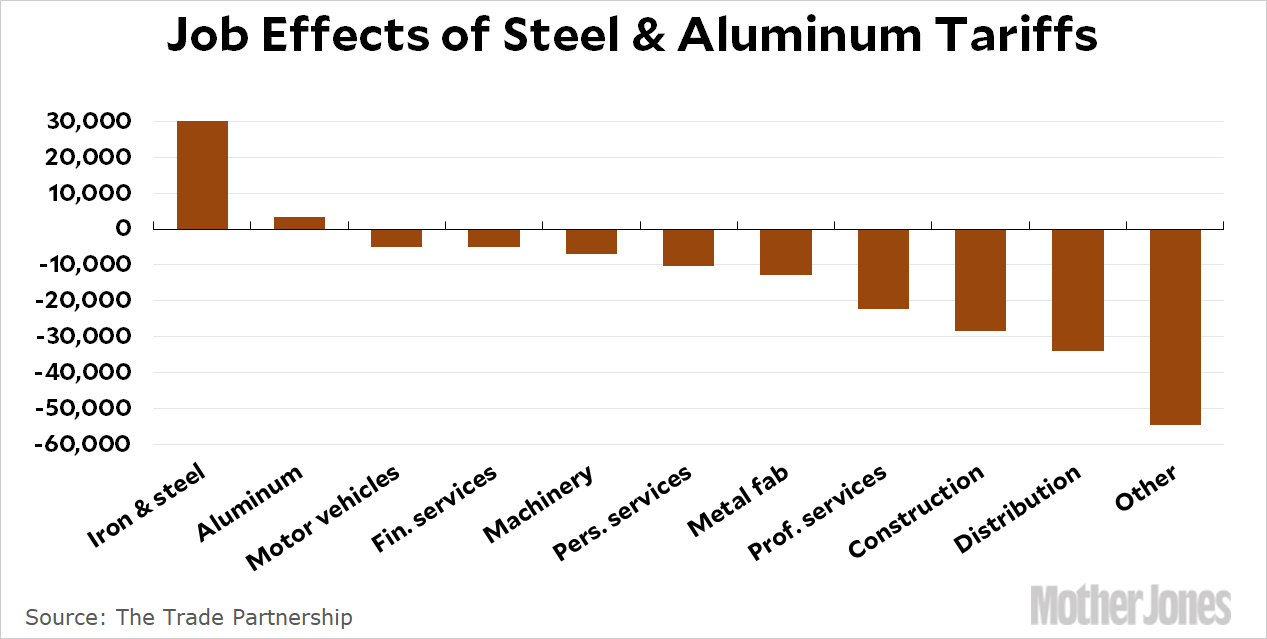
TTP estimates that the tariffs will, on net, cost about 146,000 jobs, two-thirds of which are production and low-skill jobs. This estimate doesn’t take into account any possible retaliation from our trading partners.
The TTP analysis is based on the Global Trade Analysis Project (GTAP) database. This is a model coordinated by Purdue University that’s widely used, not least by Joseph Francois, the economics professor who serves as managing director of TTP. The GTAP model, says the TTP paper, “is the same model used by the Commerce Department to arrive at the tariff rates it argues will yield increases in U.S. steel production sufficient to bring the industry to 80 percent capacity utilization.”
I’m sure we’re going to see lots of dueling estimates in the near future about the effects of Trump’s tariffs. This is just the first one.
Back in October, on a particularly sunny day in London, Marian and I decided to relax for a while on the deck chairs in Green Park. I whiled away the time snapping hundreds of pictures of everyone who walked down the path toward us. This particular tourist, however, didn’t just walk down the path. Instead she wandered all over the place, desperately trying to get a signal on her cell phone. As near as I could tell, she never did. It’s hard to say why, since there’s no lack of cell service in central London. Technology is mysterious.
Why Are Democrats Helping Trump Dismantle Dodd-Frank?
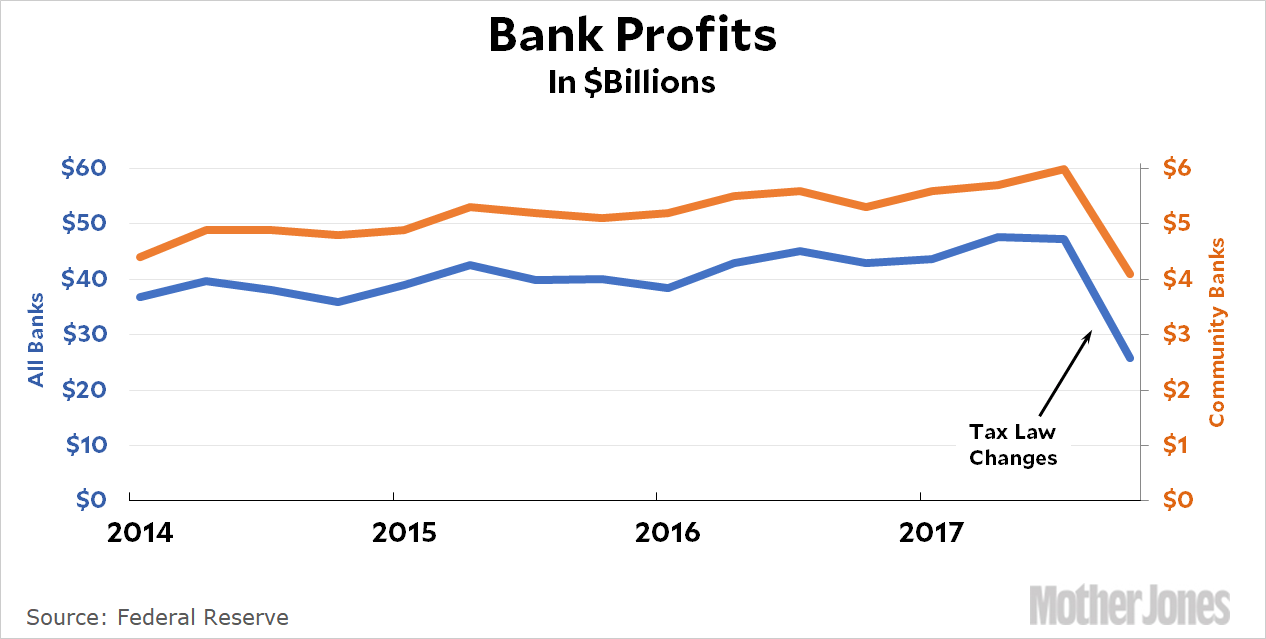
The Economic Growth, Regulatory Relief, and Consumer Protection Act—aka the Crapo bill—is allegedly meant to help out small community banks who are being whipsawed by onerous regulations designed for megabanks. That’s why a dozen Democrats say they’re in favor of it. But as I mentioned yesterday, community banks are doing fine:
Lightening the regulatory load on community banks is mostly a red herring. And besides, if that were the real reason for the bill then that’s all it would do. But it does much, much more. Here is shorter Mike Konczal:
This bill goes far beyond the health of community banks and credit unions. It removes protections for 25 of the top 38 banks; weakens regulations on the biggest players and encourages them to manipulate regulations for their benefit; and saps consumer protections….Dodd-Frank introduces regulations for banks with assets of more than $50 billion….The bill would move that line up to $250 billion.
….Dodd-Frank introduced more “stress tests”….The Crapo bill reduces their frequency….The Crapo bill will introduce a one-word change from “may” to “shall” that will pave the way for the biggest, most politically connected financial firms to argue that regulations should be tailored to be weaker for themselves….It allows community banks to violate the Volcker Rule, introduced in Dodd-Frank to prevent banks from engaging in hedge-fund-like gambling with their own funds.
Foreign banks that pose major risks, such as the Trump-friendly Deutsche Bank, will see their United States subsidiaries deregulated with the bill. It attacks the supplemental leverage ratio….The Congressional Budget Office not only assumes that it is 50 percent likely these megabanks will abuse this loophole, but also that this bill increases the chance and cost of a financial crisis overall….This bill also hurts consumers. It removes protections on mobile homes and appraisal requirements in rural areas….The Crapo bill will exempt banks that make fewer than 500 mortgages — which includes nearly 85 percent of banks — from reporting important mortgage data.
Why on earth are any Democrats, centrist or not, supporting this? At the very least, as Konczal points out, they should get something substantive in return for their votes. But they haven’t even asked for anything. In November it would be handy for Democrats to paint Republicans as the party of Wall Street. But how can they do that if the only reason a Wall Street giveaway like this passes is with Democratic votes?
In a novel I’m currently reading (I won’t say which because my point isn’t to pick on it), the author keeps Getting Things Wrong about the 90s, and not to provide deliberate creative anachronisms from what I can tell. The “internet” and “Brooklyn” of 2008 (roughly) are being presented as happening in 1998 and it’s really annoying me.
If this was only a problem in novels, it wouldn’t be so bad. But people have bad memories in real life too, and it has real-life consequences. Hillary Clinton, for example, made her fateful decision to use one email account in 2009. It seems pointlessly stupid to us today, with our iPhones and phablets and smart watches able to do anything we want them to. It’s hard to remember what 2009 was like, but the iPhone was still brand new back then and official Washington was still smitten with BlackBerries. Unfortunately, BlackBerries had serious limitations on handling multiple email accounts in a secure way. In practice, hauling around two BlackBerries was your only real solution.
But we forget about these pesky limitations of the past. BlackBerries today seem about as ancient as fax machines. Being limited to one email account is unfathomable. And yet, for security-minded folks that was reality back in the dim mists of 2009 unless you carried two devices. It was a pain, and Hillary had always used a single email account as a senator, so she just kept on doing it. Plus it was a busy time: everyone had a ton of transition stuff to attend to and no one really wanted to tell the Secretary of State that she couldn’t do this. So she did. And now Donald Trump is president.
And we respect that! But maybe you’re of a mind to support our work directly instead? We have until December 31 to raise the last $400,000 we need to keep our nonprofit newsroom running at full strength into 2026. Will you make a gift today?
We noticed you have an ad blocker on. Can you pitch in a few bucks to help fund Mother Jones' investigative journalism?
Billionaires own the media,
but they don’t own us.
At Mother Jones we know these aren’t conventional times, and they require unconventional coverage. That’s what deliver every day: fierce, independent journalism you can’t find elsewhere. Perhaps never in the history of our country has that been more necessary than now. But we can’t do it without reader support—your support. Please chip in today.
Billionaires own the media,
but they don’t own us.
At Mother Jones we know these aren’t conventional times, and they require unconventional coverage. That’s what deliver every day: fierce, independent journalism you can’t find elsewhere. Perhaps never in the history of our country has that been more necessary than now. But we can’t do it without reader support—your support. Please chip in today.