• Drawing Down Savings to Pay for Growth Can’t Last Forever

    The personal savings rate is suddenly under scrutiny. On Friday the Washington Post ran a piece calling it a “red flag” in the middle of otherwise good economic news. Today the Wall Street Journal reported on the latest numbers from the Commerce Department, noting that savings have fallen to their lowest rate in more than a decade.

    There are various ways of looking at this. Here’s one:

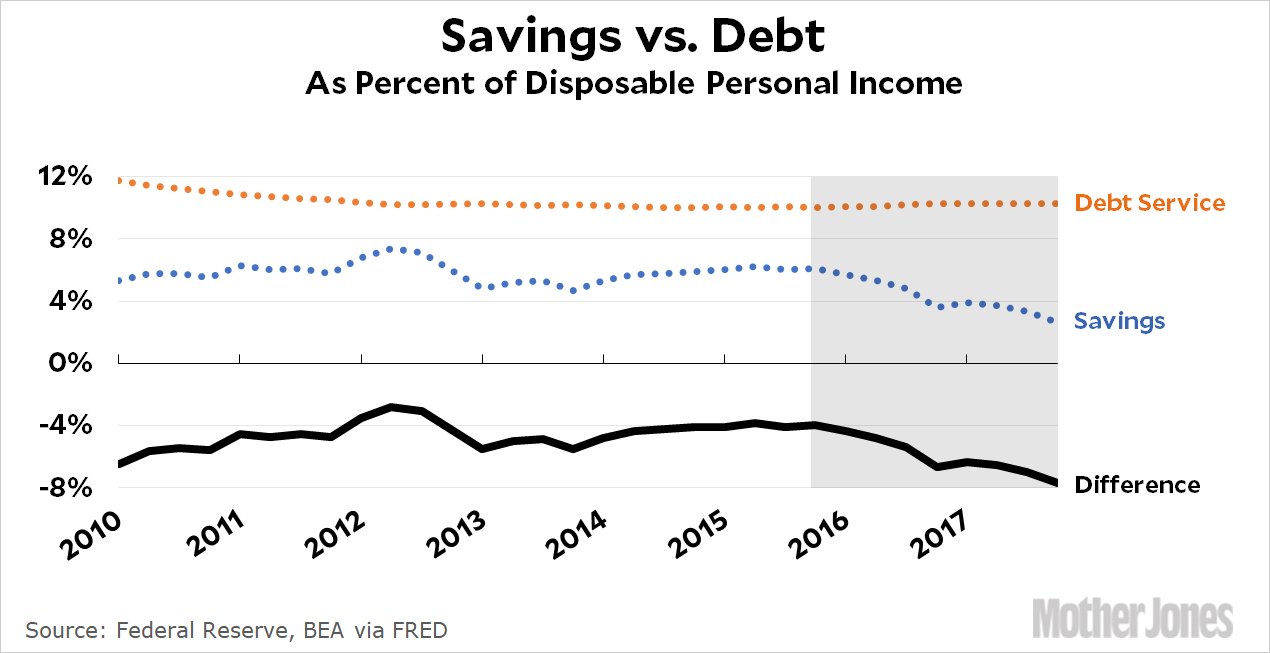
    After the Great Recession, the savings rate stayed steady because households were paying off debt primarily by reining in spending. This was not great for the economy, but it was good for personal finances. Between 2010 and the end of 2015, the difference between debt and savings improved from -6 percent to -4 percent.

    That changed two years ago. Since the beginning of 2016, savings have plummeted, but this money is not being used to pay off debt, which has stayed about the same. It’s being used to buy stuff. The difference between debt and savings has fallen from -4 percent to -8 percent.

    This is obviously not sustainable. When savings start to run out, households can keep up their spending for a while by maxing out their credit cards. Eventually, though, they have no choice but to cut back on consumption, something that will almost certainly stall the economy when it happens. Before long, that stall will turn into a recession.

    There are actually lots of red flags in the economy right now. My guess—which is worth what you paid for it—is that the US economy will continue to hum along in 2018, buoyed by the Republican tax cut and the economic recovery in the rest of the world. But I suspect it doesn’t have much longer than that. Right now, I imagine that Republicans are holding their collective breath, praying for the economy to crash precisely in November, after it can’t affect the midterm elections, and then recover precisely a year later, when the 2020 elections start to approach. They might get their wish.

  • Lunchtime Photo

    This is a long exposure of the Kenmare River. Pretty, isn’t it? I took this just a few steps away from the photo shoot with the fabulous Kenmare cat.

    Those of you who hate these long exposures of water will be glad to know that I only have one left. I will post it when your guard is down and you least expect it.

    POSTSCRIPT: I might as well use this as an excuse to post another picture of the cat. Right? Of course I’m right. Here she is, on the prowl for something or other. The Kenmare River is just behind the bushes at the top right.

  • Republican Smear Campaign Against the FBI Is Paying Off

    Ron Sachs/CNP via ZUMA

    From CBS News:

    FBI Deputy Director Andrew McCabe is retiring from the FBI, CBS News’ Pat Milton has confirmed. According to Milton, a source familiar with the matter confirms that McCabe was forced to step down. He is currently on leave and will official retire in March.

    The passive voice here is telling. Forced by whom? While we ponder that, the New York Times has this:

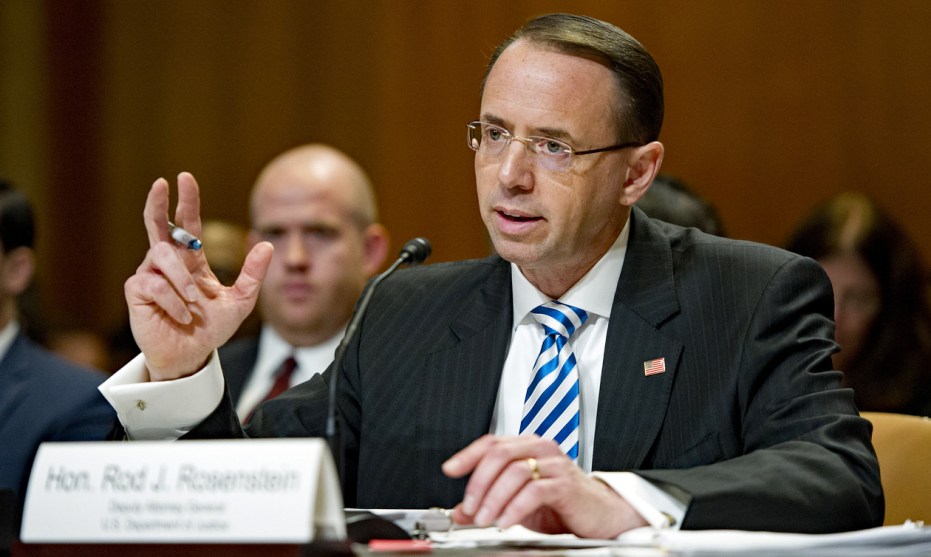
    A secret, highly contentious Republican memo reveals that Deputy Attorney General Rod J. Rosenstein approved an application to extend surveillance of a former Trump campaign associate shortly after taking office last spring, according to three people familiar with it….The memo’s primary contention is that F.B.I. and Justice Department officials failed to adequately explain to an intelligence court judge in initially seeking a warrant for surveillance of Mr. Page that they were relying in part on research by an investigator, Christopher Steele, that had been financed by the Democratic National Committee and Hillary Clinton’s presidential campaign.

    This, of course, is the infamous Nunes memo, and the Times is suggesting that in addition to all the other FBI targets, Republicans are starting to target Rod Rosenstein too. There’s hardly a top FBI official left who isn’t in the crosshairs of the Republican smear machine.

  • Support for Abortion Continues Its Six-Year Upswing

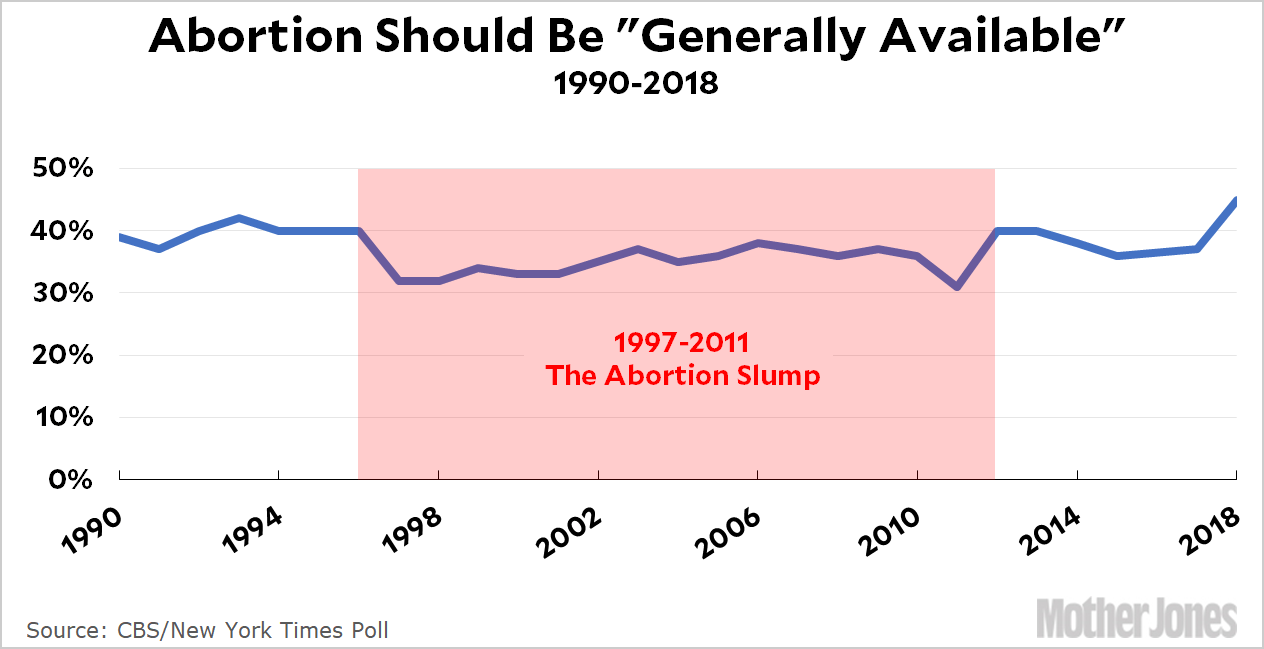
    Over at 538, Harry Enten noted this weekend that support for abortion reached its highest point ever in the latest CBS/New York Times poll. Abortion polling is notoriously variable depending on question wording, and I’ve always been a fan of this poll’s wording, which seems both simple enough and common-sensical enough to elicit real opinions:

    Which of these comes closest to your view? 1. Abortion should be generally available to those who want it. 2. Abortion should be available but under stricter limits than it is now. OR 3. Abortion should not be permitted.

    Enten’s news got me curious about the long-term trend in this poll. Here it is:

    One poll doesn’t mean much. But for the last four years “generally available” has polled steadily above the low numbers of 1997-2011. Is this meaningful? Is America a little more accepting of abortion than it was during the aughts? It looks like that might be the case.

  • Time to Put the Brakes on Jobs?

    Should the Fed continue raising interest rates?

    After several rate increases and with unemployment at a 17-year low, Fed officials face the question of whether joblessness might fall so much that they should pick up the pace of tightening to prevent the economy from overheating. The latest employment report released Friday by the Labor Department doesn’t suggest they need to move more aggressively or slow down. Employers added 148,000 jobs in December, and the unemployment rate was unchanged at 4.1%. Average hourly earnings of private-sector workers rose 2.5% from a year ago, in line with recent monthly readings.

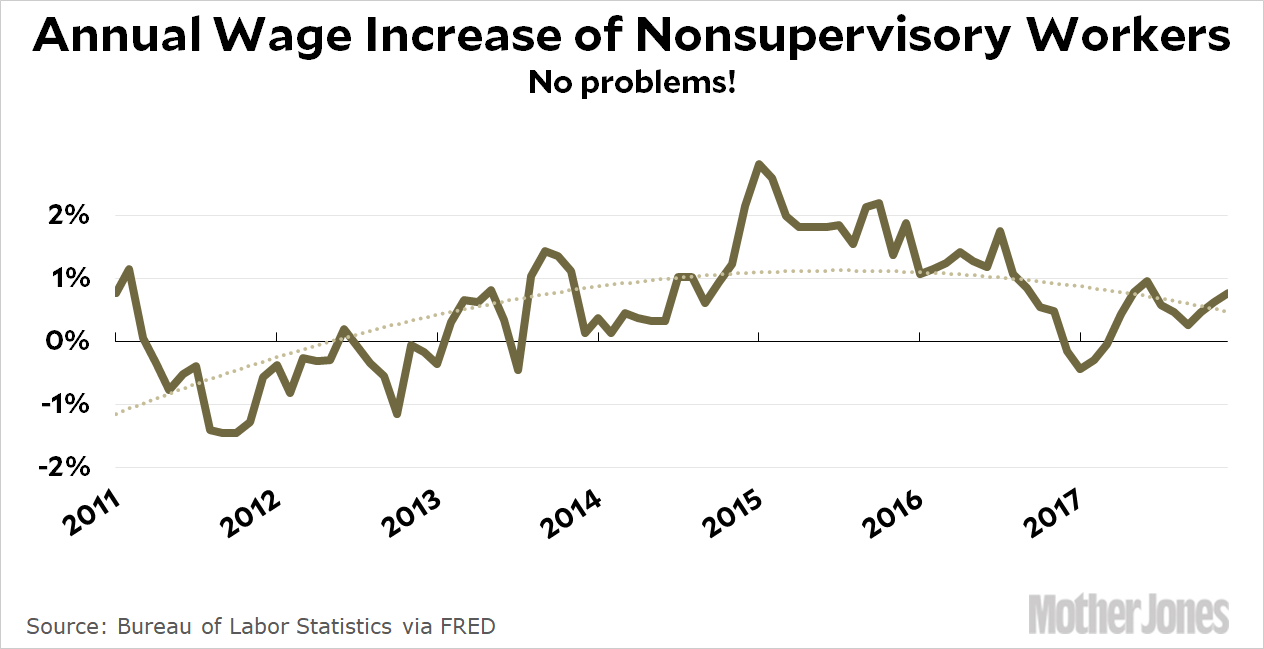
    Goodness. We wouldn’t want joblessness to fall too low, would we? That might force employers to pay people more!

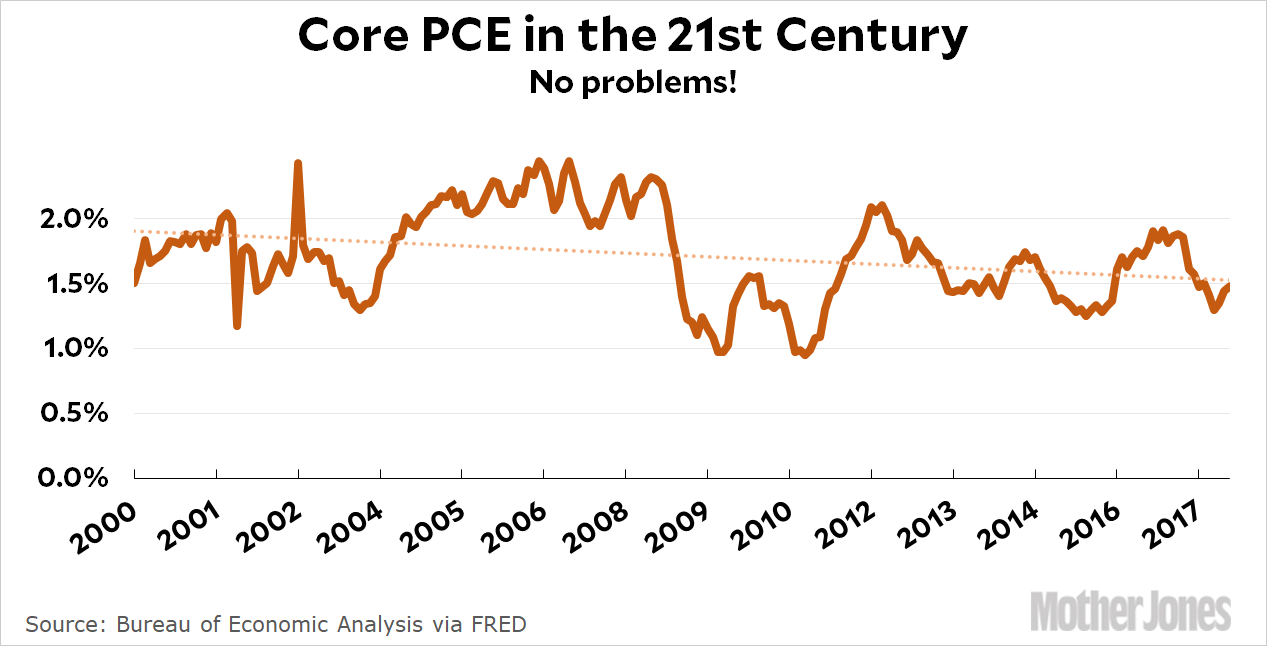
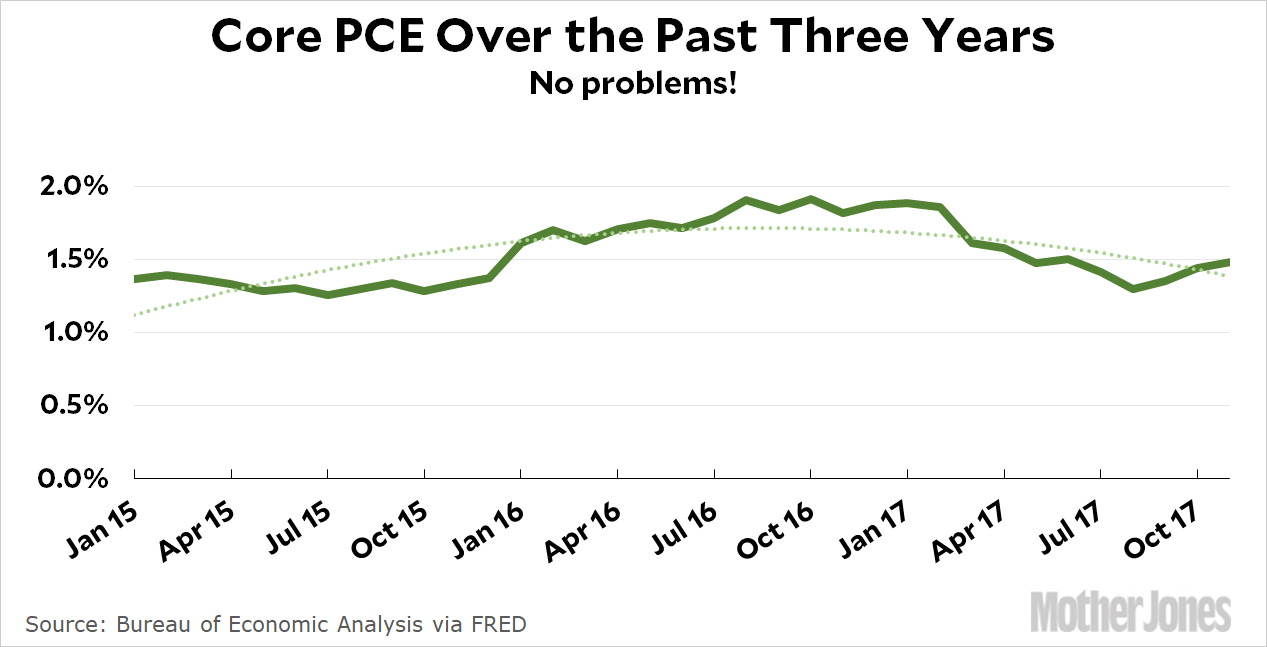
    If the Fed wants to raise rates because they think they need to keep their powder dry for the next recession, I can buy that. Maybe. But the only reason to worry about unemployment getting too low is a fear that it will push up inflation. And there’s precisely no reason to fear that inflation is about to pick up. Someday there might be, but that day is not today, not anytime in the past two decades, and unlikely to be anytime in the next few years either:

  • Does Trump’s Immigration Plan Actually Cut Legal Immigration?

    April Soasti, 9, front, and her sister Adriana, 7, stand with other community members after the Trump administration announced it was ending Deferred Action for Childhood Arrivals (DACA.)Stephanie Zollshan/AP

    As President Trump promised, his immigration plan consists of four pillars. The first is DACA and the second is better border security. There are things to argue about here, but they’re pretty easy to understand and the issues are well defined.

    The third pillar is the diversity visa lottery. This is a program that distributes a small number of green cards to countries that don’t normally send us very many immigrants. If I understand Trump’s plan correctly, the lottery would be eliminated but the green cards would be redistributed to the current employment-based quotas (i.e., they’d become “merit based”). Again, there are things to argue about here, but eliminating the lottery wouldn’t reduce the net number of immigrants and might or might not even change their composition very much.¹

    And that brings us to the fourth pillar: family sponsorships, which conservatives refer to as “chain migration.” The Trump plan would allow citizens and permanent residents to sponsor spouses and minor children for visas, but would no longer allow sponsorship of parents, siblings, or adult children. What effect would this have?

    The details of Trump’s plan make a huge difference here. At a first pass, it would cut legal immigration by about 400,000, according to estimates from the Cato Institute. That’s about a third of all legal immigration, so it’s a very big number. However, there are currently about 4 million people on the waiting list for family-sponsored visas. If these people are grandfathered, the number of legal immigrants would stay about the same. In a decade or two, after the backlog is worked off, legal immigration levels would start to drop.

    So which is it? A cut in legal immigration of about a third? Or no cuts at all for at least a decade? This is an enormous difference, and one that overwhelms all the other details. Until we have a concrete answer about this, I think it’s impossible for folks on either side of the debate to have any real idea of whether Trump’s plan is a reasonable starting point for negotiations.

    ¹Trump’s “shithole” comment has caused everyone to assume that ending the diversity lottery would primarily affect black immigrants from Africa. That might well be true, but I’d be interested in seeing some expert analysis of this.

  • A Tour of My Closet

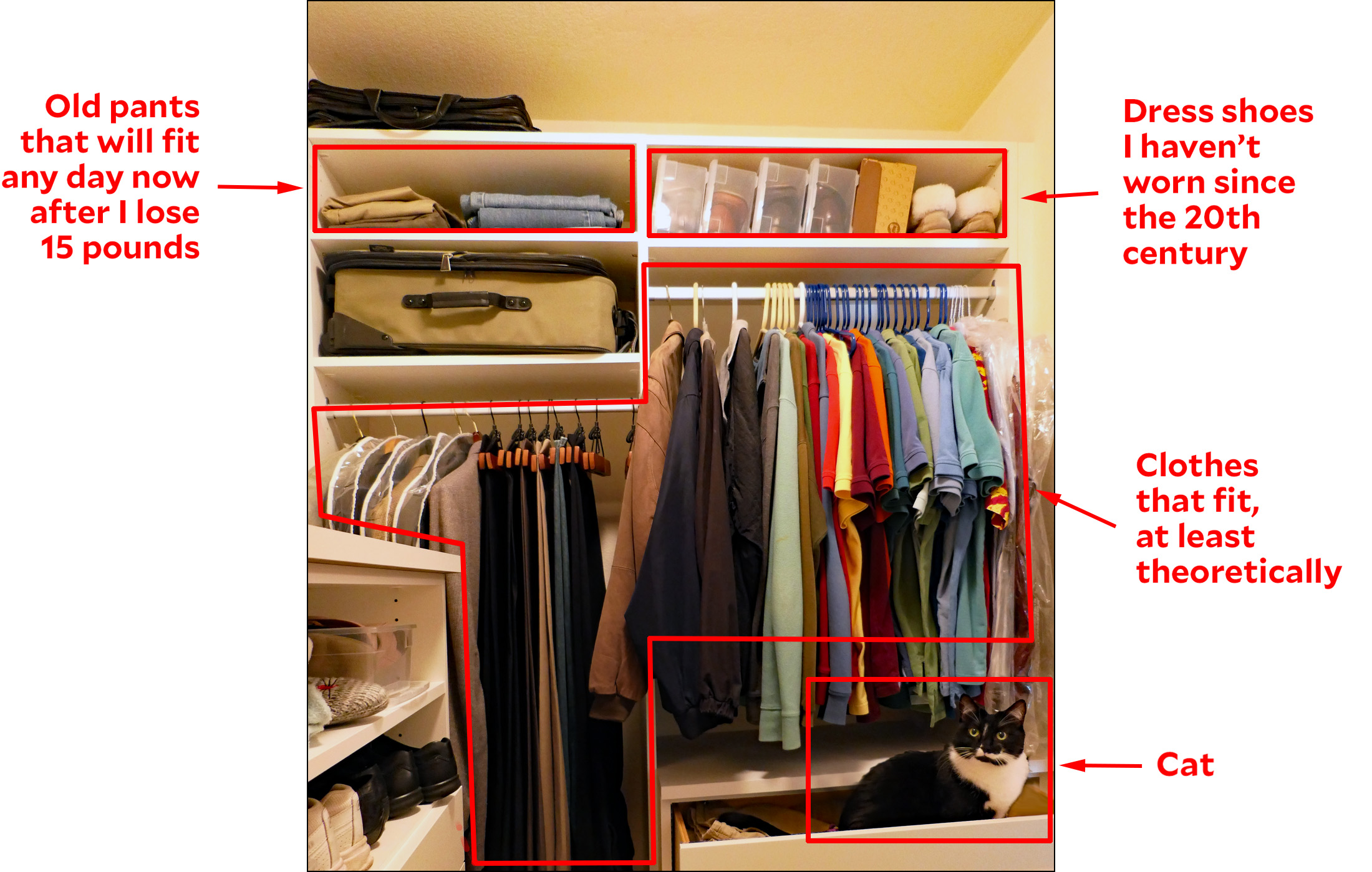
    Blogging is all about personal voice, which means you guys need to know who I really am. Well, how about a tour of my brand new closet, installed earlier this week? It’s been months in preparation, and it has room not only for my vast wardrobe, but also for my vast collection of felines. Let’s take a look around:

    That’s it! Were you expecting more? Come on: I’m not Oprah, you know. Actually, I’m a bit like Steve Jobs, but slightly more colorful. I have two or three pairs of pants to choose from plus a whole galaxy of colorful but otherwise identical polo shirts. They get replaced periodically, and right now I’m in the process of slowly replacing all the old shirts without pockets for new shirts with pockets. The pockets give me a place to put my glasses when I’m out taking pictures.

    So now you know the truth: unlike a true blogger, I don’t blog in my pajamas. I blog in stretchy pants and stretchy polo shirts. Exciting, isn’t it?

  • A Bit of Weekend Blogging Nostalgia

    Remember this?Kevin Drum Graphics LLC

    Here is Jia Tolentino on the slow death of blogging:

    Blogging, that much-maligned pastime, is gradually but surely disappearing from the Internet, and so, consequently, is a lot of online freedom and fun. Before I came to The New Yorker, my only professional writing experience was at blogs, places where a piece like this one, about disappearing blogs, would’ve been either eighty-five words or three thousand, and the lede would have been abrupt and vividly unprofessional, like a friend grabbing you by the collar at a bar.

    ….Blogs are necessarily idiosyncratic, entirely about sensibility: they can only be run by workhorses who are creative enough to amuse themselves and distinct enough to hook an audience, and they tend to publish like-minded writers, who work more on the principle of personal obsession than pay. The result is editorial latitude to be obscure and silly and particular, but the finances are increasingly hard to sustain; media consumption is controlled these days by centralized tech platforms—Facebook, Twitter—whose algorithms favor what is viral, newsy, reactionary, easily decontextualized, and of general appeal.

    Andrew Sullivan is likewise nostalgic:

    What was precious about it was its simple integrity: A writer gets to explore her craft and develop her own audience. We weren’t in it for the money or the clicks or the followers. We were in it for the core experience shared between a writer and a reader — and the enormous freedom that removing the editorial gatekeepers unlocked. It was a brief period, but an alive one, and it was largely lost — or abandoned — because of a major failure of nerve on the part of most print media.

    ….I saw when the goal across the media shifted from simply writing what you believed, however idiosyncratically, to writing more and more and more, so that the sheer volume of traffic might save the economics of web journalism. The fire-hydrant stream of “content” (“writing” was so passé) was so overwhelming that no single editor could manage it, no group of writers could give it character, and no single reader could even begin to read it all. Maybe the web made this inevitable. But it didn’t make the dissipation of so much heritage any less agonizing to watch.

    All of this is true, but I’d add something else: for me, the best part of the “golden age” of blogging was interacting with other bloggers. That was a helluva lot of fun. At its worst, sure, it was a dorm room bull session: interesting for the participants, but ultimately pretty shallow. But at its best it was vibrant, real conversation, the exact opposite of the robotic garbage that infests cable news. It was genuine. It changed a few minds here and there. And it persuaded lots of people that ordinary writers could be every bit as good as the high-priced columnists at the Times or the Post—even as half our posts were stimulated by disagreement with one of these guys. (And lest we forget, yes, they were mostly guys back then. Not everything about the golden age was great.)

    That’s largely gone. There are plenty of blogs left, but most of them have become as professionalized as the columnists we used to sneer at. That means other bloggers are rarely even linked to these days, let alone argued with. That would be unprofessional!

    I am lucky beyond belief. I took to blogging almost instantly. (As my old college roommate once said to me, “I can’t think of a better pairing of man and medium.”) The particular kind of blogging I like is general purpose and singular. That is, I want to be able to write about anything, and I want to do it on my own, not as part of a group. There are very few blogs like that left, but somehow I’ve managed to hang on. It started at the Washington Monthly, where Paul Glastris let me do whatever I wanted for many years, and then continued over the past decade right here, where Monika Bauerlein and Clara Jeffery have rather astoundingly allowed me to keep doing whatever I want.

    I suppose it’s pretty obvious that I’m obsessed with blogging. Why else would I spend time writing stuff like this on a beautiful weekend morning? But I do miss the back-and-forth with other bloggers. That’s moved on to Twitter—which I think is better than many people give it credit for—and I don’t want to resurrect it. It would be like building a gothic cathedral in the 21st century: obviously fake, not an organic part of the times. But it was fun while it lasted.

    POSTSCRIPT: I should add that reports of blogging’s demise are a little exaggerated. There are still plenty of great blogs around. Obviously what’s great for you and what’s great for me are quite different, and I don’t read as many blogs as I used to. Still, there are several dozen on my more-or-less-daily reading list. Some I read more religiously than others, and some aren’t really blogs at all. I just think of them that way because they’re in my RSS reader. Some post every day, some post about once a month. Some are easy to get to, others are a pain in the ass. Most of them I’ve been following for more than a decade, others I just started last month. In alphabetical order, here they are:

    ACA Signups (Charles Gaba)
    Alicublog (Roy Edroso)
    Andrew Gelman
    Atrios
    Balloon Juice (John Cole and gang)
    Beat the Press (Dean Baker)
    Brad DeLong
    Charlie’s Diary (Charles Stross)
    The Corner
    Crooked Timber
    Daily Howler (Bob Somerby)
    Dan Drezner
    Early Warning (Stuart Staniford)
    Economist’s View (Mark Thoma)
    Election Law Blog (Rick Hasen)
    Empty Wheel (Marcy Wheeler)
    Hullabaloo (Digby)
    The Intercept
    Jared Bernstein
    Jim Pethokoukis
    Jonathan Bernstein
    Josh Marshall
    MaddowBlog (Steve Benen)
    Marginal Revolution (Tyler Cowen and Alex Tabarrok)
    Megan McArdle
    Michael Hiltzik
    Modeled Behavior (Adam Ozimek)
    Monkey Cage
    Mother Jones
    New Republic
    New York Magazine
    Paul Krugman
    Plum Line (Greg Sargent and Paul Waldman)
    Political Wire (Taegan Goddard)
    Reality-Based Community (Mark Kleiman & Co.)
    Real Time Economics
    The Switch
    The Upshot
    Volokh Conspiracy
    Vox
    Washington Monthly (Nancy LeTourneau and others)
    Wonkblog
    xpostfactoid (Andrew Sprung)

  • Report Claims Trump Targeted Potential Witnesses for Smear Campaign

    Xu Jinquan/Xinhua via ZUMA

    I can’t quite tell if this is important or a nothingburger, but Murray Waas reports today in Foreign Policy on some additional evidence of obstruction of justice by Donald Trump. It happened last June, after James Comey testified that he had told other FBI officials about Trump’s effort to kill the Russian investigation. Trump’s lawyer told him that corroborating testimony from these officials could be bad news:

    President Donald Trump pressed senior aides last June to devise and carry out a campaign to discredit senior FBI officials after learning that those specific employees were likely to be witnesses against him as part of special counsel Robert Mueller’s investigation, according to two people directly familiar with the matter….In discussions with at least two senior White House officials, Trump repeated what Dowd had told him to emphasize why he and his supporters had to “fight back harder,” in the words of one of these officials.

    ….Since Dowd gave him that information, Trump — as well as his aides, surrogates, and some Republican members of Congress — has engaged in an unprecedented campaign to discredit specific senior bureau officials and the FBI as an institution. The FBI officials Trump has targeted are Andrew McCabe, the current deputy FBI director and who was briefly acting FBI director after Comey’s firing; Jim Rybicki, Comey’s chief of staff and senior counselor; and James Baker, formerly the FBI’s general counsel….Comey confirmed in congressional testimony the following day that he confided in the three men.

    Trump’s jihad against the FBI, and against McCabe and the others in particular, is already widely known. He has been joined in this smear campaign by Fox News, the rest of the conservative media, and several sitting members of Congress. What Waas is saying is that Trump’s targets are far from random: they are the specific people Comey said he had confided in, and that’s why Trump wants to destroy their reputation. In any dispute over what Trump asked Comey to do in their famous private meeting in the Oval Office, Trump wants it to be his word against Comey’s, full stop.

    It’s a little unclear precisely what Dowd told Trump, or precisely what orders Trump gave to others. Those details are going to make the difference between whether this is a 3 or a 7 on the obstruction-of-justice Richter scale.