• Dealmaking or Sabotage? What’s the Future of Obamacare?

    Will Donald Trump sabotage Obamacare by cutting off CSR subsidies for low-income workers?

    A pair of prominent lawmakers urged President Trump on Sunday not to sabotage the Affordable Care Act, or Obamacare, in the wake of failed Republican efforts to scrap his predecessor’s signature legislative achievement.

    ….Sen. Susan Collins, the Maine Republican who steadfastly rejected a series of GOP healthcare measures last week, blamed the Trump administration for encouraging instability in the insurance markets….“I’m troubled by the uncertainty that has been created by the administration,” Collins said on NBC’s “Meet the Press.” She contested Trump’s characterization of the payments as an “insurance company bailout.”

    “That’s not what it is,” she said, calling the reduction payments “vital assistance” to low-income Americans.

    I’ve given up trying to predict what Trump will do. I can think of a dozen ideas that might flow through that squirrelly head of his on both sides of this question.

    However, the Washington Post’s Amber Phillips has more courage—or foolhardiness—than me. Of four possible avenues for Republicans to take on health care, she ranks sabotage last. She ranks this as the most likely outcome:

    Republicans start working with Democrats to make tweaks to Obamacare.

    Surprise! The most likely option to revive Obamacare repeal isn’t to repeal it at all.

    Republicans tried for months on their own, couldn’t do it, and now some key GOP lawmakers are advocating for the opposite approach….There’s a growing consensus among GOP members of Congress that working within the confines of Obamacare may be the only way to fix what they see as wrong with the law.

    That’s a brave prediction, and I sure wouldn’t bet the ranch on it. That’s not because it doesn’t have some appeal. It plainly does. For one thing, a genuine compromise could get 60 votes, which means anything is fair game. You don’t have to worry about following all the arcane rules of reconciliation bills.

    Nonetheless, it’s hard to see it happening. The Democratic asks are fairly easy to figure:

    • First, leave everything alone. Fund the CSR subsidies, enforce the individual mandate, don’t kill the taxes, etc.
    • Maybe reduce the max percentages families have to pay for health coverage at working-class incomes (for example, at 250 percent of the poverty level, make the cap 5 percent of income instead of 8 percent). Maybe create a high-risk reinsurance pool for extremely high-cost patients. Maybe a Medicaid buy-in for anyone who wants it.

    It’s unlikely Republicans would agree to any of this, but if they did what could they ask for that wouldn’t be a deal-breaker for Democrats?

    • Change the age band to 5:1.
    • Some kind of cheap catastrophic coverage for the young.
    • Higher funding for HSAs.
    • Ease the rules for Medicaid experimentation by the states.

    There’s more like that, but it seems unlikely to appeal to very many Republicans. What they really want is (a) lower taxes, (b) lower Medicaid spending, and (c) an end to the individual mandate. I suppose Democrats might agree to very modest versions of A and B, but certainly not C, which is vital to a functioning marketplace.

    I dunno. It’s hard to see any kind of deal here, especially with Mitch McConnell so pissed off and Paul Ryan still under the spell of repealing everything. But I guess you never know.
  • California Bullet Train About to Get Hit With Blizzard of Lawsuits

    The LA-San Francisco bullet train got hit with another setback last week:

    California’s high-speed train project is likely to continue to be buffeted by environmental challenges as a result of a decision by the state’s top court. In a 6-1 ruling last week written by Chief Justice Tani Cantil-Sakauye, the California Supreme Court decided that federal rail law does not usurp California’s tough environmental regulation for state-owned rail projects.

    This is a win-win-for me. I happen to think the bullet train is a bad idea, so anything that slows it down and leads to its possible demise is fine with me.

    Alternatively, maybe this will light a fire under Jerry Brown to do something about California’s regulatory environment. It’s not that I think our environmental rules are necessarily too harsh, only that they’re incomprehensible and ungodly slow. One way or another, environmental regs at various levels of government—city, county, state, water district, coastal commission, etc.—need to be streamlined and made less ambiguous. It should be possible to enforce strict standards, but at the same time (a) make it clearer precisely what those standards are, (b) restrict the number of lawsuits over new projects, and (c) give courts the tools to rule more quickly on the lawsuits that remain. It shouldn’t take ten years just to get approval to build a high-rise in central Los Angeles. Either approve it or deny it, but don’t take forever to do it.

  • The Elderly Are Probably Better Off Than We Think

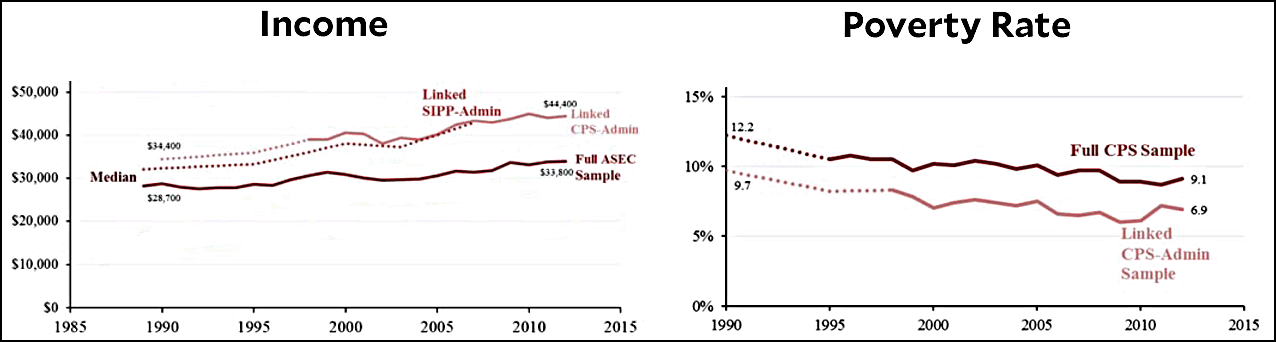
    Tyler Cowen points me today to a new Census Bureau report that suggests the elderly are better off than we think. Why? Because when they respond to surveys, they don’t accurately report pension income:

    The Current Population Survey Annual Social and Economic Supplement (CPS ASEC) is the source of the nation’s official household income and poverty statistics. In 2012, the CPS ASEC showed that median household income was $33,800 for householders aged 65 and over and the poverty rate was 9.1 percent for persons aged 65 and over. When we instead use an extensive array of administrative income records linked to the same CPS ASEC sample, we find that median household income was $44,400 (30 percent higher) and the poverty rate was just 6.9 percent….The discrepancy is mainly attributable to underreporting of retirement income from defined benefit pensions and retirement account withdrawals.

    Here’s the key pair of charts for people 65 years and older:

    It’s surprising how hard it is to get data on pension income in particular and the income of the elderly in general. For past years, the data often just doesn’t exist, and for more recent years the data is full of problems. However, this study doesn’t surprise me. After spending a lot of time diving into what data exists, I’ve come to the conclusion that, in general, the elderly are (a) better off than we think and (b) have seen their income rise considerably more than any other age group over the past couple of decades. More details here.

    The poorest elderly—primarily folks who spent their working lives at low-income jobs and now rely solely on Social Security—are truly in need, and their Social Security payments ought to be increased by a third or so. We also ought to do something about long-term nursing care, which can quickly bankrupt even the well-off elderly.

    Those two things are what progressives should focus on, not on the mythical “retirement crisis.”

  • You Want Data? FRED to the Rescue.

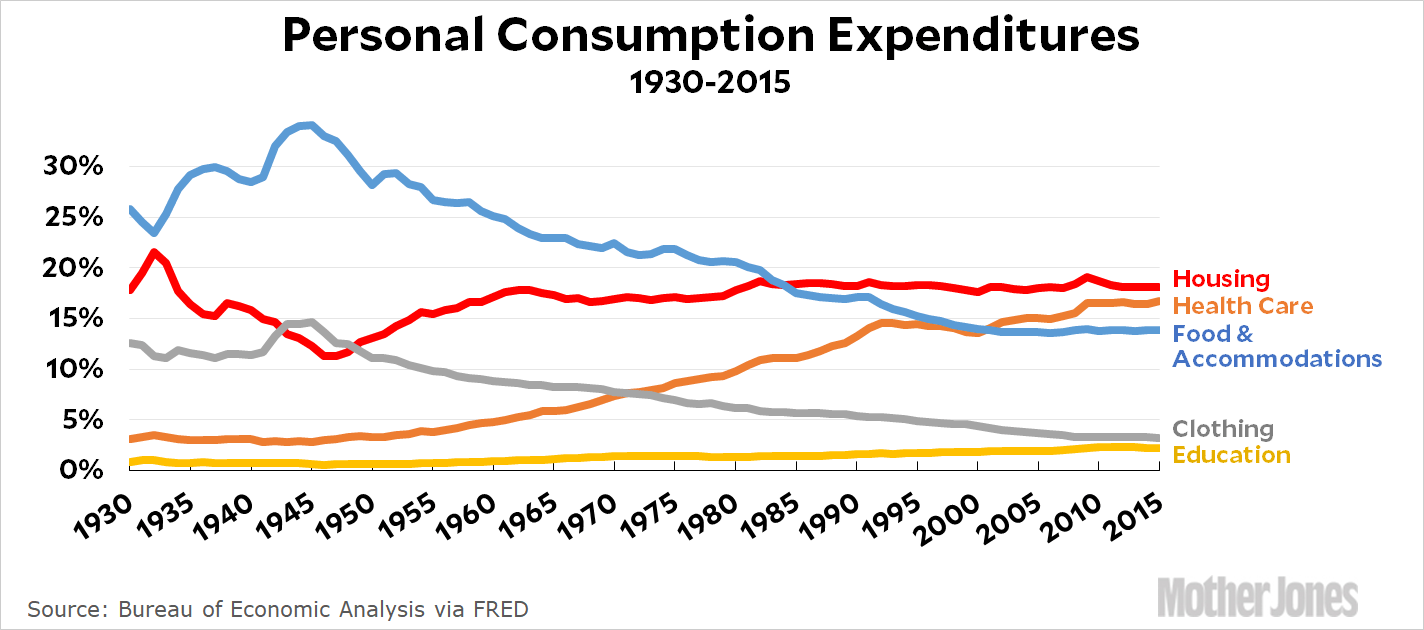
    Austin Frakt posted an old New York Times chart of personal expenditures, and a reader has a question:


    The answer, as it is so often, is FRED, the economic data aggregator from the St. Louis Fed. Here it is:

    When I use data from FRED, I always include it as a source. Why? Because it’s a great service, and deserves to get more credit. They don’t cover literally everything—for some reason, the Census Bureau doesn’t share its data, for example—but they cover a helluva lot. And once you learn how to use it, you have fast, convenient access to data from dozens of agencies. I probably could have dug up this chart over at the BEA, but it would have taken me a while. FRED made it the work of a few minutes.

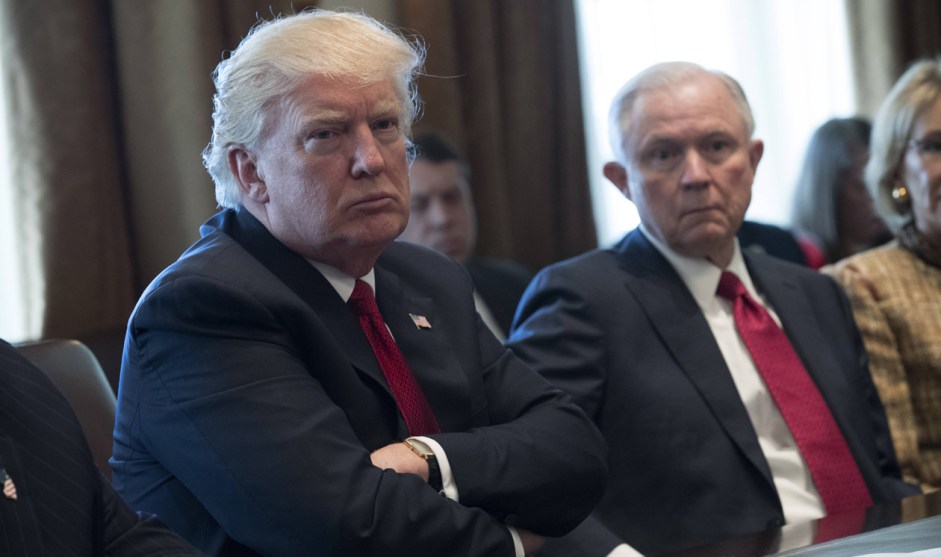
  • Donald Trump Is Steadily Firing Everyone Who Helped Him Win

    Shawn Thew/CNP via ZUMA

    Ezra Klein notes this morning that President Trump has turned on some of the people who were among his earliest and staunchest supporters:

    Attorney General Sessions was one of Trump’s earliest, staunchest supporters. On the night Trump won the election, he singled out Sessions for special praise. He thanked Sessions for being “the first man, first senator, first major, major politician” to endorse him, going on to say Sessions was “highly respected in Washington because he’s as smart as you get.”

    ….During the campaign, Priebus was among Trump’s most consequential allies….No matter what Trump said, or what Trump did, Priebus kept the RNC in his corner, and, once Trump had won the nomination, turned it into the campaign machinery Trump had never bothered to build.

    I don’t think this is just a coincidence. I’m averse to grand theories of Trump, but two things that are obvious about him are (a) he’s ultrasensitive about how narrow his victory was and (b) he doesn’t like to share credit with others. James Comey was a daily reminder that a lot of people think Trump won only because Comey’s last-minute letter sank Hillary Clinton, so Comey had to go. A lot of people credit Reince Priebus with keeping Trump viable during the primaries, so Priebus had to go. A lot of people think Jeff Sessions was instrumental in bringing evangelical support on board early in the campaign, so Sessions has to go. Trump hasn’t yet fired Steve Bannon, a guy who gets a lot of credit for turning around the Trump campaign during the summer, but I wouldn’t be surprised if he does eventually. This is probably one reason that Bannon keeps such a low profile. The last thing he wants is more magazine covers praising him as “Trump’s Svengali” or somesuch.

    Back in his real estate days, Trump’s staff was essentially invisible—and nobody cared about them anyway. Trump never had to share credit with anyone. But Washington plays by different rules, and that drives Trump crazy. There’s not much he can do about it except to fire anyone who helped him win, so that’s what he’s doing.

  • Corporations Are Raking In Record Profits, But Workers Aren’t Seeing Much of It

    From the Wall Street Journal:

    U.S. Companies Post Profit Growth Not Seen in Six Years

    America’s largest companies are on pace to post two consecutive quarters of double-digit profit growth for the first time since 2011….Earnings at S&P 500 companies are expected to rise 11% in the second quarter, according to data from Thomson Reuters, following a 15% increase in the first quarter.

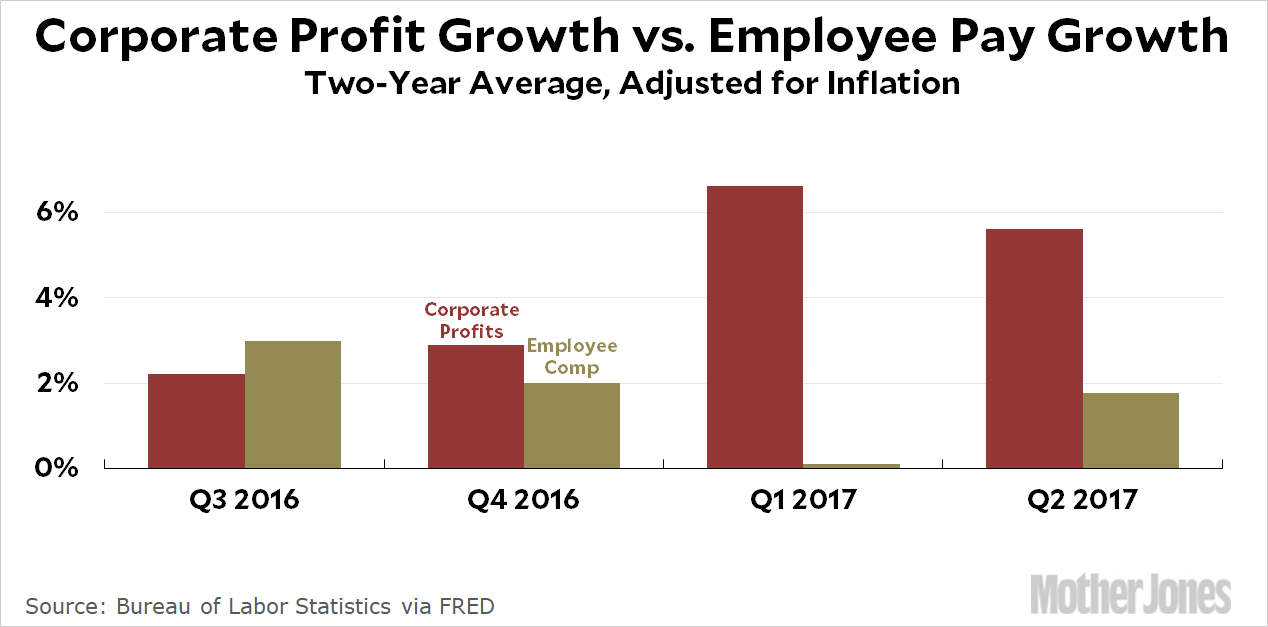
    That sounds great! So does that mean worker pay has also posted strong growth? Let’s take a look:

    I’ve used the employment cost index, which accounts for things like health care and other benefits, not just wages. And since corporate profits were down in 2015-16, I’ve used two-year growth rates, adjusted for inflation, to get a fair reading of longer-term earnings vs. pay.

    As you can see, employee compensation growth roughly matched corporate profit growth in 2016, but in the first half of 2017 corporate profits have spiked while wage growth has been meager. Basically, corporations have manufactured profits by being stingy with workers.

    I’m certainly happy to see businesses doing well. But I’d be a lot happier if this meant that workers were doing well too.

  • _____ Ranked, How To Do It in Four Easy Steps

    Would you like to make your own “_____ Ranked” lists? Sure you would! Here’s how to do it in four easy steps. Our test topic is “Uncles”:

    Step 1, off the top of my head: Uncle Sam, Uncle Vanya, “Say Uncle,” Uncle Tom, Man from U.N.C.L.E., the Minute rice guy

    Step 2, Wikipedia: nuthin.

    Step 3, crossword dictionary to find words starting or ending with uncle: unclean, carbuncle, monkey’s uncle, Uncle Fester

    Step 4, Amazon to find books/movies about uncles: Uncle Remus, Uncle Buck

    Now pick ten and put them in some order or another. It’s not worth spending too much time cogitating over this:

    1. Sam
    2. Man From
    3. Tom
    4. Vanya
    5. Say
    6. Monkey’s
    7. Ben’s
    8. Fester
    9. Remus
    10. carb

    All done!

  • New Study Says Florida Traffic Cops Are Biased—But Only a Little Bit

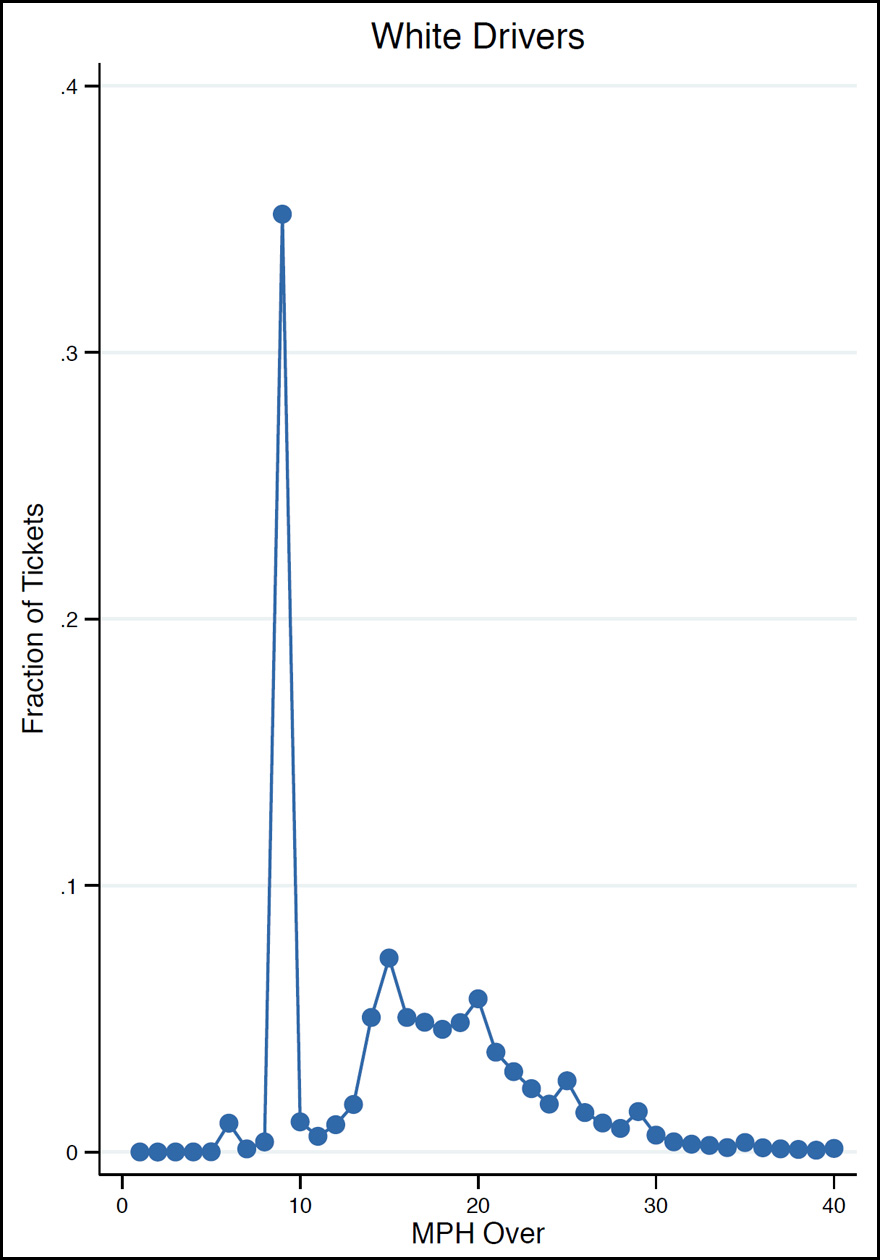
    Here’s a good-news-bad-news bit of research for the day. In Florida, the cost of a speeding ticket jumps if you’re cited for going 10 mph over the limit. However, it turns out that Florida cops have a heart, so a large number of tickets are written for 9 mph over the limit in order to give drivers a break. As you can see in the chart below, there’s a huge spike in tickets written for 9 mph over the limit:

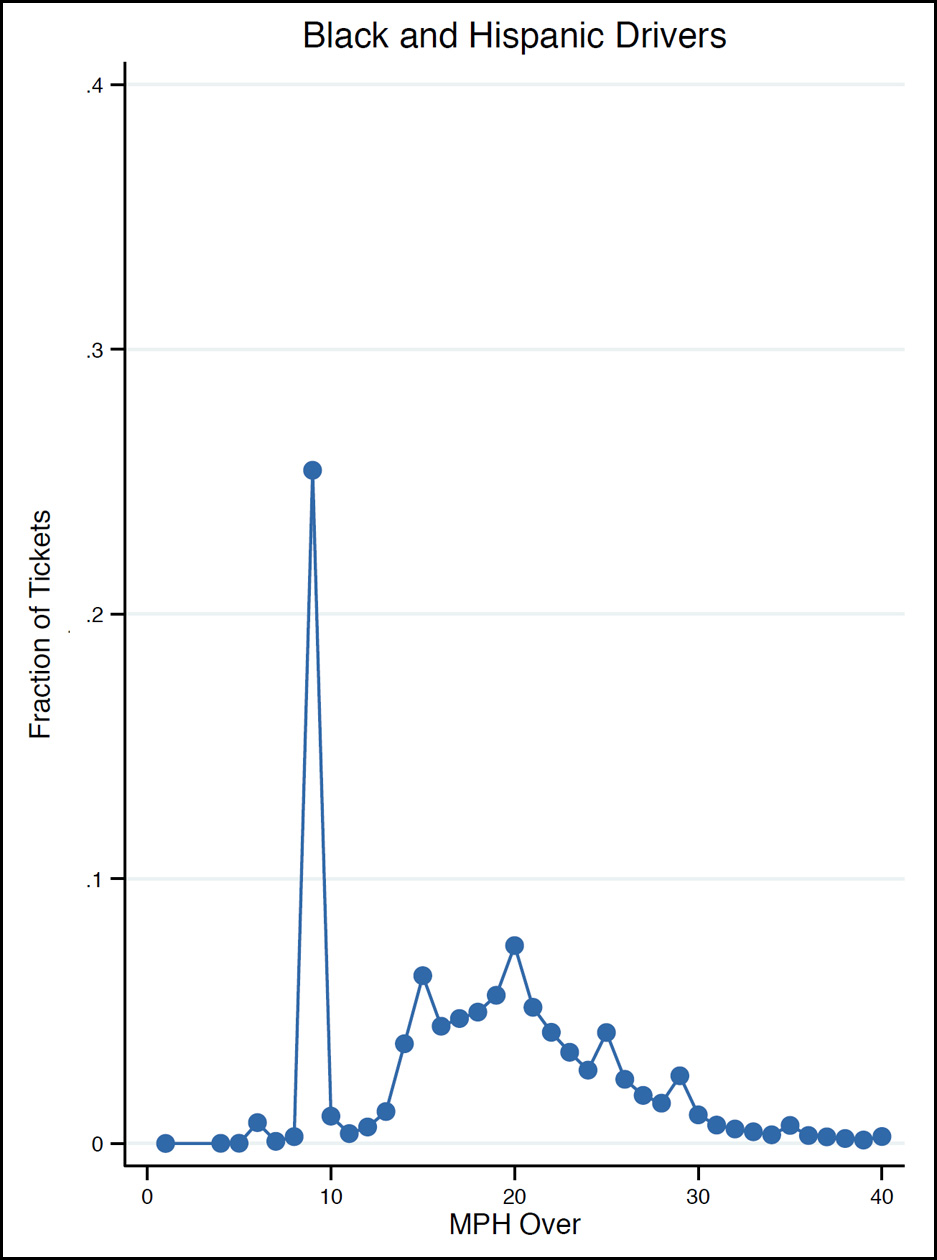
    The “white drivers” title on this chart tells you where this is going. It turns out that 35 percent of white drivers get the 9 mph break. However, only 25 percent of black and Hispanic drivers get the same break:

    That’s the bad news: white drivers are generally treated with more leniency than black and Hispanic drivers. But this is just raw data. There are also nonracial reasons why we might see this difference. So the authors controlled for things like age, income, actual speed, type of car, etc. Here’s what they found:

    In Column 1, we estimate that black and Hispanic drivers are, respectively, 3.8 and 14.9 percentage points less likely than white drivers to be cited at 9 MPH above the limit. In Column 2, we add controls….In all regressions, we find at least a 2 percentage point difference in treatment between whites and blacks and a 1.37 percentage point difference between whites and Hispanics.

    ….Across Tables 4 and 5, the greatest drop in magnitude comes from adding county-zone fixed effects, reducing the coefficient on driver black (Hispanic) from -.0276 (.-131) to -.0205 (-.0289). This reduction suggests that a large part of the disparity comes from the fact that minorities live in areas where officers are harsher to all drivers.

    So the bad news is that blacks and Hispanics are treated worse than whites. The good news is that the effect is—to me, anyway—surprisingly small: about 2 percent or less in the final model. I would have expected more. Returning to the bad news front, however, it turns out that the leniency difference is due not to lots of officers who are slightly biased, but to a subset of officers—about 10 percent or so—who are significantly biased against black and Hispanics.

    Now, it’s possible that this understates the problem because more black and Hispanic drivers are stopped in the first place, but that appears not to be the case. It’s also possible that lots of white drivers are let off with a warning, and therefore don’t show up in this data at all. The authors acknowledge this and say only that “we think these concerns do not invalidate our results.”

    The bottom line is that this kind of research confirms two points of view: that we’ve made a lot of progress in racial justice, but that we still have more progress to make. I know how banal that sounds, but that’s pretty much what this particular study suggests.

    One more note: I would be very interested to see the same technique used to estimate racial bias in ticketing for a northern state like New Jersey or Pennsylvania. I wouldn’t be at all surprised if it turned out to be worse.

  • Mothers Ranked

    1. Jones
    2. of invention
    3. Goose
    4. Day
    5. Whistler’s
    6. Teresa
    7. in law
    8. board
    9. Of All Bombs
    10. f***er