• Canada Says It Has Authority to Censor Internet in United States

    This seems like a bad thing:

    The Supreme Court of Canada ruled against Google on Wednesday in a closely-watched intellectual property case over whether judges can apply their own country’s laws to all of the Internet. In a 7-2 decision, the court agreed a British Columbia judge had the power to issue an injunction forcing Google to scrub search results about pirated products not just in Canada, but everywhere else in the world too.

    ….“This is not an order to remove speech that, on its face, engages freedom of expression values, it is an order to de-index websites that are in violation of several court orders. We have not, to date, accepted that freedom of expression requires the facilitation of the unlawful sale of goods,” wrote Judge Rosalie Abella.

    Hmmm. It is not an order that restrains speech, it is merely an order to de-index websites. I’m pretty sure I tried out similar kinds of sophistry in high school, and it did me no good. Apparently I just wasn’t aiming high enough.

    But it doesn’t really matter. This issue has been burbling along at barely radar level for years, and eventually it’s going to explode. In the print era it was never a big deal. Occasionally issues of a magazine or newspaper would be banned from a country, or China would demand that the Economist delete a chart from copies sold in their country. But this kind of thing was infrequent, and it didn’t affect anyone else. Likewise, autocratic regimes could ban publications entirely. But again, it didn’t affect anyone else.

    It’s not entirely clear to me why the internet is viewed differently, but it is. I don’t think, for example, that the Canadian Supreme Court would dream of ruling that a printed index of corporate profiles had to delete the entry of a company that had violated the law. And they definitely wouldn’t try to demand that it be deleted in every copy sold around the world. But if it’s a Google search result? Sure.

    Partly, of course, this a response to the loss of sovereign control that the internet has spawned. If a printed book were banned in Canada, the ban would be pretty effective. There would still be some underground copies circulating, but that’s small beer. A digital listing, however, is a whole different thing. Ban it on google.ca and it takes only a few seconds to search google.com instead. The ban is all but useless.

    So how will this play out? At some level, the world will either come to a consensus that censorship is hopeless, or else every country will have its own little internet. Today’s Canadian decision is hardly a big deal, but what happens when China or Russia or Vietnam demands that Amazon stop selling something everywhere in the world, not just in their country? Or that Facebook change its news feed for the whole planet? Or that Google globally delist sites insulting to Dear Leader?

    Will it still be no big deal then?
  • Let’s Cut the Crap: Trumpcare Cuts Medicaid Spending a Ton

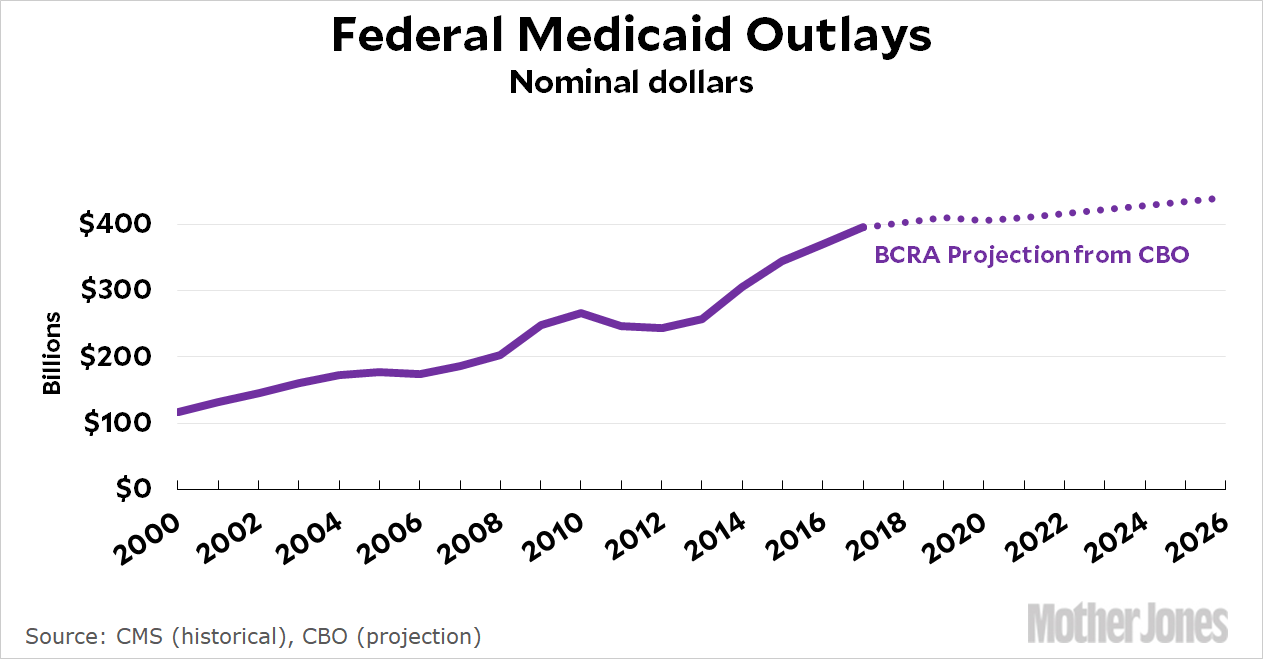
    Every tedious old argument in the world is being regurgitated lately in service of the final, desperate defense of the Republican health care bill. The latest hotness is the old “we’re not cutting, we’re just slowing the rate of growth” argument for Medicaid. So let’s make this easy. Here’s the basic chart of federal Medicaid spending since 2000:

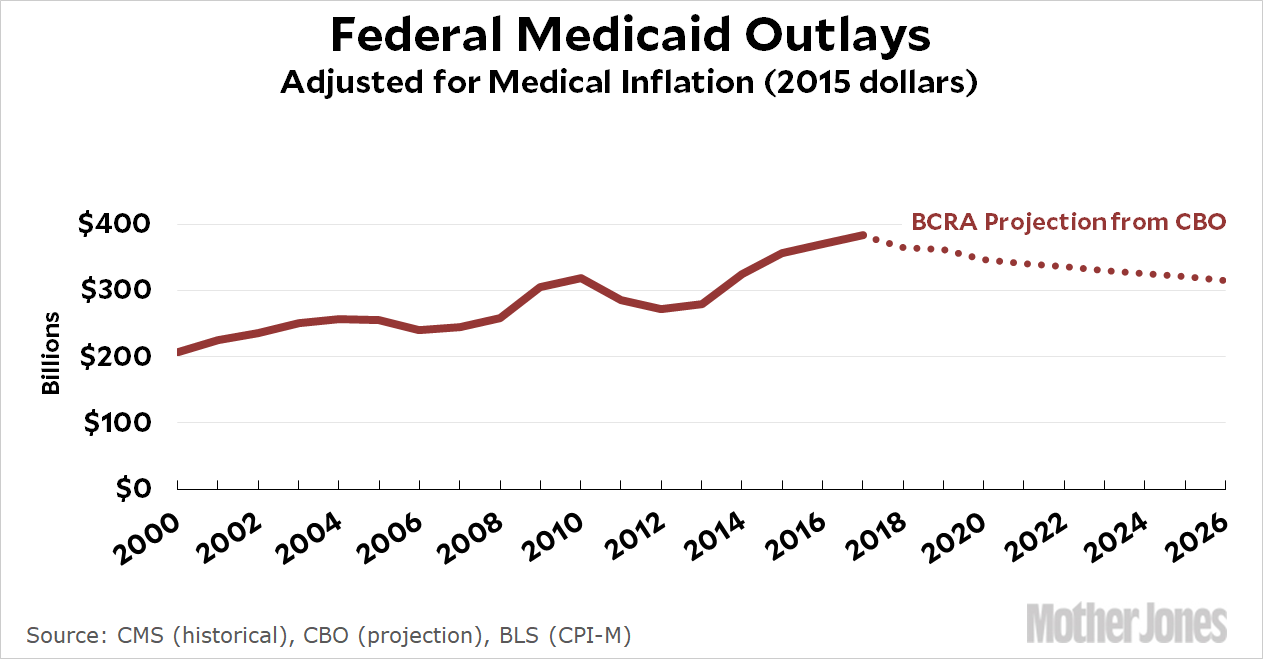
    Sure enough, spending continues to rise under BCRA. But even a high school freshman knows that you have to adjust for inflation in any time series like this. Here’s the chart for real spending:

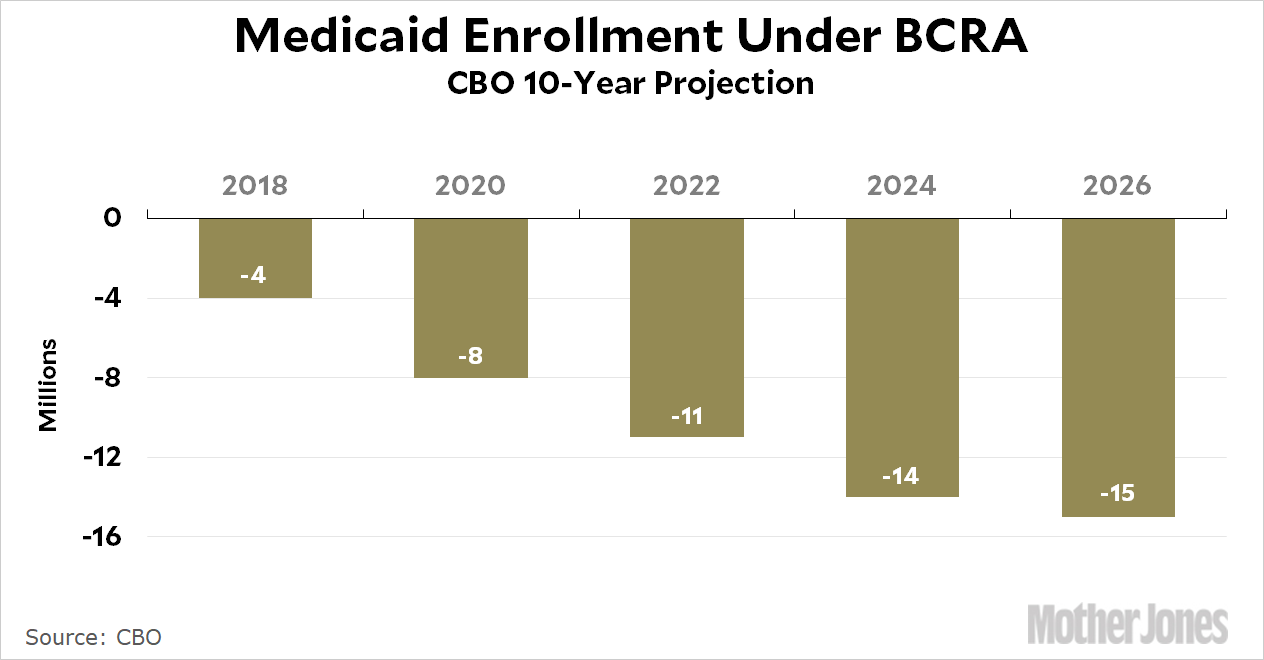
    There’s a reason this is called real spending. As you can see, Medicaid spending isn’t “slowing down,” it’s being cut. Spending in 2026 is 18 percent lower than spending in 2017. And here’s the result:

    The CBO estimates that the reduced spending will result in 15 million fewer people receiving Medicaid. Unsurprisingly, that’s a reduction of about 18 percent. It’s pretty simple.

    NOTE: Historical Medicaid spending from CMS here (NHE Table 3). CBO spending projection here (page 13). CPI-M here. I used a conservative 3 percent as the CPI-M over the next decade—a bit lower than the average over the past decade. CBO Medicaid enrollment projection here (page 17).

  • Where Are All the TVs on TV?

    This is not my usual beat, but I’m curious about something. Like millions of others, I sometimes watch the home renovation shows on HGTV. Or I catch bits and pieces while Marian is watching. And I’ve noticed that almost universally, the finished homes have no place for a TV in the shared living spaces (family room, living room, etc.). And if they do, it’s mounted above the fireplace about eight feet off the ground, which is a terrible viewing position.

    If this were a photo spread in Architectural Digest, then sure. They’re pretending to be so posh that they don’t watch TV. But this is a TV show! And yet they never have TVs in their houses.

    What’s up with this?

  • Lunchtime Photo

    What are Orange County’s most famous attractions? At a guess, I’d rank them something like this:

    1. Disneyland
    2. Knott’s Berry Farm
    3. Christ Cathedral (aka the Crystal Cathedral)
    4. Mission San Juan Capistrano
    5. Huntington Beach pier
    6. Richard Nixon library
    7. Balboa Island
    8. Little Saigon
    9. South Coast Plaza, a famous shopping mecca
    10. Other
    11. stuff
    12. The Great Park balloon

    I don’t have pictures of any of the other things, but I do have a picture of the balloon. If you’re ever in Orange County, come on out and take a ride. It’s a tethered balloon that goes up 400 feet, that being the length of its steel cable, and the view at the top is…OK, I guess. Be sure to check the weather first, since they halt balloon “flights” at the merest hint of wind. Tickets are ten bucks.

  • Trump Blather Notches Another Foreign Policy Win!

    On Monday, the White House warned that Syria would “pay a heavy price” if they launched another chemical attack. So how did that go? It’s yet another victory for Donald Trump!

    Secretary of Defense Jim Mattis claimed Wednesday that the Syrian government backed down after the White House said that Syrian President Bashar al-Assad’s forces were preparing for another possible chemical attack. “They didn’t do it,” Mattis said.

    I would like to formally announce that if Russia kills my mother in a nuclear attack, there will be grave consequences. If my mother is still alive tomorrow, that will show that they’ve backed down. I’ll let you know.

  • Conservatives Sure Are Touchy

    Conservatives sure are touchy. Here is Alexandra DeSanctis over at National Review:

    In a piece yesterday, Cosmopolitan senior writer Rebecca Nelson highlighted seven women who are supposedly “generating 2020 buzz,” and every single woman on her list is either a Democratic politician or a public figure committed to the left-wing cause.

    The list doesn’t mention Republican Susan Collins, who has been a GOP senator from Maine for over two decades. It also disregards the GOP’s remaining four female senators, several of whom have been in office longer than the Democratic senators Nelson names.

    Likewise ignored are female Republican governors across the country who outnumber their Democratic counterparts four to two. Nelson snubs U.N. ambassador Nikki Haley, who served a successful six years as governor of South Carolina and who is widely considered one of the GOP’s rising stars.

    I dunno. The article is specifically about people who “could be our first female president,” and I guess Cosmo is assuming that Donald Trump will run for reelection in 2020. This means that no one, male or female, is generating “2020 buzz” on the Republican side of the aisle. Am I missing something here?

  • Assisted Suicide Is a White Thing

    California’s assisted suicide act went into effect last year, and today the Department of Public Health released statistics for 2016. A total of 191 people requested prescriptions for aid-in-dying drugs, and 111 used them. However, because the program is very new, and only covered half the year, these numbers are certain to go up significantly in future years.

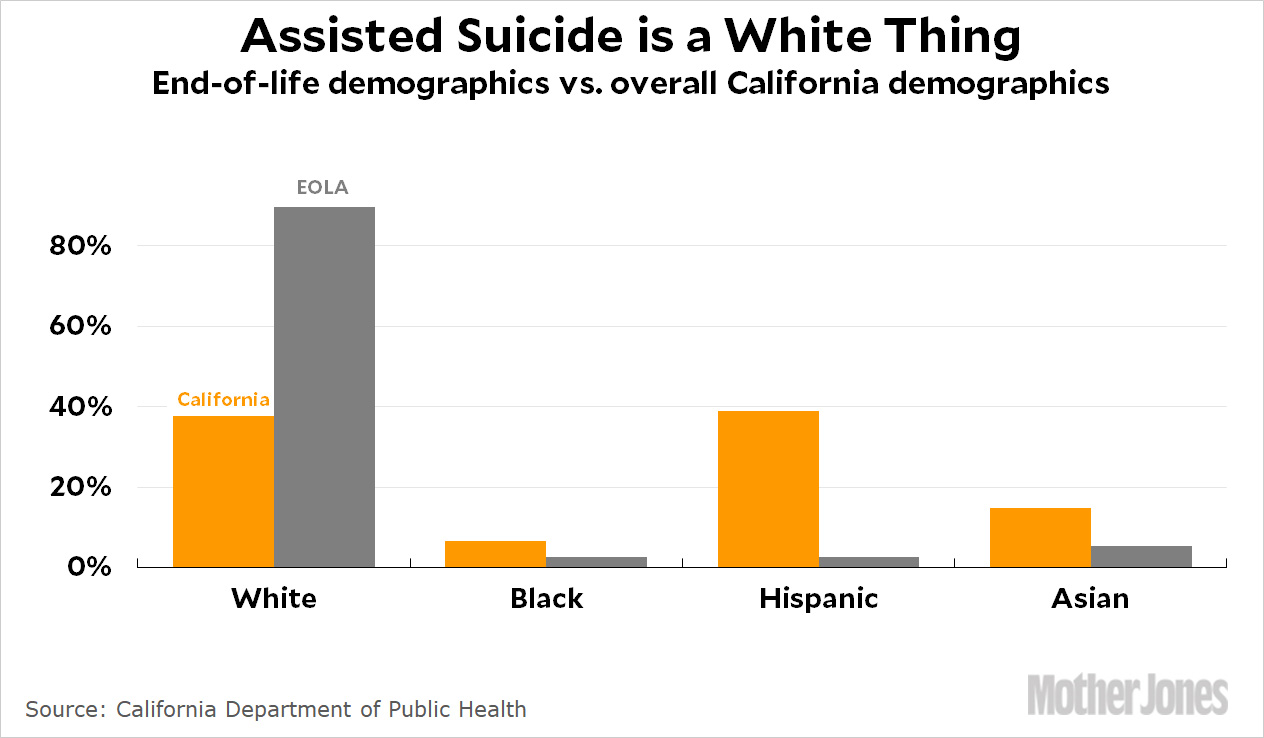
    Unsurprisingly, the initial statistics confirm what we know from other states that have similar laws: assisted suicide is barely used at all among non-whites.

    The reasons for this are not entirely clear. Among Hispanics, it’s probably partly related to religion, since the majority of Hispanics are Catholics and the church forbids suicide. More generally, it’s probably also related to a distrust of doctors among minority groups. Beyond that, I’m not sure anyone really has a persuasive explanation.

    Generally speaking, though, the main demographic for assisted suicide is professional, college-educated white folks who are used to being in charge and dislike the idea of losing control over their lives. This was true in the 90s and aughts, when it was illegal and done under the table, and I believe it’s true in every state that’s legalized assisted suicide since then.

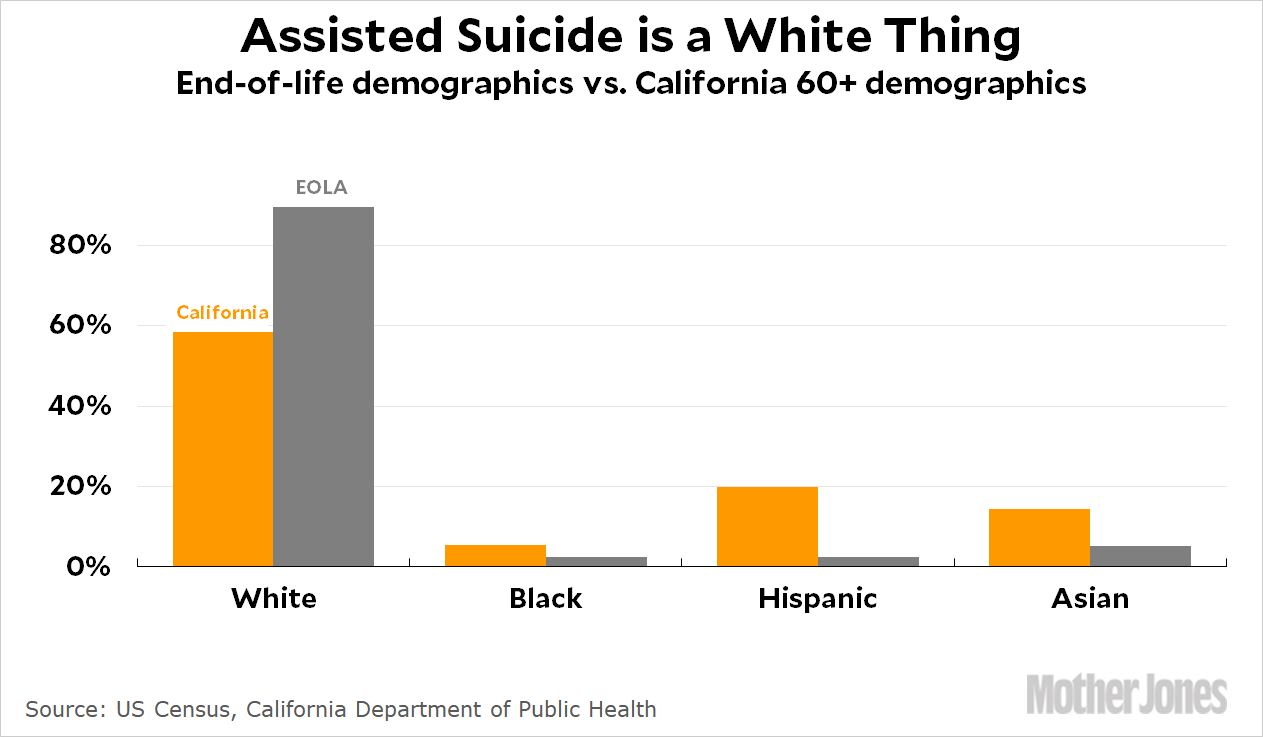
    UPDATE: Via Twitter, Forrest Sholars points out that assisted suicide is mostly an option for the elderly, and the demographics of those over 60 is different from California’s overall demographics. That’s true, especially for Hispanics, and I intended to mention this in the original post. It just slipped my mind before I published it. So here it is:

    There’s still a considerable racial disparity, but it’s somewhat less dramatic than it is when comparing to all age groups.

  • Some Notes on California’s Single-Payer Health Care Plan

    Last night a reader emailed to ask what I thought about the death of California’s single-payer health care bill. Is Assembly Speaker Anthony Rendon a progressive traitor because he tabled the bill for this legislative year? For you non-Californians out there, here are a few things to know:

    History. Don’t make the mistake of thinking that SB562 was some brand new, Bernie-esque health care reform. California Democrats have been introducing universal health care bills of one sort or another for decades. This is California’s seventh attempt, following the introduction of single-payer bills and ballot initiatives in 1992, 1994, 1998, 2003, 2005, and 2009.

    Funding. Single-payer would cost something like $200 billion, give or take a few billions. This is nearly double the entire state budget, but SB562 blithely ignored it. It included no funding mechanism at all, and simply passed that reponsibility to the state Assembly. It’s not surprising that Rendon was reluctant to shoulder this on his own over the course of the next few months.

    Prop 98. Like it or not, California has a school funding law put in place years ago by Proposition 98. It’s insanely complicated, but basically requires that 40 percent of the state budget go to K-12 schools. Using round numbers, if the state budget is $100 billion, school spending has to be at least $40 billion. If state spending goes up to $300 billion, school spending has to be at least $120 billion. Aside from being ridiculous, it also leaves only $120 billion for the health care bill. Oops.

    As far as I know, there is no tricky way to get around this. It would have to be dealt with by a ballot initiative. That’s obviously not going to happen in this legislative session.

    Waivers. This is the issue nobody pays attention to, but is probably the most important of all. To implement single-payer, California would need $200 billion in new funding plus $200 billion in federal money that currently goes to Medicare, Medicaid, veterans health care, and so forth. Without federal waivers to give California access to that money, the plan can’t go anywhere. As Duke University researcher David Anderson puts it, “If there aren’t waivers, this plan is vaporware.” What do you think are the odds that the Trump administration will grant all those waivers? Zero is a pretty good guess.

    Along the same lines, Michael Hiltzik points out that self-funded health care plans are governed exclusively by federal law. That means California would need an exemption from the law. What do you think are the odds that a Republican Congress will grant that exemption? Zero again?

    Two-thirds. This bill requires a two-thirds vote to pass. Democrats control exactly two-thirds of both houses of the legislature. They can afford to lose one vote in the Assembly and no votes in the Senate. This means the bill needs to be very, very carefully crafted.

    State plans. This is not about California in particular, but it’s worth remembering Ezra Klein’s Washington Monthly piece in 2007 about the history of state attempts to set up universal health care plans. As he concluded, “the results are pretty clear: states are no good at delivering universal health care.” Who knows? Maybe a better plan could succeed where others have failed. But it better be a pretty good plan.

    Single-payer at the state level is enormously complicated, extremely expensive, difficult to set up properly, and politically fraught. Developing a workable policy will not take months, it will take years. Bottom line: Rendon could have kept the bill alive, but it would have been a charade. It was going nowhere this legislative session and he knew it. At a policy level, this needs a lot more work before it’s ready for prime time.

  • Inquiring Minds Want to Know: How Stupid Is Donald Trump?

    Ha ha ha ha:


    Here’s the New York Times piece that Trump is griping about:

    A senator who supports the bill left the meeting at the White House with a sense that the president did not have a grasp of some basic elements of the Senate plan — and seemed especially confused when a moderate Republican complained that opponents of the bill would cast it as a massive tax break for the wealthy, according to an aide who received a detailed readout of the exchange.

    Mr. Trump said he planned to tackle tax reform later, ignoring the repeal’s tax implications, the staff member added.

    The eternal question is: evil or stupid? Does Trump really not know that the health care bill is a huge tax cut for the rich? Or does he just not want anyone to mention it in his presence? The problem here is that Trump would have to be really, really stupid not to understand that the central provision of both the House and Senate bills is a huge tax cut for the rich. I mean, nobody is that stupid. Right?

  • McConnell: Trump Attacks Are “Beyond Stupid”

    Mitch McConnell may have a dark and twisted soul, but he’s a pretty good legislative tactician. That’s why he’s basically told Donald Trump to stay out of health care negotiations in the Senate, since he’d probably just screw things up. But Trump couldn’t help himself. After Sen. Dean Heller of Nevada announced that he would vote against the bill, Trump gave the OK to a Super PAC to run ads against Heller. According to the New York Times, McConnell was pissed:

    Over the weekend, Mr. McConnell made clear his unhappiness to the White House after a “super PAC” aligned with Mr. Trump started an ad campaign against Senator Dean Heller, Republican of Nevada, after he said last week that he opposed the health care bill.

    The majority leader — already rankled by Mr. Trump’s tweets goading him to change Senate rules to scuttle Democratic filibusters — called the White House chief of staff, Reince Priebus, to complain that the attacks were “beyond stupid,” according to two Republicans with knowledge of the tense exchange.

    ….The move against Mr. Heller had the blessing of the White House, according to an official with America First, because Mr. Trump’s allies were furious that the senator would side with Nevada’s governor, Brian Sandoval, a Republican who accepted the Medicaid expansion under the health law and opposes the Republican overhaul, in criticizing the bill.

    As near as I can tell, the biggest tailwind Democrats have going for them right now is that Trump is such a cretin. I don’t know how likely it is that Republicans can pass a health care bill anyway, but there’s not much question that Trump is making it harder thanks to his bottomless ignorance of both policy and politics. Trump’s only tool is a wrecking ball, and that means he views every problem as a building to be razed. This is very definitely not how US senators like to be viewed, but Trump is too stupid to understand this.

    And who knows? In the end, that might be the thing that saves Obamacare.