I’ve just taken a quick look at the Senate health care bill. Neither preexisting nor continuous are anywhere in the bill. None of the section titles deal with preexisting conditions. It doesn’t appear that the Senate bill affects Obamacare’s protections for preexisting conditions at all. This is almost certainly because the Senate parliamentarian ruled that it had nothing to do with spending or outlays, and therefore couldn’t be included in a reconciliation bill.
The Senate bill also abolishes Obamacare’s individual mandate penalties. The net result is that if this bill passes, people will be free to go without insurance while they’re healthy, and then buy insurance if and when they get seriously ill. This is a disaster for the health insurance industry.
I don’t see how insurance companies can continue to dither at this point. The Senate bill would almost certainly be a huge financial blow to anyone who stays in the individual insurance business, and since the wording is driven by reconciliation rules it means that any final bill negotiated with the House would have to be the same. They can’t possibly accept this, can they?
Thirteen senators have labored mightily and brough forth a mouse. The Senate version of Obamacare repeal dropped today, and it’s pretty much the same as the House version:
It’s a huge tax cut for the rich.
It slashes Medicaid for the poor.
It allows states to cut back on essential benefits.
It abolishes the individual mandate.
Unlike the House bill, it keeps Obamacare’s income-based subsidies, which makes it a little more friendly to the working poor. However, it also cuts back on those subsidies.
I’ll have more details later as they become available. But the bottom line is pretty simple: it cuts a trillion dollars in taxes on the rich, which means it also cuts a trillion dollars in spending on the poor and working class. That’s simple arithmetic. As a result, it’s going to take health insurance away from a lot of people. It might be 23 million, like the House bill, or it might be slightly more or slightly less. The CBO will tell us in a few days. But whatever the answer, this is pretty much the same horrific bill that the House has already passed.
One other note: I don’t know yet how it handles pre-existing conditions. Thanks to reconciliation rules, I don’t think it can change them much. More on this later.
Watch Elizabeth Warren tear into her Republican colleagues in the Senate.
Prominent liberals didn’t oppose immigration a decade ago. Most acknowledged its benefits to America’s economy and culture. They supported a path to citizenship for the undocumented. Still, they routinely asserted that low-skilled immigrants depressed the wages of low-skilled American workers and strained America’s welfare state. And they were far more likely than liberals today are to acknowledge that, as Krugman put it, “immigration is an intensely painful topic … because it places basic principles in conflict.”
Today, little of that ambivalence remains. In 2008, the Democratic platform…referred three times to people entering the country “illegally.” The immigration section of the 2016 platform didn’t use the word illegal, or any variation of it, at all.
Why did the left move even further left on immigration? Beinart chalks it up to politics: Democrats began to believe they’d dominate elections forever if they could sew up the Hispanic vote, and that motivated them to become ever less compromising on issues important to their Hispanic base.
I suppose that’s part of it, but I’m surprised that Beinart doesn’t mention the obvious: there have been two big attempts in the past decade to pass a moderate, compromise immigration bill. The first time was in 2006, when both the House and Senate passed bills by large margins. But thanks to a backlash from talk radio and social conservatives, the bills never went to conference and the effort died.
The second time was in 2013. A bill passed the Senate by a large, bipartisan majority, but once again it hit a backlash from the tea-party wing of the Republican Party. John Boehner never allowed the bill to come up for a vote in the House, and the effort died again.
These two episodes have made it clear that compromise on immigration is pointless. That being the case, why bother playing Hamlet about the effect of illegal immigration on the wages of low-skilled natives? Especially since it’s largely a red herring anyway: it’s true that undocumented immigrants have an impact on the wages of low-skill native workers, but the effect is pretty moderate.
UPDATE: My initial post used the wrong numbers for the effect of immigration on wages. The estimates below, along with the chart, have been corrected. Thanks to Jason Richwine for pointing out the error.
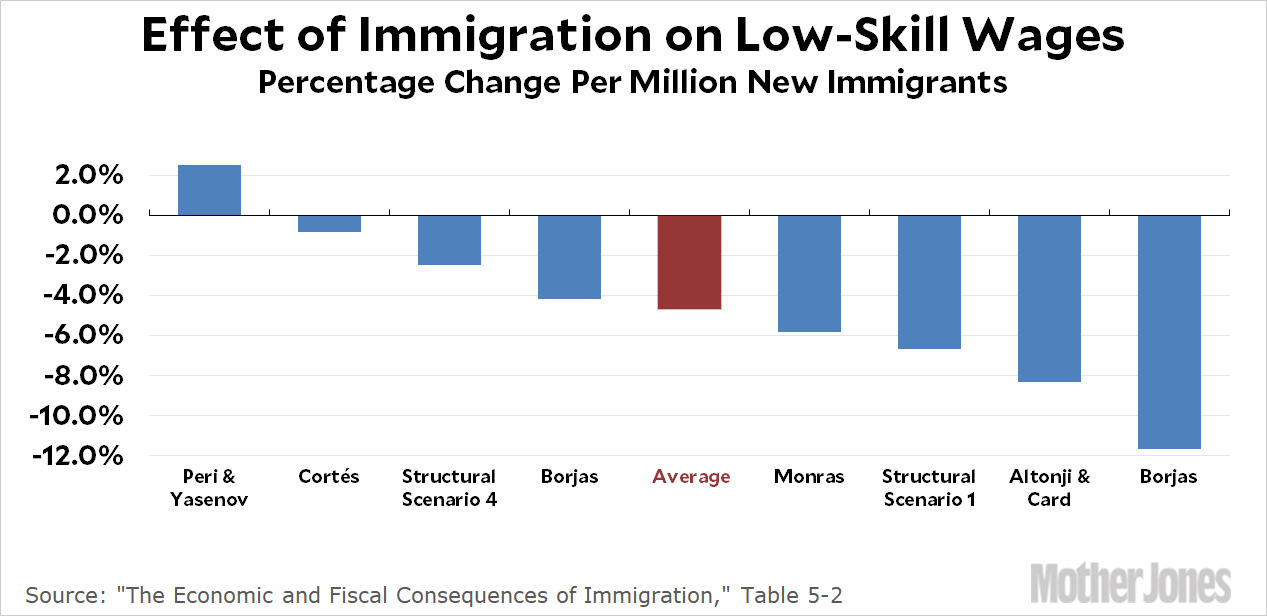
Beinart repeatedly mentions the findings of a National Academies of Sciences report on immigration and the economy, but never mentions the precise number it comes up with: for low-skill native workers, an average of all studies suggests that an influx of even a million immigrants would only lower wages about 4.6 percent in the short run.1
The same is true for state and local spending. The NAS report estimates that new immigrants cost states a net of about $1,600 per year.2 This means that an influx of a million immigrants would create a net burden of $1.6 billion. That’s less than one-tenth of one percent of all state and local spending. It’s a rounding error.
These numbers are small, and are used mostly as intellectual cover by opponents of illegal immigration. They are not even remotely the reason for opposition to comprehensive immigration reform, which comes mostly from educated native whites whose wages and taxes aren’t impacted more than a hair by illegal immigration. The real reason is almost purely cultural: dislike of non-English speakers, an inchoate fear of crime, and a vague sense that white America is fading away. But hardly anyone wants to admit that these are the real terms of the argument.
Quite a bit of new research has been done over the past decade, and the result has been, if anything, a reduction in the perceived economic effects of illegal immigration. The wage effects are roughly zero overall, and even for low-skill workers are fairly small in the short run—and get smaller over time. The fiscal effects are even smaller, and become zero over the long run. Given all this, it’s hardly a surprise that supporters of comprehensive immigration reform no longer give economic arguments much attention.31This is the average of all studies in Table 5-2 that focus on high school dropouts. The mean result was a wage effect of -0.56 percent for an increase in the low-skill labor supply of 1 percent, which amounts to about 120,000 workers. That comes to -4.66 percent per million new immigrants.
2Table 9-6.
3This is not the post I intended to write when I started out. But after reading the NAS report, it’s the one I ended up with. Maybe tomorrow I’ll write the post I originally had in mind.
Looking for cheap eats in Orange County? My go-to burger place is Duke’s, on the corner of Fairview and Warner in Santa Ana. The burgers are actually so-so, but the fries range from good to fantastic, depending on how the cook is feeling. This adds a nice frisson of anticipation every time I go there. Will it be a good fries day or a great fries day? There’s only one way to find out!
NOTE: I have received no compensation from, nor do I hold any equity stake in, The Duke’s Corporation or any of its subsidiaries or affiliates. I just like their fries.
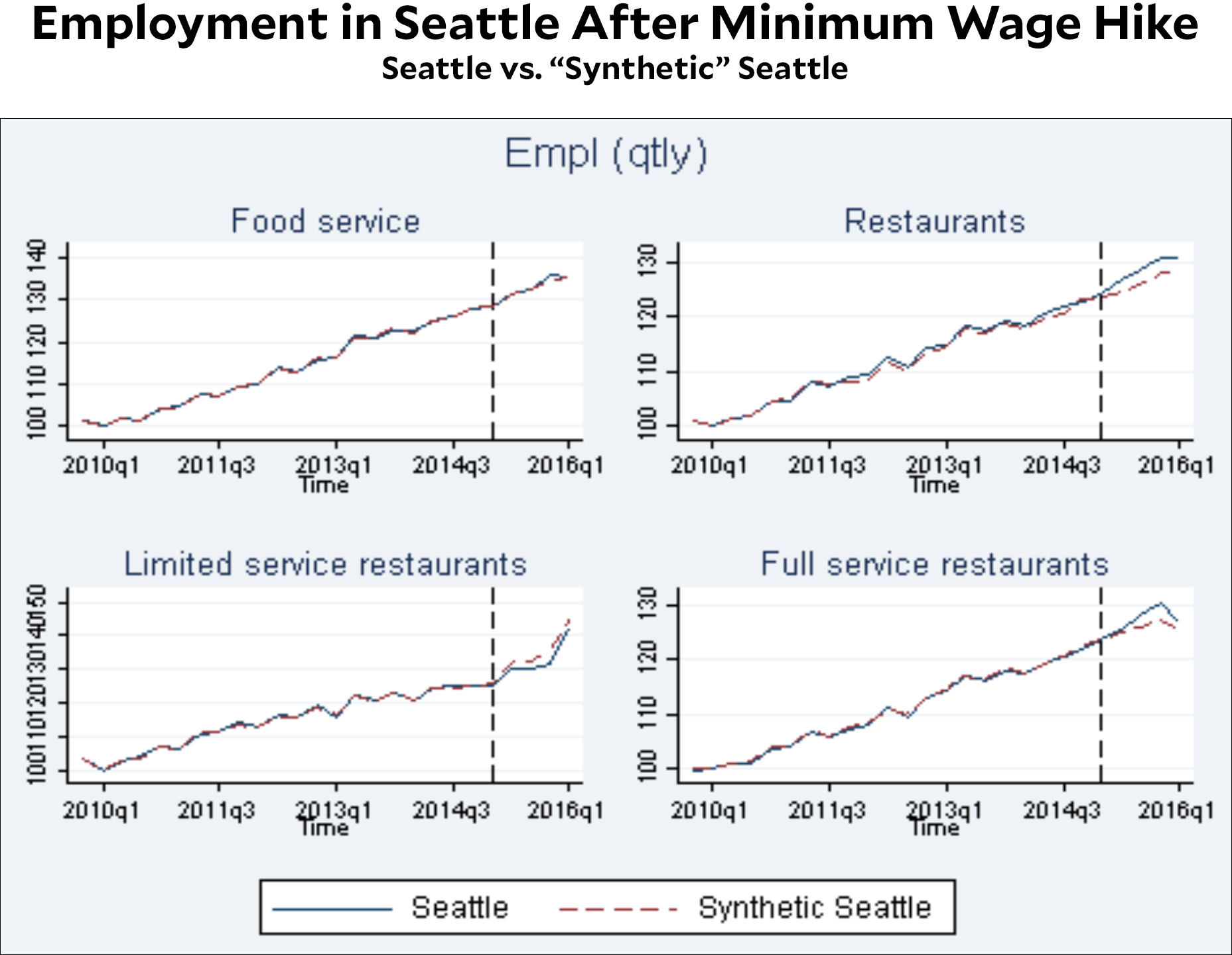
Brad DeLong points to the latest study of employment in Seattle as it steadily increases its minimum wage to $15 per hour. As usual, what we want to know is not what absolute employment in Seattle looks like, but how it compares to a similar city with a lower minimum wage.
But what is a “similar” city? The obvious candidates are cities just over the border from Seattle. But those aren’t perfect, since they might have different demographics. The latest and greatest technique, then, is to create a “synthetic” city made up of various other places similar to Seattle. If you do this properly, you get a control that tells you how Seattle is doing compared to how it would be doing with a lower minimum wage. Here’s the result for the food service industry, which is a heavy user of minimum wage labor:
As you can see, synthetic Seattle is identical to real Seattle prior to the minimum wage hike. That suggests it’s a pretty accurate composite. After the minimum wage hike, they stay pretty similar. In fact, real Seattle has slightly higher employment. The obvious conclusion is that raising its minimum wage hasn’t depressed employment in Seattle at all. DeLong comments:
Low-end labor markets simply do not appear to work like competitive markets. Rather, they work like markets in which employers have substantial market power—and thus minimum wage laws have the same efficiency benefits as does natural-monopoly rate regulation. Why low-end labor markets do not appear to work like competitive markets is a very interesting—and, I believe, unsolved—question. But it is in all likelihood a fact to deal with.
I’d add an obvious caveat to this: it’s possible that a modestly higher minimum wage has little effect when the economy is doing well. We don’t know yet how employment in Seattle will respond when the economy turns down.
This is a reference to yesterday’s election in Georgia, where Karen Handel ran endless ads linking Jon Ossoff to Pelosi. Here’s the thing. When you and I hear “Nancy Pelosi,” we think of this:
When Karen Handel’s voters hear “Nancy Pelosi,” they think of something like this:
Donald Trump’s son-in-law and chief Middle East adviser, Jared Kushner, has arrived in Israel and the occupied Palestinian Territories for a whistlestop visit aimed at restarting the long-dormant Israeli-Palestinian peace talks. Kushner’s carefully managed visit – conducted far from media scrutiny and lasting less than a day – comes amid scant indication of any imminent breakthrough between the two sides in a peace process that has been moribund since 2014.
Sure, whatever. I think Benjamin Netanyahu knows how to handle the likes of Kushner:
היום החלו העבודות בשטח, כפי שהבטחתי, להקמת היישוב החדש למתיישבי עמונה. אחרי עשרות שנים, יש לי הזכות להיות רה״מ שבונה יישוב חדש ביו״ש pic.twitter.com/sNDKlDzaCu
Israel’s prime minister, Benjamin Netanyahu, has announced the beginning of building work on the first new Jewish settlement in the occupied West Bank in 25 years, a day before a visit by Donald Trump’s son-in-law and envoy, Jared Kushner, aimed at reinvigorating the stalled peace process. The new settlement, known as Amichai, is being built to house about 300 hardline residents of the illegal West Bank Jewish outpost of Amona who were evicted by police in February after a court ruled their houses were on privately owned Palestinian land.
If you believe the timing is just coincidental, you might want to ask Joe Biden for his opinion.
At the risk of sounding a little too Kevin Drummish, everyone should settle down about Jon Ossoff’s loss last night. Also all the other Democratic losses recently. They just don’t tell us very much.
On the one hand, Democrats did a lot better than they had recently. On the other hand, parties always do better in open seats than they do running against incumbents. The “swings” of +20 or +15 or whatever are nice to see, but they don’t mean a whole lot.
It’s also way too early to draw any conclusions anyway. Keep in mind that Republicans haven’t even done anything yet. Twelve months from now, who knows what they will have accomplished? Passed a suicidal health care bill? A huge tax cut for the rich? Gotten us into a two-front war in the Middle East? Withdrawn from NATO? Declared that lead is healthy and mandated that it be put back in gasoline? Who the hell knows?
If Democrats want to win, they just need to do all the usual stuff. Find good candidates. Create an effective message. Close the character assassination gap. Raise lots of money. In other words, all the things they’d do if Hillary Clinton were president instead of Donald Trump.
Oh, and stop sniping at each other. Every district will require a different kind of candidate. Moderates for red places, liberals for purple places, Bernie-approved lefties for blue places. It’s all good.
The State Department has opened a formal inquiry into whether former Secretary of State Hillary Clinton and her aides mishandled classified information while she was the nation’s top diplomat….Depending on the outcome of the current State Department inquiry, Clinton and her aides could have their access to sensitive government documents terminated.
Senate Judiciary Committee Chair Chuck Grassley, R-Iowa, confirmed to Fox News the department’s formal inquiry. Meanwhile, Grassley’s committee launched its own inquiry into Clinton’s handling of emails, an inquiry that began in March.
Note to Republicans: Hillary lost. She will never run for anything again. And you didn’t just beat her. You beat her in the most humiliating way possible: on the back of a jaw-droppingly unqualified and emotionally unstable former reality-TV star who now occupies the Oval Office and spends his days tweeting bitterly about his latest imagined slights. Isn’t that enough? Is there truly nothing that will sate your unholy obsession with Bill and Hillary Clinton?
On the bright side, I guess we finally have evidence of at least one thing that Rex Tillerson has accomplished in the past few months.
Dave Weigel was in town a couple of weeks ago and we had a conversation that went something like this:
Weigel: I think Jon Ossoff has a real chance. Me: Nah. Weigel: Why do you say that? Me: It’s Georgia.
It seems like I’ve heard about a hundred times in the last decade that Georgia would somehow turn blue. Maybe the whole state, maybe a single district, maybe something to do with the legislature. But it never happens. It has a Republican governor, two Republican senators, 10 (out of 14) Republican members of Congress, a heavily Republican state Senate, and a heavily Republican state House. I predict that it will keep disappointing Democrats for years to come.
And we respect that! But maybe you’re of a mind to support our work directly instead? We have until December 31 to raise the last $400,000 we need to keep our nonprofit newsroom running at full strength into 2026. Will you make a gift today?
We noticed you have an ad blocker on. Can you pitch in a few bucks to help fund Mother Jones' investigative journalism?
Billionaires own the media,
but they don’t own us.
At Mother Jones we know these aren’t conventional times, and they require unconventional coverage. That’s what deliver every day: fierce, independent journalism you can’t find elsewhere. Perhaps never in the history of our country has that been more necessary than now. But we can’t do it without reader support—your support. Please chip in today.
Billionaires own the media,
but they don’t own us.
At Mother Jones we know these aren’t conventional times, and they require unconventional coverage. That’s what deliver every day: fierce, independent journalism you can’t find elsewhere. Perhaps never in the history of our country has that been more necessary than now. But we can’t do it without reader support—your support. Please chip in today.