The New York Times has yet another interview with Donald Trump, foreign policy genius. Let’s listen in:
He even called into question whether, as president, he would automatically extend the security guarantees that give the 28 members of NATO the assurance that the full force of the United States military has their back.
For example, asked about Russia’s threatening activities that have unnerved the small Baltic States that are the most recent entrants into NATO, Mr. Trump said that if Russia attacked them, he would decide whether to come to their aid only after reviewing whether those nations “have fulfilled their obligations to us.”
Vladimir Putin will be delighted to hear this. Next:
Reiterating his threat to pull back United States troops deployed around the world, he said, “We are spending a fortune on military in order to lose $800 billion,” citing what he called America’s trade losses. “That doesn’t sound very smart to me.”
Mr. Trump repeatedly defined American global interests almost purely in economic terms. Its roles as a peacekeeper, as a provider of a nuclear deterrent against adversaries like North Korea, as an advocate of human rights and as a guarantor of allies’ borders were each quickly reduced to questions of economic benefit to the United States.
Lots of politicians say American can no longer be policeman of the world. Trump actually believes it. Next:
Mr. Trump said he was convinced that he could persuade Mr. Erdogan to put more effort into fighting the Islamic State. But the Obama administration has run up, daily, against the reality that the Kurds — among the most effective forces the United States is supporting against the Islamic State — are being attacked by Turkey, which fears they will create a breakaway nation.
Asked how he would solve that problem, Mr. Trump paused, then said: “Meetings.”
Meetings. Right. And finally this:
When asked what he hoped people would take away from the convention, Mr. Trump said, “The fact that I’m very well liked.”
How very Willy Lomanesque. Trump’s campaign manager immediately stepped in to say the Times had botched its quotes and Trump didn’t really say this stuff about NATO. The Times has promised a transcript of the interview. I think Jonathan Bernstein has the right call on this:
Odds that NYT transcript makes it worse range somewhere between 99% and 100% https://t.co/rPfWqgfaP8
— Jonathan Bernstein (@jbview) July 21, 2016
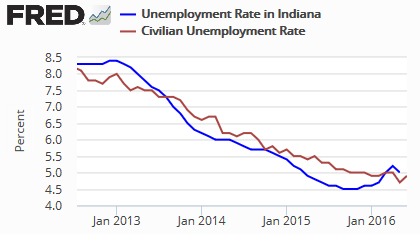 What about other economic trends? Are there more Hoosiers at work than at any time before, as Paul Ryan said while he was praising Pence? Sure. But thanks to population growth, that’s true almost everywhere. A better question is how employment compares to the nation at large. Answer: the unemployment rate since Pence took office in January 2013 has dropped from about 8 percent to about 5 percent. There’s nothing wrong with that, but it’s about the same as the rest of the country.
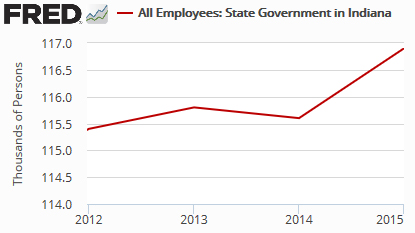 Is it true, as Pence said, that there are fewer state employees today than when he took office? I suppose there are multiple ways of counting this, but FRED tells us that the number of state employees has gone up from 116,000 to 117,000 since Pence took office. That’s pretty slow growth, but it’s not negative growth. Unless there’s been a big cut in state employees in the first half of 2016, I’m not sure why Pence would say this.
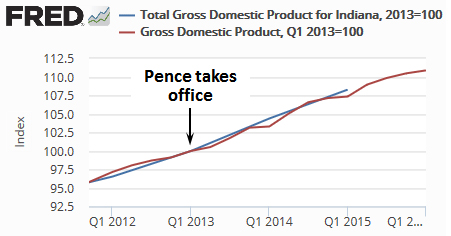 And how about the state economy in general? There are lots of ways of looking at this, but the simplest is probably state GDP. Regrettably, we only have that through the beginning of 2015. Still, if you take a look at GDP growth during Pence’s first two years in office, Indiana looks about the same as the entire country. There’s nothing to be ashamed of, but nothing much to write home about either.