
The CFPB has proposed a new rule that would prevent big companies from forcing their customers to accept mandatory arbitration in place of an actual trial in an actual court. Iain Murray is unhappy:
Like most of the CFPB’s rules, this may sound good at first hearing. In fact, it will be a disaster for the average consumer who enters into contracts like credit-card or mobile-phone service agreements….The inefficiency of the legal system has to be budgeted for, and so without arbitration,
fees will go up and some people just won’t be offered a service at all.
….Those won’t be the only ways the consumer will suffer — those who are currently “denied their day in court” will as well. Because arbitration services are much cheaper, companies that use them generally pay all the fees for the consumer as well as their own. That’s not the case in court, where the consumer bears a considerable cost. If you are lucky enough to get a contract after this rule goes into effect, you’d better budget something for your day in court, because you’re going to have to lawyer up. Of course, there’s always the chance that you’ll be asked to participate in a class action lawsuit, which this rule is primarily designed to facilitate.
Fair enough. As it turns out, corporations all offered their services quite widely back in the dark ages before arbitration clauses, but it’s true that arbitration does indeed have some benefits. Still, we’re all free marketeers around here who believe in contracts freely arrived at without undue coercion. Right? So here’s what I propose: my bank and my cell phone company should offer me the choice of accepting arbitration or not when I first sign up. If I accept, they offer me a discount. The CFPB’s only role will be to ensure that the discount is reasonably in line with the actual cost savings from arbitration. Deal?
No? I guess there must be something else going on. I wonder what?
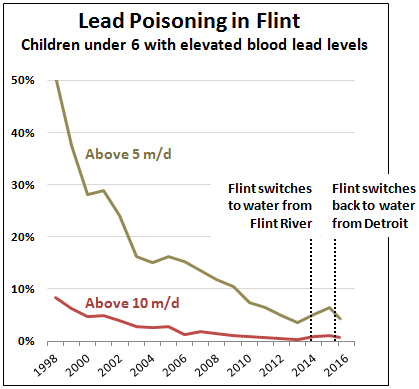 plot this out, it suggests that the average increase in BLL was somewhere between 0.2 m/d and 1 m/d. Increases in BLL are approximately associated with a loss of
  the
the 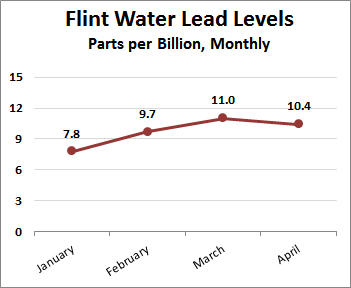 adding that the Environmental Protection Agency says using the filter makes the water safe and drinkable.
 Jonah Goldberg passes along
 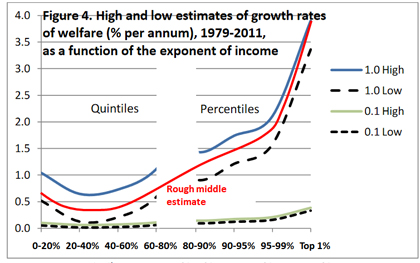 one that can’t be estimated at all, but let’s ignore all that and just assume that Komlos did his sums properly. His basic result is on the right (I’ve edited and annotated it to make his estimates a little clearer).



