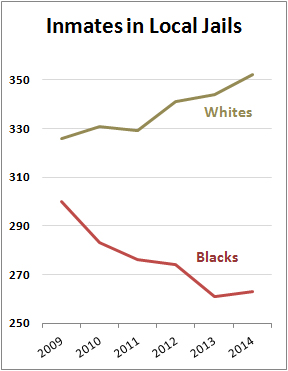
Last week Keith Humphreys noted something interesting: although incarceration rates have gone down recently, the absolute level of white incarceration has risen while the absolute level of black incarceration has fallen. But that’s for prisons. What about local jails?
Same thing, it turns out. Since 2009, the number of white jail inmates has gone up by about 30,000 while the black jail population has gone down by 40,000. Humphreys comments: “In short, if you broaden the lens of analysis from prisons to include jails, the patterns I wrote about are even stronger: Being behind bars is becoming a less common experience for African-Americans and a more common experience for non-Hispanic Whites.”
I don’t quite know what this means, but it’s an interesting tidbit of data. Blacks are still in jail (and prison) at a higher relative rate than whites, but since 2009 that’s at least starting to reverse a little.
Although customers have been rapidly abandoning their landline phones for wireless and Internet-based service, more than 18% of California households still relied on landlines for all or most of their phone service as of 2012, according to federal government estimates.
Huh. Only 18 percent? That’s a lot lower than I would have thought. And that got me curious. Which states have the highest percentage of households that have given up on landlines completely? Which states have the lowest percentage? Here’s the answer:
I don’t see much connecting the top ten. I guess they’re a little more rural than average, but that’s about it. The bottom ten, however, are exclusively from the northeast. And more recent surveys confirm this: At the end of 2014, about 30 percent of households in the northeast were wireless-only compared to 50 percent in every other region. That’s a pretty big difference.
This is just idle curiosity, but I wonder what the deal is here? Something regulatory? Why would the entire northeast be so dedicated to their landlines?
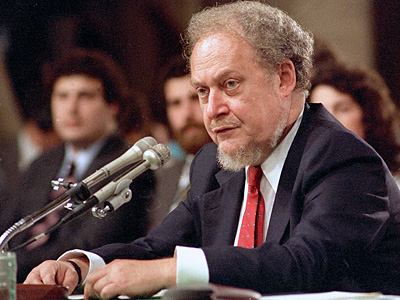
Let us speak of Robert Bork. I promise that I have a point to make with this.
If you read mainstream coverage of the political fallout over Antonin Scalia’s death, you won’t see Bork mentioned much. But you should, because his defeat for a Supreme Court vacancy in 1987 remains absolutely central to contemporary Republican views of the Supreme Court and is largely responsible for their longstanding bitterness over the direction of the court.
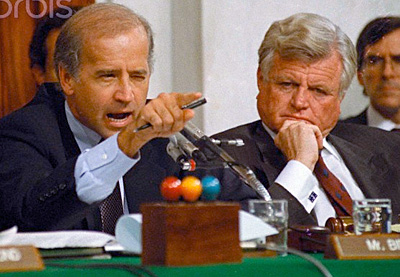
When Democrats think of Bork, it’s primarily as a reactionary anti-abortion zealot who richly deserved to be voted down in the Senate. Republicans decidedly don’t. They regard him as a brilliant legal scholar1 who was eminently qualified to serve on the Supreme Court until he was torpedoed by disgracefully unscrupulous attacks from Teddy Kennedy and Joe Biden. Bork may not have been the first Supreme Court nominee to be rejected by the Senate, but he was the first during the politically charged post-Roe era, and the first to be rejected on a nearly party-line vote over ideology, rather than scandal.
That seat eventually went to Anthony Kennedy, who turned out to be a centrist conservative. Two years later, partly to avoid another Bork-like conflagration, George H.W. Bush nominated David Souter to an empty seat. But Souter turned out to be a liberal. The year after that, Bush nominated Clarence Thomas, who was confirmed—but only barely and only after an epically ugly fight.
That four-year period from 1987 to 1991 dominates the way Republicans think about the Supreme Court. It represents two things to them: that Democrats have no qualms about waging scorched-earth campaigns of utter ruthlessness, and that Republicans need to be unceasingly alert to weak-kneed betrayal from allegedly conservative court nominees. This trauma runs very deep, and Democrats simply don’t have anything like it in their recent history. Since Roe, Democratic presidents have nominated four justices, and all four have been confirmed with only the usual amount of political squabbling and partisan trash talk. The Republican attacks on Sotomayor and Kagan were patty-cake compared to Bork and Thomas.
Because of this history, Republicans are much more sensitive to Supreme Court politics than Democrats. You can see this in the peculiarly common belief on the right that John Roberts is a conservative traitor because he voted to uphold Obamacare.2 It doesn’t matter that his reasoning was perfectly sound. He voted the wrong way, and that immediately roused memories of Kennedy and Souter and judicial betrayal.
In the same case, both Elena Kagan and Stephen Breyer voted to uphold limits on Medicaid expansion. How did Democrats react? Basically with a yawn. Most of them vigorously disagreed with Kagan and Breyer, but that was it. Nobody suggested they were traitors to the cause.
And now—finally!—for the point I promised to make: What all this means is that Republican voters are likely to be more fired up by the Scalia vacancy than Democrats. And they’re going to stay fired up by Fox News and the rest of the gang. If Democrats want to match this, they’re going to have to really work at it. My guess is that the Supreme Court fight is good for a 1-2 percent increase in Republican turnout this November. It’s not clear to me if Democrats can match this.
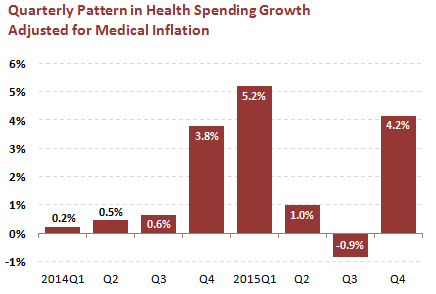
The quarterly trend in overall health spending growth using the Altarum Health Spending Economic Indicators series shows a clear peak in Q1 2015 at 6.7 percent, with subsequent declines every quarter. Partial data for Q4 (October and November) show a spending growth rate of 5.2 percent. While overall spending growth in 2015 will clearly exceed that of 2014, a reduction appears to be underway.
As near as I can tell, this spending data hasn’t been adjusted for inflation. When you do that you get the chart at the bottom, which tells a different story. There was indeed a peak in the first quarter of 2015 followed by a sharp drop, but spending growth has gone up since then.
In the long term, I’m fairly optimistic about the trajectory of health care spending. As Hempstead says, it makes sense that we saw some large increases when Obamacare was first implemented, since it brought a lot of new people into the health care system. But after the first year or two, that will flatten out and long-term trends should continue to dominate.
That said, you still need to look at this stuff in real terms. And when you do that, we’re not quite seeing the steady downward march that Hempstead suggests.
UPDATE: I originally used overall CPI to adjust the health spending numbers, but it’s probably better to use just the medical component of CPI. I’ve modified the chart to reflect this.
In further news from the always attractive intersection of Kanye West, Twitter, and money….
This ought to be good. Please go on:
In further news from the always attractive intersection of Kanye West, Twitter, and money, the businessman Martin Shkreli — known for price gouging on Aids drugs and paying $2m for the one copy of Wu-Tang Clan’s Once Upon a Time in Shaolin album — has claimed he was swindled out of $15m when he attempted to buy the exclusive rights to The Life of Pablo. Shkreli tweeted that “someone named Daquan”, claiming to be “Kanye’s boy”, contacted him to follow through on the deal, which he did. “I hope you all enjoy this stupid music SO much, and the fact it has brought me so much pain and suffering. I quit rap,” Shkreli tweeted.
Assuming he really had given $15m to someone named Daquan claiming to be Kanye’s boy, Shkreli was able to secure a happy ending. He later tweeted that the Bitcoin founder Satoshi Nakamoto was going to help him get his money back. “I always win,” he concluded.
Maybe Donald Trump will pick Shkreli as his running mate. It sounds like a match made in heaven.
Just a quick note about who Obama is going to nominate for the Supreme Court: it has to be someone willing to make a kamikaze run. It’s going to be a grueling experience for nothing, since Republicans will be happy to put the nominee through the wringer but plainly won’t vote to confirm. In fact, it might be for less than nothing. Whoever gets picked probably can’t be renominated if a Democrat wins in November.
Most likely, then, you’re putting yourself through a punishing ordeal in order to ruin your chances of ever getting a Supreme Court seat. That’s the kind of thing a party loyalist might do, but a circuit court judge? What’s the upside?
Anyway, all this is just to say that Obama may have trouble finding someone willing to be nominated. Keep that in mind when you browse through all the lists of potential candidates.
Donald Trump insists that China, Japan, and Mexico are stealing our jobs. Are they? A lot of people sure believe it. Carrier recently announced they were moving a factory to Mexico, which produced a viral video of worker reaction that’s been viewed more than 3 million times in three days. It captured in a nutshell the fear of offshoring that Trump appeals to.
So how many jobs does the United States lose each year to offshoring? Surprisingly, nobody knows. The federal government doesn’t try to track this, and companies are reluctant to talk about it. Here’s a miscellaneous sampling of various estimates:
In a report for the year 2004, BLS estimated that out of 1 million layoffs, about 16,000 represented workers whose jobs were relocated outside the country.
The Hackett Group estimates that “business-services jobs in big American and European companies” were relocated at about the rate of 150,000 per year between 2002 and 2016.
Alan Blinder, an offshoring hawk, estimated in 2006 that “offshoring to date has cost fewer than a million American service jobs, maybe a lot fewer.” In other words, maybe around 50-100,000 jobs per year.
EPI estimates that offshoring to China “eliminated or displaced 3.2 million U.S. jobs” between 2001 and 2013. That’s about 250,000 jobs per year.
Forrester estimates that 3.4 million service-sector jobs were lost to offshoring between 2003 and 2015. That comes to about 300,000 jobs per year.
So we have estimates for all jobs in 2004; business services jobs in both Europe and the US between 2002-16; total jobs through 2006; total jobs to China between 2001-13; and all service-sector jobs between 2003-15. If I had to put all this together and average the high and low estimates, my horseback guess is that maybe we’re losing a total of about 400,000 jobs per year to offshoring.
That’s about 0.3 percent of America’s 150 million jobs.
Now, this is plainly not the whole picture. Partly this is because there are lots of different things that can arguably be called “offshoring.” There’s the classic version, where you close down a plant in America and move it somewhere else. But there are also cases of brand new plants being built overseas. Is this offshoring, or is it a case of wanting to build stuff near a local market? Could be a bit of both. Then there are plant closures due to overseas competition. Technically, nothing is being offshored, but jobs are certainly being lost. And of course, all of these things contribute to pressure that keeps wages low.
Beyond that, offshoring can stand in for a host of other fears. Workers are scared of losing their jobs to automation; of equity buyouts from the Bain Capitals of the world; of losing the ability to work thanks to disability; or of being laid off and never finding a good job when the economy recovers.
In other words, 0.3 percent might not seem like much, but it stands in for a potentially much scarier number. That said, here’s the thing I’m a little puzzled by: Donald Trump’s schtick is nothing new. Anyone my age remembers this. In the 80s, it was Japan that was taking all our jobs and wrecking our economy. And it was no joke. There was real fear and real rage about this. Then, in the early 90s, it was Mexico and NAFTA. Later in the decade it was the Asian Tigers. (Remember them?) Now, for the last decade or so, it’s been China. American workers have been in a fever about losing their jobs to foreigners for more than 30 years.
And yet, we’re supposed to believe that this is the reason for all the blue-collar anger that’s come out of nowhere to power the Trump phenomenon. But it doesn’t add up. Very few workers are actually in danger of losing their jobs to offshoring. And even when you add in all the other stuff, the job market right now is actually in pretty solid shape. It’s not booming, but it’s not bad. True, there’s some evidence of permanent job loss from the Great Recession, but it’s a few percent of the workforce at most. It’s not enough to produce huge rallies for a blustering xenophobe. What’s more, the evidence from New Hampshire suggests that Trump is pulling support from nearly every demographic group: rich and poor, men and women, young and old, blue collar and white collar, dropouts and college grads, conservatives and moderates. They can’t all be in a state of hysteria about China and Mexico taking their jobs.
Just to be crystal clear: This isn’t a matter of wondering why cool logic doesn’t prevail among the electorate. What I’m wondering more about is this: what are the lived, ground-level issues that are galvanizing Trump’s supporters? The job market simply doesn’t seem to be in bad enough shape—or in different enough shape—to be responsible for a sea change in attitudes. So what is it?
The obvious response is that I’m an idiot. Middle-class incomes have been sluggish for decades, while CEOs and bankers have been raking in obscene paychecks. Wages flatlined completely about 15 years ago, and then plummeted during the Great Recession. Millions of people lost their jobs for frighteningly long periods during the recession; lost their houses; and lost their dignity. Maybe things are a bit better now, but not enough to make up for nearly a decade of misery. What’s changed, then, is simply that people have finally gotten fed up.
The other obvious response is that I’m an idiot. Everyone knows that “economic anxiety” is just a wink-wink-nudge-nudge code word for ordinary racism. That’s what binds together all of Trump’s most popular positions. His supporters don’t like Asians, don’t like Mexicans, don’t like Muslims, and don’t like blacks. “China is killing us” is just a clever way to appeal to that racism in the guise of economic insecurity. Ditto for building a wall, keeping out Muslims, and “not having time for all that PC stuff.”
Yet another obvious response is that I’m an idiot. Trump’s supporters aren’t reacting to their own lived experiences so much as they’re responding to the funhouse version they hear every day from Fox and Drudge and the radio blowhards—and the Republican candidates. If you listened to these guys, you too would think America was just one presidential term away from moral degeneration and economic collapse.
So…I don’t know. A cold look at economic time series data suggests that the economy and the job market are humming along fairly well. Polling data suggests that most people are pretty satisfied with their lives. China and Mexico aren’t really killing us. I’m not trying to naively pretend that everything is hunky dory and Nigerian princes are all showering us in wire transfers, but the truth is that the vast majority of Americans are in tolerably good financial shape right now. Of course, Republicans are doing their best to pretend otherwise, and Democrats are inexplicably willing to go along with their dour predictions of doom. Maybe that’s enough all by itself to explain the booming business in apocalyptic stories about economic anxiety. But I still think there’s something missing here. I’m just not sure what.
John Holbo has an interesting notion: President Obama should take seriously the advise part of advise and consent and give the Senate an informal list of nominees to choose from to replace Antonin Scalia. Maybe they’ll pick two or three off the list, maybe just one. Then Obama transmits his final choice for confirmation hearings.
The basic idea is that this puts Republicans in a pickle. If they flatly reject the entire list, it makes their obstructionism a little too barefaced for an election year where they need votes from more than just their base. But if they give tentative approval beforehand, then it’s harder to pretend afterward that Obama has sent them an obviously radical and unacceptable choice.
I suspect this is the kind of idea that sounds better on a blog than it does in the Oval Office, but it’s still interesting. Partly this is because the best Republican response isn’t quite as obvious as it seems. If someone on the list is genuinely moderate, what do they do? They can bet the ranch on winning the presidency and then abolishing the filibuster, which would allow them to confirm a hardcore conservative in 2017. But if they lose—or if they don’t have guts to abolish the filibuster next January—they’ll almost certainly end up being forced to confirm a more liberal justice nominated by President Sanders or President Clinton. Decisions, decisions.
Two surprising conclusions emerge when America’s culture wars — from Jefferson’s heresies to same-sex marriage — are stacked up and weighed together. Conservatives typically start the battles, and liberals almost always win them.
Conservatism is often said to be rooted in a commitment to states’ rights, free markets and limited government. But American conservatives have been for and against all these things at various times. The more consistent idea behind American conservatism is cultural: a form of life is passing away and it is worth fighting to revive and restore it. Driven by this narrative of loss and restoration, culture warriors struggle to resurrect the patriarchal family or Christian America or the homogeneous hometown.
Conservatives typically lose these battles because the causes they select are lost from the start. For example, culture warriors took on Catholics when the Catholic population was mainstreaming and gaining power. They took on same-sex marriage when many gays and lesbians were already out of the closet and accepted by their heterosexual relatives, co-workers and neighbors.
This is backward. Almost by definition—as Prothero acknowledges—conservatives want to keep existing cultural mores in place. It’s liberals who want to change them. Same-sex marriage is a typical case: the United States spent 200 years unanimously believing that it was too absurd even to contemplate. It was gay rights activists, eventually supported by mainstream liberals, who pushed it into the public sphere. Conservatives didn’t fight it before then because there was nothing to fight.
This dynamic isn’t quite universal. The temperance movement, which was generally conservative though a little hard to classify, tried to change a custom that was millennia old. Much more commonly, though, it’s liberals who fight for cultural change. In the postwar era, we’re the ones who started the fights over civil rights; gender equality; prayer in school; abortion; gay rights; voting rights; health care as a basic right; and many others.
Prothero basically says that conservatives take on these movements too late, only after they’ve already started to gain critical mass. That’s why they lose. This is true, but how else could it be? There’s no point in waging a war against something that has no mainstream support and isn’t even a twinkle in the public eye.
And of course, conservatives don’t always lose. Liberals have tried to change the culture around guns, and so far we’ve failed miserably. Drug legalization has made only minuscule progress. And after 70 years, we’re still fighting for truly universal health care.
Nonetheless, the general principle is simple: Liberals start culture fights, and conservatives respond if it looks like we’re starting to succeed. Beyond being the simple truth, it’s also something liberals should be proud of. There’s a lot of enduring unfairness in society, and the main reason I count myself a liberal in the first place is because we’re the ones who fight like hell to bring public attention to this and work to change it. Why would any liberal not gladly accept this?
Republicans are pretty unanimously refusing to consider confirming a Supreme Court nominee to replace Antonin Scalia before the election. That’s hardly unexpected, but what cracks me up is their effort to make this sound like a principled stand. “It’s been over 80 years since a lame duck president has appointed a Supreme Court justice,” Marco Rubio said last night, apparently not understanding what “lame duck” means. “We have 80 years of precedent of not confirming Supreme Court justices in an election year,” Ted Cruz agreed, apparently not realizing that Anthony Kennedy was confirmed in 1988. No matter. “It’s been standard practice over the last 80 years to not confirm Supreme Court nominees during a presidential election year,” thundered Chuck Grassley, the chairman of the Senate Judiciary committee, which will hold hearings on Obama’s nominee.
This has quickly become a meme on the right. It’s a deeply held American tradition not to confirm Supreme Court justices during an election year. Needless to say, this is ridiculous. Anthony Kennedy aside, the reason Supreme Court nominees haven’t been confirmed during election years for the last few decades is just coincidental: none of them happened to have died or retired during an election year.1Some tradition. Perhaps Scalia should be posthumously censured for having the gall to break this custom.
In any case, congratulations as usual to Mitch McConnell for not bothering with this self-righteous pretense. He says the Senate won’t vote on a replacement for Scalia because, basically, they just don’t want to. “The American people should have a voice in the selection of their next Supreme Court justice,” he said yesterday, and that’s that. Republicans have the power to delay in hopes of electing a Republican in November, and that’s what they’re going to do.
1Abe Fortas was rejected during the 1968 election year, but this had nothing to do with any kind of hallowed tradition. It was because Republicans and Dixiecrats were pissed off at the Warren Court, and preventing LBJ from elevating Fortas to chief justice was a way of showing it. They were able to use an ethics scandal to gin up opposition, and Fortas never even made it to a floor vote.
And we respect that! But maybe you’re of a mind to support our work directly instead? We have until December 31 to raise the last $400,000 we need to keep our nonprofit newsroom running at full strength into 2026. Will you make a gift today?
We noticed you have an ad blocker on. Can you pitch in a few bucks to help fund Mother Jones' investigative journalism?
Billionaires own the media,
but they don’t own us.
At Mother Jones we know these aren’t conventional times, and they require unconventional coverage. That’s what deliver every day: fierce, independent journalism you can’t find elsewhere. Perhaps never in the history of our country has that been more necessary than now. But we can’t do it without reader support—your support. Please chip in today.
Billionaires own the media,
but they don’t own us.
At Mother Jones we know these aren’t conventional times, and they require unconventional coverage. That’s what deliver every day: fierce, independent journalism you can’t find elsewhere. Perhaps never in the history of our country has that been more necessary than now. But we can’t do it without reader support—your support. Please chip in today.

 Last week Keith Humphreys noted something interesting: although incarceration rates have gone down recently, the absolute level of white incarceration has risen while the absolute level of black incarceration has fallen. But that’s for prisons. What about local jails?
 Republican views of the Supreme Court and is largely responsible for their longstanding bitterness over the direction of the court.
 amount of political squabbling and partisan trash talk. The Republican attacks on Sotomayor and Kagan were patty-cake compared to Bork and Thomas.
 While overall spending growth in 2015 will clearly exceed that of 2014, a reduction appears to be underway.
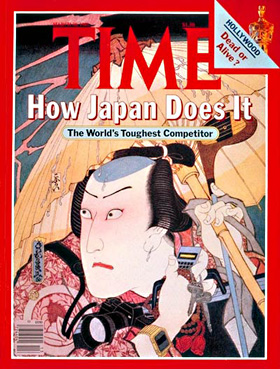 Now, for the last decade or so, it’s been China. American workers have been in a fever about losing their jobs to foreigners for more than 30 years.
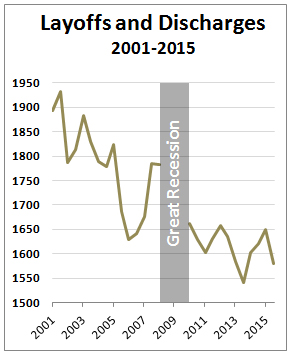 If you listened to these guys, you too would think America was just one presidential term away from moral degeneration and economic collapse.
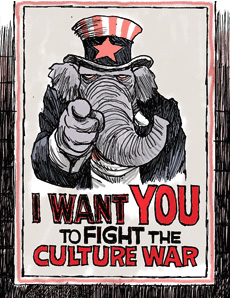 idea behind American conservatism is cultural: a form of life is passing away and it is worth fighting to revive and restore it. Driven by this narrative of loss and restoration, culture warriors struggle to resurrect the patriarchal family or Christian America or the homogeneous hometown.
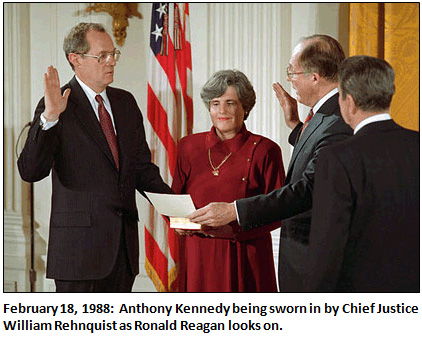 Anthony Kennedy was confirmed in 1988. No matter. “It’s been standard practice over the last 80 years to not confirm Supreme Court nominees during a presidential election year,”



