• Poor People Really Get Screwed By Ben Carson’s Tax Plan


    Back in the day—meaning approximately 2008 or so—Republican presidential candidates made a big mistake. They released their tax plans without bothering to figure out anything other than the average tax cut each one provided. The frequent result was that taxes went up on the poorest people and down on the richest. That’s bad optics.

    By 2012 they’d all wised up. Their tax cuts might be bigger for the rich, but they made sure everyone got a cut.

    When I was looking at Ben Carson’s plan last night, I realized that the poor guy hadn’t been paying attention. He figured that by setting a zero percent tax rate on income up to $36,000, he’d be guaranteeing that the poor would get a tax cut. Unfortunately, his actual knowledge of the tax code is so shallow that he didn’t realize what he meant when he said his plan eliminated all credits and deductions. That means he’s getting rid of the Earned Income Tax Credit, which often amounts to a negative tax rate for the poor. In other words, paying $0 is a tax increase for a lot of them. Citizens for Tax Justice provides the details:
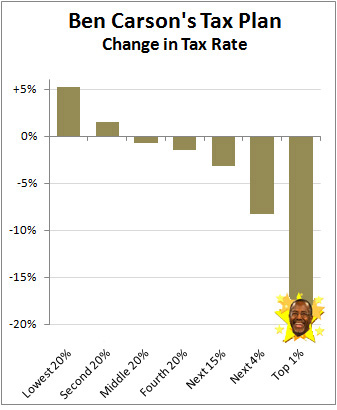
    Under Carson’s plan, the bottom 20 percent of taxpayers would receive an average annual tax increase of $792 and the second 20 percent would get an average annual tax increase of $447, while the top one percent would receive an average annual tax cut of $348,434. The main reason Carson’s plan would increase taxes on low-income families is that it would eliminate all tax credits, including the highly effective Earned Income Tax Credit (EITC) and the Child Tax Credit (CTC).

    There’s still no reason to care about this since Carson is obviously doomed to return to the book promotion racket at this point. Still, just for the record, I figure this deserves a chart to memorialize it for posterity. So here it is.
  • Are Young Women Complacent About Abortion Rights?


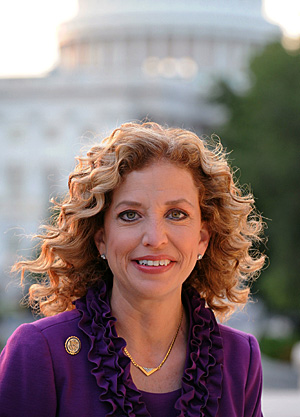
    Here is DNC chair Debbie Wasserman Schultz:

    Do you notice a difference between young women and women our age in their excitement about Hillary Clinton? Is there a generational divide?

    Here’s what I see: a complacency among the generation of young women whose entire lives have been lived after Roe v. Wade was decided.
    I won’t even pretend that I understand this answer. Complacency about what? Abortion? Politics in general? And what does this have to do with Hillary Clinton?

    Beats me. But it doesn’t really matter. Everyone assumes that DWS was talking about complacency toward abortion rights, and young feminists aren’t happy about her sweeping criticism of an entire generation. Generally speaking, though, the response has been that there are plenty of young women who work hard on abortion rights these days, which is certainly true. But DWS isn’t denying that. What she’s saying is that there are fewer young women today working hard on abortion rights. Or perhaps that they don’t have as much passion as they used to have.

    That got me curious. Is this true? Is there any evidence for it? Unfortunately, I couldn’t really figure out how you might measure it. I doubt there’s any historical data on the number of abortion activists broken up by age and gender. There’s plenty of poll data on attitudes toward abortion, but that doesn’t help—and attitudes haven’t changed a lot anyway. Is there any kind of survey data (broken up by age and gender) that shows how strongly people feel about abortion rights? Or how often it’s a significant factor in voting? Not that I could find.

    This isn’t really very important, and I suppose someone could just ask Wasserman Schultz to explain what she meant. But I’m still curious: is there any data at all that might point in one direction or another when it comes to generational attitudes toward abortion activism? Anyone have any ideas?

  • Just Because Donald Trump Says It Doesn’t Mean You Have to Report It


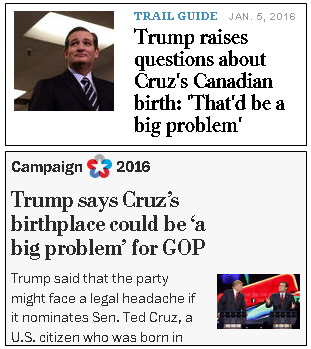
    Stop it, stop it, stop it, STOP IT! Just because Donald Trump says something calculatingly stupid and provocative doesn’t mean it has to be reported as front-page news. Everyone knows that his “Cruz is a Canadian” thing is ridiculous—and he wouldn’t bother saying it if he didn’t know that it was going to get loudly amplified by a media that just can’t say no to him.
    Look: he’s a candidate. He’s in the lead. Reporters have to report what he’s doing. I get it. But stuff like this is such obvious media bait that it should be treated as such. It should get one line at the end of the day’s campaign roundup: “In other news, Donald Trump tried to gain attention once again with a goofy claim that Ted Cruz might not be a natural born citizen.” That’s all it really needs.

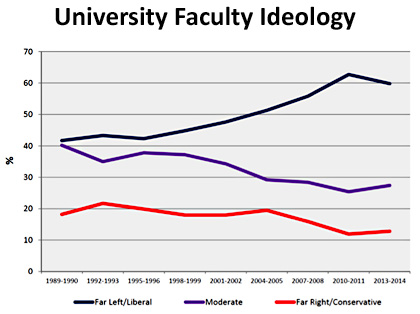
  • Chart of the Day: Universities Are Pretty Liberal Places


    The chart on the right comes from Heterodox Academy, a group founded a few months ago to promote more ideological diversity on university campuses. What it shows is unsurprising: over the past few decades, university faculties have become almost entirely liberal. And this is for all university faculty. According to HA, humanities and social science faculty are closer to 95 percent liberal.

    Why? Paul Krugman thinks it’s because conservatives went nuts starting in the 80s, so nobody with any intelligence and genuine curiosity wants to associate with them anymore. Michael Strain suggests that it might be because faculties actively discriminate against conservative job candidates. This argument has been going on forever, and there are a few basic points of view:

    • Undergrads, especially in the humanities, are mostly liberal, which means that PhD program fill up with liberals. Conservatives just aren’t interested in the liberal arts these days, so there are very few to choose from when it comes time to hire new faculty.
    • Being exposed to graduate work in the humanities converts a lot of people to liberalism.
    • Liberal arts departments consider conservative views inherently racist/sexist/etc. and are loath to hire anyone who promotes conservative views.

    Needless to say, all of these interact with each other, and more than one may be right. But here’s what I don’t get: why the endless argument? These all seem like eminently testable hypotheses:

    • Are undergraduate liberal arts departments predominantly filled with liberal students?
    • Are conservatives not much interested in the liberal arts these days? Why?
    • How many conservatives apply to grad programs in the liberal arts? How many are accepted?
    • How much do views change while in grad school?
    • How many conservatives end up getting PhDs in the liberal arts?
    • Of those, how many get tenure-track jobs?

    If, say, 95 percent of job candidates are liberal, then there’s probably no discrimination. Conservatives are being hired in proportion to their numbers. If conservatives generally don’t major in the liberal arts as undergrads, then probably PhD programs aren’t discriminating either. Etc. These all seem like fairly answerable questions.

    Most likely, there’s a vicious circle involved. As the American right became more conservative while the liberals arts became (say) modestly more liberal, it would make sense if conservatives just didn’t feel like joining up. This naturally produced a more left-leaning liberal arts faculty, rinse and repeat. Eventually you end up at 95 percent.

    But why guess? Can’t these questions at least be suggestively answered?

    For what it’s worth, I agree that it’s a problem regardless of how it happened. It’s easy for liberals to see the conservative bubble when we talk about Fox News or talk radio, and we immediately understand why it’s bad: it makes people lazy and unwilling to question their basic beliefs. We don’t see this so clearly when it’s our own bubble, but we should. Bubbles are bubbles, and ours are no better than theirs.

    And now to end on a griping note: I would be a lot more sympathetic to conservative complaints about the academy if they showed an equal concern about fields that lean heavily conservative (big business, the military, etc.). For some reason, though, that never seems to strike them as a problem. Why?

  • Tech Is Still Big. We’re the Ones Who Have Gotten Small.


    Farhad Manjoo is trying hard to dredge some kind of story out of this year’s Consumer Electronics Show:

    If news from CES feels especially desultory this year, it might not be the show that’s at fault. Instead, blame the tech cycle. We’re at a weird moment in the industry: The best new stuff is not all that cool, and the coolest stuff isn’t quite ready….Welcome to Prototype World, a brief intermission in your regularly scheduled program of disruption, during which everything new will more or less stink.

    “It’s like the junior high years in technology,” said Ben Bajarin, an analyst at Creative Strategies. “We’re in those awkward teenage years where everything looks and feels funky.”

    Over the next couple of CESes, there’s a good chance we will see a lot of devices that will feel not quite ready. Virtual reality will underwhelm, artificial intelligence will feel annoyingly unintelligent, and cars and drones that navigate themselves will seem safer when parked. There will be wearables you won’t want to wear and home devices that will make you want to buy a new place.

    Hmmm. Am I just getting old and crotchety?1 Because I’d swear that tech has felt this way pretty much every year since at least the Reagan administration. How many years did GUI interfaces seem “almost” there before they finally got genuinely useful? Ditto for portable PCs. Ditto for PDAs. Ditto for online shopping. Ditto for Unix. Ditto for open source. Ditto for social media. Ditto for a hundred other things that I’ve forgotten about.

    This is just the nature of modern tech: The really cool stuff is always a “few years” away. And when it finally comes, we’ve been talking about it so long that it seems ho-hum. Yeah, Amazon is great, isn’t it? So what’s next?

    It may be the case that there are no breakout stars at CES this year, but more generally, I think Manjoo is suffering from a problem that’s more about us than about tech. Back in the 80s and 90s, I can remember being thrilled with stuff that just seems crazy today. A 9-pin dot matrix printer? Holy cow! It’s practically print quality. (It wasn’t.) A clamshell PC that only weighs 8 pounds? Crazy! We’ll all be carrying computers everywhere we go by next year. (Actually, it took about 20 years.) PalmPilots? Who even needs paper anymore? (Still waiting on that one.)

    Back then, everything was new and exciting. Today our standards are a lot higher. We just don’t get excited so easily. Tech has been so integrated into our lives that it’s just another category of consumer appliance. We still love it, the same way that car geeks love it when new model cars are introduced, but most of us are no longer easily impressed. And when something cool does finally come along, we sort of shrug. We expect it nowadays.

    So prepared to be bored year after year at CES. Our memories may fool us, but tech has always taken a while to go from “hmmm….” to widely useful. We’re just less patient these days. In the meantime, though, can’t someone finally invent a better battery? We really have been waiting too long for that.

    1This is a rhetorical question, people. Actual answers are distinctly unhelpful.

  • When Will China Finally Abandon the Loons in North Korea?


    North Korea says that it has tested a hydrogen bomb. This seems unlikely, but it will be weeks before we know for sure. Most likely it was just another fission bomb test.

    More interesting is what this says about relations between North Korea and China. Short answer: not so great.

    The decision to detonate a bomb suggested a serious falling-out in the relationship between North Korea and China….Now, Chinese leaders are in a difficult position. They are under intense pressure to inflict harsh economic punishments on North Korea, but they worry that any resulting instability could seep back into their territory. They also face new questions about China’s efforts, over the past several months, to curry favor with Mr. Kim, whom many Chinese regard as a bizarre, bumbling figure.

    China must also reckon with the prospect that actions by the North could galvanize countries like the United States, Japan and South Korea into strengthening military forces in the Pacific, just as China is seeking to assert its dominance in the region.

    There’s something a little hard to understand about China’s continued sponsorship of North Korea. Historically it’s easy enough to understand, but for the past couple of decades it’s surely been nothing but a huge millstone around their necks. Are they really that worried about problems on the border with North Korea? Would they really lose that much face if they abandoned North Korea for good? And surely that would be more than made up for by the goodwill it would generate with the West.

    I dunno. I get that questions of loyalty and fear of unrest aren’t always entirely rational. Still, it’s hard to see that China’s alliance with North Korea buys it anything at all these days. If the DPRK imploded tomorrow, wouldn’t they breathe the same sigh of relief as everyone else in the world?

  • Ben Carson Has a Tax Plan!


    Hey, did you know that Ben Carson has finally released a tax plan? He has! (Though “plan” is perhaps a bit grandiose for nine bullet points.) There’s not really any reason you should care, but just for the record, here are the highlights:

    • No taxation of income up to $36,000 (150 percent of the poverty level)
    • A flat 14.9 percent tax on all ordinary income above that.
    • Also, business income will be taxed at 14.9 percent.
    • No taxation of interest, capital gains, dividends, or estates.
    • No deductions whatsoever, not even mortgage interest.

    This is great! At a guess, your average zillionaire would have an effective tax rate of about 8 percent compared to about 20 percent today. Ka-ching!

    And how much would this blow up the deficit? My horseback guess is that it would cost around $12 trillion over the next ten years. That’s even more harebrained than Donald Trump’s plan. You go, Ben! As for the Carson plan’s effect on the economy, here you go:

    My flat tax plan will increase our current, anemic economic growth rate of 2.2 percent by more than half. I am confident this would generate an additional 1.6 percent of growth annually. As a result, our economy would be growing at an annual rate of almost 4 percent….This expanded growth translates into more than five million additional jobs over 10 years, with a nearly 11 percent increase in wages.

    This promise springs forth fully grown, like Athena from Zeus’s forehead. Given that it’s literally just magic, I have no idea why Carson was so modest. Why not 6 percent growth and a 30 percent growth in wages? It’s all just meaningless squiggles on a page anyway.

  • 35,000 Cows: Is That a Lot or a Little?


    Here’s a little quiz. Based on the teaser on the right from the New York Times, how serious would you say this blizzard was in terms of milk production? It sounds pretty serious, no?

    But nowhere in either the teaser or the linked article does the Times tell you just how much 35,000 cows is. Here’s the answer: there are 9.3 million dairy cows in the United States, so 35,000 represents….

    About 0.4 percent.

    I don’t get it. The blizzard is a worthwhile story, and the hit to farmers in the region is serious. No problem there. Still, why not take the extra five minutes required to dig up a couple of numbers and give readers a sense of whether this is a big problem from a national perspective? The only hint is 13 paragraphs down: “Consumers should not expect noticeable increases in the prices of milk or milk products.”

    Instead, why not put something like this at the top of the story: “So far, more than 35,000 dairy cows have been found dead. Although this represents less than 1 percent of the nation’s dairy herd, for regional farmers it’s etc. etc….” Context is everything.

  • Lots of Rich People Seem to Be in Tough Financial Straits


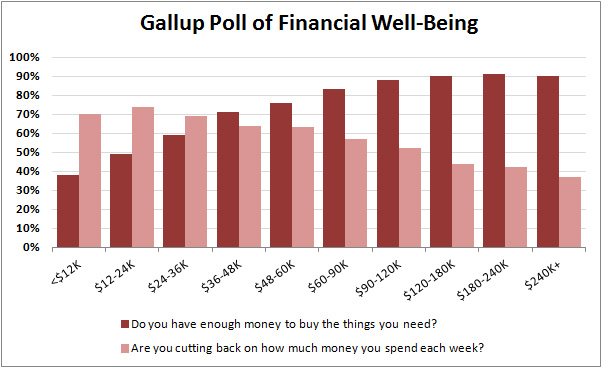
    Here’s a fairly remarkable poll from Gallup about financial well-being. The direction of the answers is unsurprising: if you earn more, you’re more likely to have enough money to buy the things you need, and less likely to be cutting back on spending.

    And yet, of those making over $240,000, a full 10 percent say they don’t have enough money to buy the things they need. And an astonishing 37 percent say they’re cutting back.

    I’m not sure what to make of this. Either there are a whole lot of rich people who manage their money really badly, or else this is some kind of statistical artifact. Or maybe rich people consider separate summer and winter getaway homes to be among the things they “need.” It’s a headscratcher.

  • Ted Cruz Knows What His Followers Want


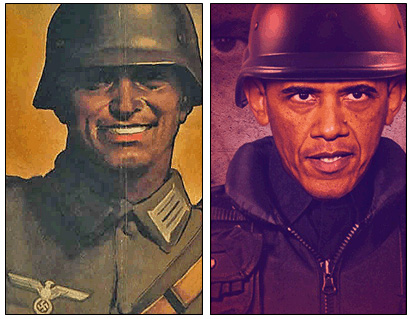
    Today’s test: one of these men is an illustration from a Nazi propaganda poster. The other is the president of the United States. Can you tell which is which?

    The president is the one on the right, of course. He’s the menacing one who looks more like a stormtrooper than the actual Nazi, but still retains plausible deniability in case someone like me happens to point out the entirely coincidental resemblance. It comes to us courtesy of the Ted Cruz campaign, which is apparently fully adopting Trumpism as its guiding vision. The full context is below.