Joe Biden says he and his family have worked through the grieving over the death of Beau Biden, but it took a long time and “closes the window” on mounting a presidential campaign. So he’s out.
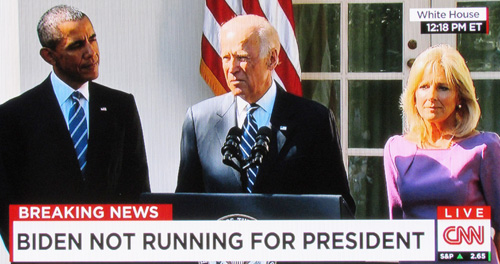

Joe Biden says he and his family have worked through the grieving over the death of Beau Biden, but it took a long time and “closes the window” on mounting a presidential campaign. So he’s out.
Dave Bry thinks it’s great that more restaurants are doing away with tipping. However, he has a list of eleven more things he also wants them to do away with. Here’s one:
The phrase “ancient grains.” Similarly, some words just don’t go so well with food. Like “decrepit” or “withered” or “wizened”, “ancient” is one of those words. Surely there’s a different descriptive we could choose. “Are the ancient grains fresh?”
That reminds me: what is this whole “ancient grains” thing all about? The BBC informs me, as usual, that I am almost comically uninformed about trending pop culture nonsense. I just heard about this recently, but Google brings up a BBC story 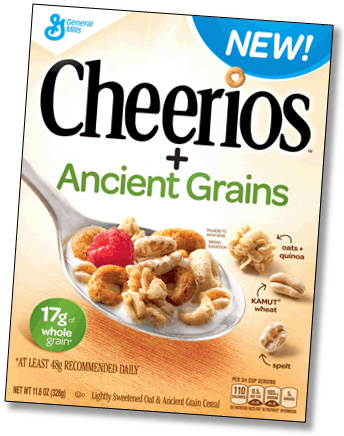 from 2014 that asks “Why do Americans love ancient grains?” In the story itself, there’s this: “In the past five years there has been an explosion in popularity of so-called ‘ancient grains’ in the American food market.” So that means this all started around 2009 and I have just heard about it now, six years later. That’s pathetic.
Fine. Let’s play catch-up. What’s the deal here?
There is no comprehensive list of “ancient” grains, but the category is generally agreed to include amaranth, barley, bulgur, buckwheat, kamut, millet, spelt, teff and quinoa….According to figures released by the US Whole Grains Council, sales of kamut rose 686% in the year from July 2013, while sales of spelt rose by 363% and amaranth by 123% — all, admittedly, from a low base.
….[General Mills] has announced it will be launching a new line of its successful breakfast cereal, Cheerios, with ancient grains next year….”Consumers may feel that the barrier to eating ancient grains is that they’re not convenient, so we figured a way to deliver them in a bowl of cereal.”
But this will also mean including five times as much sugar as in the original Cheerios recipe — 5g of sugar per 28g serving, instead of just 1g….”We feel great about the health profile of this Cheerios,” he says.
Sounds great indeed! In any case, there’s a whole bunch of high-profile articles about this from last year, most of them apparently tied to a fall PR blitz surrounding the announcement of Cheerios+Ancient Grains—which is exactly where I first heard of ancient grains a few days ago at my local grocery store. But are ancient grains really healthier than modern grains? Here’s the Whole Grains Council:
Ancient grains are certainly more nutritious than refined grain products (like white flour or refined crackers). But healthy whole grains need not be exotic. Common foods like brown rice, whole grain pasta, oatmeal, popcorn, and whole wheat bread offer the same whole grain goodness, and often at lower price points.
Popcorn! Hot damn. I’m having that for breakfast instead of Cheerios. Thanks, Whole Grains Council!
Israeli prime minister Benjamin Netanyahu on Tuesday:
Referring to the current cycle of violence, Netanyahu said Jews in Israel have faced attacks in the past — in 1920, 1921, 1929 — instigated by the “Mufti of Jerusalem,” Haj Amin al-Husseini, who allied himself with Adolf Hitler and the Nazis during World War II.
Then Netanyahu delivered this jaw-dropping assertion:
“Hitler didn’t want to exterminate the Jews at the time, he wanted to expel the Jews. And Haj Amin al-Husseini went to Hitler and said, ‘If you expel them, they’ll all come here.’ ‘So what should I do with them?’ he asked. He said, ‘Burn them.’
Ben Carson thinks the Holocaust was partly the fault of the Jews for meekly giving up their guns and not fighting back hard enough. Netanyahu thinks it’s partly the fault of the Palestinians because Hitler met with one of them a couple of years after he started exterminating Jews.
Can we all just go back to obeying Godwin’s Law and blaming Hitler for everything? Thanks.
Rep. Paul Ryan met with the Republican caucus in the House today and told them he was willing to run for Speaker. But only on his terms: unanimous support, reduced fundraising duties, and an end to mid-session attempts to remove the Speaker from power. According to a team of National Review reporters, he didn’t offer much in return—except for this:
Though it wasn’t a night in which Ryan was making many concessions — aside from a nod that he was seriously considering taking a job he has said publicly he does not want — he also hinted strongly that he will not bring an immigration bill to the House floor. He told his colleagues the issue was simply “too divisive” and he wanted to focus on the things on which the conference is in agreement, like border security and internal enforcement, as opposed to a comprehensive bill.
This doesn’t strike me as a huge concession. Ryan may be an immigration dove, but under the current circumstances there’s no way he’d try to cut a deal with Democrats for comprehensive immigration reform. Especially not during an election year. The conservative base rebelled over this in 2006 and then again in 2013. Bringing it up again would be nuts. And whatever else Ryan is, he’s not nuts.
So there you have it: no immigration reform this year or next. But you weren’t really expecting any, were you?
Jim Tankersley examines the presidential odds at PredictWise today and concludes that punters are probably underestimating Hillary Clinton’s chances of winning. Why? Justin Wolfers explains that it’s likely due to something called “longshot bias”:
The favorite tends to win in betting markets more often than indicated by the odds. So if the markets say she’s a 47% chance to be president, history suggests that the true odds are a bit better than that.
….There’s another way to get at this though, which is simply to ask whether the odds make sense. I think the idea that Clinton is only a 75 percent chance to win the nomination is nuts — she’s essentially the only serious candidate running, and it’s now clear that her campaign is not going to implode. With any candidate there are risks
that secrets may come out, but with Mrs. Clinton, we’ve had several decades for them to surface. So my (personal!) judgment is that she is at least an 85 percent chance to win the nomination, and maybe 90 percent is a more realistic assessment.
OK. But what I want to know is why the betting markets say that Democrats have a 58 percent chance of winning the presidency, but the combined chance of all the individual Democratic candidates is 63 percent. There must be some way to arbitrage this so that you’ll make money no matter what happens. Right?
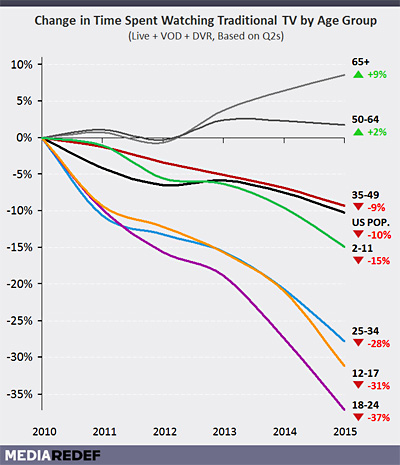 I suppose this isn’t exactly breaking news, but young people sure are abandoning traditional television in a hurry. Liam Boluk reads the eulogy:
Across all audience segments under 50, television engagement is declining rapidly…. This time is not simply evaporating. Instead, it’s moving to services such as Netflix (each of the company’s 43M US accounts watches more than 2 hours a day), Twitch (15M American viewers watching 30 minutes a day), YouTube (163M watching 35 minutes a day) and scores of other low cost (if not free) digital-first brands and services.
No television network can weather the loss of their younger audiences….Skinny bundles, adjusted affiliate fees, re-rationalized programming strategies, lower costs, declining Pay TV penetration. These can all be managed practically. But without a way of re-engaging youth audiences, all networks are on long-term life support. To thrive, they need to invest in new digital properties, create new distribution models and partnerships and invest in radically different content forms.
Traditional TV viewing among teenagers and 20-somethings has gone off a cliff since 2010. Oddly, though, old folks are watching more TV. It’s easy to understand why TV viewing among seniors might be flat—they’re not interested in YouTube and Netflix and all the other stuff the kids these day are into—but why would it be going up? Have traditional networks well and truly given up on younger viewers and are therefore programming more content that appeals to the Geritol crowd?
I’m no media analyst, so I have no great insights into all this. I just thought it was interesting to see how dramatic the decline has been among younger viewers, despite being told relentlessly that we’re in a second golden age of TV. About once a week I think I read an article telling me that some show I’ve never heard of is probably the best drama on television today—maybe of all time. I guess the kids aren’t listening.
OK, that’s enough about the poor. Let’s move on to stuff that upper-middle-class folks care about. Consumer Reports has been raving about Tesla electric cars for a while—so good it broke their rating system, scoring 103 out of 100!—and I’ve been wondering 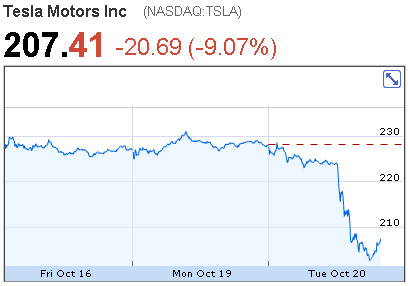 all that time what would happen after a couple of years when they started getting reliability data. Today I found out:
Consumer Reports withdrew its recommendation for the Tesla Model S — a car the magazine previously raved about — because of poor reliability for the sporty electric sedan….Consumer Reports surveyed 1,400 Model S owners “who chronicled an array of detailed and complicated maladies” with the drivetrain, power equipment, charging equipment and giant iPad-like center console. They also complained about body and sunroof squeaks, rattles and leaks.
“As the older vehicles are getting up on miles, we are seeing some where the electric motor needs to be replaced and the onboard charging system won’t charge the battery,” said Jake Fisher, Consumer Reports’ director of automotive testing. “On the newer vehicles, we are seeing problems such as the sunroof not operating properly. Door handles continue to be an issue.”
Ouch. Tesla stock, unsurprisingly, took a big tumble. But here’s an interesting question for you. I figure that there are probably fewer owners of the Tesla S who are moderately annoyed than there are people who are completely panicked because they rely on RushCard for all their money and can’t get to it. However, the former are rich and the latter are poor. Which story do you think will get faster and more sustained attention?
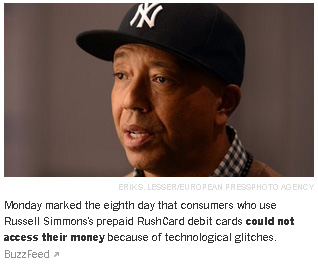 Yesterday I saw the blurb on the right at the New York Times. Russell Simmons. RushCard. On the blink for eight days. That sounds like a drag. I wonder what this is all about? Why haven’t I heard of it before now?
RushCard, according to its website, is a prepaid debit card that lets users get paychecks up to two days in advance….It’s meant to solve the real problems that come with being unbanked or underbanked. In reality, however, it’s a trap. In exchange for early access to their money, users face a web of fees and charges.
….If RushCard were reliable, this might be a fair price for convenience. But it’s not. Beginning last week, thousands of people were locked out of their accounts following an alleged “technology transition” from the company. As Jia Tolentino notes for Jezebel, these are people with no access to cash outside of RushCard. It’s what they use to live their lives.
….This is a disaster, largely uncovered because of whom it affects.
Yep. If this were a problem with, say, American Airlines mileage awards, it would have gotten about as much attention as the Space Shuttle exploding or the Obamacare website melting down. That’s because lots of upper-middle-class folks use these miles, and so do lots of journalists. But RushCard is mostly used by the invisible poor. It turns out that RushCard’s problems have been big news for the past week in a few places that cater to either the hip hop community or looking out for the poor, but in the mainstream press it’s been mostly ignored. That’s probably because very few mainstream journalists either use RushCard or know a lot of people who do.
The rest of Bouie’s column is about postal banking, which you all know I’m sort of skeptical about. I suspect there are better answers to helping the unbanked. But as a comment on the press and the invisibility of the poor, this story deserves more attention.
“I really respect the members up there and I still have a lot of Republican friends. I don’t think my chief enemy is the Republican Party. This is a matter of making things work,” Biden said Tuesday, during an event honoring former Vice President Walter Mondale.
….It was the second such remark Biden made in two days, as the vice president made similar comments at a climate change event
on Monday. “I don’t consider Republicans enemies,” Biden said. “They’re friends.”
The tea leaves have been working overtime trying to makes sense of these comments. What does Joe mean? Is this a direct shot at Hillary Clinton, who said in the debate that she was proud of the fact that Republicans were her enemies? Is it just a random Biden gurgle? Or is he only trying to calm things down?
Nobody knows. But judging by the continuing media frenzy, everyone is taking it to mean that Biden is about to throw his hat in the ring. I’m not sure I can stand the excitement.
 The House Freedom Caucus doesn’t just want a more conservative Speaker. They also want a change in governance: a commitment to “regular order,” which basically means less power to the Speaker and more power to committee chairs. This would return the House to its historic power distribution, which was transformed to give the Speaker more power starting in the post-Watergate era and then picked up steam when Newt Gingrich consolidated power in 1995. It’s gotten even more marked in recent years, as John Boehner and other Republican speakers found that in the modern era they could barely get anything done in the GOP caucus without forcing it through themselves.
So what would happen if committee chairs became more powerful and could no longer be easily bypassed by a powerful Speaker? Lee Drutman tells us:
In his forthcoming paper on congressional leaders bypassing committees, [William] Bendix leverages variation in committees to explain why some committees get bypassed more often than others.
One reason is that some committees are too moderate. As he writes: “I find evidence that the most moderate panels are regularly excluded from legislative deliberations. … Because they may produce bills that move policy away from the majority’s median, they are likely to lose their bill-drafting responsibilities.”
The other reason is that some committees are too polarized to have any productive deliberations, and letting these committees handle bills just produces partisan spectacle. What this suggests is that if more bills were to go through committees, we might get more moderate policy in some places, and perhaps even more contentious policy in other places. Then again, who knows — if committees were given more responsibility and staff and space to deliberate, they might reach some unexpected agreements.
This sounds an awful lot to me like Speakers bypass committee chairs whenever they don’t like what the committees are doing. The tea partiers in the HFC thus think that if the power of the Speaker is reined in, true conservatism will flower because the Speaker will no longer have the authority to ignore it and bring bills to a vote on his own. Maybe. I guess.
But I doubt it. In the end, Drutman thinks that decentralizing power in the House would lead to more moderate policy. “My prediction is you’d see more moderate Republicans joining with most Democrats in opposition, just as you’ve seen moderate Republicans joining with most Democrats to keep the government funded and the country from defaulting on its debt.”
I doubt that too. Previous debt default crises have been overcome only because Boehner eventually forced action. If a Speaker could no longer do that, it’s hard to see what would prevent a default if it got bottled up in a committee headed by an HFC true believer.
So my prediction is: it would produce more chaos. Some bills would get easier to pass and some would get harder to pass. Which ones? It would be the luck of the draw. Some committees would be chaired by traditional dealmakers and some would be chaired by fire-breathing tea partiers. That would probably be fun for journalists, but not so much for the rest of us.

Award-winning photojournalism.
Stunning video. Fearless conversations.


