• Hillary Clinton Support Way Up Following First Debate


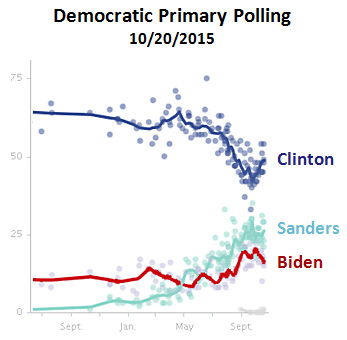
    Hillary Clinton has pretty clearly benefited from her debate performance last week. According to a newly released Washington Post/ABC poll, she leads Bernie Sanders 56-22 percent. For Sanders, that’s about the same as a month ago, but Clinton is up 10 points. When Biden supporters are asked to pick someone else, Clinton leads 65-24 percent.

    This is similar to yesterday’s Wall Street Journal/NBC poll, which had Clinton leading 49-29 percent. When Biden supporters were asked for a second choice, that rose to 58-33 percent. Generally speaking, both polls suggest that people who were unsure about Clinton were reassured by her debate performance and moved in her direction.

    On a more amusing note, the Post poll also asked people if the current fiasco over choosing a Speaker “reflects healthy debate among House Republicans or is a sign of dysfunction among House Republicans.” You will be unsurprised to learn that dysfunction won a landslide victory, 59-29 percent.

  • Obamacare Is Beating Its Goal of Reducing the Uninsured Rate


    I want to highlight something I wrote over the weekend that might have gotten buried a bit. As you may know, HHS recently announced that Obamacare would enroll 10 million people in the exchanges next year, compared to enrollment of 9 million this year. That makes it sound like Obamacare has stalled and will come nowhere near to hitting its early projections.

    This probably isn’t true, but you can easily go very far down a rabbit hole trying to figure out who’s insured via what and how that compares to early projections. I did a bit of that in Saturday’s post, but I think there’s a much easier way of tracking Obamacare’s success or failure: just look at the total number of uninsured. That’s what matters, not whether they’re covered by Medicaid or exchanges or employers or something else.

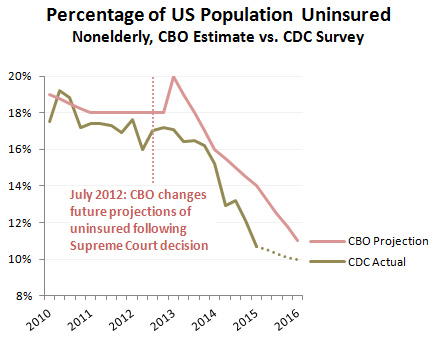
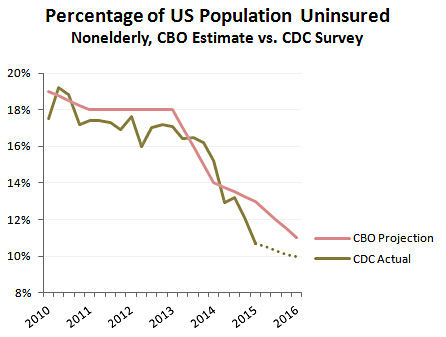
    So let’s review the tape. In 2010, just after Obamacare passed, CBO estimated that the uninsured rate would hit 8 percent by 2016. This was based on the original law, but in 2012 the Supreme Court made Medicaid expansion voluntary and most red states opted out. In July CBO updated its projections to account for this, increasing its estimate of uninsured by three percentage points. The next CBO estimate thus projected that the uninsured rate would be 11 percent by 2016. So how does that compare to reality? In its most recent survey, the CDC estimates that in the first quarter of 2015 the actual number of uninsured clocked in at 10.7 percent, and that’s likely to decline to about 10 percent or so by the end of 2016.

    In other words, once you clear away all the underbrush it looks like Obamacare is meeting or beating its goals. Some of this might be due to an improving economy, but who cares? If the economy is doing well enough that more people are getting employer coverage and fewer are being forced onto the exchanges, that’s a good thing, not a knock on Obamacare.

  • The GOP Is the Party of No Escape


    In the print magazine this month (yes! print!) I have a piece arguing that this year’s odd lack of enthusiasm among Republicans for repealing Obamacare—something that many folks have noted—is just a bellwether for wider GOP problems:

    Obamacare’s foes running out of steam is just the most obvious sign of a larger trend: A lot of traditional conservative issues are losing their momentum. Gay marriage lost its fear factor years ago….The economy is probably in good enough shape to not be a big campaign issue. Taxes have already been lowered so much that the average family pays only about 5 percent of its earnings to the IRS.

    ….True, Republicans still have a short list of hot-button topics that inflame their base, but increasingly these are wedge issues that promise nearly as much downside as upside. Immigration is the most visible example….Republican voters aren’t sold on the idea of Iraq War 2.0….Even abortion runs the risk of becoming a wedge issue for the party as activists demand that candidates take extreme positions such as opposing exceptions for rape, incest, or the life and health of the mother—even though these are popular among most Republican voters.

    The big Republican problem right now is not that they’re out of ideas. The problem is that just as Democrats were torn apart by their ideas 30 years ago, Republicans are being torn apart by theirs today. All the once-reliable Republican applause lines are fast becoming wedge issues that divide the party regulars from the tea party base. And this is all coming at the same time that Republicans are fighting the headwind of a long-term demographic shift that weakens them further with every election cycle. “In an era when the inmates are running the asylum, it’s not just Obamacare bashing that’s become a double-edged sword for Republicans. It’s nearly everything they’ve relied on for the past three decades.”

    Read the whole thing! I’m excited about it. Not because it’s the most astute piece of political analysis ever, but because it’s my first print piece in over a year. That’s right: As of a couple of months ago, I had recovered enough from chemotherapy that I once again had the energy to start writing longer print pieces in addition to blogging. And I just finished another, better one for the next issue. Read it too! (When it comes out.)

  • LA Times Says Climate Not to Blame for More Wildfires. They’re Wrong.


    California Gov. Jerry Brown says climate change is responsible for increased wildfire activity in the state. “It’s a new normal. California is burning.”

    Needless to say, climate change isn’t the only culprit. Changing land use patterns are also at fault, as is a century long habit of “fire exclusion,” in which fires aren’t allowed to burn normally. This causes dry underbrush to build up, producing huge amounts of tinder whenever a fire starts. Still, climate plays a significant role too.

    But the LA Times, once again, has devoted a long article today to debunking this. “Scientists who study climate change and fire behavior say their work does not show a link between this year’s wildfires and global warming,” writes Paige St. John. But this is a cop-out. It’s true—banal but true—that wildfire activity in any particular year can’t be conclusively blamed on climate change. It’s also true that there are other factors that have contributed to bigger fires in recent years. But a warmer climate is almost certainly to blame as well. As far back as 2006, a metastudy in Science concluded that climate change did in fact play a role in increased wildfire activity in California and throughout the West:

    Increased wildfire activity over recent decades reflects sub-regional responses to changes in climate….unusually warm springs, longer summer dry seasons, drier vegetation….longer fire seasons.

    ….The greatest absolute increase in large wildfires occurred in Northern Rockies forests….fire exclusion has had little impact on natural fire regimes….an advance in spring produces a relatively large percentage increase in cumulative moisture deficit by midsummer. In contrast, changes in Northern California forests may involve both climate and land-use effects. In these forests, large percentage changes in moisture deficits were strongly associated with advances in the timing of spring….Southwest forests….fire exclusion has had the greatest effect on fire risks….less affected by changes in the timing of spring.

    ….Broad-scale increase in wildfire frequency across the western United States has been driven primarily by sensitivity of fire regimes to recent changes in climate over a relatively large area.

    The Times piece is very strange. It starts by quoting Roger Pielke, the go-to guy for any reporter who wants a skeptical take on climate change. But even Pielke doesn’t actually say climate is unrelated to increased wildfire activity. Next up is a quote from a guy concerned with fire risk who naturally thinks we should focus on making homes safer, but doesn’t comment on climate science one way or the other. Next comes a scientist who has “concluded that global warming has indeed shown itself in California.” Then a Forest Service ecologist who says “California has had an average of 18 additional days per year that are conducive to fire.”

    Next comes a UCI team who reported that climate change will increase fires in Southern California by 64 percent over the next few decades. But instead of simply reporting that, the piece acknowledges only that fires will “increase,” and then casts doubt on the result by noting that the UCI model has error bars which indicate that the increase could be between 12 percent and 140 percent. Then a prediction from a “UC Merced expert” who speculated about “a possible decrease of such fires as dry conditions slow vegetation growth.” Finally a National Park Service climate change scientist is quoted as saying “We are living right now with a legacy of unnatural fire suppression of approximately a century.” That’s true enough. Elsewhere, however, that same scientist has also said, “climate has dominated all factors in controlling the extent of wildfire in Western U.S. forests in the 20th century.”

    In other words, virtually everyone quoted in this article either (a) says nothing about climate change or (b) says climate change is an important factor in the rise of wildfires in California and the West. And yet, somehow all of this is written in a way that makes it sound as if climate change has nothing to do with wildfires, and it’s topped by a headline that says in no uncertain terms, “Gov. Brown’s link between climate change and wildfires is unsupported, fire experts say.”

    Very peculiar.

  • Benghazi Committee Screws Up Again

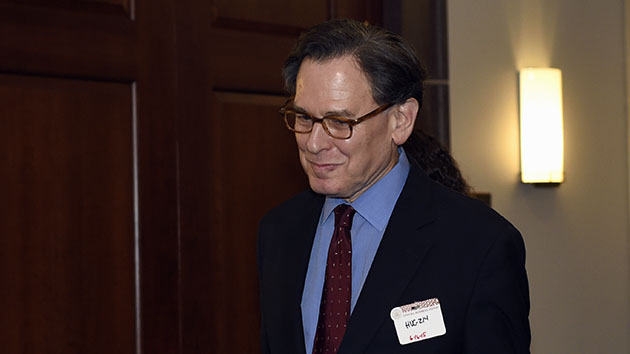
    Sidney Blumenthal, a longtime confidant to former President Bill Clinton and Democratic presidential candidate Hillary Clinton, arrives on Capitol Hill on June 16 to face questions from the House panel investigating the deadly 2012 attacks in Benghazi, Libya.Susan Walsh/AP


    Jeff Stein reports on yet another bad day for the Benghazi committee:

    Already wobbling with accusations, some by its own Republican members, that it’s been running a Hillary Clinton hit squad since May 2014, leaders of the panel struggled Sunday to fend off new charges that they had mischaracterized the former secretary of state’s handling of sensitive intelligence.

    Indeed, according to committee correspondence reviewed by Newsweek, the CIA did tell the panel on Saturday that it had reviewed 127 emails between Clinton and her close friend and outside adviser, Sidney Blumenthal, and none of it was deemed classified.

    “The CIA reviewed the material in question and informed State that it required no redactions,” the agency informed Susan Sachsman Grooms, staff director and general counsel for the panel’s Democrats, on October 17.

    What a shocker. Sidney Blumenthal didn’t have access to classified information. Who could have guessed?

    Pretty much everyone, I suppose. But Blumenthal is a longtime Clinton confidante, and one of the great white whales of the Clinton inquisition of the 90s. When his name popped up, Republicans reacted like Pavlov’s dogs, panting and drooling despite the fact that there was zero chance Blumenthal had the slightest connection or insight into the Benghazi attacks. Still, it was Sidney! Gotta be a scandal in there somewhere.

    But no. No scandal, no classified info, no favoritism. It was just Sidney doing what he does: offering information and advice—solicited or otherwise—to one of the Clintons. No worries, though. If it’s not Sidney, it’ll be someone else. Republicans are just sure they’ll find a blue dress in there somewhere.

  • Since Donald Trump Brought It Up, Let’s Ask Him Again for Evidence That He “Fought Against Going Into Iraq”


    Ezra Klein today:

    I don’t know if Donald Trump will win the Republican nomination. But even if he doesn’t, it’s increasingly clear he’s going to destroy Jeb Bush before he loses….Trump insists that [George] Bush was president both prior to and during the 9/11 attacks, and he was therefore at least partly responsible for the security failures that permitted the tragedy.

    I’m not so sure. As I recall, liberals spent a lot of time in the mid-aughts trying to make the case that George Bush was negligent in protecting the country before the 9/11 attacks—Exhibit A being the infamous Presidential Daily Brief titled “Bin Ladin Determined To Strike in US.” You’d think that would be pretty devastating, but it had its 15 minutes of fame and then faded out even among lefties. I doubt it will have any greater effect now, especially in a Republican primary.

    What it will do, unfortunately, is almost guarantee that it comes up as a question in the next Republican debate. Debate moderators seem to be wholly unable to ignore juicy Trump bait like this. That’s too bad. I don’t really care about relitigating George Bush’s negligence prior to 9/11, but I do care about letting Trump set the terms of the campaign. Enough.
    But there is one interesting thing that might come of this. Trump has lately moved on to a more defensible criticism of George Bush, asking Jeb, “why did your brother attack and destabilize the Middle East by attacking Iraq when there were no weapons of mass destruction?” This is not interesting because of what it says about George Bush—I think we already know that—but because it gives us another chance to harass Trump for lying about his opposition to the war during the second GOP debate:

    I am the only person on this dais [] that fought very, very hard against us — and I wasn’t a sitting politician — going into Iraq. Because I said going into Iraq — that was in 2003, you can check it out, check out — I’ll give you 25 different stories. In fact, a delegation was sent to my office to see me because I was so vocal about it. I’m a very militaristic person, but you have to know when to use the military. I’m the only person up here that fought against going into Iraq.

    So far, no one has managed to find even the slightest record of Trump opposing the Iraq War before it started. The closest he came was a breezy comment at the Vanity Fair post-Oscar party, three days after the war started. During the day CNN had been reporting nonstop about the battle of Nasiriya, in which 11 Americans were killed and six captured—including Jessica Lynch. It was the first serious fighting of the war, and apparently it was enough to inspire a classic Trump complaint about the incompetent losers running the invasion. “The war’s a mess,” he declared to an entertainment reporter, and then swept away.

    There’s zero evidence that he opposed the war before it started and zero evidence that he opposed it during its first year. It wasn’t until November 2004—nearly two years after the war started—that he finally spoke up. “I do not believe that we made the right decision going into Iraq, but, you know, hopefully, we’ll be getting out,” he said on Larry King Live. That was after Fallujah, after Abu Ghraib, and after the growth of the insurgency in Sadr City and Basra. Trump hardly gets any brownie points for turning against the war at that point.

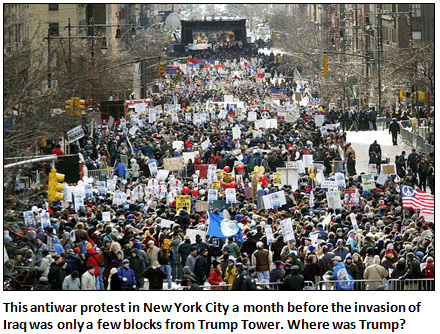
    Anyway, that would be a good question to ask Trump at the debate later this month. Where are those 25 stories about how he “fought against going into Iraq”? Where’s even one? Maybe a personal diary? Trump is not a shy man, and it’s hard to believe that he felt so strongly about this but never said anything for two long years. As I recall, there were plenty of opportunities, including one just a few blocks from his office. Let’s ask him about this.

  • Obama Understands That Presidents Can’t Make Empty Threats


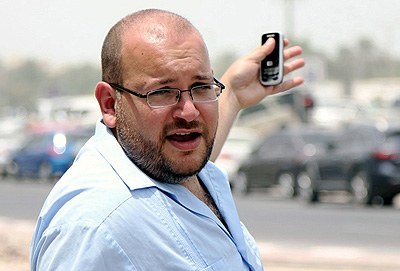
    Washington Post columnist Dana Milbank is upset at President Obama’s “passivity” in foreign affairs. Specifically, he’s upset that Obama hasn’t threatened Iran with reprisals for its sham trial of his colleague Jason Rezaian on charges of spying.

    I don’t blame Milbank. If I were in his shoes I’d be plenty enraged too. And yet, that still doesn’t make this right:

    Obama said … nothing. He didn’t go to the briefing room and make a statement. He didn’t even release a written statement.

    ….Where was the demand that Iran immediately release Rezaian and the two or three other Americans it is effectively holding hostage? Where was the threat of consequences if Tehran refused? How about some righteous outrage condemning Iran for locking up an American journalist for doing his job? Even if Obama’s outrage came to nothing, it would be salutary to hear the president defend the core American value of free speech.
    There are times when presidents should vent a little outrage, and maybe Obama should do it more often.1 But the fundamental truth about threats is that you don’t make them unless you’re willing to carry them out—and that goes double for presidents. If Obama had done what Milbank asked, and then failed to follow up, he’d open himself up to justified contempt. But if he did follow up, he’d be allowing America’s foreign policy to be dictated by the fate of a single person. Like it or not, a president can’t operate like that. He has bigger responsibilities than Donald Trump does.

    Since neither of these options is acceptable, all that’s left is to take the course Obama has decided on: say nothing and allow his State Department to work behind the scenes. That’s not very emotionally satisfying, but it’s the right thing to do.

    1Though Obama has publicly called for the release of all American prisoners in Iran on more than one occasion. “We are not going to relent until we bring home our Americans who are unjustly detained in Iran,” he said shortly after the Iran nuclear deal was announced. “Journalist Jason Rezaian should be released. Pastor Saeed Abedini should be released. Amir Hekmati, a former sergeant in the U.S. Marine Corps, should be released.”

  • A Closer Look at 2016 Obamacare Enrollment


    Warning: Lotsa numbers ahead. Sorry about that. If you’re not interested, you can skip down to the last two paragraphs for the bottom line.

    A couple of days ago, HHS projected that Obamacare exchange enrollment would reach 10 million by the end of 2016. That’s not much higher than the 9.1 million who are expected to be enrolled at the end of 2015. Has Obamacare enrollment stalled?

    Maybe. But keep two things in mind:

    • This is probably a lowball figure. HHS would rather set a low bar and beat it than set a higher bar and have to explain why they missed it.
    • Charles Gaba, who has a pretty good track record with this stuff, estimates that 14.7 million people will sign up and 12.2 million will remain by the end of the year.

    If Gaba is right, that’s an increase of about one-third from 2015. Not too bad. Still, it’s considerably less than the CBO’s original estimate of 21 million enrollees by 2016. Again, though, keep a couple of things in mind:

    • The CBO figure is for “average annual enrollment.” Since people drop out as the year progresses, this is probably equivalent to about 19 million by year-end.
    • CBO had estimated a drop of 8 million people from employer and other insurance plans. However, those numbers appear to have turned out lower than CBO’s estimates. This is a good thing—we’d prefer that people stay on their current coverage instead of being kicked off—but it obviously reduces the market for Obamacare enrollment. We should probably reduce CBO’s estimate by 3 million or so to account for this.

    In other words, on an apples-to-apples basis, a best guess suggests that we’ll end up 2016 at 12 million compared to a CBO projection of 16 million. It’s still lower than CBO’s original estimates, but not by a huge amount. This could be due to (a) an overestimate by CBO, (b) weak performance by Obamacare, (c) an improving economy, or (d) nothing more than a difference in how fast Obamacare ramps up.
    Bottom line: Because of all this, a more reliable metric of success is to skip all the details of who’s insured via what, and simply count the total number of uninsured. CBO originally estimated that the uninsured population would drop to 8 percent by 2016.  That estimate changed after the Supreme Court made Medicaid expansion voluntary, and CBO now figures that in 2016 the total number of uninsured will come to about 11 percent. The CDC estimates that in the most recent quarter the number of uninsured dropped to 10.7 percent. If Gaba’s numbers are correct, that will decline to about 10 percent or so by the end of 2016.

    In other words, once you clear away all the underbrush it looks like Obamacare is meeting or beating its goals. Some of this might be due to an improving economy, but who cares? If the economy is doing well enough that more people are getting employer coverage and fewer are being forced onto the exchanges, that’s a good thing, not a knock on Obamacare.

    POSTSCRIPT: Surveys consistently show that about half of the uninsured say they’re not on Obamacare because it’s too expensive. So for anyone who’s truly concerned that Obamacare isn’t hitting its enrollment targets, there’s an easy answer: increase the federal subsidies for the working poor so that more of them can afford coverage.

  • Friday Cat Blogging – 16 October 2015


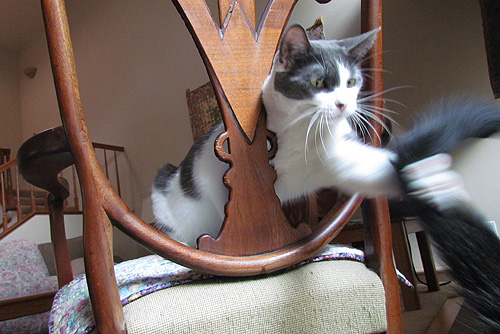
    This morning, Hopper was busily scratching her cheek on this handy chair when a tail walked by. What’s a self-respecting cat to do? Snag at it with feline reflexes, of course. Hilbert was not amused. The funny part about this is that Hilbert attacks Hopper’s tail too, but as near as I can tell she never even notices. I think she must lack nerve endings in her tail or something.