• Federal Judge Blasts Wilbur Ross Over Census Shenanigans

    Cheriss May/NurPhoto via ZUMA

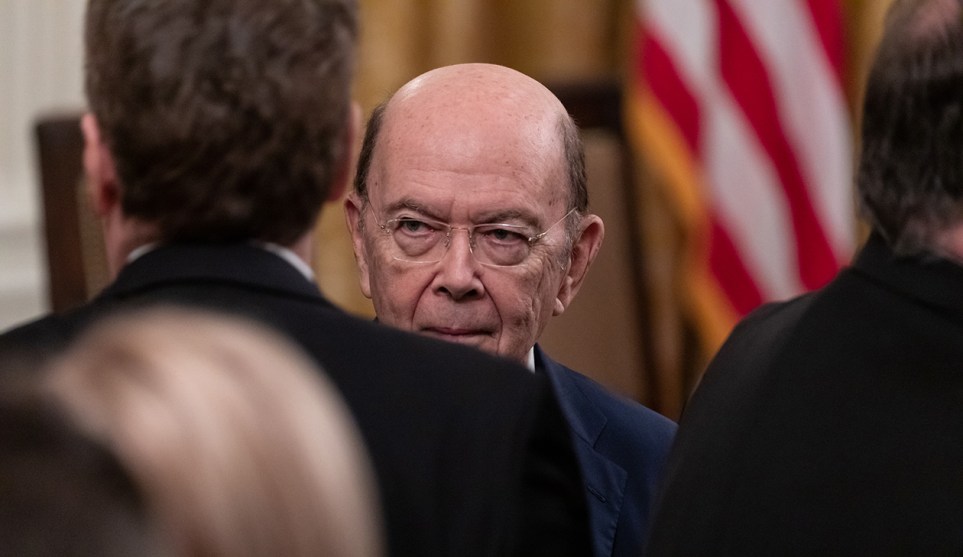
    Federal District Judge Richard Seeborg has ruled that Commerce Secretary Wilbur Ross broke the law when he insisted on adding a citizenship question to the 2020 census. Seeborg’s written opinion is brutal:

    Nearly a year before issuing that decision, on May 2, 2017, Secretary Ross sent an email to Deputy Chief of Staff Earl Comstock stating in part “I am mystified why nothing [has] been done in response to my months old request that we include the citizenship question. Why not?” What ensued was a cynical search to find some reason, any reason, or an agency request to justify that preordained result.

    ….When initially approached by Comstock about the citizenship question, the Department of Justice (“DOJ”) opted not to request its inclusion in the census. Comstock then reached out to the Department of Homeland Security, which similarly declined to request the addition of the question. Only after Secretary Ross personally interceded with then Attorney General Jeff Sessions did the DOJ switch its position and request the inclusion of a citizenship question, ostensibly to assist in the enforcement of Section 2 of the Voting Rights Act (“VRA”)

    ….Secretary Ross’s reliance on VRA enforcement to justify inclusion of the citizenship question was mere pretext and the definition of an arbitrary and capricious governmental act. Moreover, Secretary Ross’s conclusion that adding the citizenship question would enable the Census Burau to obtain more “complete and accurate data” in response to the DOJ’s request is not only unsupported, it is directly contradicted by the scientific analysis contained in the Administrative Record. PTX-26 at 1, 7. While it is of course appropriate for an incoming cabinet member to advocate for different policy directions, to solicit support for such views from other agencies, and to disagree with his or her professional staff, this record reflects a profoundly different scenario: an effort to concoct a rationale bearing no plausible relation to the real reason, whatever that may be, underlying the decision.

    The fundamental problem here is one we’ve seen before: Donald Trump and his minions seem to believe that they can simply order things to be done. After all, Trump is the head of the executive branch and cabinet officials are merely carrying out his requests, so why not?

    The answer is pretty simple: the president is indeed head of the executive branch, but he is bound by both laws and the Constitution. In this case, the Constitution requires a decennial census, and a plain corollary of this is that the executive branch is required to conduct the census as accurately as possible. In addition, there are laws in place that control how the census is conducted and what questions can be added to it. If you want to make changes, you have to follow those laws. Among other things, they require the executive to explain the reason for their proposed changes. They also require those reasons to be real, not simply made up.

    Wilbur Ross, acting as Trump’s deputy, failed to do this. As Judge Seeborg says, it’s quite obvious that Ross wanted a citizenship question added for political purposes, and then set about inventing reasons for it. The result would have been a less accurate census that arbitrarily undercounted non-citizen populations and thereby reduced both congressional representation and federal funding for states like California.

    And that, of course, gets us to the core of the whole thing: it’s just another way for Trump to get revenge on California, his most hated enemy. What a great way to run a country.

  • Should Democrats Reach Out to Fox News Addicts?

    A friend emails to say that he’s not happy with the DNC’s decision not to allow Fox to host a Democratic primary debate:

    I mean I get it….It is very much state TV for the right….It is simply the most powerful communications tool that Republicans have (by orders of magnitude) and dwarfs whatever the Democrats have.

    All that said, it’s all the Democrats have to speak directly to that population that gets almost all of their news from Fox. Granted, it’s small in number, but extremely politically powerful due to their geographic location. Yes it’s unfair and asymmetrical but that doesn’t change the fact that it’s what exists. It smacks a bit of the old DNC view of Fox’s base as hopeless, which helped convince them that local, state, and lower-office efforts were not as important as Congressional, and most importantly, presidential office. I’m not sure you can overstate how destructive to the party this view was — and is, to the extent it continues.

    This is not a hot-button issue for me. I don’t really care who hosts the Democratic debates. However, I’m skeptical that there’s any value in speaking to the population “that gets almost all of their news from Fox.” These folks strike me as the absolute core of Trump’s base, completely unreachable to any of the Democrats. Or, if you think that’s going a little too far, I’d at least say that they’re unreachable via a primary debate held nearly a year before the general election.

    However, there’s still value in having Fox host a debate: it prepares the candidates for tougher questions. That’s especially important this year, when there are so many newbie candidates who have never run for president before or participated in a presidential debate. They need all the prep they can get, and a Fox News debate early in the primary season might help toughen them up.

  • Sherrod Brown Is Out

    Sen. Sherrod Brown has announced that he won’t be running for president this year. He was one of my favorites, but I’m not surprised he made this decision. We’ve been down this road before, and each time he’s decided that he just doesn’t crave power enough to spend two years on the campaign trail.

    On the bright side, Brown is 66 years old, which would have put me in a bind if he had run. I like Brown, but I’d also like the Democratic candidate to be someone younger than 60. So at least that dilemma is taken care of.

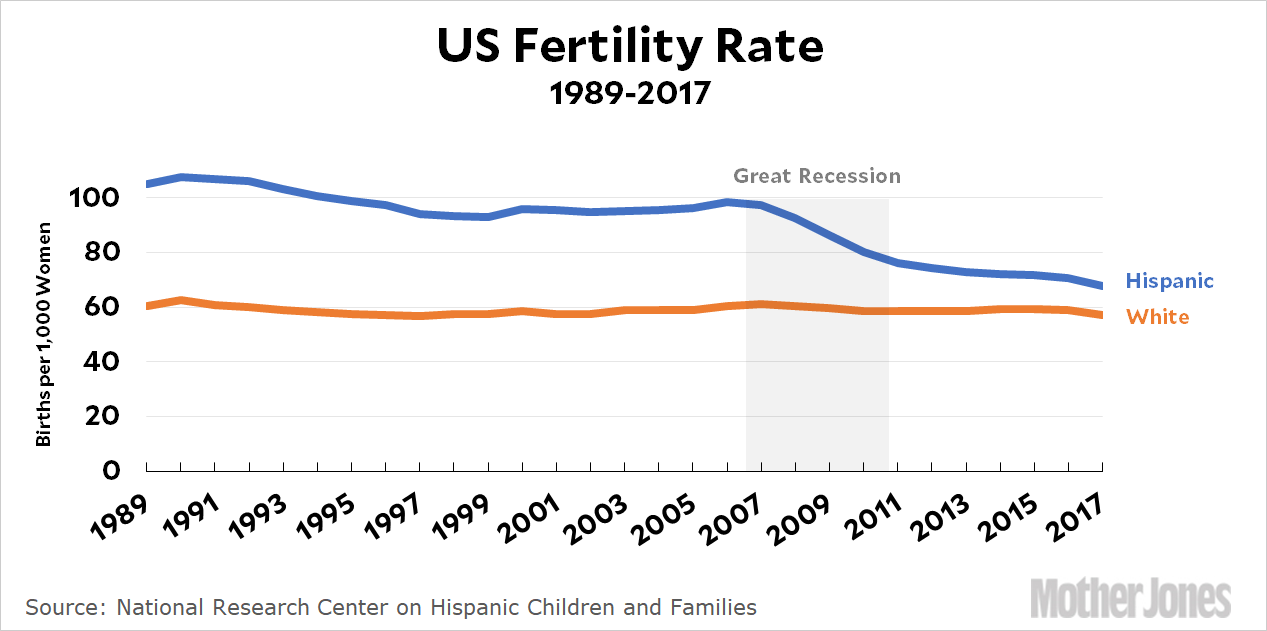
  • The Hispanic Fertility Rate Has Plummeted Since the Great Recession

    The New York Times reports today on the steadily dropping fertility rate of Hispanic women. However, you want to see it in chart form, don’t you? Here it is:

    The Hispanic fertility rate declined at a modest rate (about 0.4 percent per year) until the start of the Great Recession in 2007. Over the next four years it fell by 4 percent per year, and then continued dropping by about 2 percent per year after that. By contrast, the white fertility rate has declined only about 0.6 percent per year during the entire ten year period since 2007.

    The obvious conclusion from this is that the economy was largely responsible for Hispanic women deciding to have fewer children. However, it’s worth pointing out that two things happened in 2007: (a) the economy went into recession and (b) migration from Mexico to the US declined. Both are likely suspects in the decline of Hispanic fertility.

  • There’s a Bigger Difference Between 0 and 1 Than You Think

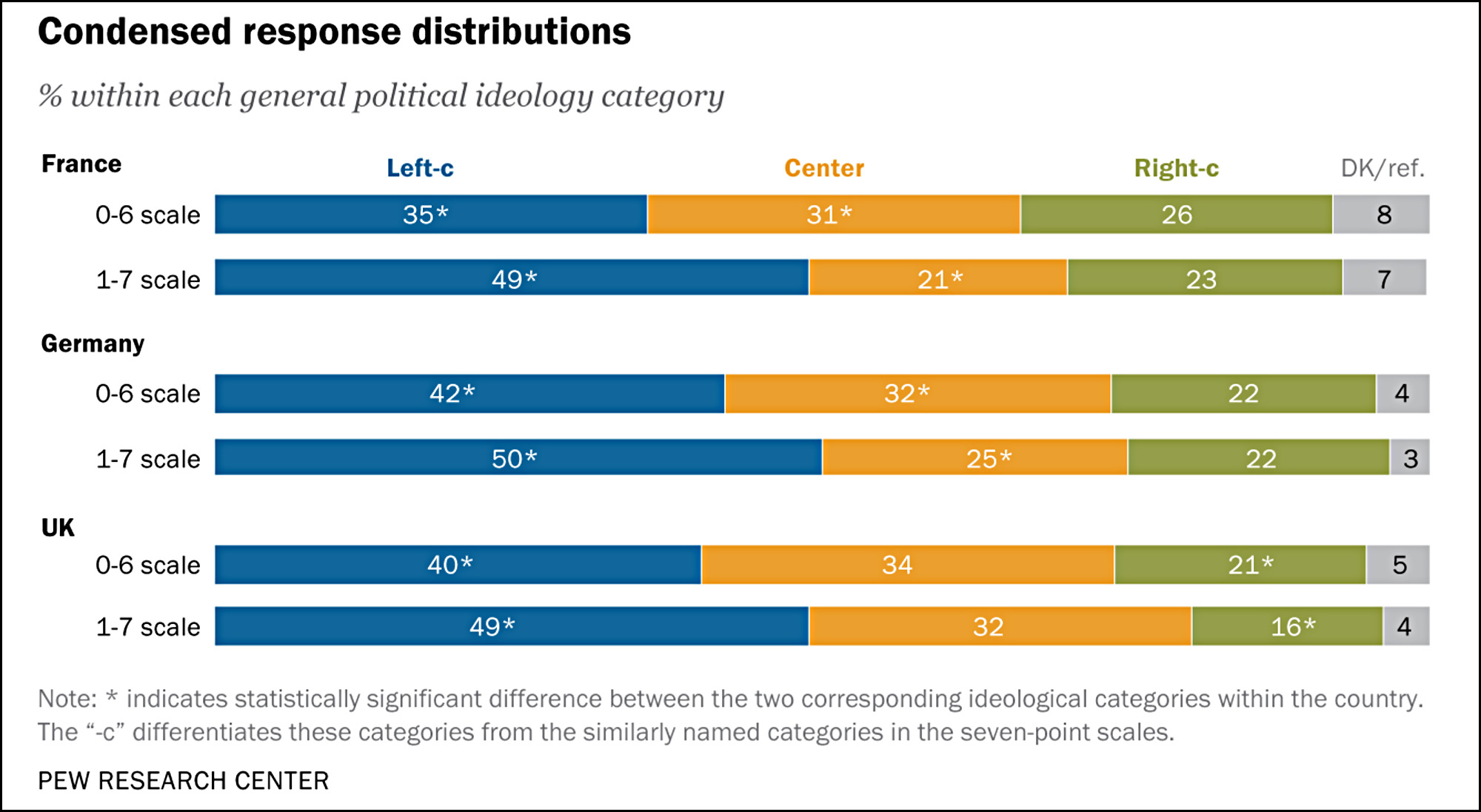
    A few weeks ago I wrote about a study showing that student evaluations of teachers could differ substantially if a scale of 1-6 was used instead of 1-10. Today, I learned that the boffins at Pew Research just finished a similar study. They wanted to test whether responses about political ideology changed depending on whether people were asked to describe themselves on a 0-6 scale vs. a 1-7 scale. Indeed they did:

    In all three countries, the 1-7 scale produced higher results for the ideology defined by a low number (which happened to be lefties in this case). The differences weren’t small, either. Take a look at France, where the percentage of lefties increases from 35 percent to 49 percent. That’s a huge difference, and all because the ranking system changed by one digit.

    This is a great example of how fragile polling can be. We obsess over things like the margin of error, which might be responsible for a point or two of error, when there are other things that can introduce errors of a dozen points or more. Of course, it’s not really correct to talk about “errors” here since we don’t know what the true value is or whether there even is one. What a study like this shows is probably that (a) lots of people are kind of fuzzy about where they stand, and (b) lots of people aren’t very good at math.

    You can see the same sort of thing with question wording. This is especially evident in polls about abortion, where seemingly small changes in question wording can produce differences of ten or twenty points. This is why you should always be skeptical when you see a headline shouting about a big shift in abortion sentiment. If the change really is big, it’s almost certainly because of question wording, not because the American public has really shifted its views significantly.

    Anyway, this is a good example of just how hard opinion polling is. Who would have guessed that a tiny change in scale would produce wild results like this?

  • Lunchtime Photo

    Here in Southern California the wildflowers are starting to bloom, and with all the rain we’ve had this year it ought to be a great season later this month and next. This is a lovely yellow wildflower in front of Morris Reservoir in the Angeles National Forest. I wish I’d had a wider angle lens for this picture, and I also wish I’d been there later in the day when the flower would have been facing the camera. But you take pictures with the equipment you have, not the equipment you wish you had.

    February 16, 2019 — Angeles National Forest, California
  • Zuckerberg: Facebook Will Build a Brand New Privacy-Obsessed Social Network

    Jaap Arriens

    Mark Zuckerberg says that Facebook is about to undergo some big changes. But as you read this, keep track of where the pea is:

    Over the last 15 years, Facebook and Instagram have helped people connect with friends, communities, and interests in the digital equivalent of a town square. But people increasingly also want to connect privately in the digital equivalent of the living room….Today we already see that private messaging, ephemeral stories, and small groups are by far the fastest growing areas of online communication.

    ….Public social networks will continue to be very important in people’s lives — for connecting with everyone you know, discovering new people, ideas and content, and giving people a voice more broadly. People find these valuable every day, and there are still a lot of useful services to build on top of them. But now, with all the ways people also want to interact privately, there’s also an opportunity to build a simpler platform that’s focused on privacy first.

    I understand that many people don’t think Facebook can or would even want to build this kind of privacy-focused platform — because frankly we don’t currently have a strong reputation for building privacy protective services, and we’ve historically focused on tools for more open sharing. But we’ve repeatedly shown that we can evolve to build the services that people really want, including in private messaging and stories.

    Media reports are calling this a “radical shift,” but I’m not so sure. Zuckerberg says clearly that Facebook itself isn’t going away and isn’t going to change. He is simply going to build a new platform to go alongside it.

    How good will this new platform be? As Zuckerberg says, in the understatement of the year, he doesn’t have a great reputation for ensuring privacy. But maybe he can change. Maybe the new platform will be really great. However, keep this in mind: in order to grow his new platform, he will almost certainly want to link it to current Facebook and Instagram users. After all, would you ignore a captive audience of billions if you were building a new social network? Probably not. Especially if you were the kind of person who says with a straight face about Facebook’s current platform, “We’ve worked hard to build privacy into all our products, including those for public sharing.” Ha ha. That’s a good one, Mark.

    If this new platform is connected in even the tiniest way to Facebook, it’s unlikely that it will be truly private. Keep your eyes wide open as this new platform progresses.

  • How Not to Be Anti-Semitic

    Sean Hansford/Mirrorpix/Newscom via ZUMA

    Last month, Rep. Ilhan Omar apologized after suggesting that support for Israel is “all about the Benjamins.” This month she stepped in it again, saying “I want to talk about the political influence in this country that says it is okay to push for allegiance to a foreign country.”

    When I first heard this, I immediately grimaced. Charges of “dual allegiance” or “dual loyalty” are a longtime weapon of anti-Semites, and surely Omar knew that. Right? The result of all this is a Democratic-sponsored resolution in the House that condemns anti-semitism but mentions only two examples: accusing Jews of loving money and accusing Jews of dual loyalty. Omar’s name is never mentioned, but it’s obviously no coincidence that those two specific things, and only those two things, just happened to make it into the text of the resolution.

    And that got me to thinking. I’m well aware of the long history of the dual-allegiance charge, and if I wanted to talk about support for Israel I’d be careful to choose better words than Omar did. But is Omar aware of the whole dual-allegiance thing? On the one hand, it’s hard for me to believe she isn’t. On the other hand, I’m 60 years old. Omar is 37 and has lived in the US only since 1995. I’m constantly surprised by the things people don’t know, much of which is a result of age differences. So at the risk of being naive, I’d say it’s quite possible that Omar wasn’t aware of the history behind her specific word choice.

    And that brings me to my request. I need to make clear up front that this is not a joke and I’m not trolling anyone. But I think it would be handy for someone to write a short piece called something like “How to Talk About Israel.” It should not be long. What I’d like is, say, a top five or top ten list of anti-semitic tropes that people ought to be aware of. For each one, provide examples of the specific word choices that are problematic. Explain how you can talk about the topic without giving offense. Maybe provide a few examples of each. But keep it brief, no more than a couple hundred words per item.

    (If anyone wants to do this for other marginalized groups, that would be great too. Remember to keep it short!)

    Does this seem ridiculous? I don’t think so. I think there are lots of young people who haven’t immersed themselves in this stuff and who have never heard of some of these insults. And that’s a good thing. They haven’t heard them because they’re a lot less common than they were half a century ago. That’s progress, but it also causes problems when Jews naturally remain sensitive to things that non-Jews have largely never even heard of.

    Anyone up for this?

    POSTSCRIPT: This should be obvious, but nothing is ever obvious on the internet. So: I’m not talking about neo-Nazis or skinheads or Proud Boys or other varieties of flamboyant anti-semitism. They know what they’re doing, and they’re hardly subtle about it. I’m talking instead about anti-semitic tropes that a normal person could accidentally repeat out of genuine ignorance.

  • Trump Administration Suddenly Gets Interested in Civil Rights

    California’s attorney general decided this week not to file charges against two Sacramento police officers who killed Stephon Clark last year. Today the Trump administration announced that they would review the case for possible civil rights violations:

    Federal authorities announced Tuesday they will conduct a civil rights review of the police shooting of an unarmed black man in California’s capital last March, a killing that triggered a year of racial upheaval in Sacramento and has become the focus of legislation to curb the use of deadly force.

    U.S. Atty. McGregor Scott and Sean Ragan, who heads the FBI’s Sacramento office, said the federal probe would examine “results of the state and local investigations,” and will determine whether the slaying of Clark, 22, violated his federal civil rights. A U.S. Justice Department spokeswoman declined to comment on why the Clark case warranted further examination, saying only that the review was “standard practice.”

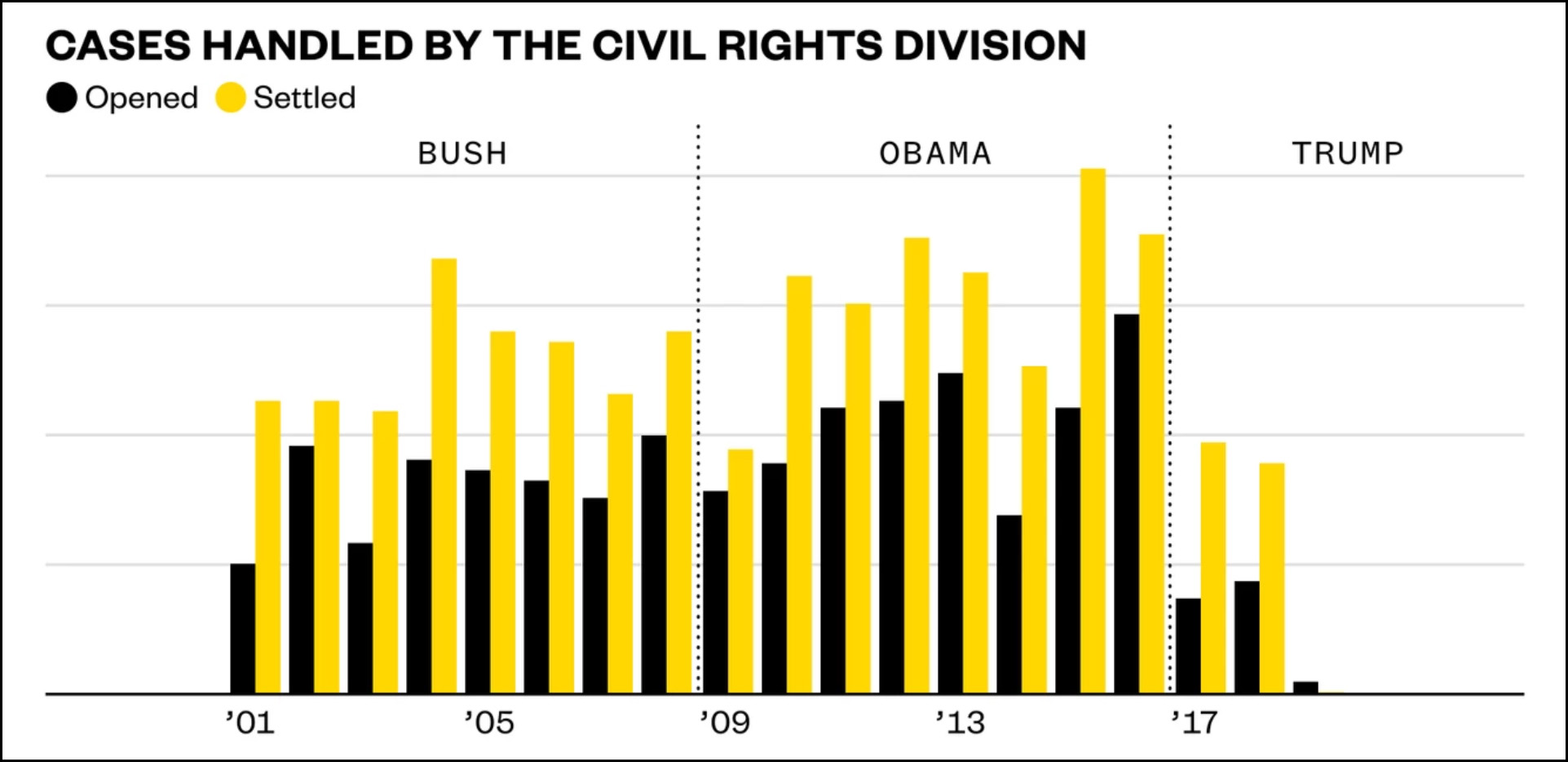
    Normally, I’d say this was a good thing and then move on. But I’m a suspicious person, and my first thought was that this actually seemed fairly non-standard for the Trump administration. Then, by chance, I came across a Vice article today that showed just how non-standard it was:

    The Trump administration sure doesn’t seem very interested in civil rights violations, does it? So why the interest in Stephon Clark? Is it because his shooting happened in California and Trump is interested in stirring up racial controversy in California?

    I don’t know. I’m just asking questions here, OK?

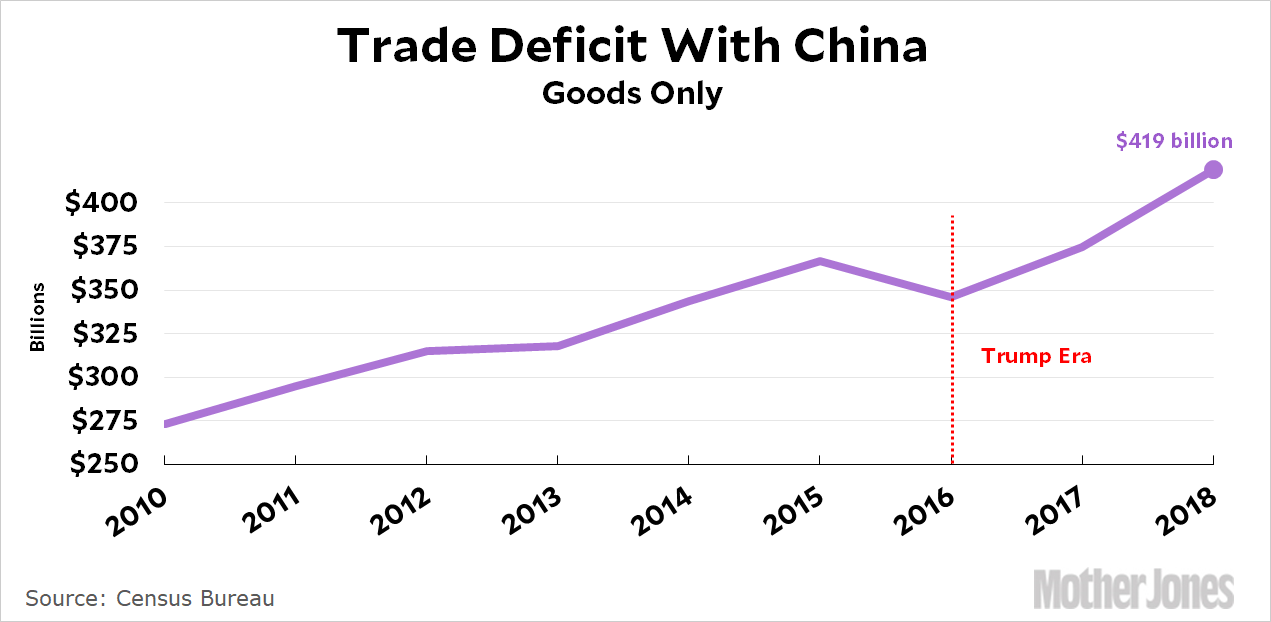
  • Trade Deficit With China Grows 21% Since Obama Era

    Poor Donald. It turns out that throwing racist hissy fits lost him the 2018 election and caused illegal immigration to rise, not fall. Today we learn that throwing xenophobic hissy fits didn’t reduce our trade deficit with China either:

    It’s almost as if policy actually matters, or something. Merely tweeting does not make something so.