The federal budget deficit ballooned rapidly in the first four months of the fiscal year amid falling tax revenue and higher spending, the Treasury Department said Tuesday….The deficit grew 77 percent in the first four months of fiscal year 2019 compared with the same period one year before.
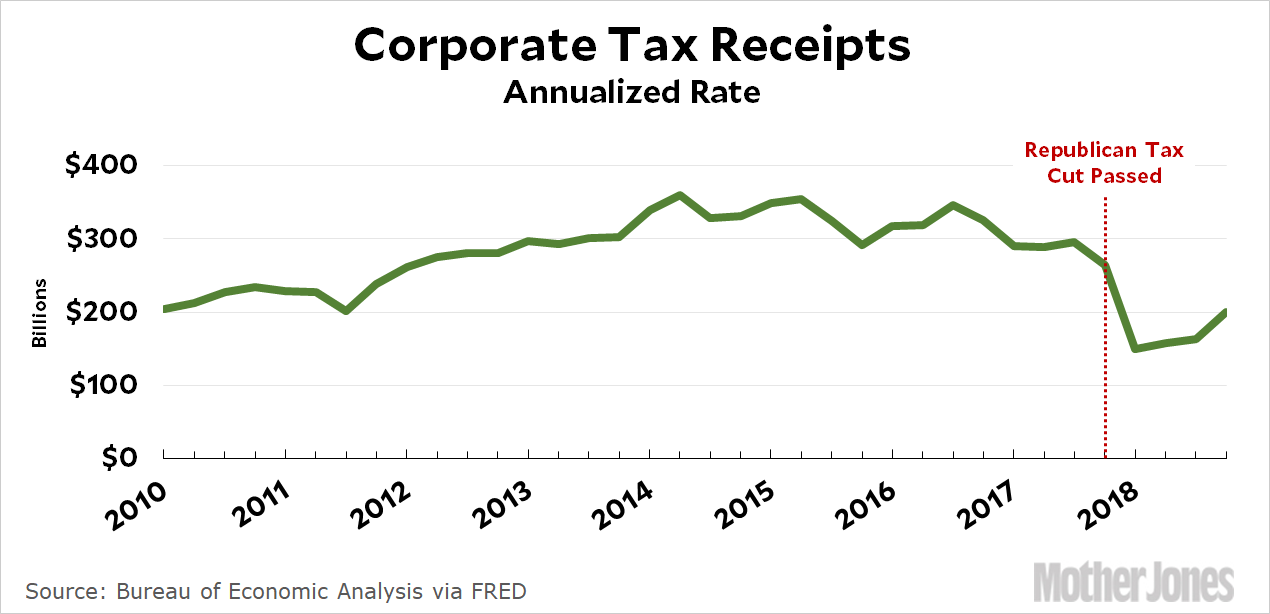
….Lawmakers enacted sweeping tax cuts at the end of 2017, and those changes continue to reduce revenue flowing to the Treasury Department. Tax revenue for October 2018 through January 2019 fell $19 billion, or 2 percent, Treasury said, though there were major reductions in the amount of money collected from businesses. Treasury found corporate tax payments over the first four months of the fiscal year dropped from from $75.5 billion to $58.9 billion, a fall of roughly 22 percent.
Ah, yes, “major reductions” in revenue from corporate taxes. Let’s take a look at that:
Sadly, it looks like those tax cuts didn’t pay for themselves. Yet again. Maybe next time.
In addition to falling revenue, the deficit has increased because of higher military spending and higher Medicare spending. The Medicare thing is sort of unexpected. Maybe I’ll take a closer look at that later today.
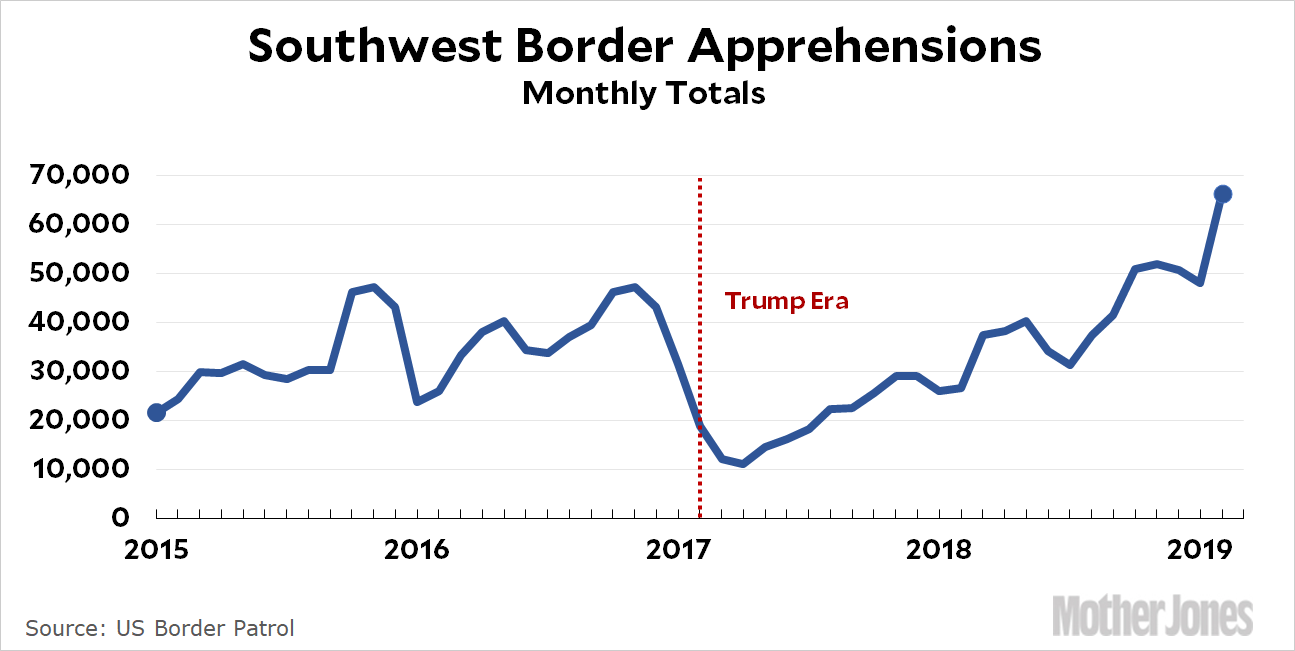
The number of migrants apprehended crossing the border is skyrocketing:
The high number of families crossing the border suggest that President Trump’s policies aimed at deterring asylum seekers are not having their intended effect. Up to 2,000 migrants who traveled in a caravan from Central America last year and faced lengthy delays in Tijuana appeared to have given up their cause as of last month after being discouraged by months of delays at the border. But the families following behind them seem only to have adjusted their routes rather than turn back. Indeed, they are traveling in even larger numbers than before.
Nice work, Donald! Whatever we were doing back in the Obama era seems to have been working OK. Whatever we’re doing now—mostly yelling and screaming, as near as I can tell—isn’t. Maybe it’s time to rethink the whole idea that Trump is the guy who can protect our borders?
In my previous post, I suggested that $5.6 billion was a drop in a bucket compared to total US exports of $1.5 trillion. But is it? Just how much is a drop in a bucket, anyway?
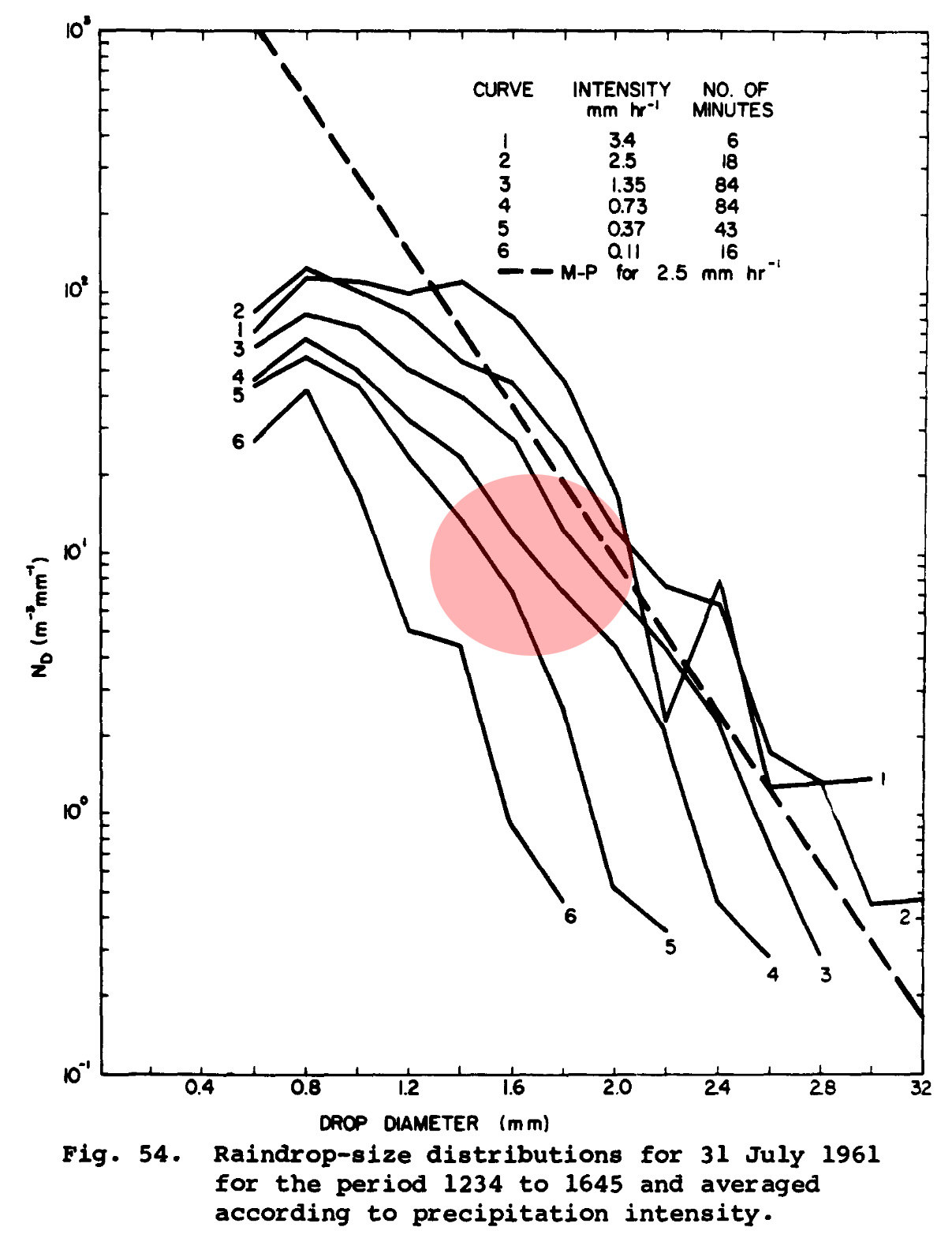
Obviously this depends on the size of the bucket, but that’s the easy part. The hard part is figuring out the size of a drop. Querying the internet produced a surprisingly wide variation of estimates that were seemingly based on nothing at all until I finally found this:
Now that’s what I’m talking about. This is old-school science from some guys at the University of Michigan doing contract work for the Air Force, for whom raindrop size and distribution were presumably important. So they went out to Flagstaff and used their radar gear to measure the average size of raindrops.¹ After 100+ pages of explaining why this is so hard blah blah blah, Figure 54 is their final distribution plot. The red circle is my eyeball guess at the average, which is a raindrop diameter of about 2mm.² That gives us a radius of 1mm and a volume of 4 cubic millimeters. At a million cubic millimeters to the liter, that’s 250,000 drops per liter, or about 1 million drops per gallon. This means that a common 3-gallon bucket holds about 3 million drops.
So a “drop in a bucket” is 1/3,000,000, or about 0.00003 percent.
As for our exports to India, $5.6 billion is 1/300th of $1.5 trillion. That’s 10,000 drops in a bucket. I stand corrected.
¹Note that I am defining “drop” as “raindrop.” Raindrops, it turns out, are quite a bit smaller than, say, a drop from an eyedropper (75,000 per gallon) or a leaky sink (15,000 per gallon)
²Which, I admit, is roughly what the internet was telling me from the start. Still, it’s always good to have hard, typewritten data to back up your Google searches.
UPDATE: Sorry, I got my cubic millimeters mixed up with my cubic centimeters, so my original post was off by a factor of 1000. No big deal between friends, right? It’s all corrected now. Thanks to the many people who pointed this out.
I’ve now read several stories purporting to outline President Trump’s new trade deal with China. All of them point in the same direction: nowhere. Trump will eliminate his tariffs, China will eliminate its retaliatory tariffs, and China will also agree to buy a few billion dollars worth of stuff it wanted anyway (LNG, soybeans, etc.). There will also be some vague movements in the direction of opening China’s economy, but mostly things that were already in progress two years ago before Trump derailed them.
In other words, after two years of huffing and puffing, Trump will get next to nothing. Just like he got next to nothing from Canada and Mexico in the NAFTA negotiations. And just like he’s so far gotten nothing from Europe. But no worries. To distract everyone’s attention from his failures, Trump has a new target: India. Here is the Washington Post:
On Monday, Trump notified Congress that the United States intends to end the preferential treatment for a host of Indian goods that now enter the country duty-free. The changes will not take effect for at least 60 days. In a letter, Trump said India would no longer receive benefits under the Generalized System of Preferences, which was set up to promote trade from developing countries. India is the GSP’s biggest beneficiary and exports about $5.6 billion in goods to the United States under the program, including motor vehicle parts, precious-metal jewelry and insulated cables.
Needless to say, this will go nowhere. Where else can it go? Even if India caves completely and provides the US with $5.6 billion worth of trade concessions in order to regain its GSP status, who cares? We export about $1.5 trillion in goods per year. Adding $5 billion is a drop in a bucket.
Still, it gives Trump some dark-skinned people to act tough about, and that’s what matters.
T-Mobile’s patronage of President Trump’s Washington hotel increased sharply after the announcement of its merger with its Sprint last April, with executives spending about $195,000 at the property since then, the company told congressional Democrats in a letter last month. Before news of the megadeal between rival companies broke on April 29, 2018, the company said, only two top officials from T-Mobile had ever stayed at Trump’s hotel, with one overnight stay each in August 2017.
I’m sure it’s jut a coincidence. All the other hotels were probably booked solid.
I was bored over the weekend and got into a Twitter convo about climate change. We were chatting, of course, about the Green New Deal, and the basic arguments in its favor were:
It was only meant to be an outline, so don’t blast it for only being an outline. Details will come later if I’m just patient.
The details don’t matter all that much anyway. There are lots and lots of ways of getting to our goals.
Things are different now. It really has a chance of getting enacted.
I don’t think the evidence backs up any of this:
Only an outline? Come on. We’ve seen this movie before. There’s nothing in the GND that we haven’t reckoned with dozens of times in the past 20 years of climate change discourse. We all know the goals we need to meet to prevent planetary suicide, and we all know the buzzwords. The GND is just the same old, same old. Some of the faces are new, but that’s all.
Details? It’s true that the deep details don’t matter too much. But the medium-level details do, because that’s where you make it clear what price you’re asking people to pay. It’s where you lose the coal state senators and the bird lovers and the unions. Without any details, the GND is just pablum designed to make us feel good even though it hasn’t the slightest chance of ever being enacted.
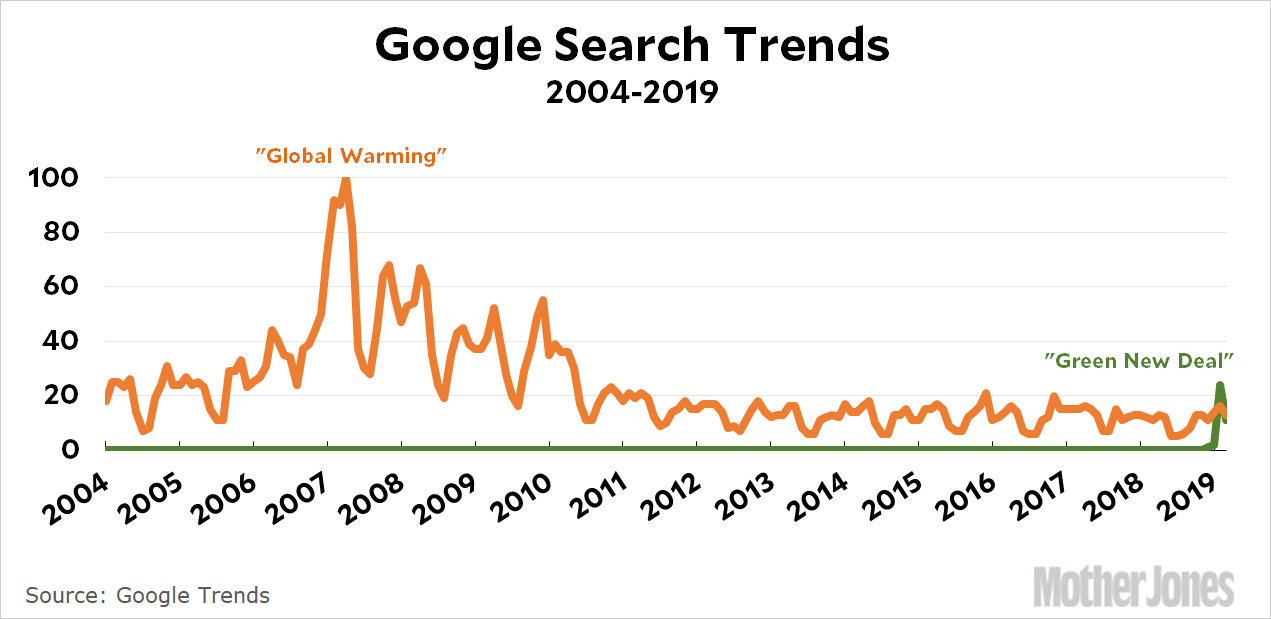
Things are different now? No, they aren’t. Polls show that even among liberals climate change is not a big concern. And as David Roberts points out in a tweet from Will Kubzansky, a simple look at Google Trends demonstrates that interest in the GND today is far lower than interest in global warming in the mid-aughts, back when Al Gore was touring the country promoting An Inconvenient Truth. That didn’t lead anywhere, and it’s unlikely that GND can do better.
It’s naive to think that things are different today and it’s naive to think that the GND will fare better than any other climate plan once the details get hashed out. Just look at what happened when AOC “accidentally” released an FAQ about the Green New Deal that went only barely further than the GND itself. She pulled it back so fast you could almost see the scorch marks.
Which brings us to my headline question: What does it mean to think radically? Is it something like the GND, which is indeed huge and all-encompassing, but also vague and timeworn? Is it radical just because of its size, even if it contains nothing new and has no chance of enactment?
I don’t think so. For 20 years we’ve tried to scare the public into adopting big climate plans that require real sacrifice, and for 20 years we’ve failed. We’ve made absolutely no progress worth talking about with this approach. So maybe a more focused plan of attack is the truly radical one.
This is why I’ve suggested that we should focus solely on selling a gigantic R&D program. It requires little or no sacrifice from voters and doesn’t violate any of the usual conservative shibboleths. It might actually be something we could pass.
But if I’m promoting the idea of spending lots of money on R&D, why not also spend lots of money on subsidies for green infrastructure? As it happens, I think that’s a fine idea. However, it’s worth remembering that global warming is global, and big subsidies affect only US emissions of greenhouse gases. The problem with this is that you could cover the United States with a dome and blast it into space…
…and it would only change the dates for planetary suicide by a decade or so. It’s nowhere near enough even if we do it. Whatever plan we come up with needs to be something that has at least a chance of affecting the entire world. New technology might do that. Subsidies targeted at Americans won’t.
The hard part of all this is that the big, comprehensive climate plan has been the centerpiece of climate change thinking forever. And that makes sense: it’s a big problem that, ideally, requires a big solution. But what if that big solution simply isn’t feasible? What if it requires more personal sacrifice than human beings have ever shown a willingness to make? What if we’ve been pushing it forever and it’s gained no traction worth mentioning? What if the rest of the world is an even bigger problem than the US?
Then the odds are strong that the big, comprehensive, America-centric program simply won’t work—not within the next two or three decades anyway, which is the timescale we’re talking about.
But it’s so appealing. It’s what climate hawks have been attached to for years and years. Dammit, it’s what we need! This is an emergency!
But it won’t work. And so I ask: Is this an emergency? If it is, then act like it. Don’t just roll out a revised version of the same thing that’s failed utterly for decades. It doesn’t matter how much you love it. If this is an emergency, then you need to be willing to think. You need to think about what might actually work, even if it’s not the big, comprehensive plan you love so much.
Think! What can we do that might actually work? What kinds of things might ordinary people actually support? What sort of plan might affect the whole world, not just one country? Knock the cobwebs out of your brain and think!
My idea might be wrong. So come up with your own. But be radical. Really radical. Accept what the real world tells you, even if it means having to wrench your mind out of its well-worn grooves. Then let’s get to work.
If we were all Republicans around here, we wouldn’t bother asking “How are you going to pay for Medicare for All?” We’d just stand up with our shoulders square and give a straight answer: “That’s a problem for Congress and I don’t want to prejudge what they might want to do.” And that would be that.
But we are not Republicans, so this is a topic of great interest. We demand that our politicians and think tanks provide concrete answers that our opponents can seize on to make sure nothing ever gets done. And so Matt Bruenig obliges us:
My idea is to completely overhaul the whole payroll tax system in the US. The United States has three payroll taxes. Social Security, Medicare, and unemployment benefits. The way they work is unemployment insurance applies to people to the first $7,000 of earnings. Social Security applies to the first $125,000. Then Medicare applies to all earnings, plus you have the additional Medicare tax that pops in above $200,000.
It is a regressive structure….So let’s squeeze all of those into flat taxes….Knock that down to less than 1 percent on all earnings…..That then opens up a lot of space in the low to mid-earners to apply a higher Medicare tax without there being a net tax increase. Because their unemployment tax has gone down substantially. Their Social Security tax has gone down substantially. Then you can do a flat Medicare tax and the net effect is it’s all falling on people making more than $100,000 a year.
I have no beef with Matt B. We liberals demand this, so he’s put some thought into it and come up with a funding plan. Would it work? I suppose so. Would it piss off everyone who makes more than $100,000 per year? Oh yes. Would it pass? Not a chance.
But this makes me curious about something. I’m sure that what I have to say isn’t new, but for some reason I’ve never come across it. Here it is: Fund M4A by taxing corporations.¹
The idea behind this is twofold. First off, you’re always better off if you don’t create new taxes on people. To the extent you can, a program is more politically palatable if it keeps the revenue streams that are already in place.
Second, taxing corporations is relatively invisible. Sure, economists will tell you that most of the tax eventually falls on individuals, but most people won’t realize it. This leaves Republicans trying to generate outrage among voters for a tax they’ll never have to pay directly. Good luck with that.
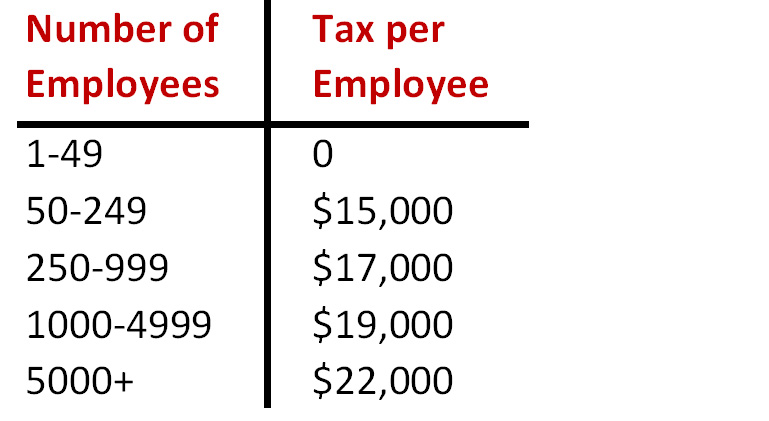
Now, the current revenue stream for private health care primarily consists of the premiums paid by corporations to provide coverage for their employees. To the best of our ability, then, we want to tax corporations so they’ll come out even: that is, their tax burden will go up but they’ll no longer have to pay health premiums. If this is a wash, then even opposition from corporations will be fairly muted. So why not levy a per-employee tax that rises moderately with the size of the corporation? For example:
This would work just like income tax: you’d pay the higher rate only on the employees above each cutoff. So if you had 50 employees, you’d pay $0 for the first 49 and $15,000 for the one employee above that.
This is far from the perfect funding mechanism if we were starting from scratch. But inertia is a bitch. You have to work with what you have, not what you wish you had.
Would this work? Or would a progressive structure provide too big an incentive for corporations to fudge their employee count? I figure there must be some kind of problem here, since it’s such an obvious funding structure. Does anyone know?
¹This would, obviously, be in addition to all the current funding streams that are already public: Medicare, Medicaid, Obamacare, etc.
This is a boy on a hill. It looks kind of mysterious, but it’s actually just a kid at a small public park who’s turning around because his father is telling him it’s time to leave. SPOILER ALERT: He didn’t want to.
My fellow neoliberal shill Brad DeLong has declared that it’s time for us to pass the baton to “our colleagues on the left.” As it happens, I agree with him in practice because I think it’s time for boomers to retire and turn over the reins to Xers and Millennials, who are generally somewhat to the left of us oldsters. Beyond that, though, there’s less here than meets the eye. DeLong says there are three reasons he thinks neoliberals should fade into the background:
Political: The original guiding spirit of American neoliberalism was the idea that Democrats had moved too far to the left and gotten punished for it with the election of Ronald Reagan. For years, neoliberals believed that if the party could be moved toward the center, it would be possible to make deals with Republicans that would lead to better governance. Needless to say, that didn’t work: Republicans, it turned out, were simply emboldened to move even further to the right. They showed absolutely no intention of compromising in any way with Democrats.
But this is old news. Charlie Peters, the godfather of political neoliberalism, conceded it publicly long ago. For at least the past decade, there’s been no reason at all to believe that the current Republican Party would ever compromise with Democrats no matter how moderate their proposals. Anyone who has believed this since George W. Bush was president was deluding themselves. Anyone who has believed it since 2009, when Obamacare was being negotiated, is an idiot. There’s nothing about this that separates neoliberals from anyone else these days.
Policy: DeLong suggests that the folks to his left are basically just social democrats like him who “could use a little more education about what is likely to work and what is not.” But with the unfortunate exception of its jihad against organized labor, neoliberals have been social democrats from the start. Bill Clinton tried to pass universal health care, after all, and I think Barack Obama would have done the same if he’d thought there was any chance of passing it.
So this is nothing new either. The question is, does DeLong intend to go along in areas where his neoliberal ideas are in conflict with the AOC wing of the Democratic Party? He plainly does not.
The world has changed: “We learned more about the world. I could be confident in 2005 that [recession] stabilization should be the responsibility of the Federal Reserve. That you look at something like laser-eye surgery or rapid technological progress in hearing aids, you can kind of think that keeping a market in the most innovative parts of health care would be a good thing. So something like an insurance-plus-exchange system would be a good thing to have in America as a whole. It’s much harder to believe in those things now.”
But has the world really changed? I don’t think so—not yet, anyway. I’ll bet DeLong still believes in these two things, but now understands that Republicans will undermine them at every opportunity. That makes it Job 1 to destroy the current incarnation of the GOP, and the best way to do that is to have unity on the left. But if and when that’s been accomplished, I’ll bet he still thinks the Fed should be primarily in charge of fighting recessions. We just need FOMC members who agree.
At the risk of overanalyzing this, I think DeLong is still a neoliberal and has no intention of sitting back and letting progressives run wild. He has simply changed the target of his coalition building. Instead of compromising to bring in Republicans, he wants to compromise to bring in lefties. Now, this is not nothing: instead of compromising to the right, he now wants to compromise to the left. But I suspect that this simply means DeLong has moved to the left over the past couple of decades, just like lots of liberals.
And this once again circles around to just how progressive mainstream neoliberals are. That is, how progressive are they now, not in 1992. And the answer, I think, is pretty damn progressive. Take a look at what folks like DeLong and Paul Krugman were writing in 2009 during the Great Recession. They wanted a bigger stimulus. They wanted the Fed to support a higher inflation target. They supported cap-and-trade. They supported universal health care but plugged loyally for Obamacare because it was obvious that it was the most they could hope for from the current political system. They wanted to (temporarily) nationalize banks. Etc. There’s not a whole lot of sunlight between neolibs circa 2009 and today’s progressives.
In fact, if there’s a place where I think they (we) have really changed, it may be in our attitude toward the original social democrats in Europe. For many of us, becoming more like Europe was once a goal. But today Britain is moving toward Brexit. Germany has dictated a destructive monetary and fiscal policy for the entire continent. The Nordic countries have moved right and are now basically neoliberal states. The European South—Spain, Italy, Greece—is on life support. Aside from envying their social safety net policies, which were put in place long ago and are now just hanging on via inertia, there is little to look for in Europe. If we want to pave a new political way in America, we’re on our own.
Can you pitch in a few bucks to help fund Mother Jones' investigative journalism? We're a nonprofit (so it's tax-deductible), and reader support makes up about two-thirds of our budget.
We noticed you have an ad blocker on. Can you pitch in a few bucks to help fund Mother Jones' investigative journalism?
We’re halfway there, but time’s running out.
With only days left in 2025, we've made real progress toward our $400,000 goal—the funding we need to keep our nonprofit newsroom running at full
strength. But to close the remaining $200,000 gap before December 31, it will take a huge surge in reader support. Whether you've given before or this is your first time, your contribution right now will matter. Will you help us get there?
We’re halfway there, but time’s running out.
With only days left in 2025, we've made real progress toward our $400,000 goal—the funding we need to keep our nonprofit newsroom running at full
strength. But to close the remaining $200,000 gap before December 31, it will take a huge surge in reader support. Whether you've given before or this is your first time, your contribution right now will matter. Will you help us get there?