“You don’t need 2,000 miles of wall because you have a lot of natural barriers,” Trump said to reporters on Air Force 1 during his flight to Paris. “You have mountains. You have some rivers that are violent and vicious. You have some areas that are so far away that you don’t really have people crossing. So you don’t need that.”
“You’ll need anywhere from 700 to 900 miles,” he said.
Two years ago, Trump said he would build a 2,000-mile wall. A year ago, he said “natural barriers” reduced the needed length to 1,000 miles. Now it’s 700-900 miles.
As it happens, we already have about 700 miles of border fencing, so Trump is suggesting that we really don’t need much more than what’s already in place. In fact, maybe we just need to upgrade our current fencing. Nobody who actually patrols the border wants a wall, after all, because you can’t see though it. They want double-layer fencing. So maybe we’ll get a couple hundred miles of that, and leave the rest the way it is.
Promise made, promise kept. Unless you actually care about the border wall, that is, in which case you’ll finally realize just how badly you got conned. Join the crowd.
Last month, OMB chief Mick Mulvaney was griping about the CBO. This seemed kind of pointless, since the CBO exists and it obviously isn’t going anywhere in the short term. So why bother? My guess was that Mulvaney was just preparing the ground for a flank attack on the CBO’s tendency to produce inconvenient estimates:
It turns out that the Senate Budget Committee isn’t actually required to use CBO estimates. They always have in the past, but that’s a custom, not a rule. They have the authority to make their own estimates, and all it takes to make them stick is a majority vote in the committee.
Mulvaney is basically trying to start up a campaign to put some spine into the SBC’s Republican members to ignore the CBO and simply score the tax bill using a model that will pronounce it deficit-neutral. That’s what this is all about.
As happens so often, I was a little too timid. This was the point of Mulvaney’s public complaints, but Republicans aren’t waiting for the tax bill to make up their own scores. It looks like they plan to do it right now:
John Thune says the Cruz amendment might not get a CBO score before the motion to proceed vote. Might just ask HHS to give their own score.
And there you have it. Just ask some friends at HHS to make up a score, have the committee chair bless it, and off we go.
Is the score anywhere close to reality? Maybe. Maybe not. Does it really matter anyway? In the long run, the heat death of the universe will get us all one way or another.
This is one of the oldest photos in my collection that I haven’t yet published. I think I decided I didn’t really like it all that much. But there is a story that goes with it.
I was hanging around at the local mall, waiting for the sun to go down and casting around for something to do in the meantime. So I stuck the camera on the lip of a fountain and took some shots with a long shutter time, which produces that soft, blurry look from running water. This one used a shutter time of 1 second, but I wanted to try something even longer.
I couldn’t. My camera flatly wouldn’t let me set anything longer than 1 second no matter what I tried. When I got home I tried again to figure out what was going on. No luck. Then I started paging through the manual. But what should I even look for? I paged and paged and paged and found nothing.
The next day I tried again, and finally I cracked it. It turns out that the previous day I had put the camera in silent mode, which turns off the fake shutter-click noise. But in silent mode, the longest allowable shutter speed is 1 second. WTF? What’s the reason for this? And how would anyone figure it out? It took me a good half hour searching through the PDF of the manual before I finally found a little footnote about it. And I still have no idea why Panasonic did this. Is it a “safety” feature, so you know when the exposure is finished? Beats me. Anyone have a better suggestion?
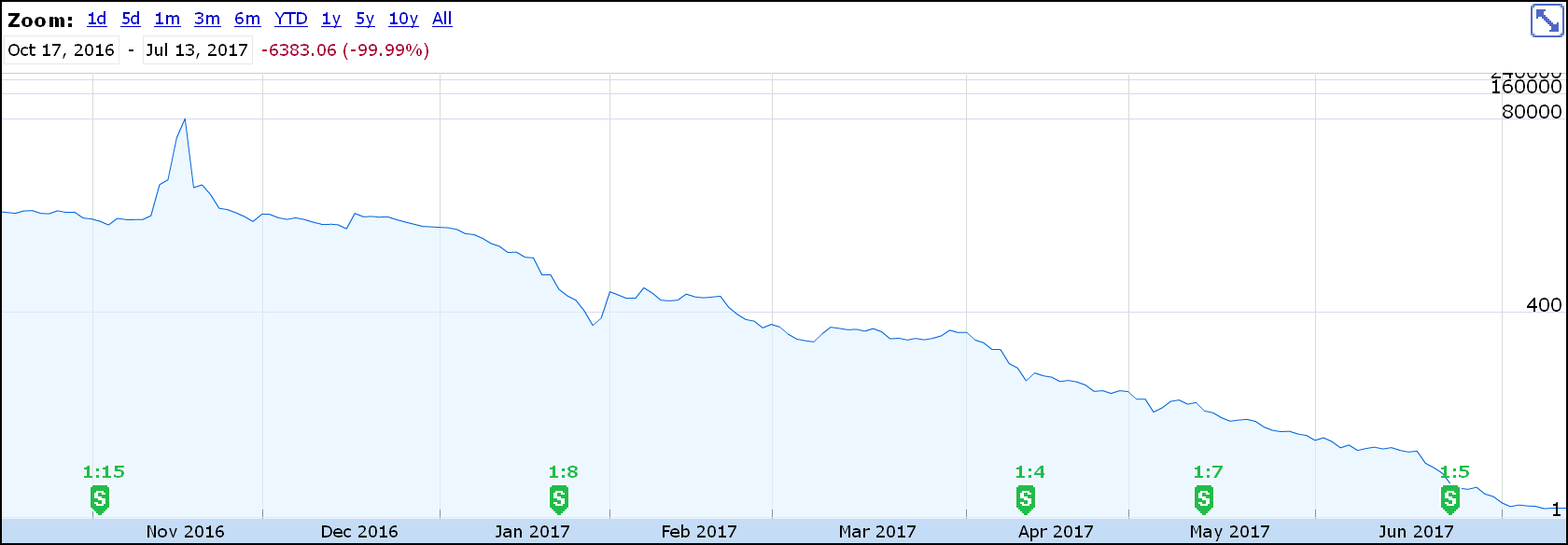
Investors who bought DryShips shares last fall and held on have lost almost all of their money. A $10,000 investment in DryShips stock at the beginning of November was worth $167,000 two weeks later, during the brief price spike, but only about $2 today.
For DryShips, however, the cash that poured in from Kalani for new shares put the shipper on a strong financial footing. Its net assets have soared. It has used the money from Kalani to roughly double the size of its fleet to about 36.
This whole story is bizarre and difficult to summarize. Basically, over the past few months DryShips has sold vast amounts of newly created stock at a discount price to Kalani Investments, a British Virgin Islands company that immediately resold it at the market price, thus making a profit. Meanwhile, the money they paid to DryShips for the stock helped the company expand.
Here’s what happened. Back in October, Dryships had about 10 million shares outstanding. Since then, they’ve executed reverse-splits that total up to a factor of 16,800:1. So if you owned 100,000 shares back then, today you own about six. By itself this doesn’t affect the value of the stock, but DryShips has issued such a gargantuan amount of new stock since October that it currently has 26 million shares outstanding—the equivalent of 450 billion pre-split shares. Your old 100,000 shares represented about 1 percent of the company. Your six shares today represent 0.00002 percent of the company. The effect of this massive dilution on long-term investors is obvious:
Ingmar Bueb, a 48-year-old opera singer, invested $220,000 in DryShips over the years, the bulk of his nest egg. The High Bridge, N.J., resident had hoped to use the profits from this long-term holding to build a small opera house, he said.
Already nursing losses by early November of last year, Mr. Bueb noticed the sudden price surge. “I went to the cafe to sell it, but then it was halted and crashed,” he said. He didn’t look again until he was doing his taxes this year and was shocked to discover that, because of the many reverse stock splits, he then owned only two shares. The investment now is worth less than $1.
Nobody knows how this happened. Not legally, anyway. One way or another, though, DryShips made money. Kalani made money. But all of this tanked the stock price by a fantastic amount. In some way that no one can figure out, shareholder value was legally wiped out and transformed into assets for DryShips and profits for Kalani. Nor can anyone figure out why the stock suddenly spiked 1,500 percent right after Election Day.
There’s got to be someone out there who’s smart enough to figure out how this happened. After all, someone was smart enough to create this scam in the first place.
National Review Institute is launching the Center for Unalienable Rights, created to be the home of free-speech warrior David French, whose new podcast, The Liberty Files, is a must-listen for anyone who cares deeply about combating the leftist assault on the First Amendment, whether on our campuses or in any other place patrolled by the ruthless Thought Police.
….The Left wants to gag, marginalize, intimidate, shut up, and, if they can, even criminalize conservatives for what we think and what we say. We intend to fight the intolligentsia, in a more focused way. We intend to beat the determined enemies of our unalienable rights. Help us prevail.
You are expecting me to mock this, aren’t you? But I’m not! Instead I have a serious suggestion.
Believe it or not, there are plenty of liberals who are concerned about this stuff too. The safe spaces/microaggressions/heckler’s veto/trigger warnings movement is not entirely beloved on the left. If this project were toned down and aimed at free speech repression on both sides, it might actually attract some bipartisan support.
I know that’s not really plausible these days. I just felt like mentioning it.
Mitch McConnell is circulating another health care bill today, and it’s like a game of whack-a-mole. The original bill would de-insure millions of people, so the new one puts a bunch of patches in place. But those patches cause obvious problems, so there are patches for the patches. It’s a purely political exercise in vote-getting that has no connection to actual health care. Good luck to the CBO trying to score this Rube Goldberg contraption.
The Senate GOP’s push to rewrite the Affordable Care Act suffered an ill-timed setback Thursday, as two centrist Republicans announced plans to offer their own health-care plan just as leaders released an updated bill of their own….In a joint interview with CNN on Thursday, Cassidy and Graham said that they would take the billions of dollars the federal government now receives in taxes under the ACA and direct that revenue to the states.
….“Our problem has been trying to combine tax reform with replacement of Obamacare,” Cassidy said. “We’re giving the money back to the states. The states can do what they want to do. A blue state can do a blue thing; a red state can do a red thing.”
Federal dollars currently spent on Obamacare health insurance — an estimated $110 billion in 2016 — would be block-granted to the states.
The individual mandate and employer mandate instituted under Obamacare would be repealed under Senate reconciliation rules which only require 50 votes.
The Obamacare requirements covering pre-existing conditions would be retained.
The Obamacare medical device tax would be eliminated but other Obamacare taxes would remain in place.
Federal Medicaid funding to the states will continue to grow in a sustainable manner, adjusted for inflation….
Federal funds would be restricted to health care spending only. These funds could be distributed by the states in the forms of tax credits, subsidies, health savings account premiums, and other means as the individual states see fit to meet their health care needs.
This should go over well with the insurance industry. They will be required to insure everyone at the same price, but they have no idea what rules will be in place to ensure against a death spiral. That’s genius.
By the way, there are lots of other Obamacare rules and regulations that can’t be repealed without 60 votes, so you have to account for how that’s going to play out too. CBO is really going to tear its hair out over this brainstorm from Graham and Cassidy.
For a party that prides itself on paying attention to economics, unlike those spendthrift Democrats who think the law of supply and demand is just a suggestion, Republicans sure don’t want to pay attention to basic health economics. This stuff isn’t rocket science, either. Sure, the details are tricky, but the basics are pretty easy to follow. As near as I can tell, though, Republicans just don’t want to follow them. Why? I suppose because Obamacare mostly does follow them, so that makes them bad. Or something.
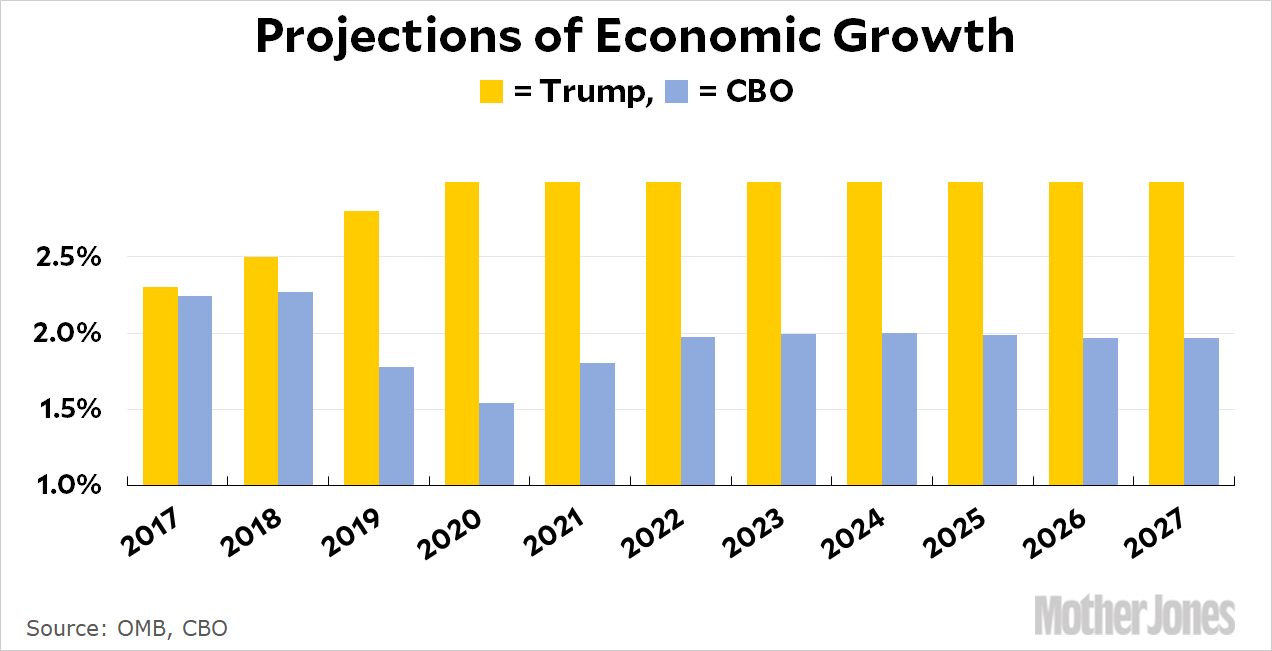
Donald Trump thinks that slashing spending will reduce the federal deficit. Fair enough. It will. But would his proposed cuts reduce the deficit by $10 trillion over the next decade? CBO thinks he’s off by several trillion dollars. Here’s why:
Trump believes that his cuts would supercharge the economy and get it to 3 percent annual growth. CBO, which is required to be reality-based, figures his cuts would increase growth by about 0.1 percent. That puts long-term growth at 2 percent per year.
Of course, CBO isn’t taking into account the effect of Trump’s massive tax cuts for the rich. That’s because they don’t exist. Trump himself, however, is under no such constraints, and his budget simply assumes the tax cuts will happen and the results will be spectacular. When you can say anything you want, that’s the kind of fantasy you come up with.
Over at the Washington Post, Paige Winfield Cunningham writes about the united effort of doctors’ groups to oppose Trumpcare:
They don’t think the present law is perfect by any means, but they’re deeply worried about the Senate health-care bill’s deep Medicaid cuts — that is, what that would mean for the ability of low-income families to receive care — and how the bill provides a pathway for states to opt out of its mandatory essential health benefits.
….[The lobbyists] said they didn’t meet with McConnell or anybody on his leadership team — which has been holding their own heart-to-hearts with moderate senators, trying to convince them to vote for the bill even with the Medicaid cuts intact. Here’s what McConnell has told several hesitant senators (including Portman and Sen. Shelley Moore Capito (R-W.Va.): The bill’s deepest Medicaid cuts are far into the future, and they’ll never go into effect anyway.
“He’s trying to sell the pragmatists like Portman, like Capito on ‘the CPI-U will never happen,’ ” a GOP lobbyist and former Hill staffer told me.
Vote for our bill because it will never really go into effect anyway. I’m sold! Where do I sign up?
It’s worth noting that even if McConnell is right, that doesn’t change anybody’s reelection calculus for 2018. They can hardly campaign on the proposition that all the bad stuff in the bill they voted for will probably never happen. Versions of ads showing Republicans pushing granny off a cliff are going to be on television 24/7 regardless.
The GOP’s best bet at this point is to let health care go and move on to tax cuts. They all agree about tax cuts, don’t they?
Let’s end the day with something more edifying than the Trump White House. Here is Jupiter’s Great Red Spot, as captured by NASA’s Juno spacecraft. Image processing was done by Roman Tkachenko, with some additional putzing around by me. Click here if you want to play around yourself.
UPDATE: Sorry, it’s Cassini that’s about to dive into Saturn and disappear forever. Juno will be around for a long time to come. I’ve corrected the text to remove the fake news that Juno was near the end of its mission and was about to dive into Jupiter.
And we respect that! But maybe you’re of a mind to support our work directly instead? We have until December 31 to raise the last $400,000 we need to keep our nonprofit newsroom running at full strength into 2026. Will you make a gift today?
We noticed you have an ad blocker on. Can you pitch in a few bucks to help fund Mother Jones' investigative journalism?
We’re halfway there, but time’s running out.
With only days left in 2025, we've made real progress toward our $400,000 goal—the funding we need to keep our nonprofit newsroom running at full
strength. But to close the remaining $200,000 gap before December 31, it will take a huge surge in reader support. Whether you've given before or this is your first time, your contribution right now will matter. Will you help us get there?
We’re halfway there, but time’s running out.
With only days left in 2025, we've made real progress toward our $400,000 goal—the funding we need to keep our nonprofit newsroom running at full
strength. But to close the remaining $200,000 gap before December 31, it will take a huge surge in reader support. Whether you've given before or this is your first time, your contribution right now will matter. Will you help us get there?