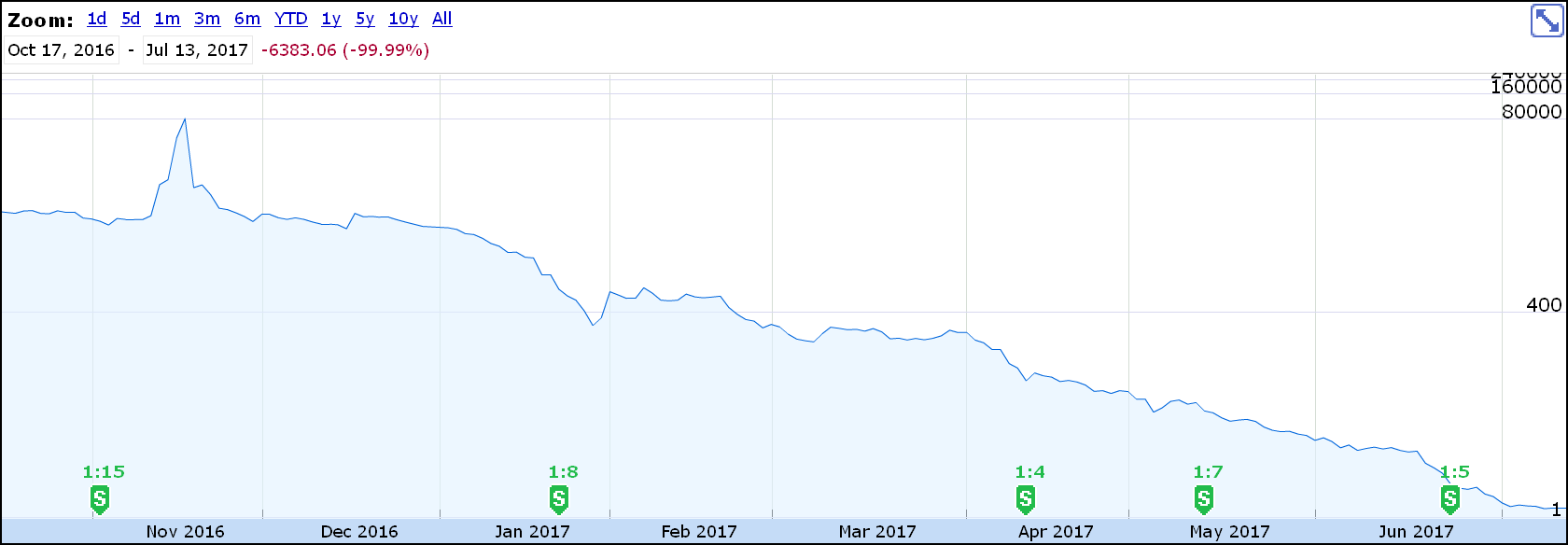
Investors who bought DryShips shares last fall and held on have lost almost all of their money. A $10,000 investment in DryShips stock at the beginning of November was worth $167,000 two weeks later, during the brief price spike, but only about $2 today.
For DryShips, however, the cash that poured in from Kalani for new shares put the shipper on a strong financial footing. Its net assets have soared. It has used the money from Kalani to roughly double the size of its fleet to about 36.
This whole story is bizarre and difficult to summarize. Basically, over the past few months DryShips has sold vast amounts of newly created stock at a discount price to Kalani Investments, a British Virgin Islands company that immediately resold it at the market price, thus making a profit. Meanwhile, the money they paid to DryShips for the stock helped the company expand.
Here’s what happened. Back in October, Dryships had about 10 million shares outstanding. Since then, they’ve executed reverse-splits that total up to a factor of 16,800:1. So if you owned 100,000 shares back then, today you own about six. By itself this doesn’t affect the value of the stock, but DryShips has issued such a gargantuan amount of new stock since October that it currently has 26 million shares outstanding—the equivalent of 450 billion pre-split shares. Your old 100,000 shares represented about 1 percent of the company. Your six shares today represent 0.00002 percent of the company. The effect of this massive dilution on long-term investors is obvious:
Ingmar Bueb, a 48-year-old opera singer, invested $220,000 in DryShips over the years, the bulk of his nest egg. The High Bridge, N.J., resident had hoped to use the profits from this long-term holding to build a small opera house, he said.
Already nursing losses by early November of last year, Mr. Bueb noticed the sudden price surge. “I went to the cafe to sell it, but then it was halted and crashed,” he said. He didn’t look again until he was doing his taxes this year and was shocked to discover that, because of the many reverse stock splits, he then owned only two shares. The investment now is worth less than $1.
Nobody knows how this happened. Not legally, anyway. One way or another, though, DryShips made money. Kalani made money. But all of this tanked the stock price by a fantastic amount. In some way that no one can figure out, shareholder value was legally wiped out and transformed into assets for DryShips and profits for Kalani. Nor can anyone figure out why the stock suddenly spiked 1,500 percent right after Election Day.
There’s got to be someone out there who’s smart enough to figure out how this happened. After all, someone was smart enough to create this scam in the first place.
And we respect that! But maybe you’d consider supporting our work directly? Help fund more journalism that seeks the truth and holds power to account. We can’t do it without you.
We noticed you have an ad blocker on. Can you pitch in a few bucks to help fund Mother Jones' investigative journalism?
Expect nothing but the truth.
Independent news is in trouble. Those in power want to silence the truth and spoonfeed you their own twisted narrative. We’re fighting back with journalism that dives deep and asks hard questions, never settling for anything less than the full story.
We can only do this work because we’re funded by readers—there are no media moguls lurking behind the scenes here. We’re fiercely independent and funded by readers just like you. Help us keep getting the truth out. Support investigative journalism today.