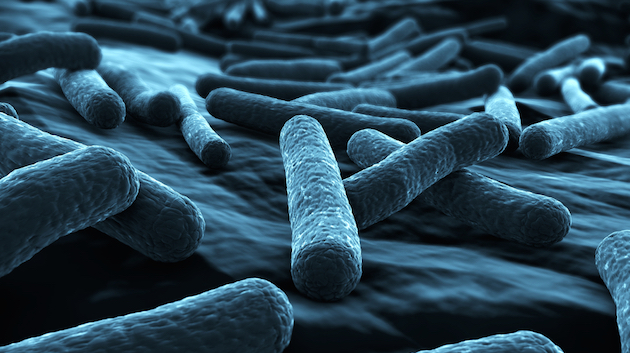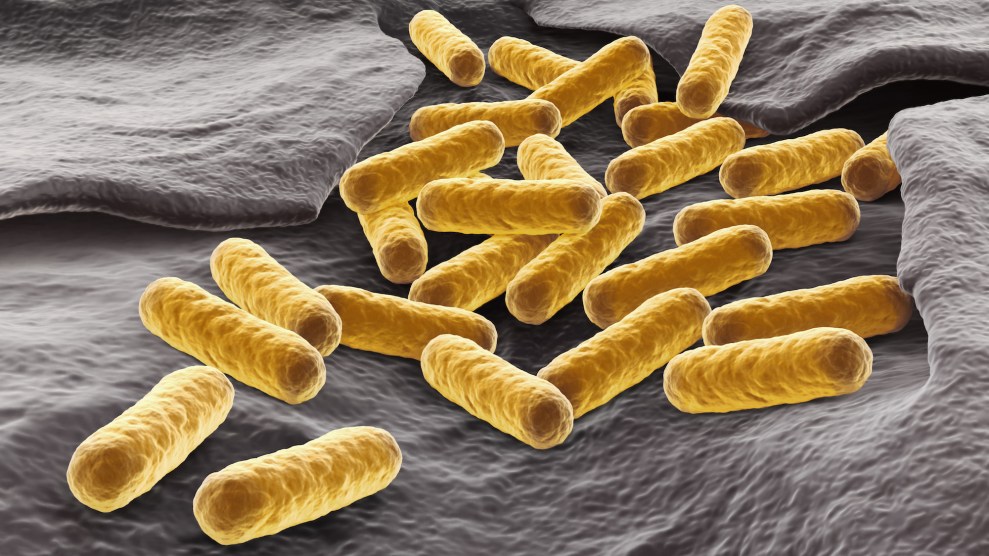
<a href="http://www.shutterstock.com/pic-133011737/stock-photo-e-coli-bacterial-colony-d-render.html?src=IVXyitXGU6TQJUhpr6siFg-1-5">martynowi.cz</a>/Shutterstock
Late last year, a team of of Chinese and UK researchers shocked the global public health world when they identified a strand of E. coli circulating among Chinese pigs that had developed resistance to colistin, a “last resort” antibiotic that’s used only to treat pathogens that can resist other antibiotics. Worse still, they found, the gene that allowed the E. coli to withstand the potent drug can easily jump to other bacterial species—including nasties like salmonella—and is “likely” to go global. The researchers didn’t mince words: “All the key players are now in place to make the post-antibiotic world a reality,” one of them told the BBC.
So, uh-oh: Researchers at the Walter Reed National Military Medical Center in Maryland have just found colistin-resistant E. coli in a person here in the United States. In response to the bad news from China, the Walter Reed crew had just begun in early May to screen all the E. coli samples that came through the facility’s medical-testing lab for the presence of that highly mobile colistin-resistant gene. It didn’t take them long to find a positive test, which they reported Thursday in the journal Antimicrobial Agents and Chemotherapy. The discovery “heralds the emergence of truly pan-drug resistant bacteria,” they wrote.
The sample came from E. coli found in a urine sample from a 49-year-old Pennsylvania woman “with symptoms indicative of” a urinary-tract infection, they reported. There’s no information on how she picked up the bacteria, but she “reported no travel history within the prior five months,” the researchers wrote.
The incident marks the first known US case of colistin-resistant bacteria in a person. The US Department of Agriculture recently reported finding it in a pig intestine. As predicted, the resistant gene, known as mcr-1, has spread rapidly across the globe. Here’s the US Department of Agriculture:
Following the revelation in China, scientists across the globe began searching for other bacteria containing the mcr-1 gene, and the bacteria have since been discovered in Europe and Canada. The mcr-1 gene exists on a plasmid, a small piece of DNA that is not a part of a bacterium’s chromosome. Plasmids are capable of moving from one bacterium to another, spreading antibiotic resistance between bacterial species.
So far, the Pennsylvania patient’s sample is the only one that has turned up positive for mcr-1, the Walter Reed researchers wrote. “However, as testing has only been ongoing for 3 weeks, it remains unclear what true prevalence of mcr-1 is in the population,” they added.
The Washington Post has more here. And make sure to check out my recent deep-dive into the long history of antibiotic use in US meat production and its connection to the unraveling of antibiotics as a tool for fighting human infections.