President Donald Trump Tuesday criticized rapidly mounting global condemnation of Saudi Arabia over the mystery of missing journalist Jamal Khashoggi, warning of a rush to judgment and echoing the Saudis’ request for patience….“I think we have to find out what happened first,” Trump said. “Here we go again with, you know, you’re guilty until proven innocent. I don’t like that. We just went through that with Justice Kavanaugh and he was innocent all the way as far as I’m concerned.”
….Also Tuesday, Secretary of State Mike Pompeo met with the king and crown prince in Riyadh and said the Saudis had already started a “serious and credible investigation” and seemed to suggest it could lead to people within the kingdom. The secretary of state noted that the Saudi leaders, while denying knowledge of anything that occurred inside the consulate, had committed to accountability “including for Saudi Arabia’s senior leaders or senior officials.”
I guess we’re all going to pretend to go along with this? And when the Saudis figure out which poor schmoes they’re going to haul in front of the cameras to take the blame, then we all breathe a sigh of relief that justice has been done?
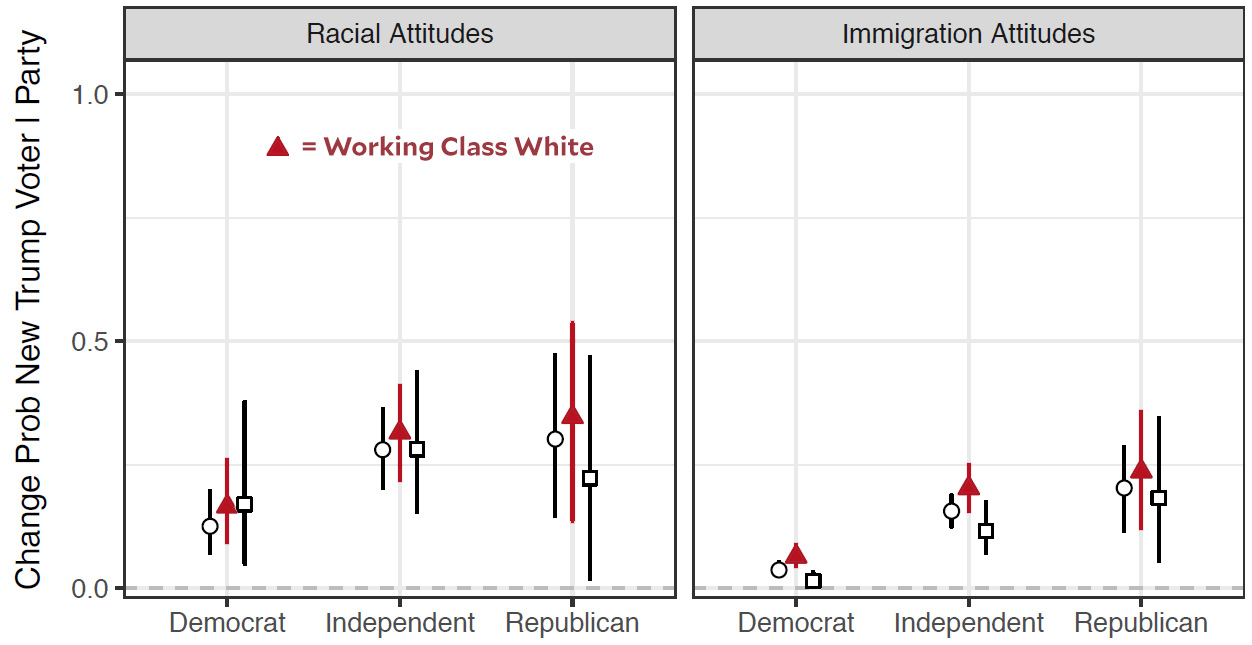
Via Zack Beauchamp, we have a new study about what motivated certain Obama voters to switch to Trump in 2016. Long story short, economic anxiety played almost no role. Rather, it was conservative racial attitudes, primarily among working-class whites:
The data source for this chart is white voters who voted for Obama in 2008 or 2012. Each point shows the effect of moving from the most liberal racial attitude toward the most conservative racial attititudes. In all cases, but especially for working-class whites, the effect is a nonzero likelihood of switching to Trump in 2016. There was no similar effect for economic anxiety.
This shouldn’t surprise anyone by this point. There’s now been a boatload of research showing that economic anxiety had little effect on the 2016 vote for Trump. To the extent that he did better than a generic Republican candidate, it was because he appealed more strongly to racial anxiety.
Now, there’s a limit to how much you can conclude from a single study, but what makes this one interesting is that it’s limited to voters who initially voted for Obama. In other words, these obviously aren’t hardcore racists: regardless of their racial attitudes, they were perfectly willing to vote for a black man in 2008 and 2012.
So what happened in 2016? One possibility, of course, is that they were willing to vote for a black man but not for a woman, regardless of race. That’s possible, but I think there’s a more likely explanation: they were willing to vote for a black man initially, but after eight years of racial triggering—partly due to the simple presence of Obama in the White House, partly due to relentlessly racial coverage of Obama from conservative media, and partly due to outside events like Ferguson and Black Lives Matter—they had gotten tired of being constantly reminded of race. They didn’t turn into overt racists, but they were open to voting for a white man with a more aggressive racial appeal than they were used to. So the pendulum swung, and a fair number of these folks with nominally centrist racial attitudes pulled the lever for Trump.
The big question is whether this is a permanent change. Did these switchers switch for a single election? Or did they become permanent Republicans as they watched the Democratic Party become more and more associated with people of color? Based on both this study and other evidence, I suspect the switch is temporary.¹
This is why I think Democrats don’t need to be shy about running on cultural and racial issues. This isn’t meant as carte blanche to campaign like Malcolm X even if you’re running in a rural Midwestern district. I mean, don’t be an idiot. At the same time, the racial anxiety set off by Obama’s presidency is almost certainly wearing off, while Trump’s white-guy-in-a-bar act is wearing thin. On issues of immigration, racial justice, sexual abuse, and so forth, a simple, straightforwardly progressive approach will work fine. There’s no need for shilly shallying just because Trump manages to gather a few thousand blowhards into a stadium once in a while.
¹There is, of course, also an underlying, long-term trend of conservative whites moving to the Republican Party, but that’s been happening slowly and steadily for nearly 50 years. I think it’s unlikely that the tail end of that process would show substantial changes in voting behavior over the course of just a couple of elections.
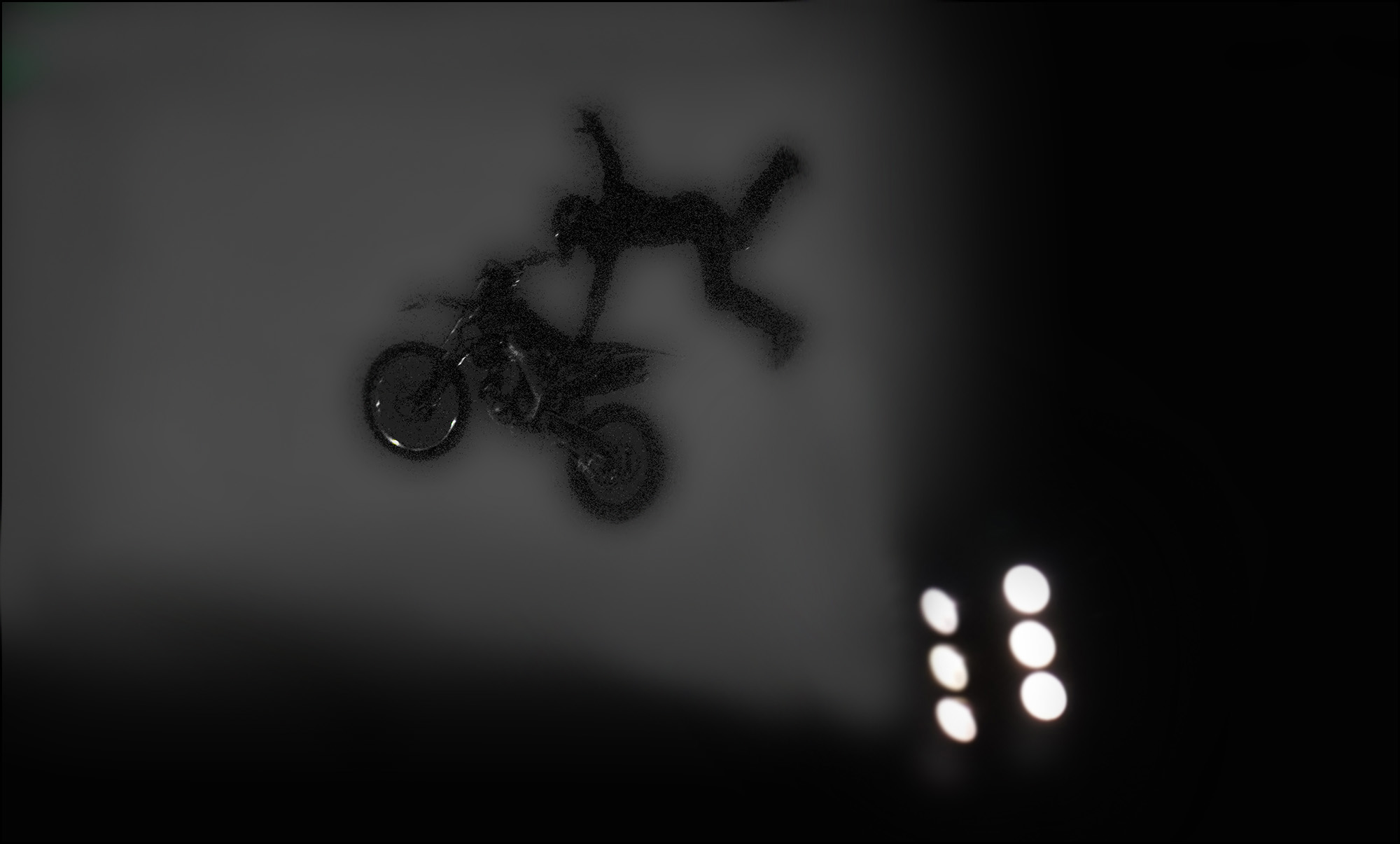
This is a picture of a motocross stunt cyclist at the Orange County Fair. It is basically an invention of Photoshop, since the raw picture is almost completely black to the naked eye with the exception of the six floodlights. However, by playing around with the lighting and the exposure curves and so forth, eventually you can sometimes get an interesting picture out of nothing.
One of them, anyway. The other couple of dozen I took were hopeless no matter what I did. But you only need one.
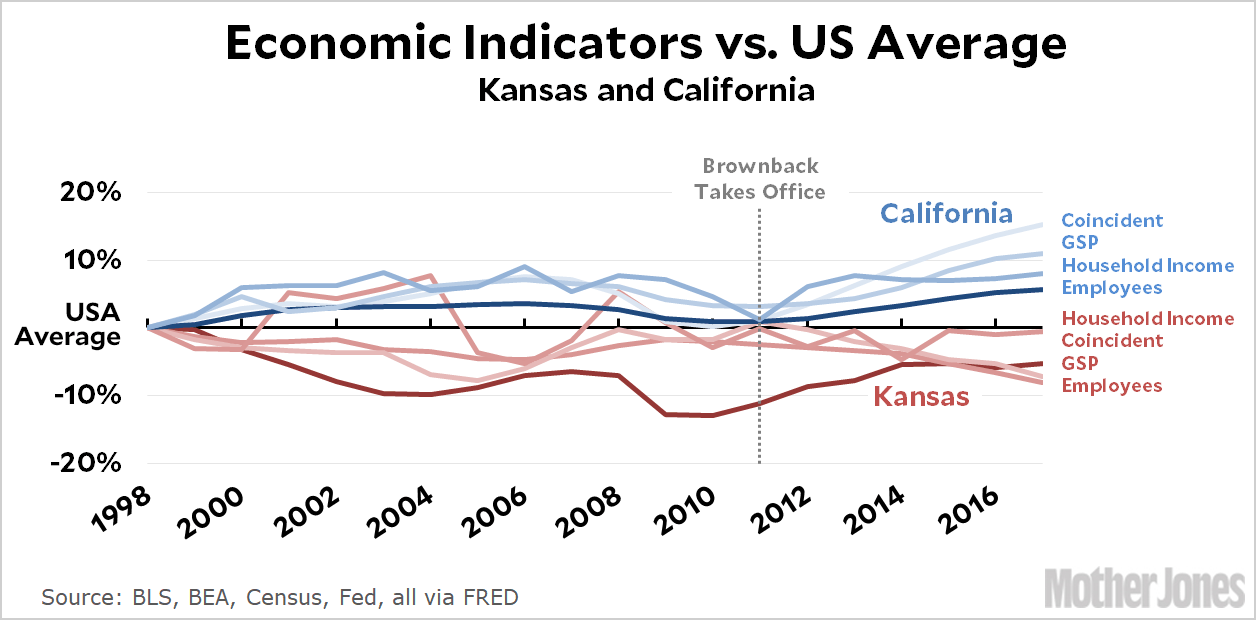
Paul Krugman was tweeting about Kansas this morning, and now that Sam Brownback’s tenure as governor is over and we have pretty complete economic indicators for his entire disastrous governorship, I figured it was time to take a final look. I included California as a comparison since it’s a big fat liberal state that should be failing grievously, and then chose four good economic series. Everything starts in 1998 so you can get a good look at what the trends looked like before 2011, and they’re all shown in comparison to the US average. So how did Kansas do?
Median household income: It dropped during Brownback’s first few years but then picked up a bit, ending with approximately zero growth.
Coincident economic activity: This is an overall gauge of a state’s economy. It rose for the first three years Brownback was governor, but then withered and ended up 5 percent below the average US level.
Gross state product: Fell during Brownback’s entire governorship, ending 7 percent below the US average.
Total workforce: Ditto, ending 8 percent below the US average.
During this same time, California grew faster than the US average on every economic indicator. I don’t know how that’s possible given all our taxes and regulations and environmental voodoo, but somehow we did.
But this is not the most remarkable part of all this. The most remarkable part is that Kansans are now holding another election and the Republican candidate is Kris Kobach—who is not only odious in his own right, but is also basically a Brownback clone. Right now the polls are neck-and-neck, and there’s a good chance Kobach will win. It just goes to show the power of Republican economic thought in certain parts of the country. Even after Sam Brownback spent eight years nearly destroying their state with his “great experiment,” it’s entirely likely that Kansans will elect a man who plans to do pretty much the same thing. I guess they just don’t like economic growth very much in Kansas.
You all know about California’s Proposition 13, don’t you? Good. So I’ll skip the details and just mention one thing it does: it limits the assessed value of your house from rising more than 2 percent per year.
Here’s an example. Marian and I bought our house in 1993 for about $300,000. Thanks to Prop 13, it is now officially valued at about $500,000, which means my property tax bill clocks in at roughly $5,000 per year. Needless to say, this bears no relationship to reality. In fact, our house is probably worth about $900,000 or so, which means I save $4,000 every year on property taxes.
But before you get too jealous, there’s a sad part to this story. What if I want to move to a new house? I don’t get to take my old, fake assessed value along with me. The new house is assessed at whatever I paid for it, which could be a million dollars or more! It’s outrageous. Why should I have to pay property taxes on the actual value of my home? After all, I’m old and pretty affluent. Paying high property taxes is for the little people.
But not to worry. Years ago, old people fought for an exemption to Prop 13 and they got it. There are some restrictions, but basically if they sell their house and buy a less expensive one when the kids move out they’re allowed to keep their old assessed value. So now everyone’s happy, right? Of course not. David Dayen explains further:
Proposition 5 says that’s not enough. So it cuts property taxes for those buying a less expensive property and for those who buy a more expensive new home, their taxes only go up on the difference in price between the home they sold and the one they buy. Proposition 5 also lets them repeat this exercise indefinitely.
This won’t expand the housing supply. It won’t even lubricate the housing market because the state has already removed any disincentive to downsizing. Proposition 5, if anything, could make prices shoot up, as senior home buyers who are saving $1,000 a month on property taxes bid up their offers.
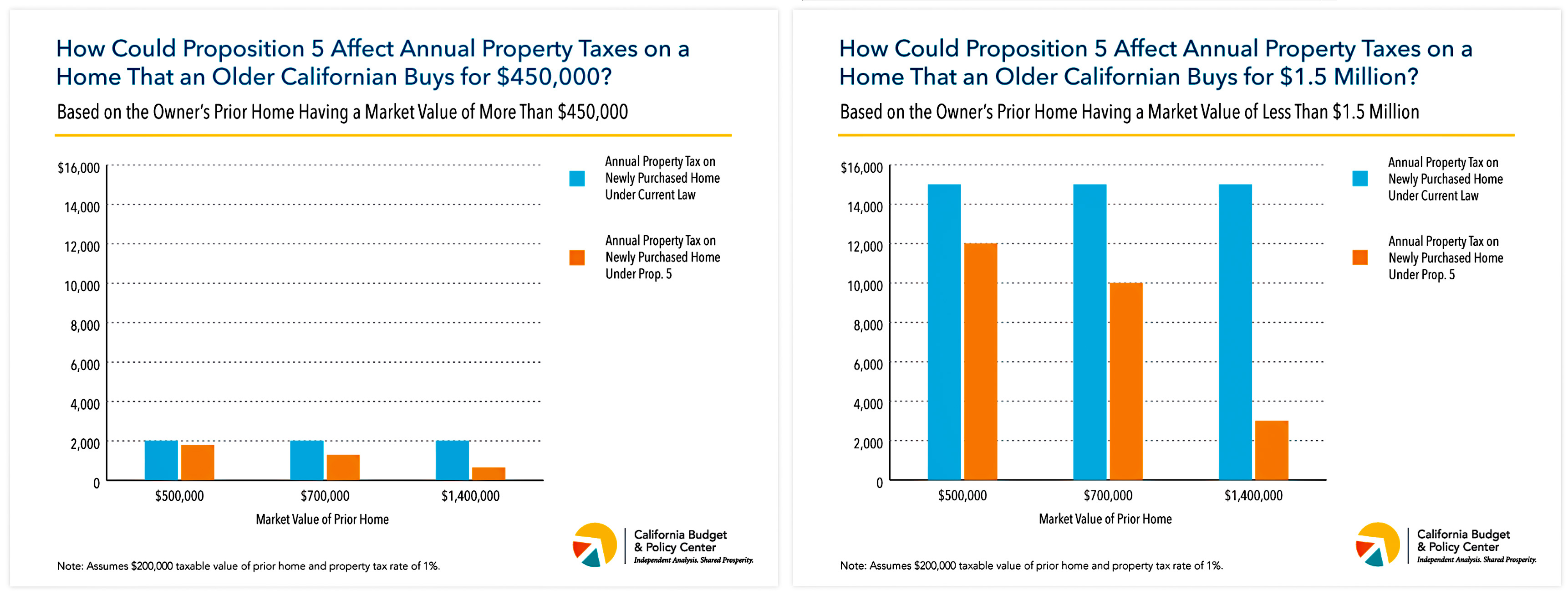
Figures from the California Budget Center show who truly benefits from this arrangement. Due to Proposition 5’s complicated formula, those selling the most expensive properties will reap far greater savings. For example, take two families who bought houses 20 years ago for $200,000. Both decide to move into $1.5 million condos. If the first family’s house is now worth $500,000, they would save $3,000 on their annual tax bill. If the second family’s home is worth $1.4 million, they would save a whopping $12,000 a year.
Forty years ago, Prop 13 was sold primarily as a matter of fairness to older property owners who were paying ever higher property taxes thanks to the red hot Southern California housing market of the 70s. The rising value of their homes was purely paper profit since they had no intention of selling them, but their rising property taxes were very real indeed.
There was some truth to this complaint, and the answer would have been some kind of narrow property tax reform that applied solely to retired folks on fixed incomes. Instead we got Prop 13, which applied to everyone. This destroyed California’s tax base and permanently moved political power to Sacramento, which ended up as the source of all decisions about how to divvy up tax revenue and how much state money to dole out to make up for the loss of local property tax revenue.
Long story short, though, old rich people still aren’t satisfied. What they really wanted in the first place was essentially an exemption from ever having to worry about the actual market value of their home. Prop 13 was only a first step. Prop 60 in 1986 allowed a one-time exemption from reassessment if you sold your house after the age of 55. Two years later, Prop 90 expanded the exemption a bit more. And now we have Prop 5, which for all practical purposes finally makes the exemption permanent no matter what. And as the CBPC points out, its benefits are massively tilted toward richer homeowners who have bigger exemptions in the first place and are more likely to move around multiple times. In other words, the people who least need it.
Prop 5 is a giveaway to the elderly rich, but that’s not all: it’s also yet another band-aid that keeps us from taking a serious look at Prop 13 and reforming it in the ways that are really needed. Here’s hoping that Californians are smart enough to vote it down.
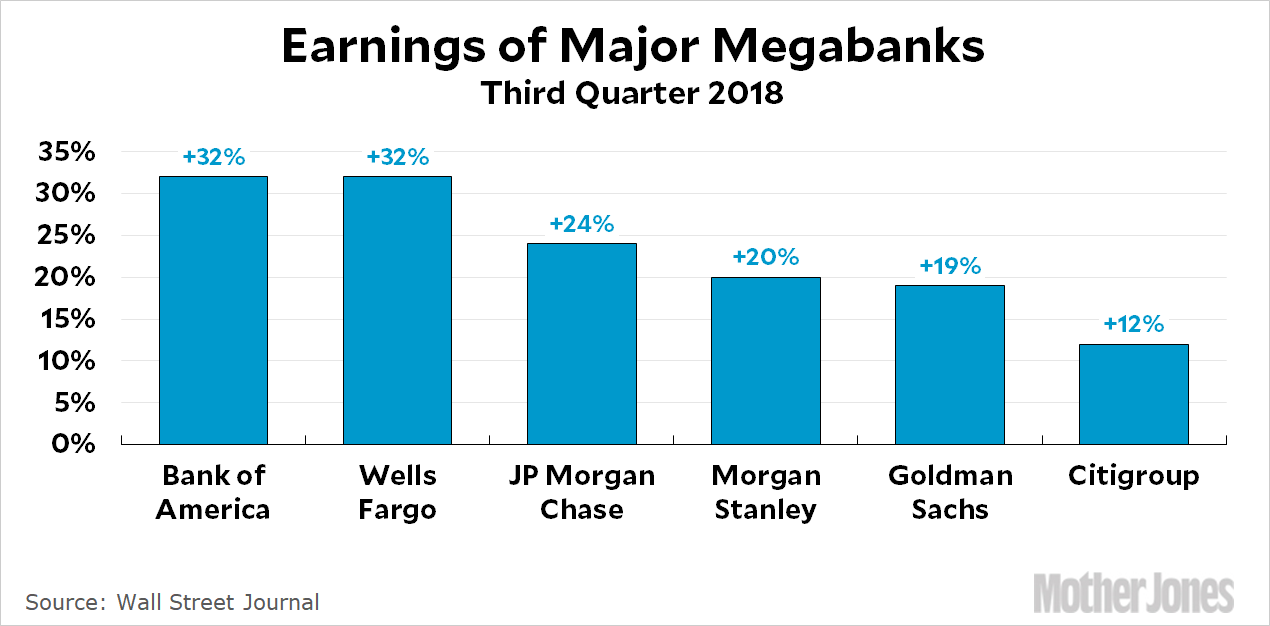
All the big banks have now reported Q3 earnings, so here they are:
These might seem like pretty spectacular results to you, since even the top percentile of ordinary schlubs didn’t see their wages go up more than 5-6 percent in the third quarter. But you’d be wrong. Several big banks were flat or even down on these results. Bank of America, for example, opened Monday at $28.11 and is currently trading at … $28.11.
But if Wall Street isn’t that impressed, the rest of us should be. An average increase in profits of 23 percent seems pretty good, especially with all these banks straining under the cruel yoke of Dodd-Frank rules that practically keep them from opening their doors for business each morning. It’s a miracle they can stay in business at all, let alone continue to increase their earnings by billions of dollars each quarter. So huzzah to America’s big banks. Truly they show what hard work and free market capitalism are all about.
The United States Senate favors states with small populations. Wyoming has half a million people and California has 40 million people, but they both get exactly two senators each.
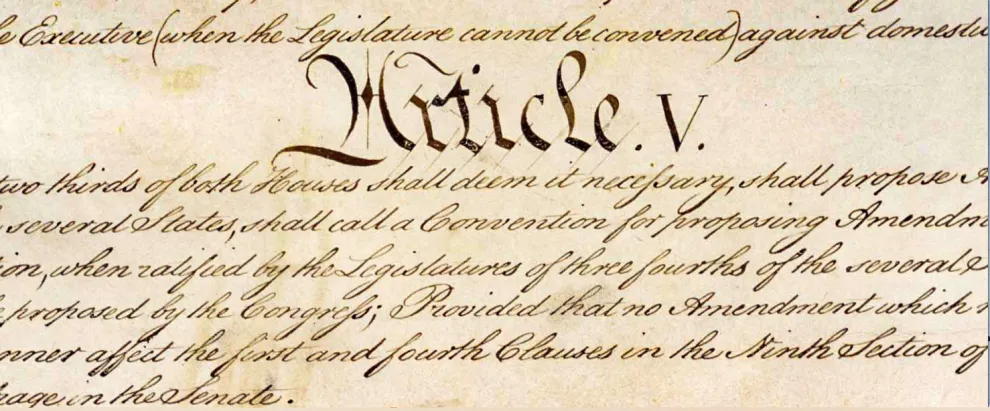
I assume we all know this, right? And we know how unfair it is. And how much it favors Republicans. And how it’s intolerable and we should change it. And how it’s the root of all evil at this moment in history. Etc. This is pretty much all true, but before anybody says anything more, I’d like to introduce you all to Article V of the US Constitution:
The Congress, whenever two thirds of both Houses shall deem it necessary, shall propose Amendments to this Constitution…..
Article V is about amending the Constitution. You all know how that’s done, so let’s skip ahead to the final sentence:
Provided that no Amendment which may be made prior to the Year One thousand eight hundred and eight shall in any Manner affect the first and fourth Clauses in the Ninth Section of the first Article; and that no State, without its Consent, shall be deprived of its equal Suffrage in the Senate.
See that? It means that you can’t amend the Constitution to change the Senate. Every state gets the same number of votes. Period. Even if you fancifully assume that there’s some way of getting a whole bunch of states to agree to reduce their own power via constitutional amendment, it doesn’t matter. There’s no way to alter Senate representation without calling a constitutional convention and literally writing a whole new constitution.
So can we please all stop yammering about this? It’s unfair and intolerable and its roots are offensive and blah blah blah. But it doesn’t matter. There’s nothing you can do to change it. If you want to yammer about something useful, how about coming up with ways for progressives to do a better job of winning votes in small states?
Uh huh. I guess we should at least be grateful that the Saudis are now demonstrating enough respect for world opinion to make up a lie. It’s slightly better than telling us all to go fuck ourselves, which has been the basic Saudi story up until now.
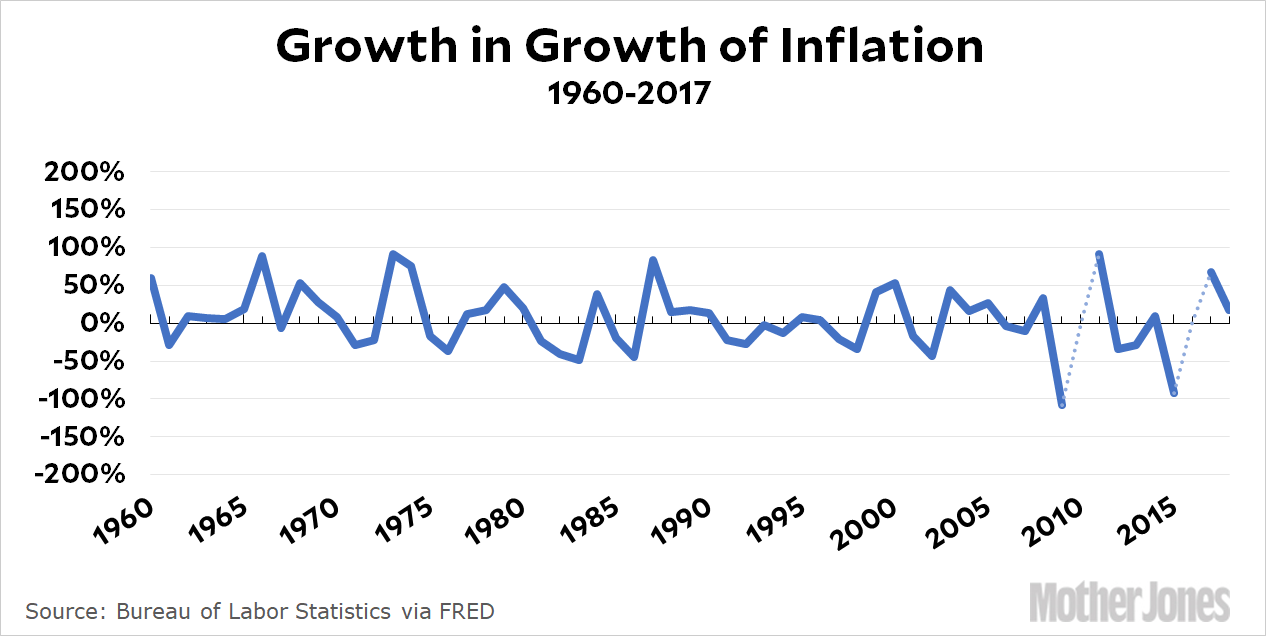
Apropos of nothing in particular except the tedium of today’s news, here’s a chart that shows not the historical growth of inflation, but the acceleration of inflation. That is, the growth of the growth rate from year to year. To make the chart readable, I’ve eliminated a couple of recent years with gigantic up and down spikes:
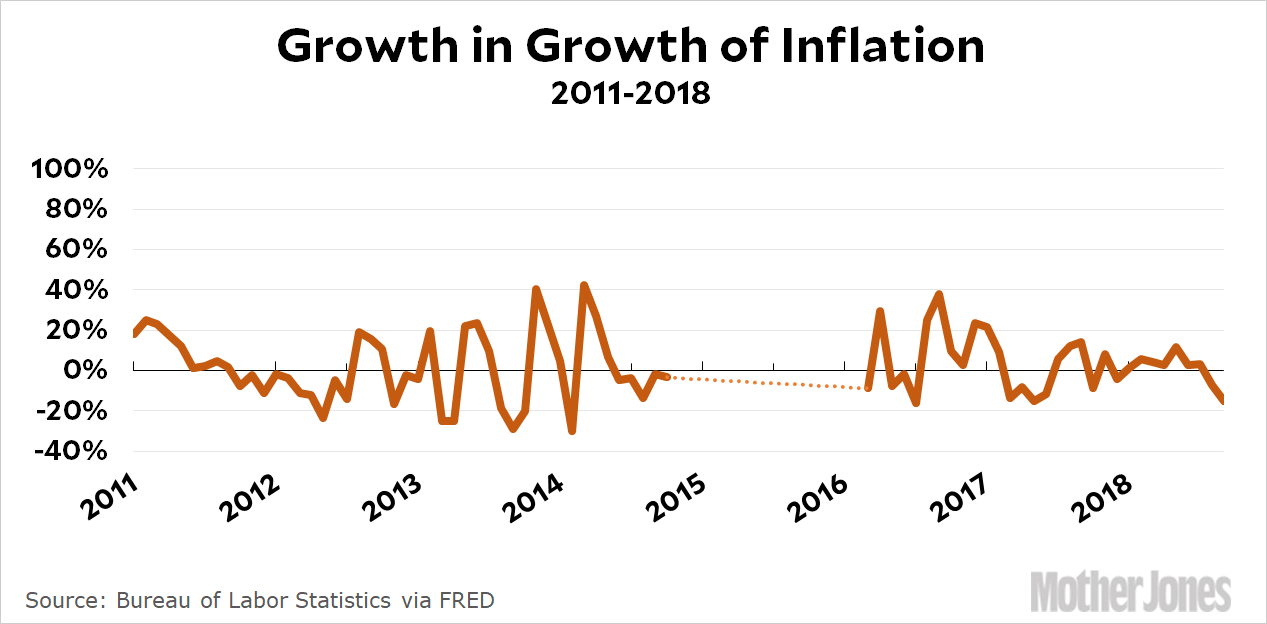
Even during the 1975-80 era, there are only a few years of consecutive positive acceleration. Here’s the same chart on a monthly basis since the end of the Great Recession:
Once again, I’ve removed 2015, which was weirdly spiky, in order to provide a better overall view of the past eight years. I don’t know about you, but I don’t see any sustained acceleration worth worrying about during the entire period. There’s about six months of consecutive positive acceleration starting in 2018, but the numbers are small and then dropped away in August and September. It looks like everything is pretty well under control for now.
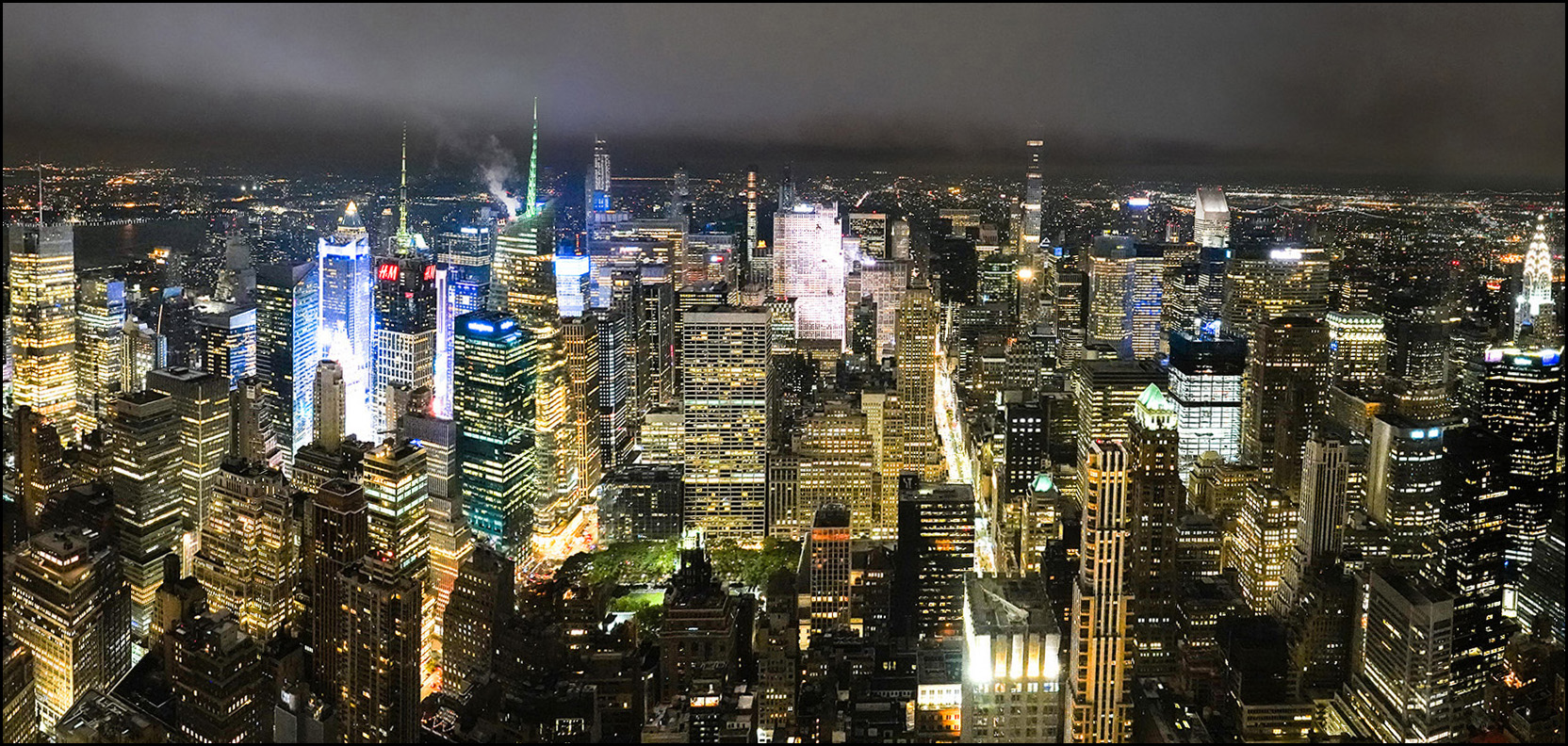
New York City was muggy and cloudy when I was there last month, which meant that it was impossible to shoot a really good skyline picture. Still, I’d never been to the top of the Empire State Building as an adult, so I went up and took a few shots anyway. This one is a panorama of three photos stitched together, looking uptown toward Central Park a little after 11 pm. Because the picture wasn’t great to begin with, I did sort of a half-ass job of the stitching, which means that you can amuse yourself by trying to suss out where the stitches are. Have fun!
And we respect that! But maybe you’re of a mind to support our work directly instead? We have until December 31 to raise the last $400,000 we need to keep our nonprofit newsroom running at full strength into 2026. Will you make a gift today?
We noticed you have an ad blocker on. Can you pitch in a few bucks to help fund Mother Jones' investigative journalism?
Billionaires own the media,
but they don’t own us.
At Mother Jones we know these aren’t conventional times, and they require unconventional coverage. That’s what deliver every day: fierce, independent journalism you can’t find elsewhere. Perhaps never in the history of our country has that been more necessary than now. But we can’t do it without reader support—your support. Please chip in today.
Billionaires own the media,
but they don’t own us.
At Mother Jones we know these aren’t conventional times, and they require unconventional coverage. That’s what deliver every day: fierce, independent journalism you can’t find elsewhere. Perhaps never in the history of our country has that been more necessary than now. But we can’t do it without reader support—your support. Please chip in today.