• 2004 vs. 2008


    2004 vs. 2008….Back in 2004, I remember at least a few bloggers and pundits arguing that liberals would be better off if John Kerry lost. I never really bought this, but the arguments were pretty reasonable. Leaving George Bush in power meant that he’d retain responsibility and blame for the Iraq war. (Despite the surge, that’s exactly what happened.) Four more years of Republican control would turn the American public firmly against conservative misrule. (Actually, it only took two years.) If we waited, a better candidate than Kerry would come along. (Arguably, both Hillary Clinton and Obama were better candidates.)

    Conversely, it’s unlikely that John Kerry could have gotten much done with a razor-thin victory and a Congress still controlled by the GOP. What’s more, there’s a good chance that the 2006 midterm rebellion against congressional Republicans wouldn’t have happened if Kerry had gotten elected. By waiting, we’ve gotten a strong, charismatic candidate who’s likely to win convincingly and have huge Democratic majorities in Congress behind him. If he’s willing to fully use the power of his office, Obama could very well be a transformational president.

    So: were we, in fact, better off losing in 2004? The downside was four more years of George Bush and Dick Cheney. That’s hardly to be minimized, especially since the upside is still not completely knowable. But for myself, I think I’m convinced. The cause of liberal change is better served by Obama in 2008 than it would have been by Kerry in 2004. Comments?

  • Voter Registration


    VOTER REGISTRATION….Matt Yglesias seconds Rick Hasen’s proposal to make ACORN’s registration drives (and the quadrennial conservative meltdown over them) obsolete by just having the federal government do it:

    The solution is to take the job of voter registration for federal elections out of the hands of third parties (and out of the hands of the counties and states) and give it to the federal government….The next president should propose legislation to have the Census Bureau, when it conducts the 2010 census, also register all eligible voters who wish to be registered for future federal elections….When people submit change-of-address cards to the post office, election officials would also change their registration information.

    I’d go even further: implement a national ID and give one to everybody, free of charge. You get it when you turn 18 (or whatever), and you get a free update every five years (or whatever). Post offices would handle most of the work, and roving mobile vans would trek through rural areas periodically to make sure everyone has easy access to whichever federal agency is tasked with providing the cards. Instead of simply requiring people to have picture IDs, the federal government would do everything it could to make sure everyone actually has a picture ID, with as little hassle as possible. Once this was in place, everyone with an ID could vote on election day unless they were barred for some affirmative reason, which might still vary from state to state. No registration required.

    This wouldn’t be perfect. Nothing is perfect. But it would be a damn sight closer than the squirrelly system we have today, and the only real objection to it is that, by God, Americans will never accept national ID cards. No “showing of papers” here in the land of the free!

    But this is ridiculous. For all practical purposes we already have a national ID system. The feds require virtually everyone to have a Social Security number, and virtually all state ID cards are based on that number. Your name is already in a zillion public and private databases keyed to your SSN number, and one more won’t really change things much. You won’t be required to show your papers any more than you already are. It will just be easier, cheaper, and more consistent for everyone — including students, the elderly, the poor, and minorities — which should make liberals happy. And if the govenrment affirmatively generates IDs free of charge for everyone, then there’s no objection to requiring ID at polling places — which should make conservatives happy.

    Which, come to think of it, is one reason we’ll probably never do it. For a lot of people, it would take all the fun out of presidential elections.

  • DST Hell


    DST HELL….Time to reset all the clocks again. Let’s see. Garage: two cars and the sprinkler timer. Living room: clock, VCR, thermostat. Kitchen: oven, microwave. Study: computer, two clocks, fax machine, telephone. Guest room: clock, VCR. Sewing room: clock, computer, VCR. Master bedroom: three clocks, VCR, Mac notebook, several watches. Also the cell phones, but they reset themselves.

    Is that all? I think that’s all. I’m probably wrong, though. There are probably several more I’m forgetting about.

  • Question of the Day


    QUESTION OF THE DAY….Are avocados good for you? Well, are they? Really?

    They’re full of fat, of course. But wait! It’s good fat. So maybe we’re talking about a fair number of calories, but no artery clogging badness. Right?

    But are avocados actively good for you, or is it just a case of not being especially harmful? If you had to choose between, say, an apple and an avocado, which one would be healthier? Does adding avocado to a turkey sandwich make it better for you? Worse? No difference? Can I really grow my own avocado tree by sticking toothpicks in an avocado pit and letting it soak in a jar of water?

    The fine folks at avocado.org inform me that avocados are rich in beta-sitosterol and carotenoid lutein and better for me than cheddar cheese. Well, duh. Unfortunately, they might be just the teeniest bit biased about the wonderfulness of avocados. So for a straight answer I turn to you, my loyal blog readers. How about it?

  • Friday Cat Blogging – 31 October 2008


    FRIDAY CAT KITTEN BLOGGING…. Last week I complained darkly of technical problems and feline noncooperation. This week those problems have been overcome and both Inkblot and Domino are taking the week off as a result. Instead, this week’s catblogging features Lily, my mother’s newest addition to the family.

    My friends, this is a kitten you can believe in.

    She is, of course, too young to run for president in 2012. But in cat years she’ll be perfectly positioned to run in 2016, and she’s practicing for the campaign by taking an executive position in my mother’s house, where she apparently managed to take over completely within a few hours of her arrival. Poor Lucy didn’t know what hit her.

    Happy Halloween, everyone. Be sure to keep your cats indoors tonight.

  • Quote of the Day # 2 – 10.31.08


    QUOTE OF THE DAY #2….From Brad DeLong, trying to figure out what the hell has happened to the economy:

    “A 3% decline in aggregate asset values should not be a big problem for the macroeconomy. Yet it is.”

    To me, the answer appears to be related to derivative speculation. But that is probably too simpleminded. My own personal simplemindedness aside, however, it scares me that the world’s most sophisticated economists don’t seem to know what the answer is either.

    On the other hand, as near as I can tell, we still don’t know for sure what caused the Great Depression or even the Black Monday crash of 1987. So maybe we’ll never really know with this one either.

  • Quote of the Day – 10.31.08


    QUOTE OF THE DAY….From Sarah Palin, unclear on the concept of freedom of speech:

    “If [the media] convince enough voters that that is negative campaigning, for me to call Barack Obama out on his associations, then I don’t know what the future of our country would be in terms of First Amendment rights and our ability to ask questions without fear of attacks by the mainstream media.”

    The First Amendment protects politicians against attacks from the press? I guess Palin’s not an originalist after all. She’s an Orwellian.

  • California Initiative Update


    CALIFORNIA INITIATIVE UPDATE….The latest Field Poll shows that Proposition 8, the initiative to ban gay marriage in California, is losing by five points, 49%-44%. That’s closer than it was last month, when Prop 8 was losing by 17 points (55%-38%), which means the anti-gay forces are gaining ground and this is probably going to be close. On the bright side, undecided voters have a tendency to vote No on controversial initiatives, so there’s a good chance Prop 8 will lose in the end.

    By the way, I saw a No on 8 ad last night that actually mentioned the words “same-sex marriage.” Only barely, mind you, but it’s still something.

    In other California news, Field says that both Prop 2 (decent treatment for farm animals) and Prop 11 (redistricting reform) are leading heavily. No news on Prop 1A, the high-speed rail bond.

  • Income vs. Consumption


    INCOME vs. CONSUMPTION….In recent years, as it finally became impossible to deny that income inequality had risen to unnerving levels, conservatives began trying out a new argument: it’s not income inequality that matters, they said, it’s consumption inequality. If middle class people were buying 50% as much stuff as rich people two decades ago, and they’re buying 48% as much as rich people today — well that’s not such a big deal, is it? Middle class lifestyles, contra liberal whining, are in pretty good shape.

    This has always been a fairly desperate attempt to deny an obvious problem. At the low end of the income spectrum it mostly depended on the fact that government welfare programs boost the incomes of the poor, which, though true, is something that’s happened only over many a dead conservative body. They never approved of most of these programs in the first place, but they were happy to use them as evidence that the economy was doing fine for poor people anyway.
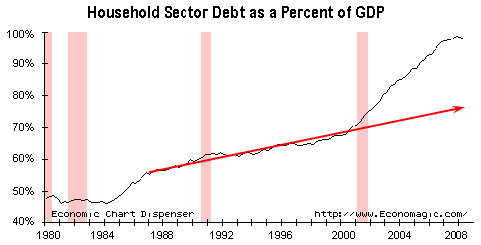
    In the middle part of the income spectrum, the consumption argument relied on — what? Well, it’s obvious: if your income is flat or down, but your consumption is rising, that means you’re borrowing. It means you’re taking out home equity loans, or maxing out your Visa card, or paying usurious rates to your local payday loan outlet. And sure enough, broad statistics show that as median incomes stagnated over the past eight years, household debt exploded. Of the increase in consumer spending we’ve seen over that period, several trillion dollars of it has been fueled solely by increased borrowing. It turns out — surprise! — that income inequality mattered after all. This debt explosion couldn’t keep up forever, which means that eventually middle class consumption was bound to plummet. And now it has.

    As for what this means, Paul Krugman explains it all for you today:

    The long-feared capitulation of American consumers has arrived. According to Thursday’s G.D.P. report, real consumer spending fell at an annual rate of 3.1 percent in the third quarter; real spending on durable goods (stuff like cars and TVs) fell at an annual rate of 14 percent.

    To appreciate the significance of these numbers, you need to know that American consumers almost never cut spending. Consumer demand kept rising right through the 2001 recession; the last time it fell even for a single quarter was in 1991, and there hasn’t been a decline this steep since 1980, when the economy was suffering from a severe recession combined with double-digit inflation.

    ….It’s true that American consumers have long been living beyond their means….Sooner or later, then, consumers were going to have to pull in their belts. But the timing of the new sobriety is deeply unfortunate. One is tempted to echo St. Augustine’s plea: “Grant me chastity and continence, but not yet.” For consumers are cutting back just as the U.S. economy has fallen into a liquidity trap — a situation in which the Federal Reserve has lost its grip on the economy.

    ….The capitulation of the American consumer, then, is coming at a particularly bad time. But it’s no use whining. What we need is a policy response.

    The ongoing efforts to bail out the financial system, even if they work, won’t do more than slightly mitigate the problem. Maybe some consumers will be able to keep their credit cards, but as we’ve seen, Americans were overextended even before banks started cutting them off.

    No, what the economy needs now is something to take the place of retrenching consumers. That means a major fiscal stimulus. And this time the stimulus should take the form of actual government spending rather than rebate checks that consumers probably wouldn’t spend.

    Let’s hope, then, that Congress gets to work on a package to rescue the economy as soon as the election is behind us. And let’s also hope that the lame-duck Bush administration doesn’t get in the way.