Get your news from a source that’s not owned and controlled by oligarchs. Sign up for the free Mother Jones Daily.

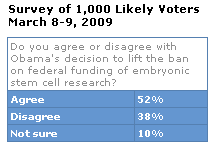
Ramesh Ponnuru complains about yesterday’s Rasmussen poll on stem cells:

The other day I commented on the poor quality of polling on stem-cell research. I’m afraid that the Rasmussen poll, cited in today’s web briefing, is no exception. Here’s the question they use: “President Obama has decided to lift the ban on federal funding of embryonic stem cell research. Do you agree or disagree with President Obama’s decision?”

Rasmussen also reports that 40 percent of those surveyed say they have followed the debate “very closely.” No estimate is given for the percentage of those respondents who are lying.

I wonder what the problem with the question is supposed to be?  In the past, conservatives have complained when pundits and pollsters talked about “stem cells” rather than “embryonic stem cells,” but the Rasmussen question is clear on that point.  Is the problem that “lift the ban” isn’t specific enough, since the Bush ban wasn’t absolute?  Beats me.  The Rasmussen question is very, very simple and neutral and avoids all the issues in Ponnuru’s previous post on the subject, so I’m not sure what the problem is.

But there always seems to be something.  Conservatives seem to be endlessly convinced that the American public would be opposed to embryonic stem cell research if only it was made graphically clear to them that this means embryos are destroyed in the process.  But there’s just not much evidence of that.  Most of us know that embryos get destroyed, and most of us don’t think that’s a big problem.

On the other hand, I sympathize with his closing paragraph.  40% is actually not too unreasonable a figure, but it’s remarkable the number of polls that ask very recondite questions and get something like a 90% response rate.  “Do you think American banks are undercapitalized and should be nationalized” will get, say, 50% in favor and 40% opposed, despite the fact that it’s a dead certainty that 80% of Americans have no idea what “undercapitalized” means and only a vague notion of what nationalization is.  But the results are taken seriously anyway.

From the desk of Mother Jones CEO, Monika Bauerlein...

Newsrooms can be funded in many ways. One of the most controversial (and volatile) ways is by a for-profit corporation or a billionaire owner. We see it across the headlines on a weekly basis: the claw backs in public media, the gutting of The Washington Post, the bending over backwards to appeal to Trump and his allies.

But not here.

When Mother Jones first started publishing 50 years ago, our founders made a critical decision: to be a reader-supported nonprofit. They knew that no corporate owner would be interested in a muckraking newsroom; they also knew that no muckraking newsroom would be interested in following the agenda of a corporate owner.

And so, we’ve been reader-funded for half a century. We rely on contributions from our readers—readers like you—whether it’s $50, or $15 a month, or whatever fits your budget. People give what they can, and every donation makes a difference for our newsroom, which has grown tremendously—in size and reach and renown—since its inception in 1976.

You may be wondering: What does it take to publish an investigation? And what does my donation actually fund? The answers are one and the same: It takes people, resources, and time. And that’s what your donation funds directly.

Every donation Mother Jones receives from readers fortifies our newsroom, whether we’re covering underreported scandals out of Washington, DC, or the most important news of the day. And right now, each donation will be doubled because of our $50,000 match. So when you make a donation—$5, $50, any amount—it’ll go twice as far.

Your support keeps us going. If you’re able, donate today.

Thanks for reading.

—Monika

From the desk of Mother Jones CEO, Monika Bauerlein...

Newsrooms can be funded in many ways. One of the most controversial (and volatile) ways is by a for-profit corporation or a billionaire owner. We see it across the headlines on a weekly basis: the claw backs in public media, the gutting of The Washington Post, the bending over backwards to appeal to Trump and his allies.

But not here.

When Mother Jones first started publishing 50 years ago, our founders made a critical decision: to be a reader-supported nonprofit. They knew that no corporate owner would be interested in a muckraking newsroom; they also knew that no muckraking newsroom would be interested in following the agenda of a corporate owner.

And so, we’ve been reader-funded for half a century. We rely on contributions from our readers—readers like you—whether it’s $50, or $15 a month, or whatever fits your budget. People give what they can, and every donation makes a difference for our newsroom, which has grown tremendously—in size and reach and renown—since its inception in 1976.

You may be wondering: What does it take to publish an investigation? And what does my donation actually fund? The answers are one and the same: It takes people, resources, and time. And that’s what your donation funds directly.

Every donation Mother Jones receives from readers fortifies our newsroom, whether we’re covering underreported scandals out of Washington, DC, or the most important news of the day. And right now, each donation will be doubled because of our $50,000 match. So when you make a donation—$5, $50, any amount—it’ll go twice as far.

Your support keeps us going. If you’re able, donate today.

Thanks for reading.

—Monika

We Recommend

Latest

Sign up for our free newsletter

Subscribe to the Mother Jones Daily to have our top stories delivered directly to your inbox.

Get our award-winning magazine

Save big on a full year of investigations, ideas, and insights.

Subscribe

INDEPENDENT. BECAUSE OF YOU.

Mother Jones has no billionaires calling the shots—just readers like you making fearless reporting possible

Donate