Get your news from a source that’s not owned and controlled by oligarchs. Sign up for the free Mother Jones Daily.

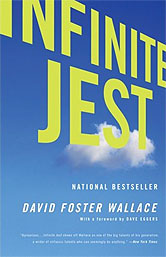
So a bunch of folks are reading David Foster Wallace’s Infinite Jest this summer and blogging about it.  Infinite Summer kicked things off and A Supposedly Fun Blog is the stomping grounds for IJ musings from a bunch of political types.

I feel kind of funny reading the things everyone has to say.  It’s an iconic book now, the kind of thing you read partly to say you’ve read it, and it’s famously long and complex.  And the footnotes.  The footnotes.

But that wasn’t my experience of Infinite Jest.  It’s absolutely not the kind of book I’d normally pick up and read, but for some reason I did back in 1997.  I have no idea why.  I’d never heard of the book and I’d never heard of David Foster Wallace, so I didn’t suffer from any preconceptions that I was making a statement by diving into it.  I was completely naive.  And I loved it.  It was long and complex — I could only read about 50 pages a day because my brain just gave out after that many pages — but I never found it pretentious or overly difficult, two adjectives often associated with it.  (A little bit difficult, yes, but a friendly kind of difficult.) To me, Wallace was having fun with the vocabulary he used, not showing off.  I got a huge kick out of the endless footnotes.  And once he finally explained what the chapter headings were about, things started making a whole lot more sense.  (Granted, that doesn’t happen until you’re a couple hundred pages in, but hey — that’s less than 20% of the book!)  If you’re interested, my original 1997 thoughts about IJ are here.

I don’t think I’m up to the task of rereading it this summer, but I’d recommend it to anyone who asks.  When you’re done, be sure to read the first chapter over again.

If you buy a book using our Bookshop link, a small share of the proceeds supports our journalism.

DECEMBER IS MAKE OR BREAK

A full one-third of our annual fundraising comes in this month alone. That’s risky, because a strong December means our newsroom is on the beat and reporting at full strength—but a weak one means budget cuts and hard choices ahead.

The December 31 deadline is closing in fast. To reach our $400,000 goal, we need readers who’ve never given before to join the ranks of MoJo donors. And we need our steadfast supporters to give again—any amount today.

Managing an independent, nonprofit newsroom is staggeringly hard. There’s no cushion in our budget—no backup revenue, no corporate safety net. We can’t afford to fall short, and we can’t rely on corporations or deep-pocketed interests to fund the fierce, investigative journalism Mother Jones exists to do.

That’s why we need you right now. Please chip in to help close the gap.

DECEMBER IS MAKE OR BREAK

A full one-third of our annual fundraising comes in this month alone. That’s risky, because a strong December means our newsroom is on the beat and reporting at full strength—but a weak one means budget cuts and hard choices ahead.

The December 31 deadline is closing in fast. To reach our $400,000 goal, we need readers who’ve never given before to join the ranks of MoJo donors. And we need our steadfast supporters to give again—any amount today.

Managing an independent, nonprofit newsroom is staggeringly hard. There’s no cushion in our budget—no backup revenue, no corporate safety net. We can’t afford to fall short, and we can’t rely on corporations or deep-pocketed interests to fund the fierce, investigative journalism Mother Jones exists to do.

That’s why we need you right now. Please chip in to help close the gap.

We Recommend

Latest

Sign up for our free newsletter

Subscribe to the Mother Jones Daily to have our top stories delivered directly to your inbox.

Get our award-winning magazine

Save big on a full year of investigations, ideas, and insights.

Subscribe

Support our journalism

Help Mother Jones' reporters dig deep with a tax-deductible donation.

Donate