
Glenn Greenwald has this to say about the Senate healthcare bill now that the public option and the Medicare buy-in have been stripped out:
In essence, this reinforces all of the worst dynamics of Washington. The insurance industry gets the biggest bonanza imaginable in the form of tens of millions of coerced new customers without any competition or other price controls. Progressive opinion-makers, as always, signaled that they can and should be ignored […]
Most of this was negotiated and effectuated in complete secrecy, in the sleazy sewers populated by lobbyists, industry insiders, and their wholly-owned pawns in the Congress. And highly unpopular, industry-serving legislation is passed off as “centrist,” the noblest Beltway value.
This is pretty much correct. The individual mandate was a way of getting support from the insurance industry. The backroom deal with Big Pharma was a way of getting support from the drug industry. The change in Medicare reimbursement rates was a way of getting support from doctors. The gutting of the Medicare commission was a way of getting support from hospitals. Provisions related to biologics, home healthcare, and the prescription drug doughnut hole were a way of getting the support of AARP.
Any honest observer has to concede that all this makes it hard to defend the final product. Except for one thing: in 1994 Bill Clinton failed to get the support of these groups and healthcare reform died. If Obama had done the same, it would have died this year too. There’s really just no question about this. It’s ugly, but that’s the real world. Which brings me to the place where I think Glenn is wrong:
Looked at from the narrow lens of health care policy, there is a reasonable debate to be had among reform advocates over whether this bill is a net benefit or a net harm.
From any kind of progressive point of view it’s hard to see how you could seriously argue that the current bill is a net harm. Sure, it makes compromises to powerful interests that are hard to swallow. But that’s why they’re called powerful interests: because they can kill your legislative priorities if you don’t assuage them. In return, though, the Senate bill brings down insurance rates, expands Medicaid, offers the prospect of moderately priced insurance to tens of millions of the uninsured, forces insurers to take you on even if you have a chronic pre-existing condition, mandates minimum levels of coverage, and takes several small but important steps toward reducing the future growth of healthcare costs. That’s an enormous advance for the progressive agenda.
There’s an alternate universe out there in which you could get all this stuff without compromise based on the sheer force of progressive arguments. Sadly, it’s not this universe. I sure hope we don’t have to learn this the hard way yet again.
 Medicaid matching rates, and child credits.
 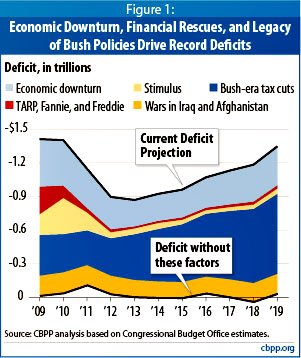 Conservatives spend a lot of time whining these days about how Barack Obama is always blaming them for all the problems he faces. Personally, though, I’d say Obama has been remarkably restrained about the whole thing, especially when it comes to our disastrous fiscal situation. In a mere eight years, George Bush and the Republican Party managed to take a thriving economy and a federal surplus and turn it into a hair’s breadth escape from Great Depression II and an endless fiscal sinkhole. Rome may not have been built in a day, but it didn’t take much longer than that for the modern Republican Party to bankrupt America.
 a too-weak bill as a sham and drawing some bright lines. If it doesn’t happen, I’ll do some Taibbi-style denunciations of Geithner & Rahm.
 A concerned reader writes:
 the view, common among many conservatives, that enriching the wealthy somehow automatically benefits the poor. That’s obviously nonsense….For this reason, I have always been more sympathetic to programs that aid the poor than other conservatives.
 I don’t want to blog endlessly about healthcare reform today because, really, there’s not all that much to say. I think the Senate bill in its present state is well worth passing, other people don’t, and that’s that.



