
It’s common for members of the wonkosphere to point out that elections are dominated by the state of the economy and that communication strategies have little impact. Jonathan Bernstein pushes back:
There’s good reason to believe that there are rarely big gaps between the effects of Democratic and Republican electioneering (including messaging), because both parties and their candidates try hard to do well in those areas. If one side abdicates, “the margins” may get a bit less marginal. So while I’d certainly recommend simply as a matter of electoral politics that presidents place a higher priority on economic growth than on spin, that’s not the same thing as saying that they should ignore spin. Plenty of stuff that only matters on the margins is still worth doing.
I think this is worth keeping in mind. It’s true that the economy matters the most, but most models show that structural factors (including the economy) account for perhaps 70% of the variance in election results. The remaining 30% is obviously a smaller share, but still: 30% ain’t nothing. And as Jonathan says, it would probably be a lot more than 30% if it weren’t for the fact that both sides are always pushing hard against each other. If one side just gave up because they decided messaging wasn’t important, they’d be a lot more likely to lose regardless of how the economy was doing.
(This is a testable proposition, by the way, though probably a tricky one. I’d guess, for example, that congressmen who run unopposed have higher approval ratings than those who don’t. Obviously a higher approval rating tends to discourage competition in the first place, but even if you control for that I’d bet that uncontested politicians rate higher with their constituents. This is largely because they get to create their own messaging strategy without anyone else pushing back.)
So: messaging does matter. Communication strategy matters. You can’t just cede the field. That said, though, I have to agree with the consensus on the left that in the particular case of President Obama’s decision today to freeze federal pay, it’s not going to work. On a substantive level, it’s far too small to have any serious effect. On a messaging level, I simply can’t believe that anybody is going to care. Obama seems endlessly besotted with the idea that he can use small executive decisions (supporting nuclear power, allowing offshore drilling, freezing federal pay, etc.) as a way of convincing the electorate that he’s really a moderate, but there’s no evidence that suggests this stuff has even the slightest impact. And it’s certainly not going to make a dent on the Republican caucus in Congress. I really have no idea what the point of this kind of thing is.
UPDATE: That was Jonathan Bernstein I was quoting up there, not Jon Cohn as I originally had it. I’ve corrected the text.
 feeling of impending doom sticks with me to this day. The experienced old ladies that had worked there for years called it “Black Friday.” I’m quite sure it had nothing to do with store ledgers going from red to black.
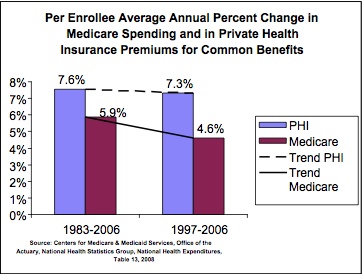 wealthy. But in a world where Medicare is just one of many payers and Medicare decides to control costs, doctors can simply stop taking Medicare patients and a lot of legislators will lose their jobs.
 careful to document the statistical sampling error, but who cares about a 3% sampling error when there might be 21 points of error from other causes?
 he concluded that it was extremely unlikely regardless of circumstances. The folks over at Five Books recently asked him for
  cables?
  responsible is to cut taxes. They need not lift a finger to cut spending because it will magically come down, just as a child will reduce her spending if her allowance is cut — the precise analogy used by Ronald Reagan to defend this doctrine in a Feb. 5, 1981, address to the nation.



