Get your news from a source that’s not owned and controlled by oligarchs. Sign up for the free Mother Jones Daily.

Everyone thinks they’re middle class. This isn’t a big surprise: the word “rich” has specific connotations (servants, mansions on the Gold Coast, 200-foot yachts, etc.) and even someone making $200-300 thousand a year probably doesn’t have any of that stuff. What’s more, most people in that income range were likely raised middle class, so culturally they still think of themselves that way even if their incomes give them a pretty comfortable lifestyle.

But Catherine Rampell notes something more interesting today. Researchers surveyed 1,100 households in Buenos Aires and asked them a purely objective question: what decile do you think your income puts you in? The bottom decile means you’re part of the poorest 10%, the fifth decile means you’re right in the middle, and the tenth decile means you’re part of the richest 10%. Here’s how things shook out:
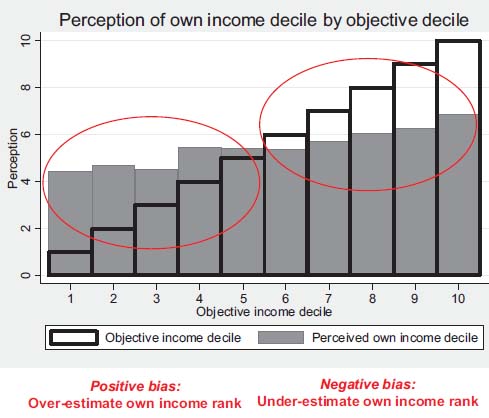
Fascinating! The very poorest thought they were actually in the fourth decile — just barely below average. The very richest thought they were in the sixth decile — just barely above average.

If the same thing is true here — and I wouldn’t be surprised if it were — it could go a long way toward explaining the political dynamics of taxation and economic policy in the United States. After all, if the poor don’t really know they’re poor, they’re never going to mount much of a fight for more egalitarian public policies. And if the well-off don’t know they’re well off, they’re going to strongly resist more egalitarian public policies. The result can be startling increases in income inequality without anyone really knowing it’s happening or caring very much about it.
DECEMBER IS MAKE OR BREAK

A full one-third of our annual fundraising comes in this month alone. That’s risky, because a strong December means our newsroom is on the beat and reporting at full strength—but a weak one means budget cuts and hard choices ahead.

With only days left until December 31, we've raised about half of our $400,000 goal—but we need a huge surge in reader support to close the remaining gap. Whether you've given before or this is your first time, your contribution right now matters.

Managing an independent, nonprofit newsroom is staggeringly hard. There’s no cushion in our budget—no backup revenue, no corporate safety net. We can’t afford to fall short, and we can’t rely on corporations or deep-pocketed interests to fund the fierce, investigative journalism Mother Jones exists to do. That’s why we need you right now. Please chip in to help close the gap.

DECEMBER IS MAKE OR BREAK

A full one-third of our annual fundraising comes in this month alone. That’s risky, because a strong December means our newsroom is on the beat and reporting at full strength—but a weak one means budget cuts and hard choices ahead.

With only days left until December 31, we've raised about half of our $400,000 goal—but we need a huge surge in reader support to close the remaining gap. Whether you've given before or this is your first time, your contribution right now matters.

Managing an independent, nonprofit newsroom is staggeringly hard. There’s no cushion in our budget—no backup revenue, no corporate safety net. We can’t afford to fall short, and we can’t rely on corporations or deep-pocketed interests to fund the fierce, investigative journalism Mother Jones exists to do. That’s why we need you right now. Please chip in to help close the gap.

We Recommend

Latest

Sign up for our free newsletter

Subscribe to the Mother Jones Daily to have our top stories delivered directly to your inbox.

Get our award-winning magazine

Save big on a full year of investigations, ideas, and insights.

Subscribe

Support our journalism

Help Mother Jones' reporters dig deep with a tax-deductible donation.

Donate