• Who is Osama?

    So it seems as if a goodly number of teenagers don’t know who Osama bin Laden is. Gadzooks! But let’s put this into a little perspective.

    We’re talking about 16-year-olds here. I was 16 years old in 1974. So let’s try to think of someone who was quite famous in the late 60s but who had largely dropped off the front page from 1970-74. How about Daniel Ellsberg? Or William Calley? Maybe Moshe Dayan?

    None of these are perfect subsititutes. But how shocked would you be if I told you that I hadn’t heard of William Calley until some teacher of mine mentioned him in a class in 1974? Probably not very. I was only 12 when he was most famous and not paying much attention to the news. And it’s not as if no teens under the age of 17 have ever heard of bin Laden. Just some of them. Probably the same ones who haven’t heard of much of anyone outside the usual teen circle of pop stars and TV celebrities. This isn’t exactly a feather in the cap of American teendom, but it’s not a sign of the Apocalypse either. It’s just kids not knowing or caring about some of the things their elders take for granted. Nothing much new about that.

  • Public Records Should be…..Public


    Should the White House release photos of Osama bin Laden that were taken after he was shot during Sunday’s raid? I’m surprised this is even being debated. Of course they should. These are public records of a very public operation against public enemy #1, and like it or not the public should have access to them. The only reason to withhold them would be for reasons of operational security, and I don’t think that applies here. Security issues are probably legitimate when it comes to releasing real-time video of the actual raid, but not to still photos of bin Laden himself.

    Release the photos. And the video of his burial at sea, for that matter. These are public records, folks.

  • Osama bin Laden and National Bankruptcy, Part 2


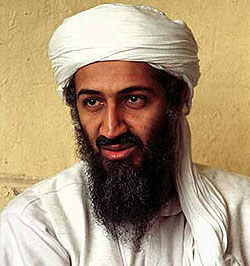
    When he planned the 9/11 attacks, was Osama bin Laden’s goal to drag the United States into a series of endless wars that would bankrupt us? I said earlier that I was “a little skeptical of attempts to take this argument too far” because bin Laden’s statements to this effect all came well after 9/11. But Daveed Gartenstein-Ross tweets:

    Re OBL not having economics in mind on 9/11, see his contemporary comments to Allouni, which I quote here: http://bit.ly/kf1vdx 

    So I clicked:

    Bin Laden’s strategy’s initial phase linked terrorist attacks directly to economic harm….In a wide-ranging interview conducted by Al Jazeera’s Taysir Allouni in the month following the 9/11 attacks, bin Laden spoke at length about the extent of the economic damage the attacks had inflicted. “According to [the Americans’] own admissions,” he said, “the share of the losses on the Wall Street market reached 16%. They said that this number is a record.”….Factoring in building and construction losses, along with lost productivity, he concluded that the cost to the United States was “no less than $1 trillion.”

    But this is an entirely different thing. This is merely bin Laden bragging about the amount of damage caused by the 9/11 attacks themselves. It says nothing about whether his longer term goal was to draw the United States into ruinously expensive military adventures overseas and massive internal security overreactions at home.

    Just to be clear: I agree that economic warfare was implicit in bin Laden’s thinking. (Likewise, Gartenstein-Ross agrees that America’s potential future insolvency is mostly the result of domestic politics, not the war against al-Qaeda.) I’d just be careful about inferring more than the evidence will bear here. The first time that bin Laden explicitly said that his strategy was to bleed the United States into bankruptcy was in 2004, after the United States had invaded both Afghanistan and Iraq. Maybe that really was his intent all along. But it seems more likely that it was something he invented after the fact to make it look as if everything was going according to plan. It may have been one thread in his thinking, but I’m not sure you can say too much more than that about it.

    FOR WHAT IT’S WORTH: My take on al-Qaeda’s actions and motivations comes largely from Steve Coll’s Ghost Wars and Lawrence Wright’s The Looming Tower. And Wright does say that bin Laden “wanted to lure the United State into Afghanistan, which was already being called the graveyard of empires” (though he doesn’t source this contention). But bin Laden himself seemed to have more prosaic views, namely that the United States was inherently decadent and weak and would retreat from the Middle East if faced by a sufficiently determined jihadist guerrilla movement, and his #2, Ayman al-Zawahiri, appeared to believe that striking the United States (and thus drawing the U.S. into battle) would serve primarily as a way of inspiring young jihadists to join the cause.

    But I’m unquestionably no expert on this. Maybe there’s more evidence than I think that bin Laden’s strategy from the start was to bait the United States into spending itself into bankruptcy. I’d just like to hear a little more pre-9/11 evidence for this.

  • Eating the Poor


    Jon Chait takes note of the remarkably large contingent of conservatives who seem genuinely outraged that Democrats accuse Paul Ryan and other Republicans of not wanting to fund healthcare for the poor and the vulnerable:

    Who do they think is on Medicaid? Prosperous, healthy people?

    No, Medicaid is a bare-bones program throwing a lifeline to people who are in bad shape. Cutting Medicaid may be the politically easiest way for Ryan to clear budget room to preserve Bush-era revenue levels, as Medicaid patients have little political clout. But it is, well, deeply immoral. I’m actually surprised that conservatives not only can’t seem to imagine (or care about) the consequences of such policies, but they can’t even imagine that people like Obama would actually feel moral outrage at their plan. They can’t imagine a liberal objection as representing anything other than an attempt to score political points. It’s bizarre. I mean, of course Obama finds it morally objectionable to take away medical care to people in nursing homes and children with special needs. That’s why he’s a Democrat.

    It’s not just conservatives, either. Media talking heads routinely stroke their chins and then, more in sorrow than in anger, accuse Democrats of “scare tactics” when they warn people about what Republican budget cuts will mean. Is that a scare tactic? I suppose it is. But it’s also the truth. The truth is that Paul Ryan’s budget, like so many Republican proposals before it, would decimate Medicare, Medicaid, SCHIP, and dozens of other programs that benefit the elderly, the poor, and the disabled. Democrats think that’s a bad idea because we think those programs are good things. What’s more, we think it’s an immoral idea because that decimation would primarily serve the purpose of keeping tax rates low on corporations and the rich. You may or may not agree about this, but either way it’s not really that hard to grasp what’s motivating liberals to feel the way they do.

  • Giving Osama bin Laden Too Much Credit

    Daveed Gartenstein-Ross argues in Foreign Policy that American policymakers never really understood Osama bin Laden’s strategy for defeating the West:

    One lesson bin Laden learned from the war against the Soviets was the importance of his enemy’s economy. The Soviet Union didn’t just withdraw from Afghanistan in ignominious defeat, but the Soviet empire itself collapsed soon thereafter, in late 1991….He has compared the United States to the Soviet Union on numerous occasions — and these comparisons have been explicitly economic. For example, in October 2004 bin Laden said that just as the Arab fighters and Afghan mujahidin had destroyed Russia economically, al Qaeda was now doing the same to the United States, “continuing this policy in bleeding America to the point of bankruptcy.” Similarly, in a September 2007 video message, bin Laden claimed that “thinkers who study events and happenings” were now predicting the American empire’s collapse. He gloated, “The mistakes of Brezhnev are being repeated by Bush.”
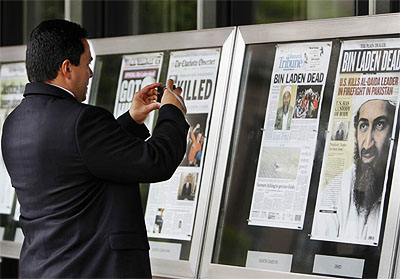
    I confess that I’ve always been a little skeptical of attempts to take this argument too far. This might well have been a thread in bin Laden’s thinking, but these “explicitly economic” comparisons all seem to have come after 9/11 and seem suspiciously opportunistic to me. Still, there’s obviously something to this, and after totting up the multi-trillion dollar cost of our various responses to al-Qaeda over the past decade, Ezra Klein muses on how successful bin Laden ended up being:

    It isn’t quite right to say bin Laden cost us all that money. We decided to spend more than a trillion dollars on homeland security measures to prevent another attack. We decided to invade Iraq as part of a grand, post-9/11 strategy of Middle Eastern transformation. We decided to pass hundreds of billions of dollars in unpaid-for tax cuts and add an unpaid-for prescription drug benefit in Medicare while we were involved in two wars. And now, partially though not entirely because of these actions, we are deep in debt. Bin Laden didn’t — couldn’t — bankrupt us. He could only provoke us into bankrupting ourselves. And he came pretty close.

    It’s a smart play against a superpower. We didn’t need to respond to 9/11 by trying to reshape the entire Middle East, but we’re a superpower, and we think on that scale. We didn’t need to respond to failed attempts to smuggle bombs onto airplanes through shoes and shampoo bottles by screening all footwear and banning large shampoo bottles, but we’re a superpower, and our tolerance for risk is extremely low. His greatest achievement was getting our psychology at least somewhat right.

    Italics mine. I’m just not willing to go that far. Yes, Afghanistan and Iraq and homeland security cost us a lot and have contributed to our parlous fiscal state. But bin Laden had nothing to do with the Bush tax cuts, nothing to do with the housing bubble, and nothing to do with an unfunded prescription drug benefit. And most importantly of all, bin Laden had nothing to do with the upcoming growth of Medicare, something that we’ve known was coming for decades. There’s simply no question that our short-term deficit was caused mostly by tax cuts and the Great Collapse of 2008, just as there’s no question that our long-term deficit is caused mostly by spiraling Medicare expenses. By comparison, the cost of our response to al-Qaeda has been fairly modest.

    Looking backward from, say, 2030, our response to 9/11 will seem like a pretty small contributor to our fiscal (in)solvency. I’ll peg it at less than 10%. For a handful of terrorists living in a compound in Afghanistan, that’s pretty impressive. But in the grand scheme of things, it’s still a nit. If America really does end up bankrupting itself, bin Laden will have had nothing to do with it. The cause will be a delusional conservative political culture that throws temper tantrums at the thought of properly funding our nation’s most popular social programs. They’d rather bring down the government than raise taxes by a few percent of GDP, and that, not a handful of delusional religious fanatics on the other side of the globe, is the real cause of our problems.

  • Chart of the Day: Energy and Recessions

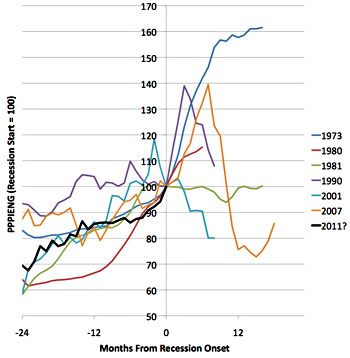
    What’s the effect of rising energy prices on the economy? Stuart Staniford looks at historical data and says that before 1970 the answer is: nothing. There’s no effect at all. But since 1970, the effect is profound: every single recession since then has been preceded by a runup in energy prices.
    And what does that runup look like? Well, it looks an awful lot like the runup we’ve exprienced over the past 24 months. That’s the heavy black line in the chart on the right. Does that mean we’re inevitably headed for another recession? Nope. But since I was being economically optimistic yesterday, I’m going to revert to my true nature today and be economically pessimistic. “I doubt energy prices can go a whole lot higher without triggering another recession,” says Stuart, “so it depends on whether the world can scrape up a few more mbd of oil to keep growth going without prices rising too much more.” Or, alternatively, perhaps a mild slowdown will cool off energy prices without triggering anything more serious.

    Still, this is worth watching carefully. There are half a dozen economic shocks that could tip a fragile recovery back into recession, and for my money, an oil shock is the most likely of them.

  • Pakistan and bin Laden


    Time’s Massimo Calabresi interviews CIA chief Leon Panetta on the bin Laden raid:

    Months prior, the U.S. had considered expanding the assault to include coordination with other countries, notably Pakistan. But the CIA ruled out participating with its nominal South Asian ally early on because “it was decided that any effort to work with the Pakistanis could jeopardize the mission. They might alert the targets,” Panetta says.

    I’m surprised to hear this. Not surprised that everyone thought this, but surprised that Panetta is saying it publicly. Our official posture toward Pakistan has been getting steadily tougher for a while now, and apparently it’s now OK to flatly to assert on the record that they’re in bed with al-Qaeda. Interesting.

    In the end, I think it’s quite possible that the effect of the bin Laden raid on our relationship with Pakistan will end up being its most important long-term consequence. Stay tuned.

  • Spinning the Raid

    Politically speaking, the question of whether finally killing Osama bin Laden is a plus for President Obama depends less on the act itself than it does on the mythologizing that follows. If we get more tick-tocks like this one in the New York Times today, it’s safe to say that Obama is going to get a pretty nice bump in the polls:

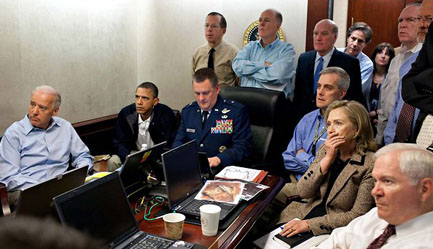
    As more than a dozen White House, intelligence and Pentagon officials described the operation on Monday, the past few weeks were a nerve-racking amalgamation of what-ifs and negative scenarios. “There wasn’t a meeting when someone didn’t mention ‘Black Hawk Down,’ ” a senior administration official said, referring to the disastrous 1993 battle in Somalia in which two American helicopters were shot down and some of their crew killed in action. The failed mission to rescue hostages in Iran in 1980 also loomed large.

    Administration officials split over whether to launch the operation, whether to wait and continue monitoring until they were more sure that Bin Laden was really there….[Defense Secretary Robert] Gates was skeptical about a helicopter assault, calling it risky, and instructed military officials to look into aerial bombardment using smart bombs….Last Thursday [] Mr. Obama met again with his top national security officials….Around the table, the group went over and over the negative scenarios. There were long periods of silence, one aide said. And then, finally, Mr. Obama spoke: “I’m not going to tell you what my decision is now — I’m going to go back and think about it some more.” But he added, “I’m going to make a decision soon.”

    Sixteen hours later, he had made up his mind. Early the next morning, four top aides were summoned to the White House Diplomatic Room. Before they could brief the president, he cut them off. “It’s a go,” he said. The earliest the operation could take place was Saturday, but officials cautioned that cloud cover in the area meant that Sunday was much more likely.

    John Brennan, Obama’s assistant for counterterrorism, called the decision to go after bin Laden’s compound “one of the … gutsiest calls of any president in recent memory.” Brennan works for Obama, so maybe that’s not unexpected. Then again, maybe it really was a gutsy call. The downside was pretty spectacular, after all, ranging from operational failure to bin Laden not being in the compound in the first place. Regardless, if this becomes the conventional wisdom over the next few days, then Obama may come out of this a bigger winner than skeptics like me think.

    For more, see the LA Times’ laudatory account, as well as David Corn’s rundown of what it all means: “The episode demonstrates that this president, who is often accused (on the left) of wimping out of political fights and (on the right) of too often wringing his hands, is willing to act decisively and take political chances.” If that’s how official Washington ends up reading this, it’s a very big win for Obama.

  • The Ed Reform Backlash

    Is a serious backlash against the ed reform community finally starting to form? Maybe. Here’s Exhibit A. Here’s Exhibit B. And of course, Diane Ravitch has been Exhibit C for a while now. These are just a few data points, and this is, obviously, far from the first time that the ed reform community has been under attack, but something strikes me as a little different this time around. It’s not just the usual suspects who are complaining, for one thing, and it’s not just the usual complaints.

    Maybe this is nothing. Maybe I just happened to see a few anti-reform pieces over the space of a few days and it struck me as more of a trend than it really is. Or maybe it’s just a projection of my own growing skepticism of the ed reform agenda. I’m not sure. One of these days I’m going to have to take the time to actually write a longish post on the subject called “10 Reasons I’m Increasingly Skeptical of the Ed Reform Agenda.” I’ve already got the reasons, but I haven’t yet done the work to flesh them out into a coherent argument. Someday I promise I will.

    In the meantime, read Exhibits A, B, and C. They aren’t earth shattering or anything. But they do point in a direction that I suspect might start to pick up steam one of these days.