Chart of the Day: The Afghanistan Surge Didn’t Work

Get your news from a source that’s not owned and controlled by oligarchs. Sign up for the free Mother Jones Daily.

On purely military terms, the 2007 surge in Iraq was pretty successful. But as a lot of people pointed out at the time, that success was due to more than just the surge itself. A lot of it was due to specific local conditions, which I usually added together and called The Four S’s (Surge, Sadr, Sectarian cleansing, and Sunni awakening). Those additional conditions never existed in Afghanistan, which made the surge there a lot more difficult.

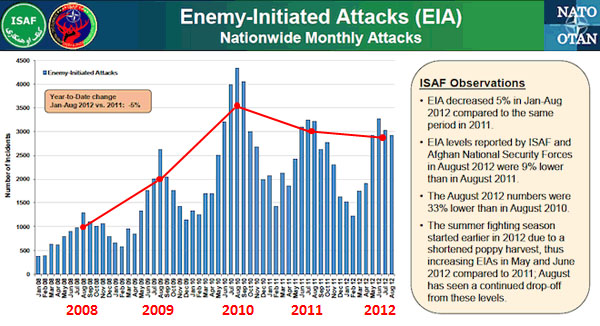
So with the Afghanistan surge now over, how did it work? As Spencer Ackerman reports, by the military’s own metrics, it hasn’t. Insurgent attacks are down slightly compared to last year, but they’re still way up compared to 2009, the year before President Obama doubled our troop presence there:

The chart [below, with red line added] measures the various attacks the Taliban and associated insurgents launched against NATO forces, month by month. In August 2009, the peak of the fighting season and the height of the internal Obama administration debate over a troop surge, insurgents attacked U.S. and allied troops — using small-arms fire, homemade bombs, mortars and more — approximately 2,700 times. In August 2012, they attacked just shy of 3,000 times.

In August 2009, insurgents used just under 600 homemade bombs on U.S.-aligned forces. They used just over 600 homemade bombs on U.S.-aligned forces in August 2012.

The same trend holds for every other month in 2009 compared to every month in 2012 for which there is data: The insurgency launched more attacks this year. In some cases, substantially more: insurgents attacked about 2,000 times in July 2009 and a shade over 3,000 times in July 2012. ISAF registered about 475 attacks from homemade bombs in July 2009; and about 625 in July 2012.

Perhaps Obama should take a hint from Apple CEO Tim Cook, who said today that he is “extremely sorry” for subjecting his customers to a new, bug-ridden maps app. Obama ought to be sorry too.
What’s independent journalism worth to you?

Our news will always be free to read, watch, and listen to online. But what is its value?

Unbiased reporting on the issues that billionaire-owned newsrooms won’t touch. Fearless research into the dark corners of government and corporations. Ferociously fact-checked news that focuses on the facts, and the facts alone.

It IS free for you and every reader, viewer, and listener to utilize. But it’s not free for our team to make. So, what’s it worth to you? Let us know by making a donation: Make a one-time donation today to support this work. Or make a monthly sustaining donation to help us plan for the future.

Whatever you choose, know that you’re supporting more independent, investigative journalism in a time when we need it most.

What’s independent journalism worth to you?

Our news will always be free to read, watch, and listen to online. But what is its value?

Unbiased reporting on the issues that billionaire-owned newsrooms won’t touch. Fearless research into the dark corners of government and corporations. Ferociously fact-checked news that focuses on the facts, and the facts alone.

It IS free for you and every reader, viewer, and listener to utilize. But it’s not free for our team to make. So, what’s it worth to you? Let us know by making a donation: Make a one-time donation today to support this work. Or make a monthly sustaining donation to help us plan for the future.

Whatever you choose, know that you’re supporting more independent, investigative journalism in a time when we need it most.

We Recommend

Latest

Sign up for our free newsletter

Subscribe to the Mother Jones Daily to have our top stories delivered directly to your inbox.

Get our award-winning magazine

Save big on a full year of investigations, ideas, and insights.

Subscribe

INDEPENDENT. BECAUSE OF YOU.

Mother Jones has no billionaires calling the shots—just readers like you making fearless reporting possible

Donate