• Oral Contraceptives Ought to be Prescribed in Yearly Quantities

    Virginia Postrel proposes a simple way to take the edge off the current row over forcing healthcare plans to cover prescription contraceptives: make them available over the counter. This wouldn’t eliminate the controversy completely, since it would apply only to oral contraceptives, but it might lower the temperature a bit:

    Partly because birth-control pills are available only by prescription, people tend to think they’re more dangerous and less well understood than they actually are. In fact, “more is known about the safety of oral contraceptives than has been known about any other drug in the history of medicine,” declared an editorial in the American Journal of Public Health back in 1993. That editorial accompanied an article arguing for over-the-counter sales…. Nearly two decades later, birth-control pills look even safer than they did then, and recent research indicates that women are both able and eager to manage their own purchase decisions.

    ….Aside from safety, the biggest argument for keeping birth-control pills prescription-only is, to put it bluntly, extortion. The current arrangement forces women to go to the doctor at least once a year, usually submitting to a pelvic exam, if they want this extremely reliable form of contraception. That demand may suit doctors’ paternalist instincts and financial interests, but it doesn’t serve patients’ needs.

    ….Right now, the American women who have the most choice are those who live near the border with Mexico, where pharmacies sell oral contraceptives without a prescription, generally for about $5 for a one-month supply. A group of researchers [] conducted extensive interviews with more than 1,000 women who live in El Paso, Texas….One result from the El Paso study surprised researchers. “Women who got the pill in clinics were significantly more likely to stop using it during the study — even though they still didn’t want to get pregnant,” Grossman says. That’s a big deal. In fact, he says, “my hope was that we would show that continuation was no worse for the OTC group, but in fact we showed it was better.”

    It’s not just doctors who resist making oral contraceptives available over the counter. Pharmaceutical companies usually resist it too. After all, it costs them money for extra testing and produces lower profits at the same time, since OTC meds generally have lower margins than prescription meds. That’s a lot of resistance to overcome.

    But here’s an interesting thing. The El Paso study that Postrel writes about did indeed find that women who got their pills at a clinic were more likely to stop taking them than women who bought them over the counter. However, that was only for women who got monthly prescriptions. Women who got six-month supplies had discontinuation rates that were nearly identical to those who bought OTC pills.

    This gibes with another study done in California that compared continuous use of contraceptives among women who got monthly supplies vs. women who got yearly supplies. Over the following 15 months, the women who got yearly supplies were less likely to run out, less likely to get pregnant, and less likely to have an abortion.

    Making oral contraceptives available over the counter might be a good idea, but it’s not something likely to happen any time soon. In the meantime, though, providing women with annual supplies instead of making them visit a clinic or refill their scripts every month might have nearly the same benefit. This would require both doctors and insurance companies to change the way they do business, but given the safety of the drugs and the danger associated with running out, annual prescriptions probably ought to be the default.
  • Is BellGate a Harbinger of Worse to Come?

    Yesterday, having watched the ludicrous Derrick Bell “scandal” evolve in the wingosphere, I took a trip down memory lane and recapped the frenzy of race-baiting that erupted from the right-wing media machine just before the 2010 elections. If recent press reports are correct, 2012 is also an election year, which suggested to me that we just might be in for a repeat performance this summer.

    That, however, is pedestrian thinking. Ed Kilgore — who hails from the South; has been involved in politics longer than me; and has a more active imagination than I do — sees a double bank shot at work:

    What strikes me about the Bell “scandal,” however, is how relatively little it seems to have to do with Barack Obama. The “story” has very quickly moved on from Obama’s anodyne introduction of Bell at a 1991 Harvard protest, to Bell’s supposed “racialism,” and to the “racialism” supposedly suffusing academia and for that matter, educational affirmative action in general.

    ….It almost seems like what our wingnut friends most want is to poke the stick at racial issues so that can scream about the horrible indignity of being accused of racism, as though they are seeking insulation against future charges of race-baiting. My concern is that’s a sign something a lot worse than video of Barack Obama with Derrick Bell could be on the way.

    I like the way you think, Brother Ed! Conservatives have long demonstrated a remarkable amount of out-of-the-box creativity when it comes to attack politics, and it’s something we could stand to learn from.

    I’m not sure I actually believe this one, though. The Bell affair just has too many signs of being a huge cockup, not some cleverly nefarious plot to get a rise out of lefties. The wingers saw Barack Obama + radical critical race guy and they were off to the races.

    But is there worse to come? Probably. So I guess Ed and I end up in the same place regardless of how we got there.

  • Sometimes the Simple Lies are the Best


    There are all sorts of clever ways to game the system so that it looks like you’re doing better than you really are. The LA Fire Department, however, decided not to bother with anything fancy:

    Federal guidelines call for first responders to arrive on scene in under five minutes 90% of the time. But a former department statistician counted all responses within six minutes, officials explained, which improved the record. Retired Captain Billy Wells, who crunched the data with a hand calculator, said he followed the department’s long tradition of using a six-minute response standard.

    Wells’ successor, Capt. Mark Woolf, said he reluctantly continued using the flawed formula for a time because he didn’t want to be blamed for a sudden drop in department performance. “I didn’t want to touch that [extra] minute because I knew the data would take a dump,” he said.

    Apparently the department fessed up after a mayoral candidate complained that response times had dropped due to budget cutbacks. But it turns out that response times had actually dropped mostly because the LAFD finally stopped lying about them. When and why did they stop lying? Sadly, the article doesn’t explain. Perhaps we’ll find out tomorrow.

  • Friday Cat Blogging – 9 March 2012

    On the left, Inkblot is looking soulfully into the depths of an empty wine glass. The effect is, perhaps, spoiled slightly by the fact that he’s perched on top of a nice, warm pizza box, but that just shows that he’s a cat of the people. Do you think Mitt Romney ever curls up with a pizza? On the right, in a picture taken earlier this morning, Domino gazes confidently into the future, secure in the knowledge that the carpet cleaning people will be finished soon. Behind her, Inkblot is holding onto Marian for dear life because he’s afraid the carpet cleaners will be here forever and he’ll never be able to go back into the house again. This is, unfortunately, not very presidential behavior, but no candidate is perfect.

  • Will 2012 Be a Reprise of 2010’s Summer of Hate?

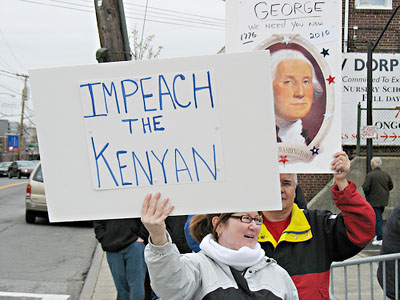
    July and August of 2010 were a festival of xenophobia and racial rage from the news organs of the right. Among the topics that generated wall-to-wall coverage on a serial basis that summer were (1) the New Black Panthers, (2) Arizona’s new immigration law, (3) the “anchor baby” controversy, (4) the “Ground Zero” mosque, (5) the Shirley Sherrod affair, (6) a new upwelling of birther conspiracy theories, (7) Glenn Beck’s obsession with Barack Obama’s supposed sympathy with “liberation theology,” and (8) Dinesh D’Souza’s contention — eagerly echoed by Newt Gingrich — that Barack Obama can only be understood as an angry, Kenyan, anti-colonialist. Plus I’m probably forgetting a few.

    But last summer was pretty quiet. Maybe the right had finally learned its lesson? As it turns out, no. Apparently it’s just that 2011 wasn’t an election year, so there was no point in pushing racial hot buttons all summer long. But 2012 is very much an election year and things are heating up early this time around. I’m speaking, of course, of the latest race-baiting pseudo-exposé on the right: the long-promised video demonstrating just how radical Barack Obama was back in his Harvard Law School days — and probably still is, though of course he’s cannily learned to hide his radicalism from the sheeple now that he’s president of the United States.

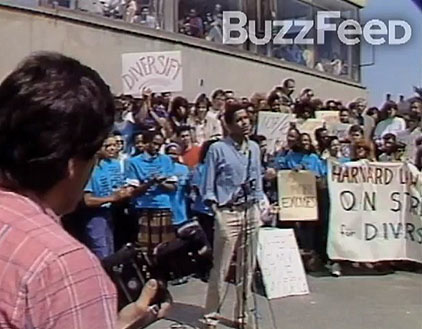
    Long story short, the late Andrew Breitbart’s site has gotten hold of a video of Barack Obama in 1991 speaking in support of Derrick Bell, a firebrand black law professor at Harvard who, at the time, was demanding that Harvard hire some women of color. Shocking! This video, however, was nothing new. It had been shown on PBS in 2008. Obama’s speech had been mentioned in books. BuzzFeed put up the video on their site before the Breitbart folks did. And the Derrick A. Bell who visited the White House last year turned out to be some other guy named Derrick A. Bell, not the famous law professor. The whole thing is a nothingburger. Paul Waldman comments:

    From the beginning of Breitbart’s enterprise, race-baiting was a key element of his attack on Barack Obama, one that continues even after his death. And he always had plenty of company, from Glenn Beck saying Obama “has a deep-seated hatred of white people,” to Rush Limbaugh’s repeated insistence to his white listeners that Obama was motivated by racial hatred in everything he did. “Obama’s entire economic program is reparations,” Limbaugh proclaimed. “The days of [minorities] not having any power are over, and they are angry,” he said. “And they want to use their power as a means of retribution. That’s what Obama’s about, gang.” When in 2009 he found a story about a white kid getting beaten up by a black kid on a school bus, Limbaugh said, “In Obama’s America, the white kids now get beat up with the black kids cheering, ‘Yay, right on, right on, right on, right on.'” And yes, he did that last part in an exaggerated “black” accent.

    Paul optimistically suggests that the sheer lameness of the Derrick Bell episode demonstrates that the race-baiting precincts of the right have a problem: “they’re running out of material.” I’d sure like to believe that. But in early 2010, would you ever have guessed that the New Black Panthers would be feted with a multi-week run on Fox News? Or that something called the “Ground Zero mosque” would suddenly burst into prominence based on the hysterical blog posts of Pamela Geller? Or that we’d spend a couple of weeks talking about “anchor babies”?

    If you did, you’re a lot smarter than me. So I’m more pessimistic. It’s an election year, and the idea that Obama is a secret radical remains a common trope among folks like National Review’s Andrew McCarthy and his like-minded scribblers. It’s also great for ratings among the talking-head set. So I suspect we’re going to see a lot more stuff like this. It’ll all just be a big coincidence that every few weeks produces yet another “controversy” that happens to appeal to underlying racial resentments, of course. There will be much tut-tutting about hypersensitive lefties seeing racism under every rock.

    I hope to be proven wrong about this. We’ll see.

  • The Fed Should Help Out the Recovery by Letting Inflation Rise a Bit

    We had some pretty decent jobs numbers today: 227,000 new jobs in February and an upward revision for January to 284,000 new jobs. Hooray! And with that out of the way, I’m going to profoundly abuse the principles of fair use and republish this post of Karl Smith’s in its entirety:

    I had considered oil prices to be the primary threat to an accelerating recovery. I do think the fundamentals are ripe for an accelerating job creation rate. 300K+ a month is not fundamentally unrealistic at all.

    I now believe, however, a panic-y federal reserve and an over-obsession with keeping inflation expectations moored is the biggest threat.

    For now I think it should be the mission of every Journalist to harp on Fed Officials as to why they are willing to tolerate half a decade of unemployment above 5% and the devastation and loss of skills associated with that but they are not willing to tolerate Core-PCE rising above 2%?

    I still think oil prices are a potential problem area, as is Europe — though the EU seems to have successfully kicked the can down the road for a while and is probably not an immediate threat. And in the Fed’s defense, they’ve made it clear that interest rates are going to stay super-low for quite a while.

    Still, a wee bit of higher inflation would be pretty welcome. Just as insurance, mind you. Let’s do everything we can to avoid an economic relapse, OK?

  • Arizona Moves to Bar “Wrongful Birth” Lawsuits


    Aaron Carroll asks:

    Should doctors be protected by law for withholding information from patients that their patients might want to know?

    Hmmm. I guess the correct answer is “no.” But I’m a little confused about whether anyone actually disagrees about this.

    At issue is an Arizona bill that would bar “wrongful birth” and “wrongful life” suits. These suits have a long history, and are generally brought by parents who believe their physician failed to tell them about a prenatal problem that might have led them to seek an abortion if they’d known about it. Some states allow these suits, some don’t. But does the Arizona bill protect a doctor who, perhaps because he or she opposes abortion on principle, deliberately withholds information that could lead the mother to seek an abortion?

    It doesn’t seem like it to me. The bill in question is SB 1359, and it’s pretty short. Here’s paragraph D:

    This section does not apply to any civil action for damages for an intentional or grossly negligent act or omission, including an act or omission that violates a criminal law.

    Any Arizona readers care to comment? Is there some kind of legal distinction between “negligent” and “grossly negligent” that’s germane here? Is “intentional” so hard to prove that in practice no one can ever do it? Is there some key distinction between a wrongful birth tort and an ordinary malpractice tort? This bill is obviously motivated by pro-life principles, and obviously it does something. But it plainly doesn’t allow doctors to deliberately lie about prenatal conditions. Still, perhaps it gives them more wiggle room to “accidentally” miss something or “just decide” not to run a test? I can’t tell. Doctors, lawyers, and Arizonans are urged to weigh in and educate the rest of us.

  • No, Virginia, There Are No Independent Voters


    Any book review that starts like this is probably worth reading:

    I suppose we should be grateful to Linda Killian. Her new book collects in one place every clichéd and suspect empirical generalization about political independents. So in that sense—and only in that sense—it is a useful volume.

    That’s from Ruy Teixeira. His simple point is one that regular readers will be familiar with: most “independent” voters are actually pretty partisan. Indies who lean Democratic vote Democratic and indies who lean Republican vote Republican. They’re just about as reliable in their voting patterns as actual Democrats and Republicans. This has long been common knowledge among political scientists who actually look at voting data.

    But what about the folks who don’t lean at all?

    Yet the “independent” group does include one sub-group whose members look and act more like swing voters. This is the so-called pure independents subgroup, those who say they do not lean toward either party. In 2008, they split their vote much more evenly between the parties—51-41 for Obama—and they have policy views that are not closely aligned with either party. But this is a small group, and because it tends to show low information, low involvement, and relatively low turnout, it is even smaller in the context of an actual election. In 2008, according to the NES, they were just 7 percent of all voters and only 20 percent of nominally independent voters.

    Independent voters aren’t entirely a myth, but they’re surely an endangered species. There just aren’t as many of these fabled creatures as the mainstream press endlessly suggests. Like it or not, we’re a partisan country.

  • Good News! Obamacare Will Cost Less than Projected

    As long as we’re on the subject of healthcare, have you heard about the conservative discovery that Obamacare is going to cost $111 billion more than originally projected? No? Good for you. It means you have a life.

    But I don’t, and in case you have heard about this you might also want to hear the actual story. Jonathan Cohn has you covered:

    After the Affordable Care Act became law, the administration became aware of a glitch in the law….Congress responded by amending the law, to redefine who would be eligible for Medicaid.

    ….As a result, some people who would have gotten their insurance through Medicaid will now get their health insurance through the new exchanges….That makes the overall cost of subsidies a lot higher. Throw in some changes in economic forecasting, and you get that extra $111 billion in subsidies.

    But that’s only half the story! The cost of subsidies has gone up, because more people will be getting insurance through the exchanges. But the cost of Medicaid has gone down, because, among other things, fewer people will be getting coverage through that program. Overall, the administration now projects the ten-year Medicaid cost to decline by $272 billion.

    So, um, subtract two, carry the one, and….you end up with net cost reduction of $161 billion over ten years. The actual number might end up being different once the accounting boffins grind all the way through their spreadsheets, but it looks a lot like it’s going to be negative.

    It’s worth pointing out, once again, the object lesson here: Obamacare isn’t perfect. It’s not set in stone. Stuff is going to go wrong and it’s going to get fixed. In a few cases, like the CLASS Act, things just aren’t going to work out and some element of the law will be abandoned. In other cases, like this one, mistakes will be corrected and costs will change modestly either up or down. And in still others, there’s really nothing wrong at all and conservatives are just trying to gin up some faux outrage. So take everything you hear with a grain of salt. Every big bill has problems, and those problems get addressed as implementation goes forward. Obamacare will be no different.