
• Presidents and the Bully Pulpit

    Do presidents really have the power to persuade? Citing the work of political scientists George Edward and Frances Lee, Ezra Klein writes in the New Yorker this week that they don’t. Not much, anyway. When presidents talk, he argues, all they really do is polarize: instead of persuading, they simply make partisan divides even starker. So if you didn’t have much of an opinion about contraceptive coverage a month ago, you probably do now — and thanks to President Obama’s intervention, you’re now for it if you’re a Democrat and against it if you’re a Republican:
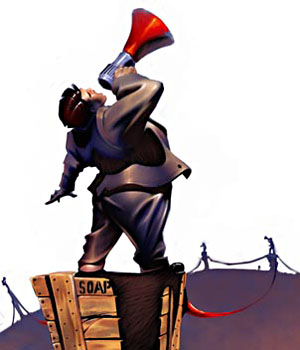
    Edwards’s work suggests that Presidential persuasion isn’t effective with the public. Lee’s work suggests that Presidential persuasion might actually have an anti-persuasive effect on the opposing party in Congress. And, because our system of government usually requires at least some members of the opposition to work with the President if anything is to get done, that suggests that the President’s attempts at persuasion might have the perverse effect of making it harder for him to govern.

    ….The question, [Paul] Begala says, is: What is the alternative to Presidential persuasion? “If you don’t try it at all, it guarantees you won’t persuade anybody,” he says. “And, to put it simply, your people in Congress and in the country will hate you if you don’t.” That’s the real dilemma for the modern White House. Aggressive, public leadership is typically ineffective and, during periods of divided government, can actually make matters worse. But passivity is even more dangerous. In that case, you’re not getting anything done and you look like you’re not even trying.

    The entire essay is worth a read. It’s surprisingly persuasive. And yet, that bolded passage makes a key point: even if presidential speeches don’t accomplish much, we really don’t know if shutting up would be any better. After all, we’ve never had a modern president who specialized in shutting up. And since it’s not a trait likely to lead to the Oval Office, we probably never will.

    I also think that Ezra doesn’t really grapple with the strongest arguments on the other side. For one thing, although there are examples of presidential offensives that failed (George Bush on Social Security privatization), there are also example of presidential offensives that succeeded (George Bush on going to war with Iraq). The same is true for broader themes. For example, Edwards found that “surveys of public opinion have found that support for regulatory programs and spending on health care, welfare, urban problems, education, environmental protection and aid to minorities increased rather than decreased during Reagan’s tenure.” OK. But what about the notion that tax cuts are good for the economy? The public may have already been primed to believe this by the tax revolts of the late ’70s, but I’ll bet Reagan did a lot to cement public opinion on the subject. And the Republican tax jihad has been one of the most influential political movements of the past three decades.

    More generally, I think it’s a mistake to focus narrowly on presidential speeches about specific pieces of legislation. Maybe those really don’t do any good. But presidents do have the ability to rally their own troops, and that matters. That’s largely what Obama has done in the contraception debate. Presidents also have the ability to set agendas. Nobody was talking about invading Iraq until George Bush revved up his marketing campaign in 2002, and after that it suddenly seemed like the most natural thing in the world to a lot of people.

    Beyond that, it’s too cramped to think of the bully pulpit as just the president, just giving a few speeches. It’s more than that. It’s a president mobilizing his party and his supporters and doing it over the course of years. That’s harder to measure, and I can’t prove that presidents have as much influence there as I think they do. But I confess that I think they do. Truman made containment national policy for 40 years, JFK made the moon program a bipartisan national aspiration, Nixon made working-class resentment the driving spirit of the Republican Party, Reagan channeled the rising tide of the Christian right and turned that resentment into the modern-day culture wars, and George Bush forged a bipartisan consensus that the threat of terrorism justifies nearly any defense. It’s true that in all of these cases presidents were working with public opinion, not against it, but I think it’s also true that different presidents might have shaped different consensuses.

    Maybe I’m protesting too much. I actually think Ezra has the better of the argument here. But even if public opinion can rarely be directly challenged and turned around, it can be molded and channeled. Presidents and their party machines can influence which latent issues stay dormant and which ones become national obsessions. They can take advantage of events in ways that others can’t. After all, talking is what human beings do. It’s hard to credit the idea that it never really accomplishes anything.
  • Justice Department Blocks Texas Photo ID Law

    The state of Texas recently adopted a law that requires residents to present photo ID at the polling place before voting. These kinds of laws are problematic even in the best cases, but Texas being Texas, their law is almost laughably brazen in its intentions. For example, in addition to driver’s licenses, the law specifies that military ID and handgun permits are acceptable forms of identification; specifies that student IDs aren’t acceptable forms of identification; and automatically qualifies elderly voters to cast mail-in ballots, which require no ID. In other words, the law does its best to make voting easy for every possible identifiably Republican-leaning constituency and hard for every possible identifiably Democratic-leaning constituency.

    And those are just the identifiable Democratic constituencies. There are others that, for pesky legal reasons, can only be indirectly targeted: primarily blacks, Hispanics, and the poor. These constituencies lack photo ID at higher rates than white, middle-class voters, and this is what the Justice Department homed in on today when it put the Texas law on hold:
    Our analysis of the January data indicates that 10.8 percent of Hispanic registered voters do not have a driver’s license or personal identification card issued by DPS, but only 4.9 percent of non-Hispanic registered voters do not have such identification. So, Hispanic registered voters are more than twice as likely as non-Hispanic registered voters to lack such identification.

    ….An applicant for an election identification certificate will be required to provide two pieces of secondary identification, or one piece of secondary identification and two supporting documents. If a voter does not possess any of these documents, the least expensive option will be to spend $22 on a copy of the voter’s birth certificate….As noted above, an applicant for an election identification certificate will have to travel to a driver’s license office. This raises three discrete issues. First, according to the most recent American Community Survey three-year estimates, 7.3 percent of Hispanic or Latino households do not have an available vehicle….Second, in 81 of the state’s 254 counties, there are no operational driver’s license offices….The third and final point is the limited hours that such offices are open. Only 49 of the 221 currently open driver’s license offices across the state have extended hours.

    The second paragraph here is a key one. Lots of people assume that getting photo ID is no big deal. Most people have it, and even the ones who don’t can easily get it. After all, it’s free! But that’s not true. First, you need a birth certificate. Middle-class folks might not realize this, but not everyone has a birth certificate handy, and both the hassle factor and the cost of getting one can be real deterrents. Add to that the hassle of getting a ride to a DMV office two counties away during working hours, and voting in the next election suddenly got a whole lot harder for you than it is for your average middle-class white suburbanite. You might even never get around to it.

    Which, of course, is the whole idea. Kudos to the Justice Department for pointing that out and doing the right thing here by putting the Texas law on hold.

  • On Third Thought, the Economy is Recovering Fairly Nicely

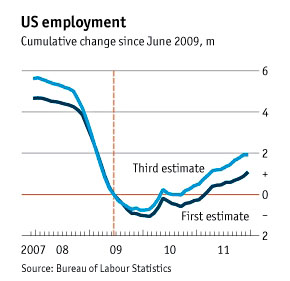
    Today is my day for publishing charts that I find interesting but don’t quite know what to think of. As you all know, government estimates of job losses and gains each month are released a few days after the end of the month. Then they’re revised, and then, two months after the initial estimate, they’re revised one last time. Mostly, though, only the first estimate ever gets much attention.

    But those revisions matter, as Ryan Avent shows in the chart on the right. The light blue line shows employment changes based on the third and final estimate, and compared to the initial estimates (dark blue) it shows that the Great Recession was both deeper than we thought and that the recovery has been more robust than we thought. On the downside, we lost something like 6.5 million jobs instead of 5.5 million, but since then we’ve gained something like 3 million jobs instead of 2 million. (As always, the little spike in 2010 is due to temporary census jobs.)

    In one sense this doesn’t matter. Both lines show that we’re about 3.5 million jobs below the previous peak. And neither line shows much acceleration in the jobs picture over the past year. Still, while this chart shouldn’t change our minds a lot about how well the economy has been doing recently, it does suggest there’s a little more cause for optimism than the headline numbers have suggested in real time.

  • Credit Conditions are Still a Headwind Against Economic Recovery

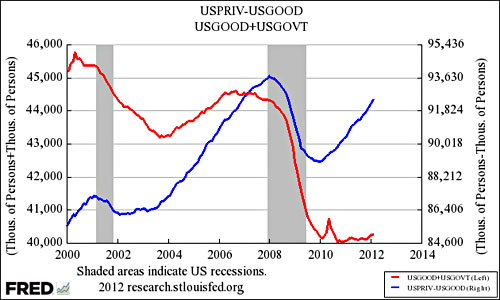
    I don’t even quite know what to make of this chart from Karl Smith, but here it is anyway for everyone to ponder. The red line represents employment by the government and by goods-producing sectors. Kablooey! The blue line represents employment by everyone else. Not bad!

    Karl’s take is that this demonstrates that the economy is still highly sensitive to credit conditions:

    We are largely talking about construction workers, metal and automotive workers, and school teachers. These workers are massively influenced by credit constraints. One cannot build a building without credit. One cannot buy a vehicle without credit and state and local governments have very little credit room by statute.

    So what we need for job growth to really hit its stride is for construction to come back, cars to come back and school teachers to come back….Because these sectors respond so much to liquidity the job recovery is still fragile.

    I’m not sure I buy the idea that government as a whole is sensitive to credit constraints. Obviously the federal government isn’t, and states are constrained by balanced-budget requirements at all times. But perhaps the ease of issuing state and municipal bonds has plummeted during the recession? I’m not sure.

    Generally speaking, I suspect this chart says more about the housing/construction market in particular than it does about broader capital goods, which I think have rebounded fairly decently over the past year or two. It also says something about reduced state and local spending, though I don’t think it’s fair to call that a credit issue. It’s more a statutory problem combined with bad austerity policy at the federal level. Further thoughts welcome, though.

  • When Is a Terrorist Group Not a Terrorist Group?

    The People’s Mujahedin of Iran, aka MEK, has long been designated as a terrorist group by the State Department. However, it was removed from the EU’s terrorist list in 2009, and there’s considerable controversy over whether MEK should continue to receive that designation from the United States. Today the group claims to be nonviolent and to represent a “parliament-in-exile” opposed to the current Iranian regime.
    Nonetheless, it does in fact remain an officially designated terrorist organization in the United States, and providing material support for a designated terrorist group is illegal. As Glenn Greenwald points out today:

    In June, 2010, the U.S. Supreme Court issued its 6-3 ruling in the case of Holder v. Humanitarian Law. In that case, the Court upheld the Obama DOJ’s very broad interpretation of the statute that criminalizes the providing of “material support” to groups formally designated by the State Department as Terrorist organizations. The five-judge conservative bloc (along with Justice Stevens) held that pure political speech could be permissibly criminalized as “material support for Terrorism” consistent with the First Amendment if the “advocacy [is] performed in coordination with, or at the direction of, a foreign terrorist organization” (emphasis added). In other words, pure political advocacy in support of a designated Terrorist group could be prosecuted as a felony—punishable with 15 years in prison—if the advocacy is coordinated with that group.

    You may think this was a bad ruling. But a ruling it is, and it’s the law of the land. And yet, a large cast of worthies, including Rudy Giuliani, Howard Dean, Michael Mukasey, Ed Rendell, Andy Card, Lee Hamilton, Tom Ridge, Bill Richardson, Wesley Clark, Michael Hayden, John Bolton, Louis Freeh, and Fran Townsend have actively lobbied for MEK and have apparently done it in coordination with MEK’s leadership.

    So shouldn’t this be against the law? Glenn, in particular, calls out Townsend, former Homeland Security Advisor under George Bush, who was a vocal supporter of the Humanitarian Law ruling. She actively supports MEK, yet appears to be under no threat of prosecution from the Obama Justice Department. Glenn again:

    An NBC News report from Richard Engel and Robert Windrem in February claimed that it was MEK which perpetrated the string of assassinations of Iranian nuclear scientists, and that the Terrorist group “is financed, trained and armed by Israel’s secret service” (MEK denied the report).

    ….Even the dissenters in Humanitarian Law argued that the First Amendment would allow “material support” prosecution “when the defendant knows or intends that those activities will assist the organization’s unlawful terrorist actions.” A reasonable argument could certainly be advanced that, in light of these recent reports about MEK’s Terrorism, one who takes money from the group and then advocates for its removal from the Terrorist list “knows or intends that those activities will assist the organization’s unlawful terrorist actions”: a prosecutable offense even under the dissent’s far more limited view of the statute.

    Discuss! Is support for MEK allowed because (a) their patrons are VIPs, not random Muslim schmoes, (b) MEK’s allegedly lethal activities are aimed at Iran, which everyone thinks is wink-wink-nudge-nudge just fine, or (c) because there’s some legitimate legal issue that distinguishes what Townsend and Rendell are doing from other cases of material support that have been prosecuted in recent years? I’d be genuinely curious to hear the other side of this argument.

  • The Abortionization of Contraceptives


    Neera Tanden writes today that our recent contraception debate is basically the end point of a trap set by liberals over a decade ago: in the wake of the partial-birth abortion debacle of the late 90s, Hillary Clinton held a meeting of women’s groups in which she urged them to shift the debate toward coverage of contraception in healthcare plans. “And if that debate took place in a way that demonstrated the extremes of the anti-choice position—so be it.”

    I’m a little skeptical that a single meeting 14 years ago was really the root cause of today’s fight, but who know? Maybe it was. More interesting, I think, is the evidence that it wasn’t really much of a trap because initially the religious right didn’t especially care about it:

    It was a Republican Senator, Olympia Snowe, who introduced the Equity in Prescription Insurance and Contraceptive Coverage Act (which lacked any sort of “conscience exception”) in 1999, and plenty of Republicans co-sponsored it.

    ….[In 2000, legislation in New York] — like the original Obama policy — only allowed an exemption for houses of worship, not religiously affiliated hospitals or colleges, perhaps because its authors recognized that the vast majority of employees at these institutions are not Catholic. But the Catholic Church did not actively resist, or try to prevent the bill’s passing….And, in some states, religious groups were silent altogether. In 1999, New Hampshire passed a law requiring contraceptive coverage in all prescription drug plans. (The law was passed by a Republican legislature and signed by a Democratic governor.) Both lawmakers and religious groups never raised the issue of religious liberty during the legislative debate; in fact, there was not a single discussion on that issue according to the legislative history.

    Back in the late 70s it was Jerry Falwell and a few others who converted an evangelical movement that was only moderately anti-abortion into the virulent pro-life activists of today. I’m not sure if there’s a specific person, or small group of people, who are similarly responsible for this latest turn, but it resembles the previous one in a lot of ways. A decade ago, contraception wasn’t a big deal, even among conservative Christians. Today it’s a litmus test and the latest battleground in the culture wars.

    So what’s next?

  • The Middle Class Really Is in a Three-Decade Slump

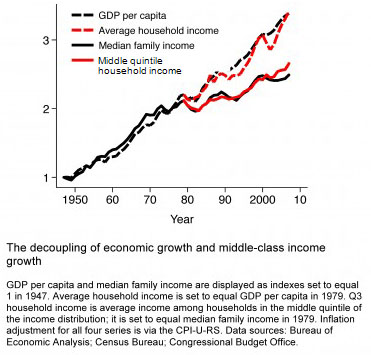
    Did middle-class incomes really decouple from overall economic growth in the mid-’70s? If you look at median family income vs. GDP per capita, the answer is yes. From 1950 through 1975, both grew at about the same rate. After that, median family income grew quite a bit more slowly than GDP per capita.

    But wait! You need to make sure to calculate inflation the same way for both measures. And maybe GDP per capita is a bad measure. Plus you need to account for health insurance and other benefits when you calculate median income. And the number of people per household has changed over time. These are all legitimate issues. So Lane Kenworthy redrew the chart to compare apples to apples: median household income vs. average household income. Median income shows only the movement of households that are smack in the middle of the middle class, while average income is similar to overall economic growth since it depends on total national income.

    In the chart below, the black lines are the original comparison. The red lines are the new comparison. As you can see, there’s really not much difference. “Decoupling,” say Kenworthy, “is real and sizable.” The rich really are hoovering up a much bigger share of national income than they used to. The only thing left to argue about is why, not whether.

  • Barack Obama’s Had a Pretty Damn Good Presidency

    In the upcoming issue of the Washington Monthly, Paul Glastris has a cover story called “The Incomplete Greatness of Barack Obama,” a headline almost guaranteed to set your teeth on edge. Normally I’d just blame the copy desk and move on, but since Glastris is both writer and editor, there’s no way to let him off the hook for this. What were you thinking, Paul?

    But let’s move on anyway. Glastris’ argument, obviously, is that Obama has been a pretty good progressive president. So why doesn’t he get more credit from us lefties?

    There are plenty of possible explanations. The most obvious is the economy. People are measuring Obama’s actions against the actual conditions of their lives and livelihoods, which, over the past three years, have not gotten materially better. He failed miserably at his grandiose promise to change the culture of Washington…In negotiations, he came off to Democrats as naïvely trusting, and to Republicans as obstinately partisan, leaving the impression that he could have achieved more if only he had been less conciliatory—or more so, depending on your point of view. And for such an obviously gifted orator, he has been surprisingly inept at explaining to average Americans what he’s fighting for or trumpeting what he’s achieved.

    As long as we’re piling on, I’d add a few other items to that list. First, Obama seems to despise the progressive base. He and his associates have made that clear over and over again. Second, he allowed Congress to take the lead on most of his domestic agenda. Whether this was smart or not doesn’t really matter. What matters is that it makes him seem almost like an observer of events over the past three years, not a commander-in-chief. Third, from a progressive point of view, his record on national security is pretty bad. No, we’re not torturing prisoners anymore, but the NSA surveillance program is still in place, American citizens are being targeted for assassination, the Afghanistan war has been escalated, drone attacks have skyrocketed, the state secrets privilege is still being used with abandon, Guantánamo is still open, and Patriot Act abuse seems to be as robust as ever.
    And yet, there’s still…the entire rest of his record. After all, Obama deserves to be judged by ordinary human standards, not by standards of perfection. A sidebar to Glastris’ piece lists Obama’s top 50 accomplishments, and I think it was a mistake to create a list so long. It ends up looking like the usual boring laundry list that any president can trumpet. Better to pare it down to 10 really top achievements in order to highlight how many truly major accomplishments Obama has been responsible for. So I did. Except I couldn’t get there. I cut it down to 13 and got stuck. Here they are, in the same order as the original Washington Monthly list:

    1. Passed Health Care Reform
    2. Passed the Stimulus
    3. Passed Wall Street Reform
    4. Ended the War in Iraq
    6. Eliminated Osama bin Laden
    7. Turned Around US Auto Industry
    9. Repealed “Don’t Ask, Don’t Tell”
    12. Reversed Bush Torture Policies
    14. Kicked Banks Out of Federal Student Loan Program
    16. Boosted Fuel Efficiency Standards
    18. Passed Mini Stimuli (July 22, 2010; December 17, 2010; December 23, 2011)
    22. Created Conditions to Begin Closing Dirtiest Power Plants
    27. Achieved New START Treaty

    These are all big deals. Big fucking deals, to quote our vice president. Unless you’re just bound and determined to sulk in your tent while insisting that health care was a sellout and the stimulus was too small and Dodd-Frank was feeble and the mini stimuli were more like micro stimuli, there’s just no way around the fact that this is a historically colossal set of progressive accomplishments, especially in the face of a historically hostile political environment.

    Obama has gotten more done for the progressive cause than Bill Clinton, Jimmy Carter, JFK, or Harry Truman.

    Now, it’s true that any serious accounting also has to include Obama’s domestic failures—most notably his feckless housing policy and his inability to pass cap-and-trade—but both of those were very heavy political lifts. (On cap-and-trade in particular, I think in retrospect that it was just flatly never going to happen no matter what Obama did.) There’s also his weak record on judicial appointments. So could Obama have done better? Was there a more effective way to deal with an unprecedentedly obstructive Republican Party? On reflection, I doubt it. During Obama’s first two years, Democrats had a filibuster-proof majority in the Senate for only 14 weeks. This means that Obama needed two or three Republican votes for every bill, and if he had taken the blustering, partisan attitude that a lot of liberals wanted, he never would had gotten them. Republican obstructionism would have been even more hardened than it was with his more conciliatory attitude. So as annoying as Obama’s “most reasonable man in the room” act was to the progressive base, it was probably his best strategy.

    I was never an Obamamaniac. Actual politicians are never as good as the versions that star in the reality TV shows that we laughingly call presidential campaigns these days, and Obama was bound to be hemmed in by all the same dynamics that hem in every president. So I don’t judge Obama against a standard that expected him to single-handedly lead a progressive revolution. His national security policy has been disappointing but hardly a disgrace. It’s just a continuation of the mainstream national security policy that both parties have endorsed for decades with only minor differences. His economic policy since late 2009 has been, perhaps, too concerned with long-term deficits at the expense of short-term job creation, but that’s been due more to political realities than to bad instincts. Likewise, his general willingness to compromise has been evidence of a pragmatic desire to get things done, not a sign of insufficient dedication to the cause. He’s a president, not the Sun King.

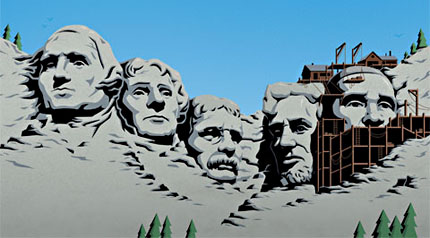
    Unlike Paul Glastris, I’m not ready to start chiseling Obama’s mug on Mount Rushmore. But unless national security is pretty much your sole obsession, I really have a hard time understanding progressives who are disappointed in him. Obama has gotten more done for the progressive cause than Bill Clinton, Jimmy Carter, JFK, or Harry Truman—and, on balance, nearly as much as LBJ, since he doesn’t have any epic disasters to weigh down his successes. For an actual, existing human being, that’s pretty damn good.

  • Breaking News: Lots of People Really Don’t Like Their Jobs Much

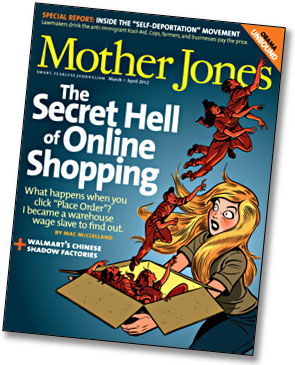
    In the current issue of MoJo, Mac McClelland has a cover story, “I Was a Warehouse Wage Slave,” about life in a gigantic distribution center that fulfills online orders from some unnamed location in the rural heartland of America. Mac worked as a “picker,” someone who dashes around the warehouse and fills up plastic tubs with the specific stuff people have ordered. In days of olde, you did this by referring to a piece of paper called a pick list, but modern warehouses have automated the whole process. In Mac’s warehouse, a mobile scanner unit told her what items to get and where to find them, and then marked each item as completed after she scanned it and put it on the conveyor belt to the packing/shipping department.

    As you will learn if you read Mac’s piece, this is grueling, physical work. You work ten-hour days, you have a quota that requires you to jog through the warehouse the entire time, lunch and potty breaks are short, the temperature is often either stifling or freezing, and there’s no real prospect of advancement. Oh, and the pay is pretty crappy too. People don’t much like working there.

    I was reminded of Mac’s story Friday night as Marian and I watched the latest episode of Undercover Boss. This is an occasional guilty pleasure, fascinating to me because of the particular morality play that unfolds each week. Basically, the CEO of some large-ish corporation dons a disguise and goes out to toil among the common laborers who work for his company. It’s kind of a weird cross between The Prince and the Pauper and Queen for a Day. The boss is typically portrayed as a well meaning but clueless type who eventually comes to appreciate the virtues of the working man (that’s the Prince and the Pauper part1), and at the end of the show each employee he’s come into contact with is let in on the ruse and given a raft of cash and prizes to help make their working-class lives a little more tolerable (that’s the Queen for a Day part).

    Friday’s episode starred Sam Taylor, CEO of Oriental Trading Company, a huge direct seller of craft and party supplies. Taylor loves OTC because its products are “fun,” and he’s enamored with the idea of running a company that’s dedicated to helping people have fun. And here’s the thing: Taylor seems like a perfectly decent guy. Not a moron, not a monster, not a Gordon Gekko.

    And yet: when he went to work for a few hours as a trainee picker in OTC’s warehouse, he was genuinely shocked to learn that Troy, the guy who shows him the ropes, really doesn’t like his job much. Taylor thinks jobs at OTC ought to be fun! Marian and I, who have both worked in manufacturing environments (though never on the floor as pickers), were just sitting there agog. I mean, even in a great company, being a picker isn’t any fun and doesn’t pay much. Nobody in his right mind actively enjoys the work. It’s a way to put food on the table and not much more.

    The same thing happened in Taylor’s next job, loading boxes into a truck. Not much fun! Packing up finished orders? Not much fun! Scanning stuff and tossing it onto OTC’s (admittedly very cool) automated conveyor belt? Not much fun!

    This isn’t to say there’s anything wildly wrong with OTC. There’s no way to tell from the edited bits on the show. But it’s a distribution company. Most of the warehouse work is physically demanding, all of it boring, it’s uncomfortable when temperatures get into the 90s, and the supervisors expect you to keep up a brisk pace no matter what job you have. Not much fun!

    Kathleen Geier, guest blogging at the Washington Monthly this weekend, quotes Corey Robin on this subject:

    I wish academics, journalists, intellectuals, and bloggers had a more concrete sense of what it’s like to work in an actual workplace in America (not to mention elsewhere). Sometimes, it seems that scholars and writers, if they think about it at all, simply assume the typical workplace to be a seminar room, a newsroom, the cafe around the corner, or their office at home.

    Well, maybe not quite that bad. But he has a point. I figure I lead about as sheltered a life as anyone not born into great wealth can lead, but hell, even I have a nodding acquaintance with what a warehouse is like. If I were CEO of a company where distribution was a mission critical part of my operation, I expect I’d have an even better idea. But Sam Taylor apparently didn’t. And I imagine there are a lot more like him.

    Lots of work is inherently tedious and low paying. That’s true even at companies that treat their workers pretty well. No one should be surprised that low-paid warehouse workers don’t like their jobs much, just as nobody should be surprised that they aren’t very excited about the prospect of retirement ages going up. Retiring at age 70 is fine for talking heads and newspaper columnists, who basically like their work and get paid pretty well, but not so fine for someone whose job is hustling around a warehouse eight hours a day picking stuff off of shelves and tossing it into plastic tubs. Some of the talking heads and columnists who blather on about this probably ought to watch Undercover Boss once in a while. They might learn as much as Sam Taylor did.

    1In The Prince and the Pauper, a young prince trades places with a peasant boy and learns what the world looks like from the bottom up. At the end, the switcheroo is corrected and everyone who treated the prince well is richly rewarded. However, although the prince learns a personal lesson from all this, nothing of any real consequence changes in the kingdom and life still sucks for most of the workers. This is almost precisely how Undercover Boss plays out each week.

