• Friday Cat Blogging – 2 November 2012

    When I sat down on the floor to take a picture of Domino this morning, she immediately made a beeline for the camera and started smooching it. Needless to say, this didn’t result in very much high-quality catblogging photography. But once she got bored and backed off a few inches I managed to get a few shots of something that was recognizably a cat.

    In any case, this is it: your final catblogging before the election. Try not to let the next few days drive you too crazy.

  • The Republican War on Reality Continues

    A recent report from the Congressional Research Service concluded that cutting taxes on the rich had no correlation with higher economic growth rates. This is hardly surprising. Outside the right-wing think tank bubble, that’s been the conclusion of practically every economist who’s looked seriously at the evidence.

    Nonetheless, congressional Republicans were shocked, and made their displeasure known. Shortly thereafter the report was withdrawn. Jared Bernstein calls this “existentially scary,” because it means that nonpartisan analysis is becoming more and more impossible. Say something that contradicts a Republican talking point, and you’d better retract it. There’s a budget markup coming soon, after all.

    However, Steve Benen reminds us that this is hardly new:

    This was consistently one of the more offensive hallmarks of the Bush/Cheney era. In 2005, for example, after a government report showed an increase in terrorism around the world, the administration announced it would stop publishing its annual report on international terrorism. Reality proved problematic, so rather than addressing the problem, the Republican administration decided to hide the reality.

    Soon after, the Bush administration was discouraged by data about factory closings in the U.S., the administration announced it would stop publishing information about factory closings.

    When Bush’s Department of Education found that charter schools were underperforming, the administration said it would sharply cut back on the information it collects about charter schools.

    And Bruce Bartlett emails to remind us that this attitude goes back even farther than that. Earlier this year, Newt Gingrich called the CBO “a reactionary socialist institution,” a statement that came as no surprise to anyone who knows his history. After the Republican landslide of 1994, Gingrich did more than most to destroy congressional access to analytical information:

    When he became speaker in 1995, Mr. Gingrich moved quickly to slash the budgets and staff of the House committees, which employed thousands of professionals with long and deep institutional memories.

    ….In addition to decimating committee budgets, he also abolished two really useful Congressional agencies, the Office of Technology Assessment and the Advisory Commission on Intergovernmental Relations. The former brought high-level scientific expertise to bear on legislative issues and the latter gave state and local governments an important voice in Congressional deliberations.

    And Bartlett points out that the current GOP routinely attacks not just the CBO and CRS, but also the Joint Committee on Taxation and the Government Accountability Office. They just don’t like having anyone around that might mess with their preferred version of reality.

  • Frum: The GOP Will Destroy America If We Reelect Obama, So We Must Let the GOP Win

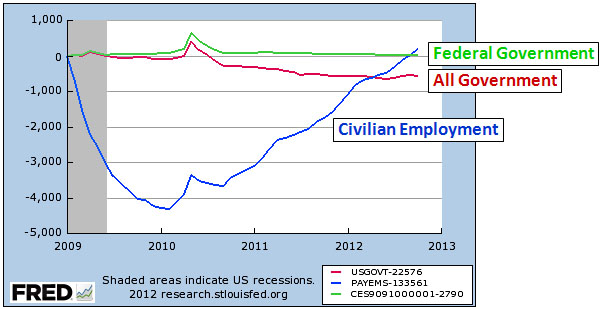
    David Frum has a very odd endorsement of Mitt Romney today. The endorsement itself isn’t odd: Romney’s a conservative and Frum’s a conservative, so you’d pretty much expect Frum to support him. But what a peculiar bunch of reasons he gives. First, he figures that Obamacare will survive no matter what, so he’d rather have a Republican in charge of implementing it. This is….not consistent with reality. Obamacare will be effectively wiped out if Romney is elected. Frum also has a peculiarly hostile reading of Obama’s Osawatomie speech from last year, which he thinks is an indication that Obama wants to vastly expand government employment. As Keith Humphreys points out, Obama sure has a funny way of showing this:

    Frum also believes that if the federal government needs new revenue, it shouldn’t come from higher income taxes. Instead it should come from carbon taxes and consumption taxes. Fine by me! But surely he knows that Romney and the Republican Party are, if anything, more hostile to those taxes than they are even to income taxes?

    But all this is just a warmup. Here’s the head slapper:

    The question over [Romney’s] head is not a question about him at all. It’s a question about his party — and that question is the same whether Romney wins or loses. The congressional Republicans have shown themselves a destructive and irrational force in American politics. But we won’t reform the congressional GOP by re-electing President Obama. If anything, an Obama re-election will not only aggravate the extremism of the congressional GOP, but also empower them: an Obama re-election raises the odds in favor of big sixth-year sweep for the congressional GOP — and very possibly a seventh-year impeachment. A Romney election will at least discourage the congressional GOP from deliberately pushing the US into recession in 2013. Added bonus: a Romney presidency likely means that the congressional GOP will lose seats in 2014, as they deserve.

    Holy cats. First of all, this is almost certainly wrong. A Republican win would embolden congressional Republicans. They’d take it as a sign that they were right all along, that America really is a conservative nation and really does want to be governed according to tea party principles. They’d be over the moon with faith in their own righteousness and would demand absolute fealty from Romney. Sure, they’d ease up on things like debt ceiling hostage taking, but not on much of anything else. The tea party wing of the GOP would be reenergized and in no mood to feel like they had to compromise their principles even a little bit.

    A loss, on the other hand, might have a salutary effect. It’s no sure thing, but it just might start some real grumbling among the business class that bankrolls the GOP and the moderate class that’s never gotten along with the tea party in the first place. It’s really the only hope there is of provoking the Republican Party to eventually deal with its crackpot wing.

    But instead, Frum makes the most overt form of the surrendering-to-terrorists argument that I’ve seen yet. If Obama wins, congressional Republicans will go completely ape and destroy the country. They will deliberately tank the economy and then impeach the president. Therefore, we have to give into them and turf Obama out of office.

    It’s appalling that people are seriously making this argument. What’s worse, it’s the relatively sensible people who are making it. This is simply nuts. No country can survive with this attitude. If congressional Republicans are truly a destructive and irrational force in American politics—and God knows, I agree with Frum about that—the answer is to fight them, not to surrender to them. That way lies madness.

  • The New York Times Should Run a Betting Market for New York Times Pundits


    The New York Times public editor thinks Nate Silver was wrong to offer a bet that his presidential forecast was right. Alex Tabarrok disagrees:

    In fact, the NYTimes should require that Silver, and other pundits, bet their beliefs. Furthermore, to remove any possibility of manipulation, the NYTimes should escrow a portion of Silver’s salary in a blind trust bet. In other words, the NYTimes should bet a portion of Silver’s salary, at the odds implied by Silver’s model, randomly choosing which side of the bet to take, only revealing to Silver the bet and its outcome after the election is over. A blind trust bet creates incentives for Silver to be disinterested in the outcome but very interested in the accuracy of the forecast.

    Overall, I am for betting because I am against bullshit. Bullshit is polluting our discourse and drowning the facts. A bet costs the bullshitter more than the non-bullshitter so the willingness to bet signals honest belief. A bet is a tax on bullshit; and it is a just tax, tribute paid by the bullshitters to those with genuine knowledge.

    I guess that might work for guys like Silver, who put hard numbers to their forecasts, but how would it work for the less quantitative pundits, who just say stuff like “Obama can win if he makes the case for activist government in the closing weeks”? Beats me. Maybe the Times should require that all predictions be footnoted with clear conditions and firm odds, and then should open its own betting market, which would offer the chance to wager on every prediction made by any Times pundit. That might actually be fun. And if the Times rakes off a small piece for the house, it could even be a money spinner.

    It might make it hard to find columnists, though. There probably aren’t very many bullshitters who would be happy to see their record of bullshit laid before the public quite so mercilessly.

  • Chart of the Day: Net New Jobs in October

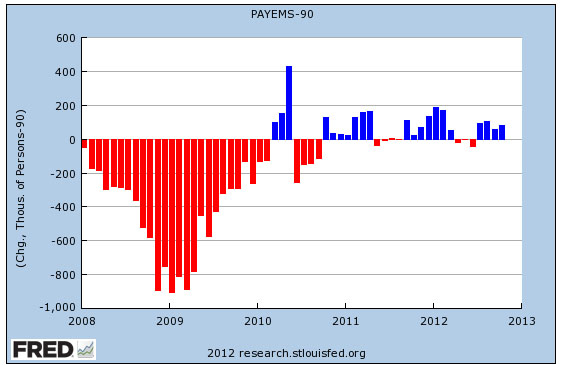
    The American economy beat expectations and added 171,000 new jobs last month. However, about 90,000 of those jobs were needed just to keep up with population growth, so net job growth is closer to 81,000 jobs. The chart below, which I update monthly, shows net job creation since the beginning of 2008, and the bottom line is that although job growth in October was higher than job growth in September, it was still fairly modest. This is pretty much the same story we’ve had all year: the economy is improving, but it’s not improving very fast. In other news, the labor participation rate was up a hair as more people started looking for work again, and as a result, unemployment ticked up slightly, from 7.80% to 7.88%. Also: revisions added 84,000 jobs to prior months’ data.

    Politically, this is a wash. It’s decently good news, but it isn’t something Obama can crow about too much. Conversely, it’s nothing that Romney can get much traction with either. If you dig into the weeds, the unemployment rate was up fairly dramatically among blacks and among those without a high school diploma, but in both cases it was just a reversion to the trendline after a flukey low number last month. The number of discouraged workers was up slightly, and the number of long-term unemployed rose a few percentage points. That’s pretty much the worst news in the report.

  • Something to Look at While You Wait for the BLS Jobs Report

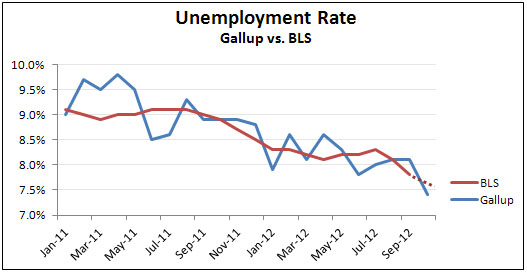
    Here’s something to ponder over while you wait for the BLS to release its final jobs report before the election. Gallup released its monthly unemployment survey on Thursday, and it showed a seasonally adjusted drop from 8.1 percent in September to 7.4 percent in October. The Gallup numbers are quite a bit more volatile than the official BLS numbers, as you can see in the chart below, but in general the two surveys move in similar directions. If that happens again on Friday, the BLS numbers will show a drop from 7.8 percent to…..I dunno….maybe 7.6 percent or so: a smaller decline than Gallup, but moving in the same direction.

    Or maybe not. We’ll know Friday morning.

    FRIDAY MORNING UPDATE: Nope. Unemployment ticked up to 7.9% according to the BLS report.

  • Drudge: “Obama Left Them Behind”

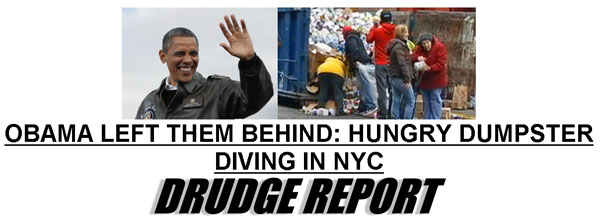
    On Monday a friend emailed me about the likelihood of conservatives going all out to make Sandy look like Obama’s Katrina. “I’d watch Drudge for the cues,” he said. “He should have a picture of a stranded black person up at some point tomorrow.” Today he emails to claim victory:

    He was a couple of days off, and the picture also includes some white people, but not bad! Here’s another of his predictions: “If Obama wins, you’ll soon start hearing the impeachment drumbeat building from Fox News types over Benghazi. They’ll go through the usual period of finger-pointing and disappointment, but it will quickly shift to a full-throated movement to re-focus their rage on Obama, and Benghazi will be the rallying cry. Trust me. I know these people. It’s not going to take that long.”

    Hmmm. I hope he doesn’t know them quite as well as he thinks. We’ll see.

  • Bloomberg: It’s No Time for a Climate Skeptic in the White House

    Here is our updated aphorism for the day:

    Depend upon it, sir, when a man knows a climate skeptic might be elected in a fortnight, it concentrates his mind wonderfully.

    This wasn’t true last week for New York City mayor Michael Bloomberg, but apparently Hurricane Sandy has brought him down from Mount Olympus. Now his mind is concentrated quite wonderfully indeed, and today he endorsed Barack Obama for president:
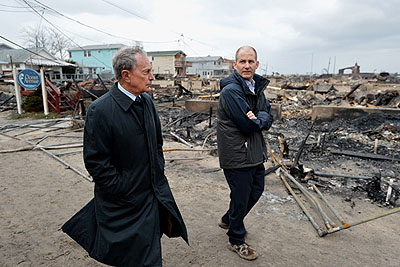
    Our climate is changing. And while the increase in extreme weather we have experienced in New York City and around the world may or may not be the result of it, the risk that it might be — given this week’s devastation — should compel all elected leaders to take immediate action.

    ….But we can’t do it alone. We need leadership from the White House — and over the past four years, President Barack Obama has taken major steps to reduce our carbon consumption, including setting higher fuel-efficiency standards for cars and trucks.

    ….Mitt Romney, too, has a history of tackling climate change. As governor of Massachusetts, he signed on to a regional cap-and-trade plan designed to reduce carbon emissions 10 percent below 1990 levels….But since then, he has reversed course, abandoning the very cap-and-trade program he once supported. This issue is too important. We need determined leadership at the national level to move the nation and the world forward.

    While we’re on the subject, Scientific American’s Mark Fischetti has an interesting post on the subject of scary climate change stories, something that I’ve been writing about recently. My problem with the scary story genre is that it’s woefully insufficient when you’re dealing with a problem that’s essentially invisible and won’t seriously affect most of us for decades. Stories about imperceptible menaces just don’t pack enough of an emotional wallop. One solution, of course, is to write scary stories about events that are extremely concrete and very visible indeed. Like, say, Hurricane Sandy. The problem is that scientists tend to be pretty circumspect about blaming any individual hurricane on global warming. But Fischetti says that might be changing:

    Hurricane Sandy has emboldened more scientists to directly link climate change and storms, without the hedge. On Monday, as Sandy came ashore in New Jersey, Jonathan Foley, director of the Institute on the Environment at the University of Minnesota, tweeted: “Would this kind of storm happen without climate change? Yes. Fueled by many factors. Is [the] storm stronger because of climate change? Yes.”

    Raymond Bradley, director of the Climate Systems Research Center at the University of Massachusetts, was quoted in the Vancouver Sun saying: “When storms develop, when they do hit the coast, they are going to be bigger and I think that’s a fair statement that most people could sign onto.”

    ….Greg Laden, an anthropologist who blogs about culture and science, wrote this week in an online piece: “There is always going to be variation in temperature or some other weather related factor, but global warming raises the baseline. That’s true. But the corollary to that is NOT that you can’t link climate change to a given storm. All storms are weather, all weather is the immediate manifestation of climate, climate change is about climate.”

    OK, this isn’t quite “climate change caused Hurricane Sandy.” But perhaps we’re moving in that direction. If we do, it could mark a sea change (if you’ll pardon the pun) in how the public views climate change. The more they see scientists linking it to concrete events—droughts in the Midwest, hurricanes in the Atlantic, wildfires in the West, icecaps disappearing in the Arctic—and the more they see scientists willing to make those links without caveating them to death, the more real climate change will become. Who knows? Maybe the scary story genre is in for a revival just at the moment I declared it dead.


  • The Economist’s Weird Centrist Lament About President Obama’s Economic Policy

    I understand bashing Barack Obama because you don’t like his social views. I understand bashing him because you don’t like his national security policy. I understand bashing him if you’re just flatly opposed to any expansion of government. But I continue to be puzzled by complaints from the center about his economic policy. Here’s the Economist:

    Previous Democrats, notably Bill Clinton, raised taxes, but still understood capitalism. Bashing business seems second nature to many of the people around Mr Obama. If he has appointed some decent people to his cabinet—Hillary Clinton at the State Department, Arne Duncan at education and Tim Geithner at the Treasury—the White House itself has too often seemed insular and left-leaning.

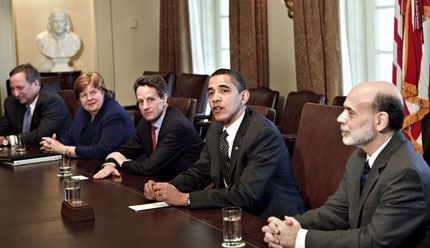
    This is crazy. As the Economist points out, Obama appointed Tim Geithner at Treasury. He reappointed Ben Bernanke at the Fed. His top White House advisor was Larry Summers, a protege of Robert Rubin and an alumnus of the Clinton White House. He appointed Peter Orszag as director of OMB. He hired Wall Street financier Steven Rattner to manage the Detroit rescue. He appointed Paul Volcker, the man who saved us from stagflation, as chair of his Economic Recovery Advisory Board. And he appointed Christina Romer as chair of the CEA—a lefty, perhaps, but certainly not a business basher. Every progressive pundit I know, from Paul Krugman on down, has mostly complained that Obama’s economic team was too centrist, too mainstream, and too Clintonian. The idea that these folks are somehow unenlightened about capitalism is laughable.

    The Economist also has a weird complaint that Obama “surrendered too much control to left-wing Democrats” over Obamacare—in reality, he didn’t surrender to them, he was forced to deal with them because Republicans refused to offer any of their votes in return for centrist compromises—but I’ll let that go. Instead, I’ll just turn the floor over to Matt Yglesias, who has the right critique of the Economist’s wrongheadedness:

    This idea that sound economic policy derives from palling around with job creators is one of the most pernicious myths out there today. And when you think about it, it undermines the whole logic of capitalism. The Soviet Union desperately needed politicians who understood agriculture, industry, and commerce because Soviet politicians were running the whole economy. In America we don’t do that. What the president has to do well is the things that he’s in charge of—being the single strongest voice in public policy disputes.

    I think the best example of this is the first term of Franklin Delano Roosevelt. Businessmen really didn’t like the guy. But the economy grew like crazy during his first four or five years in office. Why was there such strong growth? Primarily because FDR took the United States off the gold standard. That was a great idea, though it was much-criticized by business elites at the time. Tellingly, even when the policies were clearly working and the economy was growing again after years of collapse, businessmen didn’t change their mind about FDR. Which doesn’t show that they’re bad people or bad businessmen, simply that they were really bad at public policy analysis. Which is fine, because just as we wisely don’t have politicians running businesses we also wisely don’t have businessmen running the government.

    The fact that you may have brilliant ideas about running a large retail chain or marketing sneakers or selling medical supplies doesn’t mean you know how to make economic policy, and making economic policy doesn’t require you to make friends with the guy who runs the large retail chain.

    Could Obama have used a few more CEOs in his economic team? Maybe—although I doubt that it would have mollified the business community or changed the political realities of Capitol Hill much. But look. Geithner’s job was to support higher capital standards for banks whether banks liked it or not. Summers’ role was to help pass new financial regulations whether financiers liked it or not. Obama’s role was to pass healthcare reform whether the CEO of Walmart liked it or not. All of these things might have turned out better if Republicans had shown any interest in working together on them, but they didn’t. That was the hand Obama was dealt.