• America’s CEOs Want the Rest of Us to Pay For Their Folly

    Felix Salmon has a righteous rant about a group of CEOs who have written a manifesto insisting that “growing debt” is a serious threat to the well-being of the United States. But as Felix points out, “debt” has actually decreased in the past few years:

    So when the CEOs talk about “our growing debt”, what they mean is just the debt owed by the Federal government. And when the Federal government borrows money, that doesn’t even come close to making up for the fact that the CEOs themselves are not borrowing money.

    Money is cheaper now than it has been in living memory: the markets are telling corporate America that they are more than willing to fund investments at unbelievably low rates. And yet the CEOs are saying no. That’s a serious threat to the economic well-being of the United States: its companies are refusing to invest for the future, even when the markets are begging them to.

    Instead, the CEOs come out and start criticizing the Federal government for stepping in and filling the gap. If it wasn’t for the Federal deficit, the debt-to-GDP chart would be declining even more precipitously, and the economy would be a disaster. Deleveraging is a painful process, and the Federal government is — rightly — easing that pain right now. And this is the gratitude it gets in return!

    Later, after reviewing the blather that passes for a proposal, Felix translates:

    In other words, the letter basically just says “please cut our taxes, raise taxes on everybody else, and cut the benefits they get from Medicare, Medicaid, and Social Security, which are programs we individually don’t rely upon”. It’s gross self-interest masquerading as public statesmanship.

    To summarize: the economy is in bad shape, corporations are refusing to expand, the federal government is taking up some of the slack to keep the economy afloat, and 80 of our nation’s CEOs are outraged and insist that the solution is to eviscerate the middle class. Very nice. If it weren’t forbidden, I’d call this class wa — um, well, you know. Rich guys vs. the rest of us.
  • Kevin Drum’s Guide to California’s Ballot Mayhem

    This is a special post for California readers. The rest of you may safely ignore it.

    This year we have 11 initiatives on the California ballot. As longtime readers know, my default position is to oppose all initiatives. Here’s the nickel version of a longer rant about this: (1) Most initiatives these days are funded by corporate interests, not the grassroots, and corporate interests don’t really need yet another avenue to work their will on the public; (2) generally speaking, laws should be laws, not constitutional amendments or initiative statutes, where they’re essentially etched in stone forever; and (3) ballot box budgeting is a curse. So keep my biases in mind as you read this.

    It’s worth noting that my dislike of initiatives softens a bit when there’s no choice in the matter. We Californians have passed a ton of initiatives in the past, and since that etches them in stone (see No. 2, supra) it means that the only way to change them is via another initiative. I don’t like it, but that’s life. I’m mentioning this because several of this year’s initiatives fall into this category, and they account for every single one of my Yes recommendations.

    1. Temporary tax hike to benefit schools: YES. California schools are badly underfunded, and thanks to Proposition 13’s requirement that all tax bills require a two-thirds vote in the Legislature, it’s all but impossible to raise taxes to fix the situation. If tax laws could be passed by a simple majority vote, and Sacramento failed to do so, I’d take that as the will of the people and let it go. But that’s not how things are, which means a ballot initiative is the only answer. This one isn’t perfect, but it’s not bad. It deserves a Yes vote.

      There’s a competing tax measure, Proposition 38, also on the ballot. More on that below.

    2. Miscellaneous budget and local government reform: NO. Proposition 31 has some good points. Providing a small financial incentive for local governments to coordinate public services might be a good idea. It’s also got some iffy points. Allowing the governor more authority to cut spending in an emergency is a so-so idea. And it’s got some bad points. Micromanaging the budget process is a bad idea, and so is Prop. 31’s too-vague plan to allow local governments to override state regulations. All in all, Prop. 31 is a hodgepodge that just doesn’t pass a high enough bar to deserve support.

    3. Paycheck protection: NO. This zombie initiative—the third of its kind in the past 14 years—would forbid unions from deducting money from workers’ paychecks for political purposes. It’s ostensibly nonpartisan because it also bans corporations from doing this, but that’s like passing a law making it illegal for both workers and managers to go on strike. Corporations don’t do this in the first place, so in practice this initiative crushes the political power of unions but does nothing to rein in the political power of corporations. It’s a scam.

    4. Auto insurance: NO. This is another zombie initiative, backed by the zillionaire CEO of Mercury Insurance, who tried to get a nearly identical initiative passed in 2010. Here’s the short argument against it: Prop. 103, passed in 1988, allows insurers to consider only factors related to the likelihood of filing a claim when they set rates. Prop. 33 would add another factor by allowing insurance companies to provide discounts to drivers who have been continuously insured—a factor that, it turns out, has little relationship to the risk of loss. Prop. 33 might very well benefit Mercury Insurance, which could more easily poach business from other insurers if it passes, but unless you’re a Mercury stockholder that’s not a very good reason to support it. We’re better off keeping Prop. 103 the way it is.

    5. Replace the death penalty with life in prison without possibility of parole: YES. The death penalty has never been one of my big hot buttons. Still, there’s mountains of evidence that it’s applied unfairly and sometimes imposed on innocent defendants, which is reason enough to get rid of it. But it’s also worth getting rid of the death penalty because it simply doesn’t work in California. Hundreds of people sit on death row for decades at a time, and millions of dollars are spent defending them, all with little hope of the death penalty actually being imposed. Only 13 people have been executed in California since 1977, and a federal judge imposed a moratorium in 2006. It’s time to end the death penalty farce, and since it was originally imposed via initiative, the only way to do this is via another initiative.

    6. Human Trafficking: NO. California may or may not need better human trafficking laws, but it doesn’t need this sloppily written initiative that’s yet another pet project of a local zillionaire. These kinds of laws should be written by legislatures, not carved into stone forever by ballot initiatives.

    7. Three strikes: YES. Prop. 36 modifies our three-strikes law so that 25-to-life sentences are imposed only if the third strike is a serious one. This is just common sense. However, since the original three-strikes law was passed by initiative, the only way to make this change is via another initiative. It’s worth a Yes vote.

    8. GM food labeling: NO. I’ll confess to mixed feelings about this. But I’m afraid mixed feelings mean a No vote. I respect the desire to know where your food comes from, regardless of whether you want to know different things than I do, but on a substantive level I’m not convinced that GM foods pose enough of a genuine hazard to rate detailed labeling laws that are etched in stone forever. Also: This initiative, as with so many initiatives, is sloppily written; it can’t be changed after it’s passed; and it imposes expensive state labeling burdens on interstate commerce, something that I’m increasingly leery of. I’ll also note that I’m swayed by our experience with Prop. 65, which imposed labeling requirements for toxic chemicals. In the end, so many warning signs got posted that they became essentially useless. I have a feeling Prop. 37 might have the same result.

      For a different view, check out Tom Philpott’s take on Prop. 37 and its detractors here.

    9. Temporary tax hike to benefit schools: NO (with an asterisk). Prop. 38 competes with Prop. 30 as a tax measure to benefit public schools. Here’s the calm, collected argument in favor of Prop. 30: (1) it takes effect immediately, and (2) it allows the legislature more flexibility in using its funds than Prop. 38, which strictly earmarks its revenue. Since I’m a sworn foe of ballot box budgeting, I prefer the Prop. 30 approach. A bit of flexibility is a feature, not a bug.

      And now for the decidedly non-calm argument. California needs a temporary tax hike. So last year Gov. Jerry Brown did what we elected him to do: he engaged in a bit of horsetrading and hammered out a tax proposal. Liberals rebelled, compromises were made, and Brown’s measure eventually got wide support from most of the state’s major political players. This means that it’s not perfect. Real world compromises never are. But it’s still pretty good.

      So what happened? We got a competing measure funded by yet another local zillionaire, heiress Molly Munger (she’s the daughter of Warren Buffett’s business partner). And in some ways Prop. 38 really is better than Prop 30. But so what? Prop. 30 is pretty good, it’s widely supported, and the main effect of Prop. 38 is to confuse everyone and increase the risk of neither initiative passing. That’s especially true since Munger has turned this into a death march, spending her fortune not only to promote Prop. 38, but to run negative ads against Prop 30. And needless to say, this is all in addition to the usual barrels of money being poured into the Prop. 30 opposition by California’s anti-tax jihadists. Thanks, Molly!

      Self-absorbed purity contests like this really piss me off, and I would sure appreciate it if California’s zillionaires could find something else to do with their riches. That said, here’s the asterisk: if you do vote Yes on 38, at least vote Yes on 30 too. That way we still have a good chance to get something passed even if Prop 38 fails. Don’t insist on drowning the passengers just because your particular lifeboat doesn’t get chosen to rescue a sinking ship.

    10. Tax treatment for multistate businesses: YES. Back during some last-minute bargaining over a tax bill during Arnold Schwarzenegger’s term, legislators decided they didn’t quite have the courage to change California’s corporate tax code from a three-factor system (based on sales, employment and property) to a simpler system based solely on in-state sales. So they kept both systems and allowed corporations to choose whichever one gave them a lower tax bill. This was dumb, and it costs California about $1 billion per year. Unfortunately, thanks to Proposition 13’s requirement that all tax bills require a two-thirds vote, it’s impossible to fix this kludge because the anti-tax jihadists consider it a tax increase. So a ballot initiative is our only option. Prop. 39 is a sensible proposal that produces better tax incentives for corporations, stops them from gaming the system, and raises a bit of money all at once. Unfortunately, it also earmarks some of that money for special purposes. But it’s a temporary earmark, so it’s still worth a Yes.

    11. Redistricting: YES. This is a weird one. Originally it was a Republican referendum on the state Senate redistricting plan approved by the California Citizens Redistricting Commission, but in a ruling earlier this year the California Supreme Court indicated that even if the plan were nullified it would probably draw pretty similar lines itself. So backers, who wanted a No vote (which would overturn the CCRC plan) gave up. However, there was no way to remove Prop. 40 from the ballot, so it’s still here. A Yes vote upholds the redistricting plan, and no one is opposing that.

  • The Disposition Matrix

    I don’t have time to write a long post about this right this second, but you should read Greg Miller’s piece in the Washington Post today about the “disposition matrix,” the latest and greatest upgrade of President Obama’s kill list:

    The matrix contains the names of terrorism suspects arrayed against an accounting of the resources being marshaled to track them down, including sealed indictments and clandestine operations. U.S. officials said the database is designed to go beyond existing kill lists, mapping plans for the “disposition” of suspects beyond the reach of American drones.
    Although the matrix is a work in progress, the effort to create it reflects a reality setting in among the nation’s counterterrorism ranks: The United States’ conventional wars are winding down, but the government expects to continue adding names to kill or capture lists for years….That timeline suggests that the United States has reached only the midpoint of what was once known as the global war on terrorism. Targeting lists that were regarded as finite emergency measures after the attacks of Sept. 11, 2001, are now fixtures of the national security apparatus. The rosters expand and contract with the pace of drone strikes but never go to zero.

    Doug Mataconis has a good summary of reaction to Miller’s piece here. It’s worth a read.

  • Obama: GOP Will Eventually See the Light on Immigration Reform


    On Monday, the Obama campaign agreed to an interview request from the Des Moines Register on the condition that it be off the record. How do we know this? Because shortly after the interview concluded the Register’s editor wrote a long blog post complaining about it. He’s getting a lot of praise for this, but at the risk of being a little #slatepitch-y, I wonder if he deserves this praise? If he had refused Obama’s conditions, he’d then have every right to complain publicly. But once he agrees, doesn’t “off the record” sort of imply that you not immediately start bitching about it as soon as the interview is over? I’d certainly be reluctant to talk to someone off the record if I thought it would just make me a target of abuse as soon as the conversation was over.

    But I haven’t really thought this through. Maybe some big-time journalism ethicist ought to weigh in on this. In any case, shortly after the Register’s gripe-fest was posted, the Obama campaign agreed to lift its restriction and allow the Register to post a transcript of the interview. One question they asked was about how Obama could get anything done given the “partisan gridlock that has gripped Washington and Congress,” and that’s a pretty good question. Obama’s answer was basically about the fiscal cliff focusing everyone’s attention, but then he moved onto another subject:

    The second thing I’m confident we’ll get done next year is immigration reform. And since this is off the record, I will just be very blunt. Should I win a second term, a big reason I will win a second term is because the Republican nominee and the Republican Party have so alienated the fastest-growing demographic group in the country, the Latino community. And this is a relatively new phenomenon. George Bush and Karl Rove were smart enough to understand the changing nature of America. And so I am fairly confident that they’re going to have a deep interest in getting that done. And I want to get it done because it’s the right thing to do and I’ve cared about this ever since I ran back in 2008.

    So….what does the hive mind think about this? It all makes perfect sense to me, but that, if anything, is a pretty good reason it won’t happen. This is the tea-party-ized GOP we’re talking about, after all, and good sense is not exactly its hallmark.

    On the other hand, if Romney loses and the tea party appears to be responsible for yet another Senate debacle, who knows? Maybe their grip on the party really will be loosened. The folks who actually run the Republican Party will put up with losing only just so much, and Obama is certainly right that they have every incentive to stop pissing off the Latino community. I just wonder who will win in a showdown between the true believers and the real bosses.

  • Yet More Non-Scandal Over Benghazi

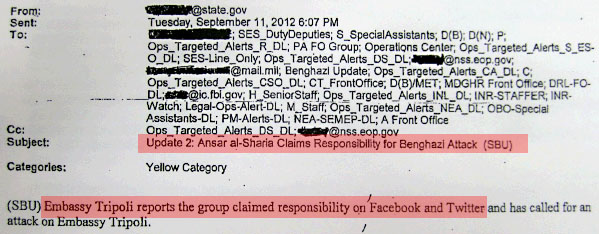
    As usual, I’m trying to figure out just where the scandal over Benghazi is supposed to lie. Last night, CBS News breathlessly released three emails sent to the State Department on the day of the attacks. Two of them were reports that the compound in Benghazi was under assault. Here’s the third:

    And this proves….what? Both Obama and Hillary Clinton talked from the start about the attacks being the work of extremist elements. Susan Rice and Jay Carney later suggested that there had been protests outside the consulate and that a YouTube video had played a role in instigating the attack, but that’s because this is what the CIA was telling them at the time. What’s more, to this day there’s still evidence that the video played a role. (An opportunistic one, probably, but a role nonetheless.) As for the charge that Obama was trying to downplay al-Qaeda involvement, that’s not because he was trying to hold onto his reputation as the guy who killed bin Laden. It’s because Ansar al-Sharia was a homegrown group with virtually no connection to al-Qaeda central. There really was no al-Qaeda involvement.

    This is crazy. Where does this stuff keep coming from? Based on the evidence we know today, the worst you can say about the White House is that they didn’t do a very good job of coordinating the messages being delivered to the public by all the various agencies. Beyond that, it took about a week for everyone to get on the same page because that’s how long it took before the intelligence community had a good handle on what actually happened. There’s just no scandal here.

  • Mitt Romney, America’s Pragmatist


    Paul Waldman asks:

    In the entire history of the United States of America, from George Washington’s election in 1789 on down, has there been a single candidate as unmoored from ideological principle or belief as Mitt Romney?

    Beats me. I’m not enough of a historian to know. But it’s worth noting that this isn’t necessarily a knock on Romney. Liberals have been banging away on Multiple Choice Mitt for a long time, but the fact is that lots of voters probably aren’t bothered by this. They like the idea of a president who’s pragmatic and non-ideological, willing to change his mind to fit changing circumstances instead of fitting everything into a liberal or conservative straitjacket.

    I’m not saying this is what Romney actually is. I’m just saying that describing him as “unmoored” might not be nearly the insult we think it is.

  • It Sure Doesn’t Look to Me Like We’re Winning in Afghanistan

    Stewart Upton pens a remarkably unpersuasive argument in Foreign Policy today that things are actually going pretty well in Afghanistan:

    We’re Winning in Afghanistan: Why hasn’t the media noticed?

    ….We are reaching the point in which the misperception being created by the media is undermining our ability to achieve their own definition of success in Afghanistan: denying al Qaeda a safe haven via a strengthened Afghan security force that is capable of taking over lead responsibility in the future.

    Have insider attacks and sensational Taliban attacks taken place? Yes, and we are accountable for that. But there is something to the comments made by senior officials that the sensational attacks are reflective of a desperate insurgency. If you were a Taliban commander losing an insurgency for the past couple of years since the surge, wouldn’t you feel the need to conduct sensational attacks to give the perception your narrative is winning out and to reassure your followers?

    In the space of two paragraphs, Upton hauls out two of the hoariest old tropes of the Afghanistan apologists: (1) media pessimism is undermining us, and (2) all those Taliban attacks are just a sign of desperation. Then there’s this:

    The results of the surge — specifically, the growth of the Afghanistan National Security Forces (ANSF) in both size and capabilities — has made it possible for the coalition to transition to what we call a Security Force Assistance mode of operations….Should Afghans see confidence and esprit de corps in the ANSF, we could see something similar to the “Anbar Awakening” in Iraq.

    That confidence is starting to build….This past week all of the casualties for our area of operations were members of the ANSF. Don’t underestimate ANSF’s bravery or their willingness to put their lives on the line for their country because they are doing it every single day. They are not afraid of the Taliban, and they move quickly to the sound of the gun.

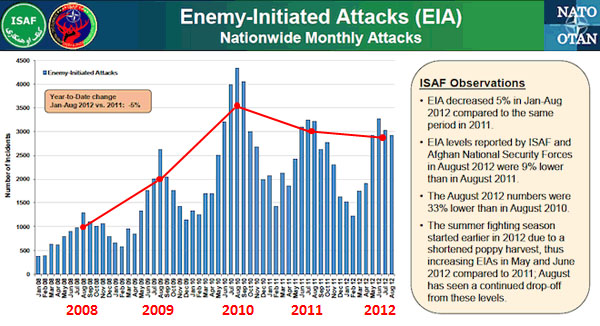
    I don’t know how things are really going in Afghanistan. Hell, maybe Upton is right. And the truth is that I’m willing to let them stick to their current 2014 timetable. It’s probably the best chance we have of a non-catastrophic endgame. Nonetheless, Upton’s happy talk rings pretty hollow when ISAF’s own figures show that Taliban attacks remain at far higher levels than they were in 2008 and 2009, before the surge started. I don’t see a lot of reason for optimism in the chart below.

  • Chart of the Day: Cherry Picking in the Medicare Market

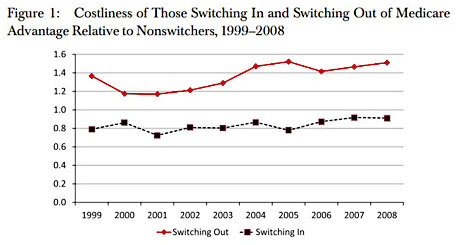
    Supporters of plans to voucherize Medicare often point to Medicare Advantage as a model. MA providers bid for Medicare contracts and are typically paid a set amount for each beneficiary they sign up. In theory, because MA providers compete against each other (and against traditional Medicare), they have an incentive to provide services more efficiently, offering seniors greater benefits and better care per dollar spent.
    That’s debatable, but Austin Frakt points us to a new study that makes it an even more dubious claim. The chart on the right is the key evidence, and it requires a bit of explanation. For each year since 1999, it shows the average cost of patients who switch in and out of Medicare Advantage. In 1999, for example, Medicare patients who switched in to MA plans had average costs (in the previous six months) that were 80% of the average. Patients who switched out of MA plans had average costs (in the subsequent six months) that were 40% higher than average.

    This same dynamic has held year after year. What it means is that, somehow, MA plans find ways to attract patients with low costs and dump patients with high costs. In other words, to the extent they provide better services for lower costs, they do it by cherry picking the healthiest patients and leaving the sickest patients for traditional Medicare.

    If we switch to a fully voucherized Medicare system, as Mitt Romney and Paul Ryan would like, this would almost certainly become worse. Private plans, it turns out, aren’t really any more efficient than traditional Medicare, and would probably end up competing on the basis of ever more brutal ways of making their plans attractive to the healthy and unbearable to the sick. This does not strike me as a very appealing model.

  • Richard Mourdock Gets in Trouble for His Extremely Conventional Religious Beliefs

    Indiana Treasurer Richard Mourdock, a darling of the tea party who’s now running for the Senate, is in hot water:

    Defending his stance that abortion should be illegal even in the case of rape, Mourdock explained that pregnancy resulting from nonconsensual sex is the will of God. “I’ve struggled with it myself for a long time, but I came to realize that life is that gift from God,” Mourdock said. “And even when life begins in that horrible situation of rape, that it is something that God intended to happen.”
    Mourdock is getting beat up pretty bad for this, and I think that’s just fine. At the same time, can’t we all acknowledge that this is just conventional Christian theology? Theodicy is the study of why an omnipotent God permits the existence of evil, and while the term is of fairly recent vintage, Christians and Jews have struggled with the question itself pretty much since the time they decided God was omnipotent. See Job, Book of, for more. Or, if you want to check out something that was more likely to influence Mourdock directly, take a look at the recent mega-bestseller The Shack, which engages with almost precisely the question that Mourdock has struggled with.

    What I find occasionally odd is that so many conventional bits of theology like this are so controversial if someone actually mentions them in public. God permits evil. My faith is the only true one. People of other faiths are doomed to spend eternity in Hell. Etc. There’s a lot of stuff like this which is either explicit or implied in sects of all kinds, and at an abstract level we all know it. Somehow, though, when someone actually says it, it’s like they farted in church. Weird.

  • How Strong Is the American Navy?

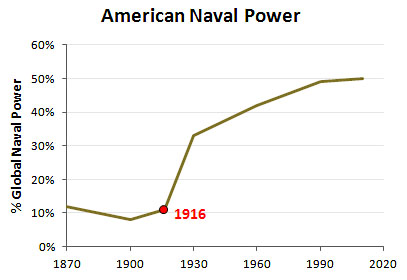
    Mitt Romney says the American Navy is smaller than it was in 1916. In a naive ship-counting sense, where big ships and small ships all carry the same weight, that might be true. But what really matters is relative strength: how powerful is the U.S. Navy compared to all the rest of the navies of the world? Over at the Monkey Cage, Brian Crisher and Mark Souva summarize a dataset they created earlier this year that estimates the naval power of various countries from 1865 through 2011. The chart on the right is taken from their data.

    So how are we doing? In 1916, America controlled about 11 percent of the world’s naval power. In 2010, we controlled about 50 percent. We may have fewer ships than we did during World War I, but we carry a way bigger stick than we did back then. Measured in the only way that makes sense, American naval strength today is greater than it’s ever been in history.