• The High-Tech Lynching of Susan Rice

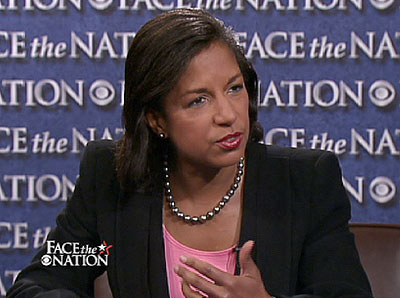
    One of the key scapegoats of the right-wing outrage machine in the wake of last month’s assault in Benghazi has been UN Ambassador Susan Rice. Why? Because four days after the attacks, she taped interviews with several Sunday talk shows in which she falsely suggested that the attacks had been inspired by the “Innocence of Muslims” YouTube video. This charge has since been repeated 24/7 on Fox News and picked up over and over by mainstream news outlets as well.

    It’s outrageous, all right, but not because Rice really did anything wrong. She didn’t. At this point, the known facts are pretty simple:

    • The CIA’s collective judgment on Saturday the 15th, when Rice taped her interviews, was that the protests earlier in the week in Cairo — which had been inspired by the video — had also inspired protests in Benghazi. Later, extremist elements hijacked those protests to storm the consulate. The CIA subsequently backed off its belief that there had been protests in Benghazi, but that only happened later. On Saturday, the CIA told Rice there had been protests, and that’s what she said on TV.
    • The evidence to this day suggests that, in fact, the YouTube video did play a role in the attacks. It’s simply not true that Rice invented or exaggerated about that.
    • Rice was, in fact, properly cautious in her TV appearances. The transcripts here are crystal clear. On Face the Nation, for example, she carefully told Bob Schieffer that she couldn’t yet offer any “definitive conclusions,” but that “based on the best information we have to date” it appeared that there had been a spontaneous protest in Benghazi “as a reaction to what had transpired some hours earlier in Cairo where […] there was a violent protest outside of our embassy sparked by this hateful video.” She then immediately added: “But soon after that spontaneous protest began outside of our consulate in Benghazi, we believe that it looks like extremist elements, individuals, joined in that effort with heavy weapons of the sort that are, unfortunately, readily now available in Libya post-revolution. And that it spun from there into something much, much more violent.” When Schieffer pressed her on whether the attack had been preplanned, or whether al-Qaeda was involved, she said directly that we simply didn’t know yet.

    So how is it that mainstream reporters have managed to repeat the right-wing attacks on Rice so endlessly and without any apparent pushback? Bob Somerby suggests that four factors allowed it to happen:

    • Death by lack of certainty. The press wants a simple story and just won’t accept statements of uncertainty at face value.
    • Death by complexity. Rice told a multi-part story that the press insisted on simplifying into submission. 
    • Death by submission to power. The right wing outrage machine yelled loudly about Rice’s perfidy, and the rest of the press followed along.
    • Death by liberal silence. Liberals did nothing to fight back. Rice was on her own.

    Susan Rice has been made into a bizarre caricature of herself. The transcripts of what she said are easily available, and by now it’s plainly obvious that her comments were careful, considered, and accurately represented the collective assessment of American intelligence at the time she offered them. It’s time to stop the lynching.

  • Tonight We Will See the Foreign Policy Version of Moderate Mitt


    Ed Kilgore examines Mitt Romney’s options in the foreign policy debate tonight:

    Consider the advice offered to Romney for tonight’s debate by the New York Times’ Bill Keller. Here are the headlines: (1) Go easy on Benghazi; (2) Say Something nice About the Palestinians; (3) Extend a hand to Mohamed Morsi; (4) Concede that the war in Iraq was a mistake; (5) Don’t rush into Syria; (6) Open the door to a deal with Iran; (7) Apply some Bain rigor to defense; and (8) Cool it on China.

    ….But how does a presidential candidate who has repeatedly and heatedly and redundantly defined America’s interests in the Middle East as identical with those of Bibi Netanyahu do (2) and (6)? How does the nominee of a party whose base is for the most part quite happy with the idea of American foreign policy being organized around a straight out war against Islam going to do (1), (2), (3), (4), (5), or (6)? Can a candidate who’s been running around Hampton Roads telling voters that they’ll all starve if the defense budget is allowed to decline an iota suddenly get Bain-ish on Pentagon spending?

    Ed, Ed, Ed: where has your right and proper cynicism gone? Of course Romney will do most of these things. How? Why, he’ll just open his mouth and say the words. He’ll be careful not to phrase any of this stuff in the form of concrete promises, but Romney is obviously dedicated to his Moderate Mitt persona when he’s on a national stage, and I don’t doubt that he’ll find a way to extend this tonight. For the record, I don’t think he’ll go as far as #4, and I don’t think he needs to rein in his instincts on #8, which is a fairly popular position. But the rest of them? With the proper nuances and caveats, none of them should cause him a problem. I’m not quite sure what strategy he’ll pursue on Benghazi (I suspect that cooling it would be a good idea, but I’m hardly 100% sure of that), but that’s the only question mark. The rest of this stuff is easy to fudge.

  • The Benghazi Controversy, Explained

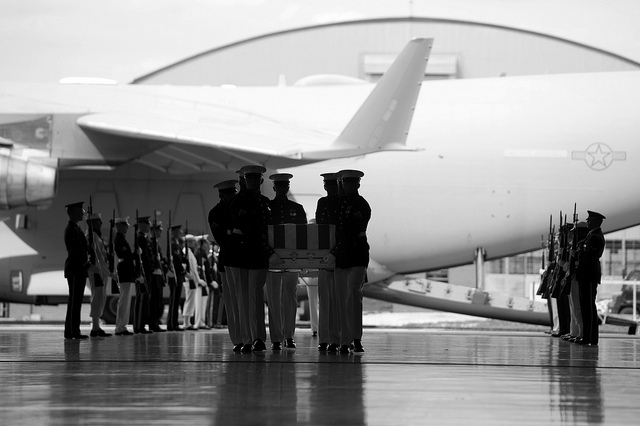
    The caskets of US ambassador to Libya J. Christopher Stevens, foreign service officer Sean Smith, and security officers Tyrone S. Woods and Glen A. Doherty are escorted through an honor cordon during a transfer ceremony at Joint Base Andrews, Maryland, on Sept. 14, 2012.<a href="http://www.flickr.com/photos/secdef/7987131153/" target="_blank">Secretary of Defense</a>/Flickr

    The reporting on what we know about the Benghazi attacks on September 11 just gets more and more interesting. Let’s do a quick Q&A:

    Why was President Obama initially unwilling to call it an act of terror?

    He wasn’t. The day after the attack, on September 12, he gave a Rose Garden speech in which he said, in reference to the assault, “No acts of terror will ever shake the resolve of this great nation.” At campaign stops that day and the next, he again referred to the Benghazi assault as “an act of terror.” A McClatchy report sums up the evidence: “In the first 48 hours after the deadly Sept. 11 attacks on U.S. diplomatic outposts in Libya, senior Obama administration officials strongly alluded to a terrorist assault and repeatedly declined to link it to an anti-Muslim video that drew protests elsewhere in the region, transcripts of briefings show.”

    A day after the attacks, the CIA station chief in Libya reported to Washington that there were eyewitness reports that the attack was carried out by militants. Why didn’t Obama administration officials say so?

    They did. Hillary Clinton, for one, referred to it as an attack “by a small and savage group.”

    Okay, but that McClatchy report quoted above also says that a few days after the attacks administration officials started putting more emphasis on the “Innocence of Muslims” video. Why? It had nothing to do with the Benghazi attacks.

    That’s not what locals said. As David Kirkpatrick reports: “To Libyans who witnessed the assault and know the attackers, there is little doubt what occurred: a well-known group of local Islamist militants struck the United States Mission without any warning or protest, and they did it in retaliation for the video…The fighters said at the time that they were moved to act because of the video, which had first gained attention across the region after a protest in Egypt that day.”

    So the video might have played a role. But why did UN ambassador Susan Rice put the video front and center in her Sunday morning appearances a week after the attacks?

    She didn’t, really. On Face the Nation, she said the “best information” at that moment suggested that Benghazi began “as a reaction to what had transpired some hours earlier in Cairo where […] there was a violent protest outside of our embassy sparked by this hateful video.” She then immediately added: “But soon after that spontaneous protest began outside of our consulate in Benghazi, we believe that it looks like extremist elements, individuals, joined in that effort with heavy weapons of the sort that are, unfortunately, readily now available in Libya post-revolution. And that it spun from there into something much, much more violent.”

    Still, why even mention the video? By that point, wasn’t it clear that the real cause of the attacks lay elsewhere?

    Not really. We now know that the CIA still believed the video was partly to blame for the violence. David Ignatius reports that a set of “talking points” prepared by the CIA on September 15, the day Rice taped her TV appearances, “support her description of the Sept. 11 attack on the U.S. Consulate as a reaction to Arab anger about an anti-Muslim video prepared in the United States. According to the CIA account, ‘The currently available information suggests that the demonstrations in Benghazi were spontaneously inspired by the protests at the U.S. Embassy in Cairo and evolved into a direct assault against the U.S. Consulate and subsequently its annex. There are indications that extremists participated in the violent demonstrations.'”
    Fine. But why did Rice suggest that the attacks came after a “spontaneous” protest at the Benghazi consulate? There was no protest.

    True, but Rice didn’t know that at the time because the CIA talking points still referred to “demonstrations” that had been inspired by the protests in Cairo. As David Martin reported: “Over that same weekend, US intelligence began to uncover evidence that there had not been a protest outside the consulate. That new intelligence did not get to Rice before she appeared on the Sunday talk shows, making her the target of Republican accusations the administration was trying to cover up the terrorist attack.”

    But why did anyone think there was anything “spontaneous” about this in the first place? In fact, the assault on the consulate was preplanned by “Al Qaeda elements,” as Libyan President Mohammed Magarief said, wasn’t it?

    No. The LA Times reports that Magarief was mistaken: “The assault on the U.S. diplomatic mission in Benghazi last month appears to have been an opportunistic attack rather than a long-planned operation, and intelligence agencies have found no evidence that it was ordered by Al Qaeda, according to U.S. officials and witnesses interviewed in Libya…The attack was ‘carried out following a minimum amount of planning,’ said a U.S. intelligence official…A second U.S. official added, ‘There isn’t any intelligence that the attackers pre-planned their assault days or weeks in advance.’ Most of the evidence so far suggests that ‘the attackers launched their assault opportunistically after they learned about the violence at the U.S. Embassy in Cairo’ earlier that day, the official said.”

    Still, the Obama administration was negligent in refusing a stream of requests from American diplomats in Libya to provide more security, wasn’t it?

    That’s possible. However, increased security probably wouldn’t have changed anything. As the New York Times reported a couple of weeks ago, “The requests were denied, but they were largely focused on extending the tours of security guards at the American Embassy in Tripoli—not at the diplomatic compound in Benghazi, 400 miles away.”

    Bottom line: There were conflicting reports on the ground, and that was reflected in conflicting and sometimes confused reports from the White House. I don’t think anyone would pretend that the Obama’s administration’s response to Benghazi was anywhere near ideal. Nevertheless, the fact is that their statements were usually properly cautious; the YouTube video really did play a role; the attack was opportunistic, not preplanned; and it doesn’t appear to have had any serious connection with Al Qaeda. It’s true that it took about 10 days for all this to really shake out, but let’s be honest: 10 days isn’t all that long to figure out what really happened during a violent and chaotic attack halfway around the world. I get that it’s a nice opportunity for Republicans to score some political points in the runup to an election, but really, there’s not much there there.

  • Friday Cat Blogging – 19 October 2012

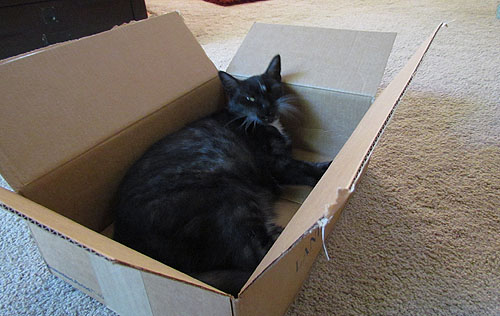
    Around here, we’re not selfish about birthdays. I get what’s inside the box, Domino gets the box itself. As you can see, everyone is pretty contented with this arrangement.

    In other news, a new catacomb has been discovered in Rome. By a cat: “Curti and a friend were following the cat at 10pm on Tuesday when it scampered towards a low tufa rock cliff close to his home near Via di Pietralata in a residential area of the city. ‘The cat managed to get into a grotto and we followed the sound of its miaowing,’ he said. Inside the small opening in the cliff the two men found themselves surrounded by niches dug into the rock similar to those used by the Romans to hold funeral urns, while what appeared to be human bones littered the floor.”

    Sure, dogs might save you if your house catches on fire. Big deal. Cats are helping us reclaim the lost relics of Western civilization. Advantage: cats.

  • Iranian Oil Exports Continue to Plunge

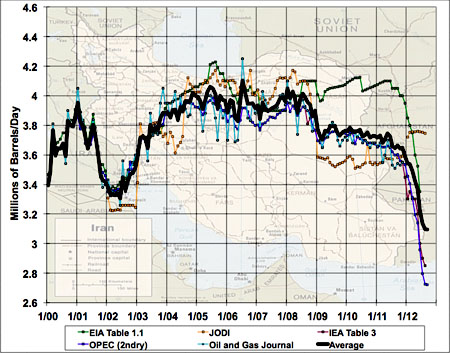
    Stuart Staniford catches us up today on Iranian oil production, which is falling like a rock. During 2009-10, Iran was producing about 3.7 million barrels per day. Today, they’re producing about 3.1 million bpd. Almost all of this decline represents a drop in exports, which in turn represents a loss of roughly $20 billion per year in revenue. As a percent of GDP, that’s about the equivalent of $600 billion for the United States. In other words, sanctions are hurting them.

    Also: cyber war! “Since we are placing the Iranians under very severe pressure with sanctions, they have the motivation to learn quickly and cyberattacks are very cheap.” I’m a little less concerned with Iranian cyberattacks than Stuart is, but in the long term there’s no question that this is a growth industry.

  • Quote of the Day: Peter King Thinks Four Minutes Is Too Long to Talk Without Mentioning Terror


    Steve Benen directs my attention to Rep. Peter King (R-NY), who has a whole new criticism of President Obama’s handling of the Benghazi attacks:

    As far as it being an act of terror, the president was almost four minutes into his statement on September 12th before he mentioned an act of terror…. It wasn’t until he was well into the remarks.

    Uh huh. This is a new record. Republicans have been trying for weeks to gin up national outrage over the fact that it was several days before we knew for sure what had happened in Benghazi. They never got much traction with this line of faux umbrage — largely because there really was legitimate confusion about what happened — and fairly or not, Candy Crowley put a stake through its heart on Tuesday when Mitt Romney stupidly repeated an echo chamber attack without bothering to check whether it was actually true.

    Now, instead of moving on, King is doubling down. For some reason, Republicans think it’s outrageous that Obama didn’t instantly know what had happened in Benghazi. They think it’s outrageous that he didn’t immediately jump to conclusions in the absence of firm facts. And now King thinks it’s outrageous that in his Rose Garden speech, Obama took four full minutes to suggest that it was an act of terror.

    Conservatives are obsessed with the idea that we demonstrate weakness unless the word “terror” is applied instantly to every attack against the United States. But it’s a loser. It worked great during the Bush years, but not so much anymore. Give it a rest, guys.

  • Sorry, but Mitt Romney’s Abortion Absolutism Is Fair Game

    In a primary debate earlier this year, Anderson Cooper asked: “If hypothetically Roe versus Wade was overturned, and the Congress passed a federal ban on all abortion, and it came to your desk, would you sign it? Yes or no?” Mitt Romney said he’d be delighted to sign such a bill, and the Obama campaign is making hay with this in the ad on the right. Michael Scherer thinks it’s a cheap shot:

    Here is the transcript, from a Republican debate on Nov. 28, 2007:

    ….Romney: Let me say it. I’d be delighted to sign that bill. But that’s not where we are. That’s not where America is today. Where America is, is ready to overturn Roe v. Wade and return to the states that authority. But if the Congress got there, we had that kind of consensus in the country, terrific.

    Romney conditions his support for this hypothetical bill on an America that does not exist, or one in which there is “such a consensus in this country that we said, we don’t want to have abortion in this country at all, period.” He also says clearly, “that’s not where we are.” In other words, he does not say that he would push against popular opinion to support such a bill. He is also silent on whether his ban would include exceptions for rape, incest and the life of the mother. Obama supporters say he doesn’t need to be explicit about exceptions, since the question is about “all abortions.” But the history of abortion debates within the Republican Party suggests otherwise.

    I don’t really see Scherer’s point here. It’s true that Romney thinks (accurately) that no flat ban on abortion is likely to cross the president’s desk in the near future. So in the sense of trying to figure out what will actually happen over the next four or eight years, it’s probably true that a President Romney wouldn’t have a chance to sign a flat ban on abortion.

    But that’s only half of what any election is about. The other half is about what a prospective candidate wants to do. I don’t think the United States will ever return to the gold standard, for example, but the fact that Ron Paul supports it tells me that he’s a crank. That’s reason enough not to vote for him.

    Likewise, even if Romney never has the opportunity to sign a nationwide ban on abortion, he’s obviously saying that he’d like to if he ever got the chance. What’s more, Romney probably would get a chance to overturn Roe v. Wade by appointing a Sam Alito clone to the Supreme Court, and he knows very well that this would result in plenty of states flatly banning abortion. This tells me he’s an abortion extremist, and it tells me a lot about who he is. It’s fair game.

    As for whether Romney, in his heart of hearts, wants to ban all abortions nationwide, or would reject a bill unless it made exceptions for rape and incest, who knows? Romney is obviously willing to fudge the question depending on what audience he’s talking to, and it’s hardly dirty pool for the Obama campaign to take advantage of that. The ambiguity in the Obama ad is a direct result of the ambiguity in Romney’s position.

  • Obama Continues to Bounce Back

    Polling guru Nate Silver tweets me a series of early birthday presents:

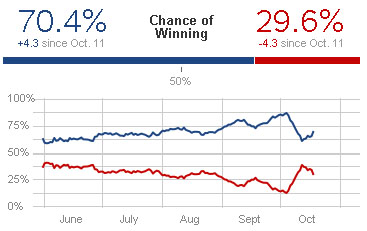
    Obama had a strong day of polls in swing states today. He’s up a fair bit in our forecast, to 70.4% from 65.7%.

    Also, the polls with the most recent field dates generally suggest more strength for Obama than those from earlier in the week.

    National polls published in past 24 hours: Obama +3.2, Obama +3, Obama +3, Obama +1, Obama +0.6, Obama +0.5, TIE, Romney +7.

    I don’t think there’s much question that Obama has started bouncing back from the slide that started in late September. The weird Gallup tracking poll is the only one that still has Romney ahead, but the bulk of the polls show Obama now leading both nationally and in the key swing states. For what it’s worth, my rough take has always been that Obama has about a two-thirds chance of winning, and I still think that. Nothing so far has really changed my mind.

    In other news, Todd Akin continues to suck wind in Missouri. This is bad for my forecasting batting average, but I find that I can bear up surprisingly well under the strain.

  • You Don’t Work as Hard as You Think You Do

    Via Matt Yglesias, here’s an interesting BLS study about how many hours people say they work vs. how many hours they actually work. This is actually sort of a pet topic of mine. My experience is solely with white-collar offices, but for years I noticed that my colleagues routinely overestimated how many hours they worked. As it happened, I frequently worked a little late and a little on weekends, so I had a good sense of just how many people were in the building after 6 pm or on Saturdays. Answer: virtually no one. You could fire a cannon through the place and not risk hitting anyone. And yet, people routinely thought they worked something like 50 hours a week.

    But guess what? 50 hours a week is actually a lot. It means working until 7 pm every night. Or it means working until 6 pm every night and then working a solid chunk of hours on Saturday. And there just weren’t many people who did that. (Nor was much work being done at home. You’ll just have to trust me on that.) The numbers are even worse for 60 hours a week. You’d have to work 10-hour days routinely and a good chunk of hours on both weekend days. There are people who do this, but honestly, not all that many.

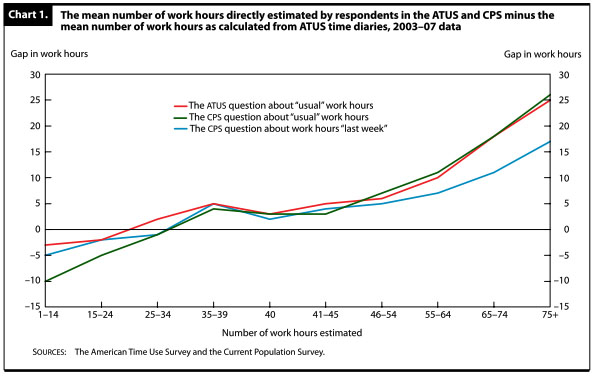
    Anyway, the chart below demonstrates this graphically. It shows the gap between hours reported and hours actually worked:

    As you can see, people who report working 50 hours a week typically overestimate by about 5 hours. My take on this has always been simple. If you stay late a couple of days a week, it feels like a strain. You feel like you’ve really put in the hours. And since, in the modern work environment, 50 hours sounds only moderately hardworking (60 hours is the lower bound for real workaholics), that’s what you convince yourself you worked that week. But the truth is that two or three late nights actually adds up to maybe 45 hours or so.

    At the high end it gets even worse: 75 hours is 10-11 hours every day, or 12-13 hours six days a week. Not many people really do that. But if you work 60 hours a week, the truth is that you’re working a helluva lot of hours. That’s 10-hour days six days a week. But since 60 hours is just your basic workaholic level, and you feel like you’re doing more than basic workaholic hours, you figure you must really be working 70 or 80 hours a week.

    There are some people who really do work these kinds of hours, of course. And there are people who work multiple jobs and put in lots of hours. But among your typical hardworking office types, bragging on your hours comes with the territory. As with other kinds of bragging, however, you should take it with a grain of salt.

  • Chart of the Day: Who’s Afraid of Chris Matthews?

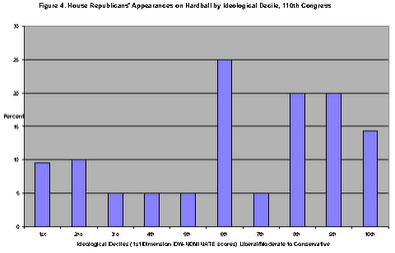
    Seth Masket passes along a chart today showing which members of Congress are most likely to appear on Hardball. Among Democrats, it turns out that liberals and moderates are about equally likely to appear. Among Republicans, conservatives appear all the time but moderates are nearly absent. Why?

    Hell if I know. But if I had to guess, I’d say that moderate Republicans have so little influence that there’s no point in talking to them. Second guess: moderate Republicans are boring, so Chris Matthews is uninterested in them. He’d rather book fire-breathers that he can mock. Third guess: moderate Republicans usually don’t have safe seats and figure that appearing on a liberal chat show is a lose-lose proposition for them.