• FTC Offers $50,000 Prize to End Robocalls


    Economists have long touted the value of prizes to motivate innovation. One of the most famous recent examples is the X Prize, a $10 million prize that was promised to the first private team that could safely launch a three-passenger craft 100 kilometers into space twice within two weeks. The prize was eventually won in 2004 by Burt Rutan’s SpaceShipOne.

    Today, the FTC announced a prize for a far more worthy cause:

    After years of using traditional regulatory tools to block billions of illegal marketing calls, the FTC says, the agency is launching a public contest in search of new technical solutions.

    The prize: $50,000.

    ….The agency will be taking entries between Oct. 25 and Jan. 17. Judges will score proposals based on workability (worth 50 percent), ease of use (worth 25 percent) and the idea’s potential for a wide rollout (worth 25 percent). Applicants can submit ideas to block pre-recorded marketing calls on landlines, cellphones or both.

    Hooray! Seriously. I don’t know if this will work, and I don’t know if $50,000 is enough, but this is a great idea. It’s exactly the kind of thing that might prompt some unappreciated genius to come up with a harebrained idea that’s just crazy enough to work. We should do more stuff like this.

  • How the Fiscal Cliff Will Reenergize President Obama

    I’m a little tired of the whole “fiscal cliff” meme, but I suppose we all blog about the news we have, not the news we wish we had. And today, the Washington Post informs us that if President Obama is reelected he’s going to go medieval on House conservatives who refuse to extend the Bush tax cuts for the middle class unless tax cuts for the rich are included in the package:

    Freed from the political and economic constraints that have tied his hands in the past, Obama is ready to play hardball with Republicans, who have so far successfully resisted a deal to tame the debt that includes higher taxes, Obama’s allies say.

    In the days after the November election, the tables will be turned: Taxes are scheduled to rise dramatically in January for people at all income levels, and Republicans will be unable to stop those automatic increases alone.

    ….Some Republicans — such as Sen. Jim DeMint (R-S.C.), a tea-party favorite — have conceded that an Obama election victory would amount to a mandate to raise the top rates. But [John] Boehner recently ruled out that idea, and senior GOP aides say letting the top rate rise, even briefly, above 35 percent is a line party leaders cannot cross.

    This is a scenario that Jon Chait has been writing about for quite a while. On December 31, he thinks, Obama can simply let the Bush tax cuts expire and then start with a clean slate. At that point, Obama is the one with all the leverage:

    On January 1, 2013, we will all awake to a different, substantially more liberal country. The Bush tax cuts will have disappeared, restoring Clinton-era tax rates and flooding government coffers with revenue to fund its current operations for years to come. The military will be facing dire budget cuts that shake the military-industrial complex to its core.

    ….All this can come to pass because, while Obama has spent the last two years surrendering short-term policy concessions, he has been quietly hoarding a fortune in the equivalent of a political trust fund that comes due on the first of the year. At that point, he will reside in a political world he finds at most mildly uncomfortable and the Republicans consider a hellish dystopia. Then he’ll be ready to make a deal.

    Leading up to the New Year, there will be a concerted effort to preempt this policy shift, by bringing the two parties together to consummate a version of the endlessly touted (but little-understood) Bowles-Simpson agreement that GOP House members rejected….

    Chait believes that Obama will refuse to make a Bowles-Simpson-ish deal during 2012 because he knows that his leverage will be far greater once the Bush tax cuts are finally gone. “I know what Obama-land looks like when it’s under the spell of bipartisan delusions,” he says, and after the gut punch the White House took during the debt ceiling fiasco, he’s convinced they’re no longer under any delusions about Republican obstructionism. So this time, Obama will just wait calmly until January 1st, and then let Republicans twist in the wind if they refuse to negotiate. Eventually they will, and Obama will win because he holds all the cards.

    Maybe! Obviously this scenario depends on Obama winning reelection, but it also depends on Democrats holding firm. If Republicans can peel off a few centrist Dems in the Senate and pass some kind of deal, Obama might be hard pressed to hold out. Nonetheless, I think Chait is basically right. A freshly reelected Obama has little reason to waste time negotiating in December (though he’ll probably have to pretend just for the sake of form), when he knows that January produces a whole new ballgame. And unlike 2010, when the economy was fragile and January heralded a new Republican majority, 2012 will be just the opposite.

    Republicans won’t concede on taxes unless their backs are to the wall and they no longer have any choice. Obama probably gets that. We can all hope, anyway.

  • 2nd Circuit Court Strikes Down DOMA


    Here’s some good news. A three-judge panel of the conservative 2nd Circuit Court has struck down the odious Defense of Marriage Act on a 2-1 vote. The opinion was written by Chief Judge Dennis Jacobs, a very conservative appointee of the first George Bush. Ian Millhiser of ThinkProgress has the news:

    This is a really big deal. Jacobs is not simply saying that DOMA imposes unique and unconstitutional burdens on gay couples, he is saying that any attempt by government to discriminate against gay people must have an “exceedingly persuasive” justification. This is the same very skeptical standard afforded to laws that discriminate against women. If Jacobs’ reasoning is adopted by the Supreme Court, it will be a sweeping victory for gay rights, likely causing state discrimination on the basis of sexual orientation to be virtually eliminated. And the fact that this decision came from such a conservative judge makes it all the more likely that DOMA will ultimately be struck down by the Supreme Court.

    This ruling makes it likely that the Supreme Court will take on DOMA in the fairly near future. Stay tuned.

  • Study: Multivitamins Reduce Cancer Among Men

    Have you been taking your multivitamins? Me neither. But a new study suggests that multivitamins can reduce the long-term risk of cancer in men. Aaron Carroll runs it down for us:

    Here’s the gist. They rounded up more than 14,000 doctors 50 years or older in 1997 and randomized them to get a daily multivitamin or placebo, and then they followed them through June of 2011. Otherwise, they did nothing to these participants, so there’s every reason to believe they were otherwise treated similarly. They wanted to see if the two groups developed cancer at different rates. They did.

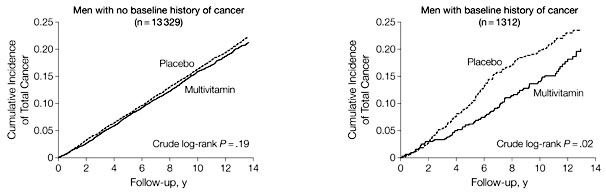
    Men who took a daily multivitamin had a statistically significant lower rate of cancer than those who took the placebo (17.0 versus 18.3 events per 1000 person-years)….This was an extremely large study, well done, with amazing follow-up. You can’t dismiss it easily.

    The chart below shows the difference in cancer rates for men with and without a baseline history of cancer. Technically, there was no statistically significant difference between the cancer and non-cancer groups because the sample size of the cancer group was fairly small. But statistics be damned. It sure looks to me that you should really think hard about taking a multivitamin if you have a previous history of cancer. The adjusted hazard ratio in this group was 27% lower than the placebo group. In the non-cancer group it was only 6% lower.

    Also: if you have no parental history of cancer, multivitamins had a big effect. The hazard ratio in this group was 14% lower than in the placebo group.

    As Aaron says, “Multivitamins are cheap. You can buy them by the barrel at Costco. There are few harms or side effects.” In other words, there’s probably no reason not to take them, and there might be a big benefit. The full study is here.

  • Post Hoc Not Always Propter Hoc

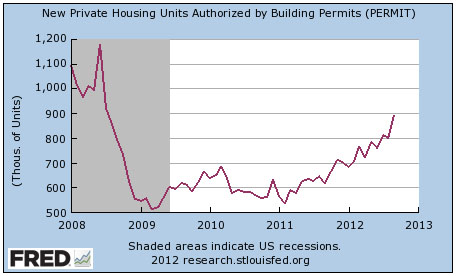
    The Census Bureau announced today that housing permits were up 11.6% in September compared to the previous month. Matt Yglesias thinks Ben Bernanke deserves the credit:
    That’s all great news for the economy. I also think it’s a clear sign of the power of QE3….Since monetary policy primarily works through expectations, it primarily works very quickly. QE3 was clear, forceful, and yet also relatively modest so a short-term one-off surge in investment activity (housing starts) and durable goods purchases (car sales) followed by a speedy return to the trend growth path is exactly what we should expect.

    Well….maybe. But QE3 was announced on September 13, so it would have to work very quickly indeed to affect housing permits in the same month. Too quickly for the real world, I think. First, there would need to be one heck of a lot of builders with plans all drawn up and financing in place, eyes fixed on CNBC just waiting for the right moment to submit their applications. Second, local bureaucracies would then have to circulate the applications to all the various planning agencies, review and approve whatever variances are required, and issue the permits in record time to make the end-of-month cutoff. It’s true that the September number is well above the recent trend, but color me skeptical that QE3 had anything to do with this.

  • Here It Is, the World’s Simplest Tax Analysis

    Earlier today I promised you that an analysis of Mitt Romney’s tax plan from last night would be a lot easier than an analysis of his earlier plan. As you recall, Romney’s previous proposal was to cut rates 20% across the board and eliminate deductions to make up for it. This means you have to model all the various deductions currently in the tax code and figure out how much each one is worth. Then you get into endless arguments about whether your model is right, which deductions are “on the table,” etc. etc. In the end, it’s your study vs. my study and may the best man win.

    Romney’s new plan slices through this Gordian knot by simply capping the total level of deductions at $25,000. It doesn’t matter which deductions you take or how much they’re worth. You just assume a $25,000 cap and you’re done. No details needed. Easy peasy.

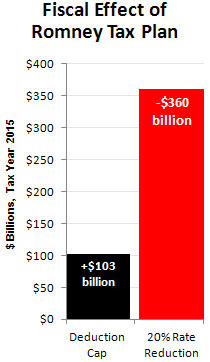
    So here it is, the world’s simplest tax analysis. Based on studies from the Tax Policy Center (rate cuts here, deductions here), it’s an estimate of the effect of Romney’s plan on tax revenue in the year 2015:
    • Tax loss from the 20% rate cut: $360 billion
    • Tax increase from the $25,000 deduction cap: $103 billion

    Is this still too complicated? The colorful graph on the right should make everything clear. Romney is $257 billion short, and the rest of his plan (eliminating the estate tax, eliminating investment taxes for middle-income earners, lowering the corporate tax rate) just makes things even worse. One way or another, Romney has a whole slug of revenue he needs to make up. His plan just doesn’t add up.

  • Cutting Carbon Emissions the Cap-and-Trade Way

    Speaking of climate change, one of the best ways of reducing carbon emissions is to implement a cap-and-trade scheme. Basically, the government sets a nationwide cap for carbon emissions and then auctions off permits on a quarterly basis. Companies can buy permits at auction, and they can later trade them on the open market as their needs vary. The government caps and companies trade. It’s a pretty elegant solution to reining in carbon pollution.

    Of course, the whole point of these permits is that they raise the cost of energy, and Republicans quickly dubbed it cap-and-tax when Democrats tried to shepherd a bill through Congress, and that was enough to doom it. But that doesn’t mean it’s impossible everywhere. As I mentioned three years ago in my “10 Things You Should Know About Cap-and-Trade” article, Europe is already doing it. (It’s item #3.) Brad Plumer runs down a few of the growing pains they’ve had since their ETS program started in 2005:

    The ETS handed out far too many pollution allowances between 2005 and 2007, which caused carbon prices to collapse….Meanwhile, some electric utilities received free pollution permits and were able to earn “windfall profits” from their good fortune. That appears to have been an error, too. There’s also the potential for fraud within the system. In theory, companies can get a pass on their pollution by buying carbon offsets—paying for projects elsewhere that reduce carbon, such as planting trees in Brazil. But these programs are often criticized for poor oversight (and some of them might have happened anyway). That needs to be reformed, too.

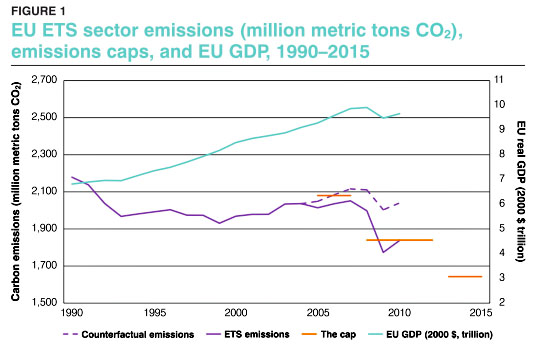
    These are the kinds of problems any big new program has, and they’re being ironed out over time. But let’s look at the bigger picture: has ETS cut carbon emissions? The latest “Results and Lessons Learned” report from the Environmental Defense Fund has the answer. Without ETS, total European emissions would currently be around 2 billion metric tons per year. With ETS, emissions are around 1.8 billion metric tons. Still too much, but headed in the right direction. This stuff isn’t pie in the sky. We could do it if we wanted to.