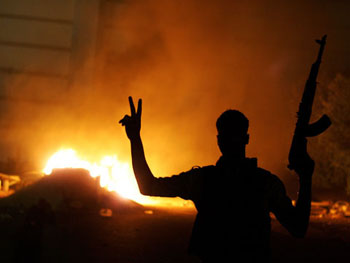
• The Real Story Behind the Benghazi Attacks

    I didn’t notice this when it was first published, but David Kirkpatrick wrote a must-read piece on the Benghazi attacks in the New York Times on Monday. I’ve been mildly critical of the Obama administration for sticking too long to the storyline that the attacks were inspired by a YouTube video, but it turns out that on-the-ground reporting actually backs that up:

    To Libyans who witnessed the assault and know the attackers, there is little doubt what occurred: a well-known group of local Islamist militants struck the United States Mission without any warning or protest, and they did it in retaliation for the video. That is what the fighters said at the time, speaking emotionally of their anger at the video without mentioning Al Qaeda, Osama bin Laden or the terrorist strikes of 11 years earlier.

    ….The fighters said at the time that they were moved to act because of the video, which had first gained attention across the region after a protest in Egypt that day. The assailants approvingly recalled a 2006 assault by local Islamists that had destroyed an Italian diplomatic mission in Benghazi over a perceived insult to the prophet. In June the group staged a similar attack against the Tunisian Consulate over a different film, according to the Congressional testimony of the American security chief at the time, Eric A. Nordstrom.

    And was it an al-Qaeda-sponsored terrorist attack?

    Whether the attackers are labeled “Al Qaeda cells” or “aligned with Al Qaeda,” as Republicans have suggested, depends on whether that label can be used as a generic term for a broad spectrum of Islamist militants, encompassing groups like Ansar al-Shariah whose goals were primarily local, as well as those who aspire to join a broader jihad against the West.

    ….Other Benghazi militia leaders who know the group say its leaders and ideology are all homegrown. Those leaders, including Ahmed Abu Khattala and Mohammed Ali Zahawi, fought alongside other commanders against Col. Muammar el-Qaddafi. Their group provides social services and guards a hospital. And they openly proselytize for their brand of puritanical Islam and political vision.

    Spencer Ackerman says that you can nonetheless make a good case that “Jay Carney and Susan Rice misrepresented the Benghazi attacks,” and I think that’s fair. As Kirkpatrick notes, this might have been for political reasons:

    Peter Feaver, a political scientist at Duke University who advised the Bush administration on the domestic politics of its foreign policy, said, “The line was ‘Osama bin Laden has been killed, the war on terror has been won,’ so why muddy that?” He added, “Faced with a range of possibilities, they went with the one that was politically convenient.”

    Still, the bottom line appears far more favorable toward Obama’s handling of the attacks than Republicans want to admit. There really is evidence that the video played a role in instigating the assault. Obama (and Hillary Clinton) really did cautiously refer to the attacks as “acts of terror” shortly after they happened. The attackers really do appear to be local fighters with only the most tenuous possible connection to al-Qaeda. In the end, there’s not much left to the Republican story aside from some blame-game bickering over whether the State Department should have beefed up security in the months before the anniversary of 9/11. That’s pretty weak tea.

  • The Media Blackout on Mitt Romney’s Tax Plan


    Bob Somerby has been complaining for some time that major news outlets have never really reported on the basic impossibility of Mitt Romney’s tax plan. Today he reminds me of what I said about this a couple of months ago:

    Quite sensibly, Kevin Drum suggested that the Post and the Times might be planning fuller reports in the future. But alas! One week went by, then several more passed.

    Sensible! And yet, it didn’t really happen. Annie Lowrey and David Kocieniewski produced a single he-said-she-said piece for the Times in mid-September, while the Post doesn’t appear to have had anything at all from its straight news reporters.

    I dunno. Maybe the conventions of news reporting in America simply make it impossible to write about this. It’s too complicated and there are too many dueling studies. News reporters aren’t allowed to dismiss hackwork even when they know that’s what it is, so hack studies end up getting as much play as real ones.

    For what it’s worth, though, I think that last night might have changed the playing field a bit. Here’s how Romney described his plan during Tuesday’s debate:

    I’m going to bring rates down across the board for everybody, but I’m going to limit deductions and exemptions and credits….One way of doing that would be say everybody gets — I’ll pick a number — $25,000 of deductions and credits, and you can decide which ones to use. Your home mortgage interest deduction, charity, child tax credit, and so forth, you can use those as part of filling that bucket, if you will, of deductions.

    There’s obviously still some weasel room in this since Romney only says that this is “one way” of implementing his tax plan. Still, it’s now the most public, most specific version of his plan out there, and more to the point, it’s also very easy to evaluate. You don’t have to figure out which deductions are on the table, or how much each one is worth. No more arguing over life insurance interest exclusions or state tax deductions. All you have to do is analyze the value of itemized deductions for each income group and then figure out how a $25,000 cap would affect their tax obligations. There are still some ambiguities to worry about (is the tax exclusion of healthcare benefits part of this bucket?), but overall, this is fairly straightforward.

    At this point, I’m not sure that anyone cares, though. The media seems disinclined to really hold Romney to account for his tax plans; the public seems to consider it a tedious argument over a bunch of confusing numbers; and the Tax Policy Center may think that yet another review of Romney’s tax plan isn’t worth its time. We’ll see.

  • Last Night’s Big Loser: Climate Change

    I want to expand on something I mentioned at the tail end of my post-debate roundup last night: the big loser in Tuesday’s debate was climate change. Neither candidate mentioned it, but they practically fell all over each other to declare their love for coal and fracking and drilling for oil on federal land. Here’s an edited bit of the conversation about energy yesterday:

    OBAMA: Natural gas production is the highest it’s been in decades. We have seen increases in coal production and coal employment.

    ROMNEY: Oil production is down 14 percent this year on federal land, and gas production was down 9 percent….What we don’t need is to have the president keeping us from taking advantage of oil, coal and gas….We’re going to bring that pipeline in from Canada.  

    OBAMA : We’re actually drilling more on public lands than in the previous administration….And natural gas isn’t just appearing magically. We’re encouraging it and working with the industry….Oil production is up, natural gas production is up.

    ROMNEY: I was just at a coal facility, where some 1,200 people lost their jobs….I will fight for oil, coal and natural gas….I will fight to create more energy in this country…taking advantage of the oil and coal we have here, drilling offshore in Alaska, drilling offshore in Virginia where the people want it.

    OBAMA : We’ve built enough pipeline to wrap around the entire earth once. So, I’m all for pipelines. I’m all for oil production.

    ROMNEY: I appreciate the jobs in coal and oil and gas. I’m going to make sure we’re taking advantage of our energy resources. We’ll bring back manufacturing to America. 

    There were plenty of nods toward renewable energy in the conversation, but they were mostly pro forma. And they certainly weren’t made in the context of climate change. They were mostly made in the context of “energy independence.” The closest Obama came to saying anything climate chainge-ish was a vague reference to being “environmentally sound.” Romney never came close at all.

    I’m not really sure what to say about this. Pundit law suggests I should have a few hundred pithy words about it, but I really don’t. Rightly or wrongly, both campaigns have apparently decided that climate change is a loser. Romney doesn’t want to admit that it even exists, since this would enrage a tea party base that believes it’s all a liberal conspiracy theory, and Obama apparently recognizes that it’s a political loser and will gain him nothing. After the Copenhagen talks failed and cap-and-trade became cap-and-tax, he pretty much gave up on it.

    Politically, he might be making the right decision. No broad climate change policy has a ghost of a chance of passing right now, and a public already battered by recession doesn’t want to hear about carbon taxes or rising energy prices. Things like higher CAFE standards might be less efficient, but at least they’re doable. And investments in clean energy, though risky in their own right (Republicans have certainly done their best to make Solyndra a dirty word), may be the best we can hope for right now.

    It’s funny, though. There was also a fair amount of China bashing last night, and you’d think Obama could at least use that to his advantage. Do we really want to cede dominance in solar technology to the Chinese? Or should we be investing to make sure that American solar technology is the best in the world? It’s not the most high-minded approach to climate change, but it might work. Any port in a storm.

    UPDATE: More from Ed Kilgore here.

  • It’s Time For Romney to Give Benghazi a Rest

    There’s lots of chatter this morning about Mitt Romney’s “Benghazi moment” last night, and Ed Kilgore wonders if Romney will keep up his attacks on Obama’s handling of Libya next week. “Given the extremely narrow nature of Romney’s foreign policy critique of Obama last night and throughout the campaign, you do have to wonder what the final debate next week will be like. Will Romney continue to conduct an inquisition of exactly what Obama said when on the Libya killings, treating the incident as a sort of domestic version of Fast & Furious, a key to the Vast Liberal Conspiracy?”

    That’s pretty much my question too. Adam Serwer has a good rundown of the bickering over whether Obama really referred to Benghazi as an act of terror in his Rose Garden speech the next day, or whether he was just generically referring to acts of terror, and anyway, even if he did, why did he then decline to do it again a few days later, etc. etc. That’s all fine, I guess, just part of a tight campaign entering its closing days.

    But what I really wonder is: how has this become a serious question anyway? Why does anyone care if it took two weeks to decide that Benghazi was an act of terror? Two weeks! That’s not exactly an eternity. Even if it were true that Obama spent a few days waiting for firm intelligence reports before making firm statements, is there anything wrong with that? Isn’t that what a president should do?

    Republicans seems to think that this is some kind of huge gotcha moment that will show Obama as a weak and flailing leader on the world stage. But I suspect they’re caught up in their own echo chamber, the same one that insists Obama wants to take your guns away and has spent the past four years apologizing for America. Unfortunately, the more they dive into the conspiratorial weeds on this, the worse they look to ordinary Americans who don’t really mind that President Obama waited a few days to sift through the evidence instead of going off half cocked within a few hours. That approach brings back sour memories of George Bush, while the endless forensic analysis of exactly what Obama said and when he said it probably brings to mind fever swamp Kennedy assassination obsessives poring over frames of the Zapruder film.

    I really doubt that Romney is doing himself any favors by keeping this up. Fairly or not, Candy Crowley put a stake through the Republican storyline when she embarrassed Romney over his slipshod accusation, demonstrating vividly that he had mindlessly bought into yet another Great White Whale from the right-wing outrage machine without bothering to check things for himself. That’s not Moderate Mitt, and that makes it a loser. He’d be well advised to move on to something that strikes average voters as a little less childish.

  • Debate Reax – 16 October 2012

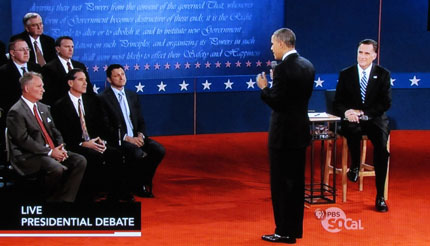
    Here’s the exchange of the night, coming right after Romney tried to score a point by claiming that it took Obama two weeks before he referred to the Benghazi attack as an act of terror:

    ROMNEY: I think it’s interesting the president just said something, which — which is that on the day after the attack he went into the Rose Garden and said that this was an act of terror.

    OBAMA: That’s what I said.

    ROMNEY: You said in the Rose Garden the day after the attack, it was an act of terror? It was not a spontaneous demonstration, is that what you’re saying?

    OBAMA: Please proceed governor.

    ROMNEY: I want to make sure we get that for the record because it took the president 14 days before he called the attack in Benghazi an act of terror.

    OBAMA: Get the transcript.

    CROWLEY: He did in fact, sir. So let me — let me call it an act of terror….

    OBAMA: Can you say that a little louder, Candy?

    Obama played this really, really well. He let Romney dig himself into an ever deeper hole, and just smiled when Romney tried to get him to directly deny it. This turned out to be either lucky or smart, because it gave Candy Crowley a chance to fact check Romney and confirm that she was there and she heard Obama refer to Benghazi as an act of terror on the very next day. This is going to get a lot of play. It was also a serious own-goal for Romney, who had plenty of strong criticisms available on Libya but ended up overreaching on a very specific charge that was dead wrong. That was dumb.

    The CBS insta-poll gives the win to Obama, 37%-30%. CNN’s “scientific” poll gives it to Obama, 46%-39%. A Battleground poll of swing states gives Obama a bigger win, 53%-38%. And an online poll by Google Consumer Surveys gave Obama his biggest win of all, 48%-31%.

    Maybe the second best moment came when Romney was defending himself against charges that he invested in China: 

    ROMNEY: Mr. President, have you looked at your pension?

    OBAMA: You know, I don’t look at my pension. It’s not as big as yours so it doesn’t take as long.

    This was a weird moment. The original charge from Obama was a tired attack about Bain Capital investing in companies that specialized in outsourcing, and Obama deserves a ding for that. On the other hand, it had come about five minutes earlier, and it was kind of bizarre that Romney suddenly decided he had forgotten to respond to that and brought it up again out of nowhere. And then it turned around and bit Romney in the ass when Obama got off a pretty good line in response. Just goes to show the value of discipline. Romney should have left well enough alone.

    And here was Obama’s third-best moment:

    So what I’ve said is, your first $250,000 worth of income, no change. And that means 98 percent of American families, 97 percent of small businesses, they will not see a tax increase. I’m ready to sign that bill right now. The only reason it’s not happening is because Governor Romney’s allies in Congress have held the 98 percent hostage because they want tax breaks for the top 2 percent.

    I liked the hostage talk there. But I have no idea whether anyone else liked that passage as much as I did.

    Andrew Sullivan, who has spent the past couple of weeks in wrist-slitting mode, is now thrilled: “To my mind, Obama dominated Romney tonight in every single way: in substance, manner, style, and personal appeal. He came back like a lethal, but restrained predator. He was able to defend his own record, think swiftly on his feet, and his Benghazi answer was superb. He behaved like a president. He owned the presidency. And Romney? Well, he has no answers on the math question and was exposed. He was vulnerable on every social issue, especially immigration. And he had no real answer to the question of how he’d be different than George W Bush.”

    A lethal but restrained predator!

    Apparently, “binder full of women” is the Twitter and Facebook catchphrase of the night. This is a reference to Romney’s claim that when he became governor of Massachusetts and put together a cabinet, “I went to a number of women’s groups and said, ‘Can you help us find folks,’ and they brought us whole binders full of women.” This entire passage struck me as vaguely patronizing at the time, though I confess that when I re-read it in transcript form it didn’t seem so bad. Maybe it was something in Romney’s tone, which seemed a little false in a “some of my best friends are black” kind of way.

    UPDATE: Now I remember the lines that struck me as patronizing. First Romney admitted that his entire staff was initially unable to find any qualified women to work in his administration. Then, a little later, he said this: “We’re going to have to have employers in the new economy, in the economy I’m going to bring to play, that are going to be so anxious to get good workers they’re going to be anxious to hire women.” I don’t think Romney meant anything patronizing here, but it was unfortunate wording nonetheless. It implies that employers will only hire women once the economy gets strong enough that they’re desperate to hire just about anyone.

    UPDATE 2: Apparently the “binder” comment isn’t even true. David Bernstein explains:

    What actually happened was that in 2002 — prior to the election, not even knowing yet whether it would be a Republican or Democratic administration — a bipartisan group of women in Massachusetts formed MassGAP to address the problem of few women in senior leadership positions in state government. There were more than 40 organizations involved with the Massachusetts Women’s Political Caucus (also bipartisan) as the lead sponsor.

    They did the research and put together the binder full of women qualified for all the different cabinet positions, agency heads, and authorities and commissions. They presented this binder to Governor Romney when he was elected.

    ….Note that in Romney’s story as he tells it, this man who had led and consulted for businesses for 25 years didn’t know any qualified women, or know where to find any qualified women. So what does that say?

    Sheesh. Romney is just constitutionally programmed to deceive, isn’t he? And all in service of a point that probably won him no favors with women anyway.

    Andrew Sprung thinks Obama saved the best for last: “Lord-a-mercy, Obama just killed Romney on the 47%. Was it genius, or luck that he saved it for the end, when there was no time for rebuttal?” Here’s what Obama said:

    I believe Governor Romney is a good man. Loves his family, cares about his faith. But I also believe that when he said behind closed doors that 47 percent of the country considered themselves victims who refuse personal responsibility, think about who he was talking about. Folks on Social Security who’ve worked all their lives. Veterans who’ve sacrificed for this country. Students who are out there trying to hopefully advance their own dreams, but also this country’s dreams. Soldiers who are overseas fighting for us right now. People who are working hard every day, paying payroll tax, gas taxes, but don’t make enough income.

    Obama is stealing a Romney riff here. Romney is fond of saying that Obama is a good man, but in over his head. Obama turned this around, saying that Romney is a good man, but only cares about the rich guys he’s spent his life hanging around.

    James Joyner thinks Obama won the debate, but: “Overall, even if the debate is a draw, it’s a minor win for Obama simply because it stops the bleeding from Round 1.” That’s probably true.

    Ed Kilgore: “Imaginative Romney effort to make ‘self-deportation’ sound like defense of immigrants’ autonomy. Didn’t work.” Yeah, that was definitely a nice try, but still pretty lame. Here was Romney’s quote: “Self-deportation says, let people make their own choice. What I was saying is, we’re not going to round up 12 million people, undocumented illegals, and take them out of the nation. Instead let people make their own choice.” I doubt that this cut any ice with anyone, though the truth is that “self-deportation” is (a) genuinely moderate compared to the Republican Party mainstream, and (b) not really very different from the policy Obama has followed for the past four years.

    By the way, the big loser tonight was climate change. Neither candidate mentioned it, but they practically fell all over each other to declare their love for coal and fracking and drilling for oil on federal land. Yuck.

  • Debate Liveblogging – 16 October 2012

    WRAP-UP: Well, that was like night and day, wasn’t it? Obama was way crisper than he was two weeks ago, and he adopted Joe Biden’s habit of frequently interrupting to accuse Romney of getting his facts wrong. On several occasions, Obama warned viewers that the Romney of the primaries was not the same Romney on display tonight, and that they should believe the old Romney, not the fake new one. I thought this worked pretty well, but then, I would, wouldn’t I? Transcript here.
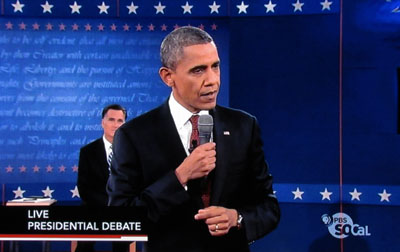
    For my money, the worst moment of the night for Romney came on Libya. He hauled out a stale conservative talking point about Obama not calling the Benghazi attack an act of terror, and when he confronted Obama about it, Obama just smiled and let him hang. Unexpectedly, this flustered Romney. Then, a few seconds later, Candy Crowley interrupted to confirm that Obama did, in fact, call it a terror attack the very next day. That really flustered Romney. This is the kind of segment that ends up getting repeated on cable news over and over and over.

    Obama had a pretty good line early on about Romney’s economic views: “Governor Romney doesn’t have a five-point plan, he has a one-point plan. And that plan is to make sure that folks at the top play by a different set of rules. That’s been his philosophy in the private sector, that’s been his philosophy as governor, that’s been his philosophy as a presidential candidate.” I wish Obama had had a chance to hammer that a little harder, but it never really came up again until the very end.

    On taxes, Romney has talked before about the idea of capping deductions rather than eliminating them, but this was by far the most public forum in which he’s mentioned it. For all practical purposes, I think that makes this the official Romney position: A 20% across-the-board rate cut paired with a $25,000 maximum for itemized deductions. The math on that comes nowhere close to working, though, and it’s pretty easy to prove it. I wonder how long it will be before the Romney campaign backpedals on this?

    Obama did a good job of hitting Romney on his tax plan, taking it slowly and all but accusing him of deliberately trying to deceive middle-class voters. It’s hard to know if this made a dent, though. Too many numbers just puts people to sleep.

    Oddly enough, I think both candidates did better tonight than two weeks ago. Obama was, obviously, way better. I’d give him an A-. But Romney was better too. I’d probably give him a good B, maybe even a B+ if I were feeling generous. I don’t know how much the first debate really affected the polls, but if it did, this one ought to correct at least some of the damage.


    Obama’s the underdog! The fate of Western civilization rests on his debating skillz! Let the liveblogging commence….

    10: 39 – And that’s a wrap.

    10:32 – Obama answer on China is getting kind of wonky.

    10:26 – Question for Romney about outsourcing to China. I hope Obama doesn’t repeat his “Romney invested in Chinese outsourcers” wheeze when he gets his rebuttal.

    10:24 – Everybody agrees on importance of parents! Hooray!

    10:23 – Now Candy Crowley asks Romney why he changed his mind on assault weapon ban. Ouch.

    10: 22 – Romney playing to the base with Fast & Furious nonsense.

    10:20 – In the end, however, Obama mildly in favor of renewing the assault weapon ban. Romney flatly opposed.

    10:18 – A gun question. Obama playing it right down the middle.

    10:17 – Romney flustered when Obama refuses to answer him. Then Candy Crowley fact checks Romney in real time! Crowd claps! This might be the highlight of the debate.

    10:14 – Obama offended at suggestion that his diplomatic team might be playing politics with attacks. Pretty good response.

    10:13 – Romney is dissing Obama for attending a fundraiser the day after the Benghazi attack? That’s pathetic.

    10:12 – This is pretty much the first real foreign policy question, isn’t it?

    10:11 – Question: who screwed up security in Benghazi? Obama: We’ll get back to you.

    10:07 – Crowley now getting annoyed. Obama getting into a tiff over rules. I don’t think that works, no matter how justified.

    10:05 – OK, now Romney switches to “self deportation.” His explanation: “Let people make their own choice.” Sounds so cuddly!

    10:04 – Romney just totally blows off Candy Crowley when she tries to ask a followup.

    10:02 – Obama has a very nice, crisp answer on immigration.

    9:59 – Romney pretty tough on illegal immigration. No more Moderate Mitt. I guess focus groups showed that this was a winning position.

    9:56 – Romney pretty crisp when attacking Obama’s first term. Both guys actually seem more comfortable arguing over past four years than upcoming four years.

    9:53 – Obama on Romney and the GOP Congress: “He said ‘Me too.'” Repeated over and over. Decent line.

    9:51 – Obama is in his wheelhouse defending his past four years. Not sure that will get the job done, though.

    9:49 – Maybe I missed something. I thought the Bush question was about wars etc., but maybe I misheard.

    9:48 – Wait. “I came through small business”? Is Romney talking about Bain Capital?

    9:46 – “What is the biggest difference between you and George W. Bush?” Question is about foreign policy, but Romney just goes back to his five-point plan. Totally evading the question.

    9:41 – Romney’s answer about women seemed vaguely condescending to me. Wonder if it came off that way to anyone else?

    9:37 – Crowley cuts off tax discussion just as it starts to get interesting. Of course, not everyone might think tax discussions are as interesting as I do.

    9:34 – Obama now getting a little too deep in the weeds. But  decent attack anyway. Romney responds on his tax numbers: “Well of course they add up.” Then pivots away instantly.

    9:32 – Obama calling out Romney on deductions. Good attack, but will it work?

    9:29 – Hostage talk from Obama. Excellent.

    9:26 – Ah. Romney going public on the idea of capping deductions, this time at $25,000. Math still doesn’t work, but this is now getting close to being his official position. Also, really doubling down on not cutting taxes for the rich.

    9:19 – Conservatives sure are obsessed with drilling on federal land.

    9:16 – Trying to paint Romney as anti-coal probably not a good idea, especially after accusing him of being Mr. Coal.

    9:15 – “Moderate Mitt” is back. He loves renewable energy!

    9:14 – Obama hammering on green energy. Good.

    9:11 – Romney is right that Obama took GM through bankruptcy. Obama is right that Romney’s plan wouldn’t have worked. Obama: “Governor Romney doesn’t have a 5-point plan, he has a one-point plan.” Good line.

    9:09 – Romney trying to pretend “real” unemployment rate is 10.7%. Spare me.

    9:07 – Obama going with a numbered list for his jobs plan. Good move. Then a shift to taxes.

    9:03 – Romney seems to have sat down on his barstool OK. Whew!

    8:59 – Here’s hoping that Candy Crowley ignores all the weird rules the campaigns insisted on during pre-debate negotiations.

  • Obama’s Poll Drop: We’ve Seen This Movie Before

    Andrew Sullivan continues to freak out:

    Here’s a dishhead bleg: when was the last time that a sitting president in a re-election campaign lost six percentage points in the polls in two weeks in October?

    That’s pretty specific, and I suppose the answer is “never.” But let’s change the question: When was the last time Barack Obama lost six percentage points to a Republican challenger?

    Pete Souza/The White House/FlickrPete Souza/The White House/FlickrAnswer: 2008. On September 1st, Obama led John McCain by 6.4 points. On September 10th, McCain led Obama by 2.5 points. That’s a swing of 8.9 points. But when the election was actually held, Obama won by 5 points.

    Look: Polls change. That’s politics. Beyond that, though, there are a couple of specific reasons everyone should settle down a bit. First, the fundamentals have always suggested that this would be a close election. The consensus of the political science models is an Obama win by maybe 2 points or so. Second, I’m increasingly convinced that a couple of years from now some enterprising political scientist will write a paper thoroughly debunking the idea that Obama’s debate performance was as horrible as everyone is making it out to be. Instead, the recent poll changes will come down to three things:

    • A late September surge by Romney for reasons that are (at the moment) still a bit of mystery.
    • Reversion to the mean. Obama was never going to win the election by 5 or 6 points, and his recent drop has been baked into the cake for a long time. His big lead was mostly an artifact of stupid mistakes by Romney, and eventually Romney recovered from them.
    • The media freakout over Obama’s debate demeanor.

    Obama didn’t turn in a great debate performance, but it was nowhere near bad enough to account for the kind of poll declines we’ve seen over the past couple of weeks. That’s my two cents, anyway.

  • Supreme Court Approves Early Voting in Ohio

    Earlier this morning Stephanie Mencimer asked, “Could Bush v. Gore Save Obama in Ohio?” You see, Ohio’s Republican legislature had ended early voting for everyone except active duty military and the Obama administration had taken them to court, arguing that if soldiers got to vote early, then everyone should get to vote early:

    The Obama campaign challenged the move, and in August, a federal judge agreed that Ohio had violated the Constitution’s Equal Protection Clause by allowing some people to vote early but not others. In early October, the Sixth Circuit Court of Appeals upheld the decision and ordered Ohio to keep the polls open for the weekend for everyone if they do it for the military and overseas voters. The state has filed an emergency petition with the Supreme Court to overturn the order. The Obama campaign, naturally, is opposed, and has filed a brief arguing that Bush v. Gore demands that the court protect the integrity of the voting process.

    ….As a result, the court now will have to prove whether it was serious or simply partisan when it sided with Republicans by declaring that “[t]he right to vote is protected in more than the initial allocation of the franchise. Equal protection applies as well to the manner of its exercise.”

    So how did that turn out? A few minutes ago we got the answer:

    The United States Supreme Court has given the green light to early voting in Ohio in the three days prior to November’s election. The brief, one sentence order from the court Tuesday is a setback for Republican leaders in the state, who had asked the justices to step in and allow pending restrictions to take effect.

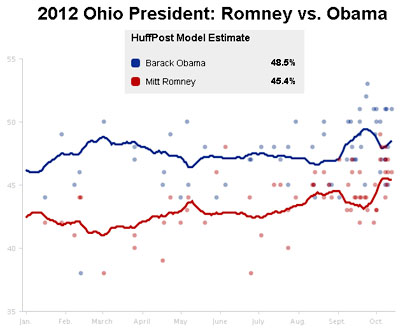
    Ohio will appeal the ruling, but that takes time and won’t affect this year’s election. For now, Bush v. Gore has finally handed a small victory to Democrats. That’s good news for Obama in a state where he’s started to turn things around and needs all the help he can get.

    UPDATE: Ari Berman points out that although the same rules now apply to everyone, Ohio Secretary of State Jon Husted is limiting early voting hours for the three days prior to the election. The Supreme Court’s ruling is good news for Obama, but Ohio Republicans are still doing their best to limit access to the polls.

  • Today Produces Yet More “Facts” to “Check” From the Romney Campaign

    In today’s edition of ridiculous time wasters, we bring you a bout between heavyweight contender Mitt Romney and referee wannabe Glenn Kessler of the Washington Post. The question at hand: how should we rate Romney’s contention that he has three studies verifying that his five-point economic plan would create 12 million jobs?

    The winner is….Kessler, of course. Romney has always said that he’d create 12 million jobs in four years, but the studies in question (a) use timeframes of 8-10 years, and (b) don’t evaluate his plan anyway. Four Pinocchios for Romney!
    The loser is….all of us who still have functioning brain cells — including Kessler, who was forced to spend precious hours of his life on this nonsense that no one at Romney HQ even pretends to believe in the first place. But the rest of us still have to go along with the gag. Presidential candidates these days can literally say anything they want, and we’re all required to stroke our chins and pretend to take them seriously.

    In any case, the real answer to this question is a lot simpler: if elected, Romney probably will create 12 million jobs in his first term. So would Obama. So would my cat. And we don’t need any studies to prove it. If the economy grows at about 3-4% for the next four years, we’ll add 12 million new jobs, and there’s a pretty good chance that the economy will indeed grow at about 3-4% for the next four years. We might be coming out of our recession slowly, but we are coming out of it, and this means that 12 million jobs is sort of a no-brainer. It’s sort of like promising that unemployment will fall under 7%. It will, of course, but that’s a pretty low bar. We should expect better.

  • Sorry, Mitt: In the Real World, Tax Reform Doesn’t Boost Growth

    Bruce Bartlett writes today that a Romney-style tax reform, where you lower rates and eliminate deductions, is a pretty good idea. In theory, it should produce higher economic growth.

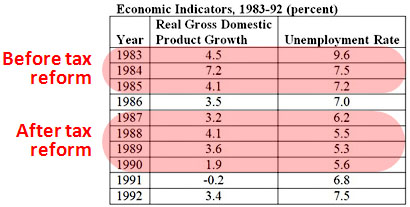
    The problem is that when tax rates are within a fairly modest range, the effect is either nonexistent or too small to be noticeable. The table on the right shows what happened after the famous 1986 tax reform, and more rigorous research confirms that it had little effect on growth:

    By the mid-1990s, it was the consensus view of economists that the Tax Reform Act of 1986 had little, if any, impact on growth. In an article in the May 1995 issue of the American Economic Review, the Harvard economist Martin Feldstein, a strong supporter of tax reform who had served as chairman of Reagan’s Council of Economic Advisers, found large changes in the composition of income, but the only growth effect was a small increase in the labor supply of married women.

    In a comprehensive review of the economic effects of the 1986 tax reform act, in the June 1997 issue of the Journal of Economic Literature, Alan Auerbach of the University of California, Berkeley, and Joel Slemrod, the University of Michigan economist, also found that the primary impact was on the shifting composition of income. They could find no significant growth effects. They concluded, “The aggregate values of labor supply and saving apparently responded very little.”

    Even if you assume that Romney could manage to make his tax numbers add up (he can’t), and even if you assume his plan has any serious chance of getting through Congress (it doesn’t), it wouldn’t do much for growth. Rationalizing the tax code might be a good idea, but it’s not the answer to an economic downturn. Romney should focus more of his attention on jobs and less on the endless conservative obsession of lowering taxes on the rich at all costs.