• So How Did That Whole “Lesser of Two Evils” Thing Work Out For You in 2000?

    I’m a little nonplussed that it’s suddenly become a thing to write about whether any self-respecting liberal can vote to reelect Barack Obama, given that he’s a warmonger who kills innocent Muslims with his drone attacks. The reason I’m nonplussed is that this meme got kicked off by a piece written last week by Conor Friedersdorf in the Atlantic, and Conor isn’t a liberal. Of course he’s not thrilled about the prospect of voting for Obama. Not only does he dislike Obama’s foreign policy, but he doesn’t like Obama’s domestic policy either: as far as I know, he’s not a fan of Obamacare or the stimulus bill or Dodd-Frank or Obama’s dismissal of Simpson-Bowles or any of that. There’s nothing much there for him to like aside from the repeal of DADT.

    In other words, Conor’s piece is about the equivalent of E.J. Dionne telling us why he won’t vote for Romney. Of course he won’t. Who cares?

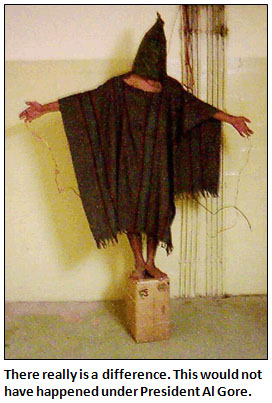
    That said, if you’re an actual lefty agonizing over whether you can possibly support the lesser of two evils this year, I have nine words for you: How did that work out for you in 2000? Even if you assume that Al Gore would have passed the Patriot Act; and invaded Afghanistan; and given the NSA free rein to engage in wholesale amounts of warrantless surveillance; and approved the torture of enemy combatants — even if you assume all that, do you think we would have invaded Iraq if Al Gore had been president? That didn’t just happen, after all. It’s not as if the public was baying for Saddam Hussein’s scalp. It happened only thanks to a very determined effort by Dick Cheney and his fellow neocon sympathizers, and it happened only after a very deliberate, months-long marketing campaign from the Bush White House.

    Now sure, you can spin weird counterfactuals here if you want to, but really, there’s just no plausible scenario in which this would have happened under President Al Gore. And on the warmonger front, that’s a pretty big deal, no? Frankly, if Al Gore had literally implemented the entire Bush agenda except for the Iraq war, that would be reason enough to vote for him.

    In other words: yes, there really is a difference. Libya and the drone strikes don’t even come close to comparing to Iraq. So go ahead and vote for Gary Johnson if you must, but do it with your eyes open. Whatever good it accomplishes, it also puts us one vote closer to having Dick Cheney’s old foreign policy gang back in the West Wing. I’m not quite sure how the math on that one ever gets above zero.

  • It’s Zinger Time!

    With the first presidential debate approaching, we’re starting to see lots of retrospective pieces about famous debate gaffes of the past. The Wall Street Journal has a greatest hits parade here, and it’s fun because it includes video clips of the various moments. Still, don’t take it too seriously. The most famous gaffe of all, Richard Nixon’s refusal to wear makeup and his profuse sweating in the television studio, probably didn’t actually make any difference. The myth that Nixon lost the debate among TV viewers but won among radio listeners was seriously called into question long ago. And as Bob Somerby reminds us, Al Gore’s famous sighing in 2000 didn’t prevent him from posting a convincing win over George Bush in the overnight polls. It was only after the media got hold of the sighing meme that it took off.

    As for the others, who knows? Reagan was already well ahead of Jimmy Carter when he invented the debate zinger in 1980, and it’s pretty unlikely that George Bush looking at his watch in 1992 really made much of a difference. As for the Ford and Dukakis gaffes — well, I don’t know. But I guess I’d like to see some evidence that there was a sharp tick in the polls shortly afterward.

    In any case, if there’s anything that partisans of all stripes should hold against Ronald Reagan, it’s the idiotic obsession we now have with debate zingers. Romney’s team has apparently been hard at work on the zinger front, and the New York Times reports that they’ve “equipped him with a series of zingers that he has memorized and has been practicing on aides since August.” Great. I don’t doubt that Team Obama is doing the same, but the big difference here is that the Romney guys actually bragged about it. This is so mind-numbingly stupid that Romney probably ought to be tossed out of the race just for sheer campaign incompetence.

  • It’s October, So It Must Be Time For a Surprise

    Anton Brand/Shutterstock; Harry E. Walker/MCT/ZUMAAnton Brand/Shutterstock; Harry E. Walker/MCT/ZUMAAccording to Craig Unger at Salon, a “highly reliable source” tells him that the Romney campaign is “chortling with glee” over an October Surprise they plan to unleash in the coming days.

    Republican operatives are primed to unleash a new two-pronged offensive that will attack Obama as weak on national security, and will be based, in part, on new intelligence information regarding the attacks in Libya that killed U.S. Ambassador Chris Stevens on Sept. 11….[The source] added that they planned to release what they hoped would be “a bombshell” that would make Libya and Obama’s foreign policy a major issue in the campaign. “My understanding is that they have come up with evidence that the Obama administration had positive intelligence that there was going to be a terrorist attack on the intelligence.”

    Really? Well fine. I wasn’t going to do this, since the prospect of an October Surprise hasn’t really been a topic of conversation this year, but back in 2004 it was, and I wrote a short little history of October Surprises for the Washington Monthly. It never got published, but by God, no research should ever go to waste, should it? So in honor of October 1st, here it is. If you have the stamina to make it all the way to the end, there’s even a short little contest. Enjoy.


    In July 1940, at the height of his powers and running for an unprecedented third term, Franklin Roosevelt surveyed the Democratic party in search of a running mate. After due consideration his eyes lighted on his Secretary of Agriculture, Henry Wallace, a selection his closest advisors and most of the Democratic party chiefs warned him away from. FDR refused to listen: “They will go for Wallace or I won’t run,” he insisted testily.

    And why not? Wallace was popular, a good speaker, and had done a creditable job of running the Department of Agriculture. What’s more, he was honest to a fault, a fervent New Dealer, and intensely loyal to Roosevelt. Oh, and one more thing: in this era before FBI background checks, it turned out that Wallace had an additional trait that FDR either didn’t know about or didn’t take seriously: he was a wee bit eccentric.

    Unfortunately for Roosevelt, his Republican opposition did know.

    It turns out that Wallace had long had a weakness for religious mysticism, and in the early thirties he had hooked up with Nicholas Roerich, a fork-bearded, Tibetan-robed exponent of Theosophism called “The Guru” by his followers. This still might not have been so bad except for one more detail: Wallace had written letters to Roerich, letters that typically started with “Dear Guru,” rambled along for a few paragraphs of mystic nonsense, and ended with “May Peace, Joy and Fire attend you as always.” And in 1940 those letters still existed, safely preserved in a Wall Street vault by the Republican national treasurer.

    With the help of a friendly reporter from the Pittsburgh Post-Gazette, the Republican plan was simple: hold on to the letters until shortly before the election and then release them, resulting in a frenzy of bad publicity that would sweep them to victory in November before the Democrats had a chance to respond. It was, perhaps, the first example of something that today is a staple of American political legend: the carefully planned and deliberately timed October Surprise.

    In the end, the Republican plan didn’t work and the letters were never released. Why? Perhaps because Wendell Willkie decided it was beneath him. Perhaps because the Republicans were worried it would cause a backlash. Or perhaps it was because Willkie had a mistress and FDR made it clear that two could play the October Surprise game. Whatever the reason, the letters stayed in their vault and Roosevelt ended up winning the election by 5 million votes.

    But as a campaign strategy the October Surprise was just getting started. The archetype of all October Surprises, and the one that gave it its name, came in 1980, when muckraking columnist Jack Anderson alleged that Jimmy Carter was planning a mid-October invasion of Iran to rescue the American hostages held there. Ronald Reagan’s campaign director added credibility to Anderson’s charges by telling reporters that the possibility of something happening in October “has been nagging at some of us for some period of time.”

    But what? Nine years later, in her book October Surprise, Barbara Honegger finally laid it out: she charged that fears of a last-minute hostage release had more than “nagged” at the Reaganites. In fact, she said, they had been so obsessed by the possibility that they dispatched William Casey, later Reagan’s CIA chief, to sabotage the Carter negotiations by making contact with the Iranians and promising them more and better weapons for their war against Iraq if they kept the hostages in Tehran until Reagan was safely in the White House. The Iranians agreed, and after his inauguration Reagan kept his end of the bargain by funneling arms to the ayatollahs via Israel.
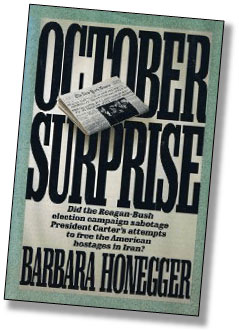
    Honegger’s baroque conspiracy theorizing convinced few, and even Gary Sick’s more sober analysis three years later has mostly been brushed off. There are plenty of open questions about what really happened, and plenty of websites that breathlessly retail Honegger and Sick’s charges, but the consensus in Washington is that, in fact, nothing happened.

    This isn’t to say that October Surprises are merely the stuff of black helicopter conspiracy theorists, though. On the contrary. In fact, there’s been at least one genuine October Surprise in recent presidential history, and it will come as no surprise to anyone that this particular jack-in-the-box popped its lid in 1968 — and the man turning the crank was Richard Nixon.

    The case was made conclusively by Nixon biographer Anthony Summers in his 2000 book The Arrogance of Power. Nixon, says Summers, was worried that LBJ might help the Democrats to victory by starting up peace talks in Vietnam, a popular move that almost certainly would have helped Hubert Humphrey’s candidacy. But Nixon did more than just worry. Via a Freedom of Information Act request, Summers got hold of an FBI memo that reported on the results of a wiretap on the phone of the South Vietnamese ambassador.

    It turns out that an official at the Republican National Finance Committee had contacted the ambassador and told him to “hold on,” a message that apparently reached its target: two days later South Vietnamese President Nguyen Van Thieu refused to participate in the peace talks and LBJ’s overtures went nowhere. Nixon went on to win one of the closest elections in history.

    (Oddly, it turns out that LBJ knew about Nixon’s efforts at the time but decided not to go public with it. It’s unclear why.)


    So October Surprises come in all shapes and sizes: real ones, imagined ones, and ones that never happened. But it’s worth pointing out that they’ve become such an ingrained part of American political folklore that even successful ones can end up producing little more than electoral cynicism, doing more harm than good in the end.

    Need an example? Look no further than California’s raucous gubernatorial recall election in 2003. On October 2, five days before the election, the Los Angeles Times published a long awaited bombshell: in a meticulously researched front-page story they charged that Arnold Schwarzenegger had a long history of groping and sexually assaulting women that he had worked with in Hollywood.

    As it happens, this wasn’t actually much of a surprise: it was an open secret even before the Times story was published; the facts of the story were never disputed; and Schwarzenegger himself admitted the next day that he had “behaved badly.” Nonetheless, just the fact that the Times printed the charges so close to the election had a galvanizing effect: most voters saw it as simply another dirty campaign trick and Schwarzenegger’s support actually rose. In the end, the recall passed 55%-45%.

    Despite this decidedly mixed record, the political chattering classes — and official Washington alike — seem unable to resist speculating about October Surprises every four years. During the 2000 presidential campaign the Wall Street Journal even ran a contest, kicked off by predictions from three of its own: Melanie Kirkpatrick suggested a last-minute arrest of Slobodan Milosevic, John Fund posited a government shutdown unless Republicans approved a Medicare drug benefit, and Seth Lipsky speculated about a breakthrough in the Middle East peace process (plus a pardon for Israeli spy Jonathan Pollard). As it turns out, of course, Slobo was eventually captured by Bush, the government continued to chug along during the election, the Middle East remains at war, and Pollard continues to languish away in North Carolina.

    So how about this year? It’s gotten off to a slow start and we need more and better rumors, which is where all of you come in. Here are a few to get you started:

    1. Obama (or Benjamin Netanyahu on his own) will bomb Iran’s nuclear facilities.
    2. Romney will unveil bulletproof evidence that Obama knew an attack on the Benghazi consulate was imminent but decided to do nothing about it.
    3. Obama will open up the Strategic Petroleum Reserve in order to reduce gasoline prices.
    4. In a surprise move to lock down the stoner vote, Obama will issue an executive order legalizing marijuana.
    5. A secret videotape will be leaked showing Romney insulting half the country as a bunch of moochers who refuse to take responsibility for their lives. Oh wait.….

    Add your own in comments. The best answer gets the warm glow of being prominently displayed in a future blog post.

  • Obama Apparently Has Pact With Devil in Swing States

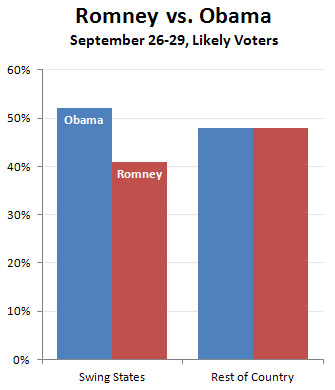
    The latest results from the Washington Post/ABC News poll are pretty interesting. Not because they tell us anything especially new — Obama is doing well in swing states — but because the magnitude of his lead is so astonishing. I did a bit of quick back-of-the-envelope arithmetic and concluded that Obama and Romney are probably dead tied in all the non-swing states put together. But Obama leads 52-41% in swing states. That’s a difference of 11 points between swing states and non-swing states.
    Are Obama’s ads really that much better than Romney’s? Is his early start in the ground game paying off this big? Or what? This sure seems like a surprisingly massive difference.

    The madcap pollsters at the Post also continued this year’s big new fad of asking a whole bunch of bizarro questions about the candidates: Who would you rather have as ship’s captain during a storm, who would you rather invite home to dinner, who would you go on an overnight camping trip with, who would you rather have babysit your kids, whose music playlist would you rather listen to, who would you rather see as a contestant on Dancing with the Stars? Poor Mitt did badly on all of them except for the babysitting question.

    However, in yet another indication of liberal bias in polling this year, they didn’t ask who you’d rather have do your taxes, or who you’d rather have as a 401(k) investment advisor, or who you’d rather hire to manage your hedge fund. I bet Romney would have done pretty well in those categories.

  • Mattress Buying Is Very Annoying


    I agree with Rohin Dhar that the mattress industry is rotten. However, not because of this:

    The top four companies (Sealy, Serta, Simmons, and Tempur-Pedic) make up 59% of the industry revenue. The top fifteen mattress companies make up a whopping 81% of the market. Low levels of competition lead to consumers paying obscenely high prices for mattresses.

    Is this unusual? It doesn’t sound all that unusual to me. Four companies that control about half the market and a dozen that control 80% of the market? I don’t know what’s average for national industries like this (or even how you’d calculate “average”), but isn’t this pretty average sounding?

    (Via Andrew Sullivan.)

  • Quote of the Day: Math Is Hard

    From Paul Ryan, explaining to Chris Wallace why he refuses to talk about the Romney tax plan in detail:

    I don’t have the time. It would take me too long to go through all of the math.

    Well okay then! I guess we should all stop worrying our pretty little heads about this. After all, I’m sure Ryan and Romney’s team of economists has been meticulous with their calculations.

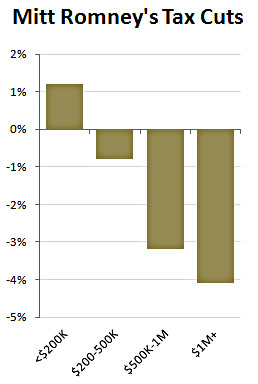
    Still, my great-grandmother was from Missouri, and I guess I’d like to see the arithmetic anyway. You never know, after all. It might turn out, for example, that Romney’s plan would cut taxes on millionaires and raise taxes on the middle class, and he just doesn’t want anyone to know this. Sounds crazy, doesn’t it? But you never know.

  • Low Interest Rates, High Inflation, and NGDP Targeting

    NGDP stands for nominal GDP, and it’s the level of GDP without adjusting for inflation. It’s become much talked about lately because of proposals that this is what the Federal Reserve should target. Not interest rates, not inflation, and not unemployment. Just make sure that NGDP rises steadily (say, 5% per year) and the economy will prosper. In some years, that might mean 4% real growth and 1% inflation, and in others it might mean 1% real growth and 4% inflation. Doesn’t matter. It’s all good.
    Matt Yglesias explains how this works using an example of a company trying to decide whether to expand production:

    You look to your left and you see a stack of dollars. You look to your right and you see a bunch of machines. Do you want to trade the dollars for the machines? It’s a close call.

    Now a little birdie from the Bureau of Labor Statistics shows up and tells you that the price level is going to surge over the next three years. Suddenly your decision is made for you. That stack of dollars isn’t as valuable as you thought it was. Buy the machines!

    But no, a second little birdie arrives this time from the Bureau of Economic Analysis and it’s here to tell you that the level of real output is going to surge over the next three years. Suddenly your decision is made for you. That pile of machines is more valuable than you thought it was. So go buy them!

    The point is that any information pointing toward higher NGDP at the margin points in the direction of marginally more investment.

    It’s worth adding a piece that got left out here. If this explanation were literally true, then all we’d need to spur economic growth is high inflation all the time. Weimar Germany would be an economic miracle instead of a millstone that continues to hang around Angela Merkel’s neck a century after the fact.

    But the missing piece is interest rates. Interest rates generally vary with inflation, so in the first example our befuddled CEO will stay befuddled. Sure, he figures, inflation will be up, but so will the returns his CFO can make by investing the corporate cash hoard. The knife edge between keeping money in the bank and spending it on increased production is still a knife edge.

    The way this calculus changes is if the Federal Reserve keeps interest rates low and promises to keep them low for a good long time. This is the “expectations channel.” If the Fed does this, and if you believe that they’re dead serious no matter what, then you might as well buy the machines. Cash sitting in the bank is going to lose value, and if the decision was a close call in the first place, this will be enough to make plant expansion look like a better deal.1

    Note that if it’s not a close call, none of this matters. But the whole point of policies like this isn’t to get everyone in the country to change their preferences. It’s to change things on the margin. If 10% of the companies in America are on the fence about increasing production, and the promise/threat of low interest rates is enough to push them over the edge into increasing production by 10%, then that’s 1% more overall production. And that’s great for the economy.

    The key here is credibility. Investors have to believe that the Fed is absolutely committed to its NGDP goal and won’t back down even if inflation rises. And this, of course, is the problem with NGDP targeting: investors aren’t idiots, and they know perfectly well that there’s plenty of opposition to any policy that tolerates higher inflation. This makes it nearly impossible for a central bank to convince the markets that there’s absolutely no chance that it will change its mind. Given the real-world political constraints here, I don’t really see how this is likely to change in the near future.

    1Put in different terms, the hurdle rate for the investment has gone down. For all practical purposes, the cost of money is negative, and this makes the financial case for spending money on plant expansion more favorable. It’s really negative real interest rates that are doing most of the heavy lifting here.

  • Citizens United is Now the Right’s Go-To Excuse for Labor Bashing

    Here in the great state of California, corporate interests have been trying for years to pass a “paycheck protection” initiative that would prohibit unions from making payroll deductions for political purposes. They’ve failed every time, not because my fellow citizens are deliriously in love with public sector unions, but just because of the manifest unfairness of these things. Even people who aren’t crazy about unions have a hard time swallowing an initiative that deliberately cuts off labor at the knees but does nothing to stop corporate spending.

    But they never stop trying, and their latest effort is Proposition 32, which is on the ballot this November. The LA Times reports that it’s way behind, mostly likely due to a brilliant ad that’s been running around the clock on local stations in these parts. You can read the whole piece if you’re interested, but I was especially charmed by this bit at the very end:

    Although the measure would block the direct flow of money from corporations and unions to candidates, experts said businesses would be free to spend unlimited amounts on independent committees to boost or challenge candidates and ballot measures. Labor would be free to do likewise, but its fundraising mechanism would have been cut off.

    “You can’t keep big money out of politics,” said Gary Jacobson, a political scientist at UC San Diego. “But you can make it harder for your opponent to raise money.”

    The initiative’s backers acknowledge the measure’s limitations, saying they went as far as existing law allows. The U.S. Supreme Court ended limits on political spending through independent organizations in 2010. The court ruled such contributions to be free speech, protected by the Constitution.

    “Anybody who wants to get serious about campaign finance reform runs right into all of the cases under the 1st Amendment,” said Michael Capaldi, a Republican attorney who helped draft Proposition 32.

    Isn’t that great? Corporate interests are now using Citizens United as their go-to excuse for why they have no choice but to be unfair. We’d really like to end corporate spending, honest we would. But the Supreme Court won’t let us. It’s sad. But at least we can go halfway and end union spending, and half a loaf is better than none, right? We’re doing the best we can here, folks.

    You could refloat the Titanic with the crocodile tears on display here. I can’t help but admire their chutzpah.

  • Friday Cat Blogging – 28 September 2012

    After a hard day of being a cat, there’s nothing quite so satisfying as Marian coming home and pulling off her shoes so you can get a nice big snootful of that lovely foot aroma. Am I right or am I right? You know I’m right.

  • Romney Aides “Pretty Resigned” to Losing


    Over at NRO, Denis Boyles passes along an anecdote from Sam Coates of the London Times, who says that everyone in Europe is now assuming that Mitt Romney will lose in November:

    Coates said the assumption of a Romney defeat fit his own view of the Republicans surrounding Mitt, a pessimism he saw back when Romney was in London eating his foot while talking about the Olympics. “His aides were there,” he said, “and they were telling some of our political advisers that, really, they weren’t that optimistic about their guy’s chances. They’re pretty resigned to it not going well, and it’s interesting to see that people are already moving away from his campaign.

    So what’s the answer? You guessed it: Romney’s being too damn moderate. He needs to let his tea party flag fly:

    In fact, what Americans seem to want is more polarization, not less. Those Republicans who try to campaign by galvanizing and leading their base, instead of ignoring and avoiding it, must be feeling now the way Romney’s dour aides have apparently felt all along — “pretty resigned,” minus the pretty.

    We’re going to be hearing a lot more of this as time goes by and Romney’s campaign looks ever more hopeless. Despite the fact that Romney has faithfully adopted virtually every position the tea party has demanded of him, the true believers are already preparing the ground for his increasingly inevitable election-day repudiation. And their story is going to be exactly what you think: Romney was never really one of them and the American public sniffed that out. They wanted a real red-meat conservative, and Romney wasn’t that guy.

    You see, true conservatism can never fail, it can only be failed. Welcome to 2013.